

How to Explain Worry Time to a Child and Raise an Emotionally Resilient Human
How to Explain Worry Time to a Child and Raise an Emotionally Resilient Human
Learning how to explain worry time to a child involves teaching them a proven cognitive behavioral technique where daily anxieties are captured and deferred to a short, designated time window, empowering them to contain and process their fears rather than hopelessly trying to suppress them.
Key Takeaways
- The Science : Worry Time is a stimulus control technique from Cognitive Behavioral Therapy (CBT) — a well-researched method that reduces anxiety not by eliminating worries but by giving them a dedicated, bounded place and time
- The Counterintuition: Telling a child “don’t worry” paradoxically makes anxiety worse; the brain cannot suppress a thought without continuously monitoring for its return
- The Language: Age-appropriate scripts matter enormously — a five-year-old, a ten-year-old, and a teenager each need entirely different metaphors and vocabulary to grasp the same concept
- The Container: Every child needs a physical or digital “container” (a box, a journal, a plush monster) that matches their personality and makes the practice tangible
- The Timing: Late afternoon (3:30–5:00 PM) is neurologically optimal; scheduling worry time near bedtime can backfire and worsen sleep problems
- The Process: Success depends on five precise, repeatable steps: Acknowledge → Capture → Review → Categorize → Release
- The Parent’s Role: The goal is not to solve the worry but to hold the framework with calm, consultant-like neutrality — modeling emotional regulation through steady presence
- The Long Game: Children who develop strong emotional regulation skills show lower rates of adolescent depression, stronger academic outcomes, and better lifelong health
The Moment Every Parent Recognizes
It is 8:47 PM on a Tuesday. The dishes are done. The bedtime story has been read. The lights are finally off. And then — as predictably as the tide — comes the soft padding of small feet down the hallway, the door creaking open, and a small voice delivering a worry that feels, to its owner, as large and immovable as a mountain:
“What if nobody wants to sit with me at lunch tomorrow?”
The parental instinct in that moment is immediate, reflexive, and deeply loving. It sounds like reassurance: “Don’t worry, sweetheart. Of course people will sit with you. You’re wonderful. Now go back to sleep.”
It feels like the right thing to say. In many ways, it is the kind thing to say. And yet — the worry almost never leaves. It may retreat for a few minutes, just long enough for the parent to return to the couch, but it is rarely gone. It is waiting. Often, it returns the next night wearing a slightly different costume — a different worry, a different scenario, but the same underlying engine of anxiety humming beneath the surface.
This is a moment that millions of families navigate every single day, and the numbers confirm that it is not a fringe experience. The Centers for Disease Control and Prevention (CDC) reports that anxiety disorders affect approximately 9.4% of children aged 3–17 in the United States — translating to roughly 5.8 million children grappling with worry that goes beyond the ordinary, everyday kind. The Child Mind Institute, one of the leading independent nonprofit organizations dedicated to children’s mental health, notes that anxiety has become the single most common mental health challenge facing young people today. Perhaps most strikingly, their research indicates that 80% of children with a diagnosable anxiety disorder receive no treatment whatsoever.
That statistic bears repeating, because its implications are enormous. Four out of five anxious children are navigating their inner storm without professional guidance — which means the burden of support falls almost entirely on parents, grandparents, teachers, and caregivers who are doing their absolute best with instincts that, while loving, were never designed for this particular challenge.
This is where the story takes a turn that most parents do not expect.
Over the past three decades, cognitive behavioral researchers have developed and refined a technique that is deceptively simple in its execution and remarkably powerful in its effects. It is called Worry Time — sometimes referred to as scheduled worry or stimulus control for worry — and it asks parents to do something that runs against every protective instinct in their body: instead of trying to make the worry disappear, they give it a seat at the table. A specific seat, at a specific time, with a specific set of rules.
Why “Don’t Worry” Backfires
To understand why Worry Time works, it helps to first understand why the thing every parent instinctively says — “don’t worry about it” — so consistently does not.
The explanation begins with a brief tour of the brain, and it does not require a neuroscience degree to grasp.
The Fire Alarm That Won’t Shut Off
Deep inside every human brain, there is a small, almond-shaped structure called the amygdala. Think of it as the brain’s smoke detector — its entire job is to scan the environment for threats and, when it detects one, to sound the alarm. When the amygdala fires, it triggers what most people recognize as the “fight-or-flight” response: the heart beats faster, the muscles tense, the palms sweat, and a wave of urgency floods the body. This system evolved over hundreds of thousands of years to keep humans alive in a world full of physical dangers — predators, falling rocks, sudden storms.
The problem is that this ancient smoke detector was never updated for modern life. It cannot distinguish between a genuine physical threat (a car swerving toward a child on a bicycle) and a social or hypothetical one (the worry that nobody will sit with the child at lunch). To the amygdala, both feel equally urgent and equally real. The alarm sounds just as loudly for an imagined future scenario as for a present danger.
When a child is in this alarm state — when the amygdala has, in effect, seized control of the brain’s operating system — something critical happens to the prefrontal cortex, the region of the brain located just behind the forehead. The prefrontal cortex is the seat of everything parents are trying to activate when they offer reassurance: logical reasoning, perspective-taking, future planning, the ability to weigh evidence and arrive at a calm conclusion. Neuroscientist Daniel Goleman, who popularized the concept of emotional intelligence, coined the term “amygdala hijack” to describe the moment when the emotional alarm system overwhelms this rational processing center.
The analogy that captures this most clearly is a simple one: asking a worried child to think logically is like asking someone to calmly read a book while a fire alarm is blaring six inches from their ear. The information simply cannot land. The rational brain is, in that moment, offline.
This is the first reason that “don’t worry” fails. It is a message addressed to the prefrontal cortex — but the prefrontal cortex is not currently accepting calls.
The Thought You Cannot Un-Think
The second reason is even more counterintuitive, and it comes from a famous line of research that began in the 1980s with psychologist Daniel Wegner at Harvard University.
Wegner conducted a now-classic experiment in which he asked participants to do something apparently simple: do not think about a white bear. For five minutes, participants were instructed to push the image of a white bear out of their minds. The result was precisely the opposite of what one might expect. Participants who tried to suppress the thought experienced a dramatic rebound effect — when the suppression period ended, they thought about white bears more frequently and more intensely than a control group that had been allowed to think about bears freely.
Wegner named this phenomenon ironic process theory, and decades of subsequent research have confirmed and expanded its reach. The mechanism is, once understood, almost painfully logical: in order for the brain to successfully suppress a thought, it must maintain a background monitoring process that continuously checks whether the forbidden thought is occurring. That monitoring process, by its very nature, keeps refreshing and reactivating the thought it is trying to suppress. The act of trying not to think about something requires thinking about it.
The implications for childhood anxiety are direct and profound. When a parent says “don’t worry about the math test” or “stop thinking about the scary movie,” the child’s brain is placed in an impossible cognitive bind. The instruction to suppress the worry creates a monitoring loop that ensures the worry never fully leaves. The child is not being defiant or difficult — the child’s brain is doing exactly what brains do when asked to suppress a thought. It is a design feature, not a flaw.
This is the second reason that reassurance-based approaches fall short. They are not merely ineffective — they can be actively counterproductive, increasing the very anxiety they are meant to relieve.
What Works Instead: The Principle of Containment
If suppression amplifies worry and reassurance cannot reach the hijacked brain, what is left?
The answer, which has emerged from decades of clinical research in cognitive behavioral therapy, is not suppression but containment — a fundamentally different strategy with a fundamentally different underlying logic. Containment does not attempt to eliminate the worry. It does not argue with it, reassure it away, or pretend it does not exist. Instead, it acknowledges the worry as real, valid, and deserving of attention — and then it gives that attention a boundary. A time. A place. A beginning and an end.
The analogy that researchers and clinicians frequently use is one from ordinary domestic life. Consider how most functioning adults handle a task that threatens to overwhelm their day — say, an inbox full of emails arriving during a period of focused work. The productive response is not to answer every email the instant it arrives, which would fragment concentration and ensure that nothing of substance gets accomplished. Nor is it to pretend the inbox does not exist, which merely creates a mounting sense of dread. The productive response is to batch the emails — to designate a specific window of time in which they will all be addressed, and to defer them until that window arrives.
The emails do not disappear. But they lose their power to hijack the day. The brain learns, through repeated experience, that those demands have a time and a place, and that they will be attended to. The sense of urgency — which was always, at some level, a product of uncertainty (“what if I forget? what if it’s urgent?”) — gradually dissolves.
This is exactly what Worry Time does for anxious thoughts, and this is why understanding the technique matters so much for any parent trying to figure out how to explain worry time to a child in a way that actually works.
What Worry Time Actually Is
With the “why” established, it is worth defining the “what” with precision, because Worry Time is not a vague philosophy or a loose suggestion. It is a structured behavioral technique with specific rules, and its effectiveness depends on those rules being followed consistently.
The Clinical Definition
In the language of psychology, Worry Time is a stimulus control intervention. That term — stimulus control — sounds technical, but the concept behind it is one that every person already understands intuitively, even if they have never heard the phrase.
Stimulus control simply means training the brain to associate a particular behavior with a particular context — and only that context. Sleep researchers, for example, use stimulus control as a frontline treatment for insomnia: patients are instructed to use their bed only for sleeping, and to get up and go to another room if they find themselves lying awake and worrying. Over time, the brain re-learns to associate the bed with sleep rather than with wakefulness. The context (the bed) becomes a trigger for the desired behavior (sleeping) rather than the undesired one (worrying).
Worry Time applies the same principle in reverse. Instead of removing worry from an unwanted context (the bed), it establishes a designated context for worry — a specific time, a specific place, a specific duration. The brain is trained, through repetition, to understand that worry has a home, and that home has walls, a door, and a clock. Outside those boundaries, worry is gently but consistently deferred.
The Psychological Shift: From Helpless to Empowered
There is a dimension of Worry Time that extends beyond anxiety reduction into something broader and arguably more important: the development of agency — the felt sense of being in control of one’s own inner life.
Anxiety frequently operates by convincing its host that the worries are both urgent and uncontrollable — that the emotional disturbance is something happening to the child rather than something happening within the child. This perception of helplessness is not just distressing; it is self-reinforcing. The more helpless a child feels in the face of worry, the more alarming the worry becomes, which produces more helplessness, which produces more alarm. This is the anxiety cycle, and it is the engine that drives chronic worry in children and adults alike.
Worry Time disrupts this cycle at its most critical point. When a child successfully defers a worry — when they write it on a card, place it in a box, and return to their math worksheet — they have just done something that their anxiety told them was impossible. They have just demonstrated, through action rather than argument, that the worry is notin charge. They are. That small moment of mastery, repeated dozens and then hundreds of times across weeks and months, rewires the child’s fundamental relationship with their own emotions.
As Dr. Tamar Chansky, a child psychologist and the author of Freeing Your Child from Anxiety, captures it: “The goal is not to have a worry-free child. The goal is to have a child who has a working relationship with their worry — who can acknowledge it, set it aside, and get on with living.”
The Preparation That Makes Everything Else Work
Before the first Worry Time session begins, two foundational decisions need to be made thoughtfully. They may seem like small logistical details — choosing a container, picking a time — but research and clinical experience both suggest that these choices have an outsized impact on whether the practice takes root or withers.
Choosing the Right “Worry Container”
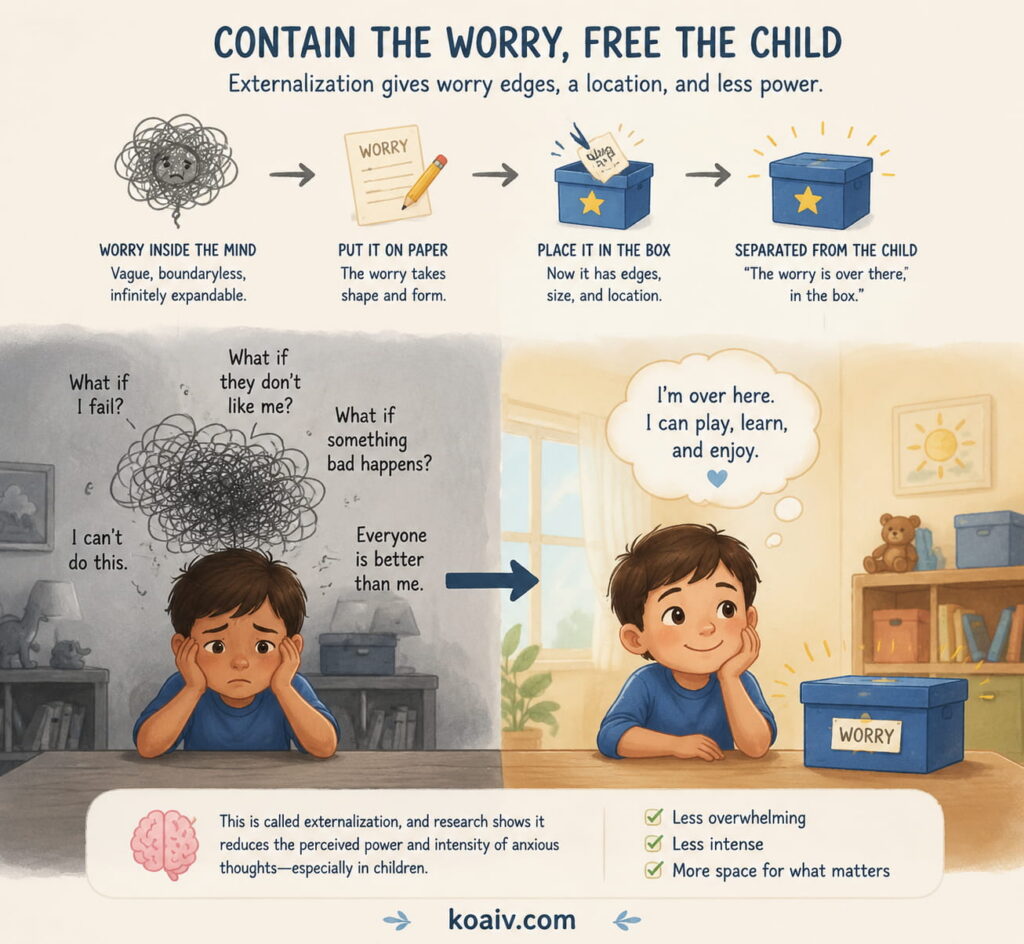
In clinical settings, the most commonly recommended tool is the Worry Box — a small, physical container (a shoebox, a decorated jar, a wooden chest) into which a child places written, drawn, or dictated worries throughout the day. The metaphor is psychologically potent: the worry is real, it is acknowledged, it is treated with respect — and it has a specific place to live that is not inside the child’s head.
The container serves a critical cognitive function that is easy to overlook. When a worry is swirling inside a child’s mind, it is vague, boundaryless, and infinitely expandable — it can grow to fill every available mental space. The moment that same worry is written on a piece of paper and placed inside a physical box, it has been transformed: it now has edges. It has a size. It has a location.
And crucially, it has been separated from the child.The worry is over there, in the box. The child is over here, free to do other things. This is the psychological process known as externalization, and research in developmental psychology has consistently shown that it reduces the perceived power and intensity of anxious thoughts, particularly in children.
However — and this is a point that clinical guidelines often underemphasize — children are not a monolith. A practice that delights a seven-year-old may feel infantilizing to a twelve-year-old and absurd to a teenager. The container should fit the child, rather than asking the child to fit the container.
Here is a range of options, calibrated by personality and developmental stage:
| Container | Best For | Why It Works |
|---|---|---|
| The Worry Box | Children ages 4–8 who respond well to ritual and tangible objects | Creates a concrete “home” for abstract feelings; the act of closing the lid provides physical closure |
| The Worry Monster | Children ages 4–7 who are playful and imaginative | A plush toy with a zippered mouth that “eats” worries written on paper; transforms anxiety into a game, activating the play system and deactivating the threat system |
| The Worry Journal | Children ages 8–13 who are verbal and introspective | Writing engages the prefrontal cortex and naturally begins the process of emotional processing; research in the Journal of Experimental Psychology found that expressive writing about anxious thoughts significantly reduced physiological stress markers |
| The Worry Whiteboard | Children who crave impermanence and visual closure | Worries are written, reviewed, and then physically erased — the act of wiping the board provides a satisfying, tangible release ritual |
| The Worry Voice Memo | Tweens and teens (ages 11+) who prefer privacy and technology | Recording a worry into a phone or tablet feels natural and private; hearing oneself articulate the concern often provides immediate distance and perspective |
| The Worry Notes App | Teens (ages 13+) who live in digital environments | A private, password-protected notes document; respects autonomy, reduces stigma, and integrates seamlessly into the teen’s existing habits |
The choice of container is not merely aesthetic or preferential — it is a strategic decision about engagement. A child who finds the container appealing will use it willingly; a child who finds it boring, embarrassing, or babyish will abandon the practice within days. Taking the time to let the child participate in choosing or decorating their container is not indulgence — it is investment.
Establishing the Time
The second foundational decision — when to schedule Worry Time — is informed by chronobiology (the science of how biological rhythms affect behavior) and by practical wisdom from clinicians who have implemented this technique with thousands of families.
The optimal window is mid-to-late afternoon, typically between 3:30 PM and 5:00 PM. This timing is deliberate and serves multiple functions:
First, it is positioned after the school day, when most of the social, academic, and logistical stressors that generate childhood anxiety have already occurred. The child has real, lived material to bring to the session — not hypothetical worries about the day ahead, but concrete experiences that can be reviewed and processed.
Second, it is positioned well before bedtime, which is critical. The American Academy of Sleep Medicine identifies pre-sleep rumination — the cycle of repetitive, anxious thinking that occurs when lying in bed — as one of the primary drivers of childhood insomnia. Activating worry content in the 90 minutes before sleep can prime the brain for exactly this kind of rumination, undermining the body’s natural wind-down process and creating a secondary problem (poor sleep) on top of the primary one (anxiety). A mid-afternoon session allows sufficient time for the nervous system to return to baseline before the evening routine begins.
Third, mid-afternoon corresponds to a natural dip in cortisol levels. Cortisol, the body’s primary stress hormone, follows a predictable daily rhythm: it peaks in the morning (which is why many people feel their most anxious upon waking), declines throughout the day, and reaches its lowest point in the evening. Scheduling Worry Time during the afternoon decline means the child is reviewing their worries when their stress hormones are naturally subsiding — the biological equivalent of discussing a problem when everyone has calmed down rather than in the heat of the moment.
Two scheduling rules are non-negotiable:
- The session must have a fixed, predictable time. Consistency is the mechanism by which the brain learns the new pattern. If Worry Time happens at 4:00 PM on Monday but 6:30 PM on Tuesday and not at all on Wednesday, the brain never fully internalizes the deferral — and the child will continue to feel that worries must be addressed immediately, because there is no reliable future window they can count on.
- Sessions should have a hard time limit of 10–20 minutes, depending on the child’s age. (A rough guide: 10 minutes for children under 8, 15 minutes for ages 8–12, and 15–20 minutes for teens.) This limit is not arbitrary. Longer sessions risk crossing the line from processing into rumination — a critical distinction. Processing moves through a worry: it examines it, categorizes it, and resolves or releases it. Rumination circles around a worry, revisiting the same anxious ground without making progress, which reinforces the neural pathways of anxiety rather than weakening them. The timer is a guardrail against this slide.
How to Explain Worry Time to a Child at Every Age
This is the moment that most parents find simultaneously most important and most daunting. The psychological concept of stimulus control must be translated into language that is not merely comprehensible but compelling — language that meets the child where they actually are, developmentally and emotionally.
What follows are detailed, field-tested scripts and frameworks for three developmental stages. These are not meant to be recited word-for-word (children are remarkably sensitive to inauthenticity) but rather to serve as templates that parents can adapt to their own child’s vocabulary, interests, and temperament.
For Early Childhood (Ages 4–7): The Worry Bug
Young children live in a world governed by stories, characters, and concrete images. They do not yet possess the cognitive architecture for abstract reasoning about “scheduling” or “deferred processing.” What they do possess is a powerful capacity for imaginative play, narrative engagement, and relationship with anthropomorphized characters. The strategy for this age group, therefore, is to personify the worry — to give it a name, a face, and a set of behaviors that the child can interact with as they would a character in a story.
The Initial Conversation (Introducing the Concept):
“You know how sometimes a little bug starts buzzing around your head? It’s really loud, and it makes it hard to play or think about anything else. Well, everybody has a special kind of bug called a Worry Bug. It’s not a bad bug — it’s actually trying to help, because it’s trying to warn you about things. But sometimes it gets confused and starts buzzing about things that aren’t really dangerous at all.
The good news is, your Worry Bug has very good manners. If you tell it, ‘I’ll listen to you at our special meeting time,’ it will wait! So here’s what we’re going to do. Every single day at [time], we’re going to have a special meeting — just you, me, and the Worry Bug. We’ll listen to everything it wants to say. But the rest of the day? The Worry Bug goes in its house.”
At this point, introduce the physical container — whether it is a decorated box, a worry monster, or a jar — as the “Worry Bug’s house.”
During the Day (When a Worry Arises):
“Oh, that sounds like the Worry Bug talking! What does the Worry Bug look like right now — is it big or small? What color is it? Let’s draw it really quickly and put the picture in the Worry Bug’s house. The monster will keep it safe until our meeting. Right now, it’s time for [current activity].”
The invitation to draw the worry is not merely a distraction technique — though it serves that function effectively. The act of giving the worry a visual form engages the prefrontal cortex (the brain’s rational, creative center) and naturally begins to modulate the amygdala’s alarm response. Research published in Art Therapy: Journal of the American Art Therapy Association has found that artistic expression reduces cortisol levels in children as young as four. Additionally, externalizing the worry — giving it a shape that exists outside the child’s body — creates psychological distance between the child and the feeling, which is a core mechanism of therapeutic change across virtually every school of child psychology.
For Middle Childhood (Ages 8–12): The Brain Boss Approach
Children in this developmental stage are beginning to understand systems, rules, and the concept of metacognition — a term that simply means “thinking about thinking.” (For a clearer picture: metacognition is the ability to step back from one’s own thoughts and observe them, almost as if watching a movie of one’s own mind.) They are ready for a more mechanistic, empowering explanation — one that positions them as the protagonist in a story of mastering their own brain.
The Initial Conversation (Introducing the Concept):
“I want to tell you something really interesting about how brains work — including yours, which is an incredibly powerful one. Your brain is basically a supercomputer. It runs tons of programs all day long: the ‘paying attention in class’ program, the ‘playing soccer’ program, the ‘being a good friend’ program. And it usually runs them really well.
But sometimes, a glitchy program starts running in the background — a loop that just repeats the same worried thought over and over, like a pop-up window you can’t close. And here’s the tricky part: if you try to ignore the pop-up, it just keeps popping up even more. Sound familiar?
So here’s what smart computer users do. They don’t ignore the glitch. And they don’t let it take over the whole screen either. They schedule a specific time to open that program, look at it carefully, figure out if it’s a real problem or just a bug, and then close it properly. That’s what we’re going to do. Every day at [time], we’re going to open the worry program together, look at everything it’s trying to tell you, and decide what to do about it. You’re going to teach your brain who’s the boss. And — spoiler alert — it’s you.”
The Practical Mechanism: For this age group, index cards work exceptionally well. Each worry gets its own card: the worry is described on the front, and on the back, during the actual Worry Time session, the child — with parental guidance — categorizes it into one of two buckets. This categorization framework is inspired by the work of Stephen Covey (who popularized the distinction in The 7 Habits of Highly Effective People) and is now widely used in CBT-informed school counseling programs:
| CIRCLE OF CONTROL | CIRCLE OF CONCERN |
|---|---|
| Things I can actually do something about | Things that matter to me, but I can’t control them right now |
| Make a small action plan | Acknowledge the feeling, practice a calming technique, and choose to let go |
| Example: “Math test on Friday” → Study 10 min after dinner | Example: “What if there’s an earthquake?” → We’ve practiced our safety plan, and that’s enough for now |
The power move: Learning which circle a worry belongs to is one of the most important emotional intelligence skills a person can develop — and most adults never fully master it.
This simple two-category system does something remarkably sophisticated: it begins to build the metacognitive muscle of distinguishing productive worry (which has a solution and can be addressed through action) from unproductive worry (which has no immediate solution and must be managed through acceptance and coping). This distinction — between problems to be solved and uncertainties to be tolerated — is arguably one of the most important emotional intelligence skills a human being can develop, and a significant number of adults have never been explicitly taught it.
For Tweens and Adolescents (Ages 13+): The Bandwidth Conversation
Teenagers occupy a paradoxical developmental space. Their brains are undergoing the most dramatic neural reorganization since infancy — the prefrontal cortex, responsible for impulse control, future planning, and emotional regulation, is still under construction and will not be fully mature until the mid-twenties. At the same time, teenagers have a fierce need for autonomy, an acute sensitivity to being condescended to, and a social world in which vulnerability carries real risk.
The framing of Worry Time for this age group must be peer-to-peer in register, grounded in concepts from their own daily experience, and delivered with respect for their growing independence.
The Initial Conversation (Introducing the Concept):
“There’s something about anxiety that most people don’t realize — it works exactly like a background app on your phone. You know how some apps keep running even after you close them, and they drain your battery, use your data, and slow everything else down? Anxiety does the same thing to your brain. It runs in the background while you’re trying to focus in class, hang out with friends, or fall asleep — and it drains your mental battery the whole time.
Most people deal with it by either trying to delete the app — which never works, because the phone just reinstalls it — or by pretending the app isn’t running, which doesn’t stop it from eating your battery. The actual fix is smarter: you force-quit the app during the hours when you need your processing power for other things, and you give it dedicated time later, when your battery is charged and you actually have the bandwidth to deal with it properly.
That’s literally what this technique is. It’s not therapy, it’s not ignoring your feelings, and it’s not positive thinking. It’s resource management. You schedule a specific time to open the anxiety app intentionally, deal with whatever’s in there, and then force-quit it again so it stops crashing everything else.”
For adolescents, Worry Time works best as a self-directed practice. Parents should make themselves available — the standing offer of “I’m here if you want to talk through any of it” should be genuine and unconditional — but the practice itself should be the teenager’s to own. A private journal, a voice memo, or a notes document serves as the container. The scheduled review can happen independently, and the teen should be trusted to manage their own process.
This is not a concession to teenage stubbornness. It is the therapeutic point. The development of autonomous emotional regulation — the capacity to manage one’s own inner states without external scaffolding — is the developmental task of adolescence. Worry Time, practiced independently, is precisely the kind of structured self-management that builds this capacity.
A Step-by-Step Anatomy of Successful Worry Time
Understanding how to explain worry time to a child is the critical first step. But explanation alone is not sufficient — the practice must be implemented with a consistent, repeatable structure. What follows is the five-step protocol that clinicians use, translated into language and actions that work in a home setting.
Step 1: The Acknowledgment
When a worry surfaces outside of the designated Worry Time window, the first response must be genuine validation — not a brush-off, not a dismissal, and not an immediate pivot to the deferral.
This distinction matters more than most parents realize. If a child says, “I’m worried about the spelling test,” and the parent immediately responds with, “Put it in the worry box,” the child receives a subtle but damaging message: my feelings are an inconvenience to be managed, not an experience to be heard. Over time, this erodes trust in the practice and in the parent.
The correct sequence takes only a few seconds longer but makes an enormous difference:
First: Validate. “That worry makes a lot of sense. Spelling tests can feel really stressful.”
Then: Redirect. “Let’s write this one down so we make sure we talk about it at worry time. I don’t want us to forget it, because it’s clearly important to you.”
The validation step communicates two things simultaneously: your inner world matters to me, and I am not afraid of your feelings. Both messages are deeply calming to an anxious child, because anxiety thrives in environments where emotions feel unwelcome or overwhelming to caregivers.
Step 2: The Capture
Immediately after validating, the worry is externalized — written down, drawn, dictated, or recorded — and placed in the designated container. This is the “filing” step, and its function is dual.
First, it provides cognitive offloading. The brain’s working memory — its capacity to hold information in active awareness — is limited. (Cognitive psychologists generally estimate it can hold approximately 4–7 items at any given time.) When a worry is occupying one of those precious slots, it is consuming mental resources that could otherwise be directed toward schoolwork, play, social interaction, or any of the dozens of tasks that make up a child’s day. Writing the worry down and placing it in a container literally frees up cognitive space. The brain no longer needs to hold the worry in active memory because it has been offloaded to an external storage system — the box, the journal, the app.
Second, the act of capture creates a commitment contract. By writing down the worry and scheduling a time to address it, the parent is making a promise: this will not be ignored. It will be attended to. This promise is what allows the deferral to work. The brain’s urgency mechanism — the sense that “I must deal with this RIGHT NOW” — is driven largely by the fear that the worry will be forgotten or dismissed. When the child has tangible evidence that the worry has been captured and will be reviewed, the urgency softens. The brain can release its grip.
Step 3: The Review
At the designated time, the child and parent (or, in the case of older children, the child independently) sit down, open the container, and review each captured worry.
This step is where the practice’s most powerful moment of learning tends to occur.
Very frequently — and parents report this with something approaching astonishment — the worry that felt catastrophic at 10:00 AM has either resolved itself entirely or shrunk dramatically by 4:00 PM. The friend the child was sure would not sit with them at lunch turned out to be friendly and normal. The math problem that seemed impossible became manageable after the teacher’s explanation. The thunderstorm that the child was sure would be terrifying passed without incident.
This is not magic. It is the natural consequence of cortisol dynamics. When a worry first strikes, cortisol levels spike, and the stress response inflates the perceived severity of the threat — like a funhouse mirror that makes everything look larger and more distorted than it actually is. As the hours pass and cortisol naturally declines, that distortion fades. The worry, viewed from the vantage point of a calmer nervous system, returns to its actual proportions.
When this happens, the most valuable thing a parent can do is to name it explicitly and celebrate it:
“Look at this one — this morning it felt huge, and now it’s practically gone. That’s not because the worry was silly. It’s because your brain is learning something really important: worries feel biggest when they first arrive, and they almost always get smaller when you give them some time. That’s your brain getting better at this.”
This moment of reflection is, in many ways, the therapeutic core of the entire practice. The child is not being taught a theory about worry. The child is observing, through their own lived experience, that worry is temporary, that the alarm eventually passes, and that they are capable of waiting it out. This is the lived knowledge that builds genuine resilience.
Step 4: The Categorization
For worries that remain significant at review time — and some will — the next step is to apply the categorization framework described earlier.
Problem-Solving Worries are those that live in the Circle of Control. They have identifiable causes and actionable solutions. The parent’s role here is to help the child create a brief, concrete, achievable action plan:
- “I’m worried about the science project.” → “It’s due Friday. Let’s break it into three parts and do one tonight.”
- “I’m worried I was mean to my friend.” → “That sounds like something that could be fixed with a conversation. Would you like to talk to them tomorrow?”
The transformation is precise: the worry is converted into a plan, and anxiety is converted into agency. The child moves from “I’m scared” to “I know what to do” — one of the most powerful emotional shifts a human being can experience.
Uncertainty Worries — those that live in the Circle of Concern — require a different and in some ways more challenging response. These are worries about things that genuinely cannot be controlled: natural disasters, a loved one’s health, whether a friendship will last, the vast and unpredictable future. These worries cannot be solved through action, because there is no action to take.
The protocol for uncertainty worries has three elements:
- Validate the feeling without trying to fix it: “It makes sense that you’d worry about that. Lots of people — including adults — think about that sometimes.”
- Practice a grounding technique to regulate the nervous system. The most widely recommended method among child psychologists is the 5-4-3-2-1 sensory grounding exercise, endorsed by the Anxiety and Depression Association of America (ADAA):5-4-3-2-1 GROUNDING EXERCISE
- Make a deliberate, explicit decision to release the worry: “We’ve thought about this, we’ve acknowledged how it feels, and we’ve done everything we can. Now it’s time to let this one go for today.”
5-4-3-2-1 GROUNDING EXERCISE
When a worry feels too big to think through, use the five senses to return to the present:
- Name 5 things you can SEE
- Name 4 things you can TOUCH
- Name 3 things you can HEAR
- Name 2 things you can SMELL
- Name 1 thing you can TASTE
This exercise forces the brain to engage with sensory input from the present moment, which interrupts the future-focused loop of anxious thinking and brings the prefrontal cortex back online.
Teaching a child to distinguish between these two categories — and to apply the appropriate response to each — is one of the most sophisticated emotional intelligence lessons available. It is worth noting that many adults struggle with this distinction throughout their entire lives, often applying problem-solving to situations that call for acceptance, or applying resignation to problems that have clear solutions. A child who learns this framework at eight or ten carries a significant advantage into adolescence and adulthood.
Step 5: The Hard Stop and the Transition to Joy
When the timer ends, the session ends. Completely. This boundary is not cruel — it is essential.
The closure ritual should be tangible and decisive:
- Papers are ripped up, crumpled, or folded away
- The box lid is closed
- The journal is shut and placed on a shelf
- The whiteboard is wiped clean
The physical act of closure sends a clear signal to the brain: the worry period is over; a different kind of time is beginning. This is stimulus control at its most concrete — the change in physical context signals a change in mental mode.
Immediately following the session, the child should transition into a deliberately positive, high-engagement activity. This is not a reward in the traditional behavioral sense — it is a strategic transition designed to redirect the brain’s attentional resources away from worry content and toward present-moment enjoyment. Effective transition activities include:
- A board game or card game with a parent (combines positive interaction with cognitive engagement)
- A walk outside (physical movement is one of the most potent natural anxiolytics known to science)
- Cooking or baking together (sensory engagement, structured activity)
- A favorite show or music (immediate mood elevation)
Over time, the brain begins to associate the end of Worry Time with the onset of something pleasurable. This association neurologically reinforces the practice: the hard stop feels less like a loss and more like a doorway.
When It Gets Hard — Troubleshooting the Most Common Obstacles
No behavioral intervention unfolds without friction, and Worry Time is no exception. Three obstacles emerge with particular frequency in clinical and home settings, and each has a well-established solution.
Obstacle 1: “I Can’t Wait — I Need to Worry About It NOW”
This is the most common challenge, particularly in the early weeks of practice and particularly with children who have higher baseline anxiety. The child may become distressed, insistent, or tearful when asked to defer a worry. The urgency feels real to them, and it is important to honor that — while still maintaining the boundary.
The Solution: The Broken Record Technique
The response should be warm, empathetic, and unwaveringly consistent. The parent does not engage with the content of the worry, does not provide reassurance about the specific concern, and does not enter into a negotiation about whether this particular worry is urgent enough to warrant an exception.
Instead, the parent uses gentle, repetitive redirection — the same message, delivered calmly, as many times as necessary:
“That sounds really important, and I can tell it’s bothering you. Let’s write it down right now so we definitely don’t forget it. I promise we’ll talk about it at worry time.”
If the child pushes back: “I know it’s hard to wait. And I also know you can do it. Let’s get it into the box.”
Consistency is the mechanism by which this approach works. The brain is essentially learning a new expectation: worries will be heard, but they will be heard at the scheduled time. Each time the boundary holds, the brain’s confidence in this new pattern strengthens. Each time the boundary breaks — each time the parent makes an exception “just this once” — the brain receives the opposite message: urgency works. If I push hard enough, the rules change. This sets the learning process back significantly.
Most families report that the resistance diminishes substantially within two to three weeks of consistent practice.
Obstacle 2: Worry Time Itself Becomes a Source of Anxiety
Occasionally, a child begins to dread the session itself — feeling anxious about the upcoming period of engaging with their worries. When this occurs, it is a signal that the reward architecture surrounding the practice needs adjustment.
The Solution: Enhance the Transition Reward
The period immediately after Worry Time should become the most enjoyable 20–30 minutes of the child’s day. This is not bribery — it is behavioral design. When the brain anticipates a positive experience on the other side of a challenging one, the challenging experience becomes tolerable and eventually even valued.
Effective approaches include:
- Dedicated, undivided one-on-one time with a parent (remarkably powerful for children of all ages)
- A special snack that is reserved exclusively for the post-Worry Time period
- The child’s choice of family activity
- A favorite podcast, audiobook, or show
The message the child receives, implicitly but unmistakably, is: Worry Time is not a punishment or a chore. It is the threshold you cross to get to something wonderful.
Obstacle 3: The Parent’s Own Anxiety Enters the Room
This is perhaps the most commonly overlooked challenge — and the most important one to name.
Parents are not emotionally neutral observers of their children’s distress. They are deeply invested participants whose own nervous systems are activated, often powerfully, by their child’s suffering. When a child says, “I’m afraid nobody likes me,” a parent’s amygdala fires just as surely as the child’s does. The parent’s heart rate may increase, their breathing may shallow, and their own worry — Is my child okay? Am I failing them? Should I be doing more? — may flood their awareness.
If this parental anxiety enters the Worry Time session — through tense body language, an urgent vocal tone, over-engagement with the worry content, or visible distress — it will be detected by the child instantly. Children are extraordinarily attuned to their parents’ emotional states; research in developmental psychology has shown that children as young as 12 months can detect and respond to parental stress through nonverbal cues alone. A parent who is visibly anxious about the child’s worry sends an inadvertent but potent message: This worry is as dangerous as you feared. Even the adult in the room is scared.
The Solution: The Consultant Posture
The ideal parental stance during Worry Time is not that of a fellow worrier, nor that of an emotional rescuer, but of a warm, curious, fundamentally unafraid consultant. The posture communicates: I take your concerns seriously. I am interested in understanding them. And I am not remotely threatened by them.
This is, in itself, a form of co-regulation — a process in which one person’s regulated nervous system helps to calm another person’s dysregulated one. When a child brings a worry to a parent whose breathing is slow, whose voice is steady, and whose body language communicates calm confidence, the child’s nervous system receives a powerful implicit signal: If the most important adult in my world is not alarmed by this, then perhaps I do not need to be alarmed either.
Achieving this posture is not always easy, particularly for parents who struggle with their own anxiety. It is worth noting — without judgment — that the practice of learning how to explain worry time to a child sometimes also becomes a practice of learning to manage one’s own emotional responses. This is not a failure; it is a feature.
Why This Matters Beyond Bedtime
It would be easy to frame Worry Time as a narrow tool for a narrow problem — a technique for managing childhood anxiety and nothing more. But the research suggests that its implications are considerably broader.
The longitudinal data on children who develop strong emotional regulation skills — the broad category into which Worry Time falls — paints a compelling picture of long-term impact. Studies tracked by the American Psychological Association (APA) and the National Institute of Mental Health (NIMH) have consistently found that children who learn to identify, tolerate, and manage difficult emotions in early and middle childhood demonstrate:
- Lower rates of adolescent depression and anxiety disorders
- Stronger academic performance (emotional regulation is a core component of executive function, which governs attention, task initiation, and sustained effort)
- More resilient and satisfying social relationships (the ability to manage one’s own distress prevents it from being projected onto peers)
- Better long-term physical health outcomes (chronic unmanaged stress is a well-documented contributor to cardiovascular disease, immune dysfunction, and metabolic disorders)
The APA’s compendium on childhood resilience identifies a specific finding that merits emphasis: it is not the absence of distress that predicts adult wellbeing, but the capacity to manage distress. Children who are shielded from all anxiety do not develop resilience — they develop fragility. Children who are taught to engage with anxiety skillfully develop the emotional musculature to navigate whatever challenges adulthood presents.
Worry Time, practiced consistently over months and years, builds this muscularity one small session at a time. The ten-year-old who learns to defer a worry, review it at the designated time, discover that it has shrunk, categorize the remainder, and release it — that child is not merely managing today’s lunchroom anxiety. That child is rehearsing a cognitive and emotional skill set that will serve them when they face college applications, job interviews, relationship difficulties, and the thousand unforeseeable challenges of an adult life.
This is, ultimately, what makes the technique worth the effort it takes to implement. The bedtime tears may be the presenting problem, but the real prize is much larger.
Conclusion
There is something quietly radical about Worry Time — something that goes against the grain of a culture that prizes immediate resolution, instant comfort, and the frictionless elimination of negative feelings.
The technique asks parents to do something genuinely difficult: to sit with their child’s discomfort without rushing to extinguish it. To trust that the discomfort, when given a structure and a boundary, will teach the child something that no amount of reassurance ever could — that feelings are not emergencies, that the alarm always passes, and that the capacity to endure uncertainty is not a burden but a superpower.
It does not require a therapist’s office, specialized equipment, or a crisis to begin. It requires a box, a timer, a child, and a parent willing to hold the structure with quiet confidence. The investment is fifteen minutes a day. The return is a lifetime of emotional resilience.
For any parent standing in a darkened hallway at 8:47 PM, listening to small feet pad across the floor and a small voice deliver a worry that feels — to its owner — as vast and terrifying as the ocean: this is the path forward.
Not “don’t worry.”
Instead: “I hear you. Let’s write that one down. We’ll look at it together tomorrow at four o’clock. And I promise you — you and I, we’ve got this.”
We cannot promise our children a world without worries. The world will supply those abundantly, in forms we cannot anticipate and configurations we cannot control. But we can give them something more powerful than a worry-free life: we can give them the tools to ensure that their worries serve them rather than rule them.
That is, in the end, the whole project of raising an emotionally intelligent human being. And it begins — remarkably, productively, and with more evidence behind it than most parents realize — with the simple, radical act of scheduling the worry.
Sources & Further Reading:
- Centers for Disease Control and Prevention — Data and Statistics on Children’s Mental Health
- Child Mind Institute — Comprehensive Guide to Anxiety in Children
- American Psychological Association — Anxiety
- National Institute of Mental Health — Anxiety Disorders
- American Academy of Pediatrics — Emotional Wellness and Resilience
- Borkovec, T.D. et al. — Stimulus Control Applications to the Treatment of Worry

October 25, 2026