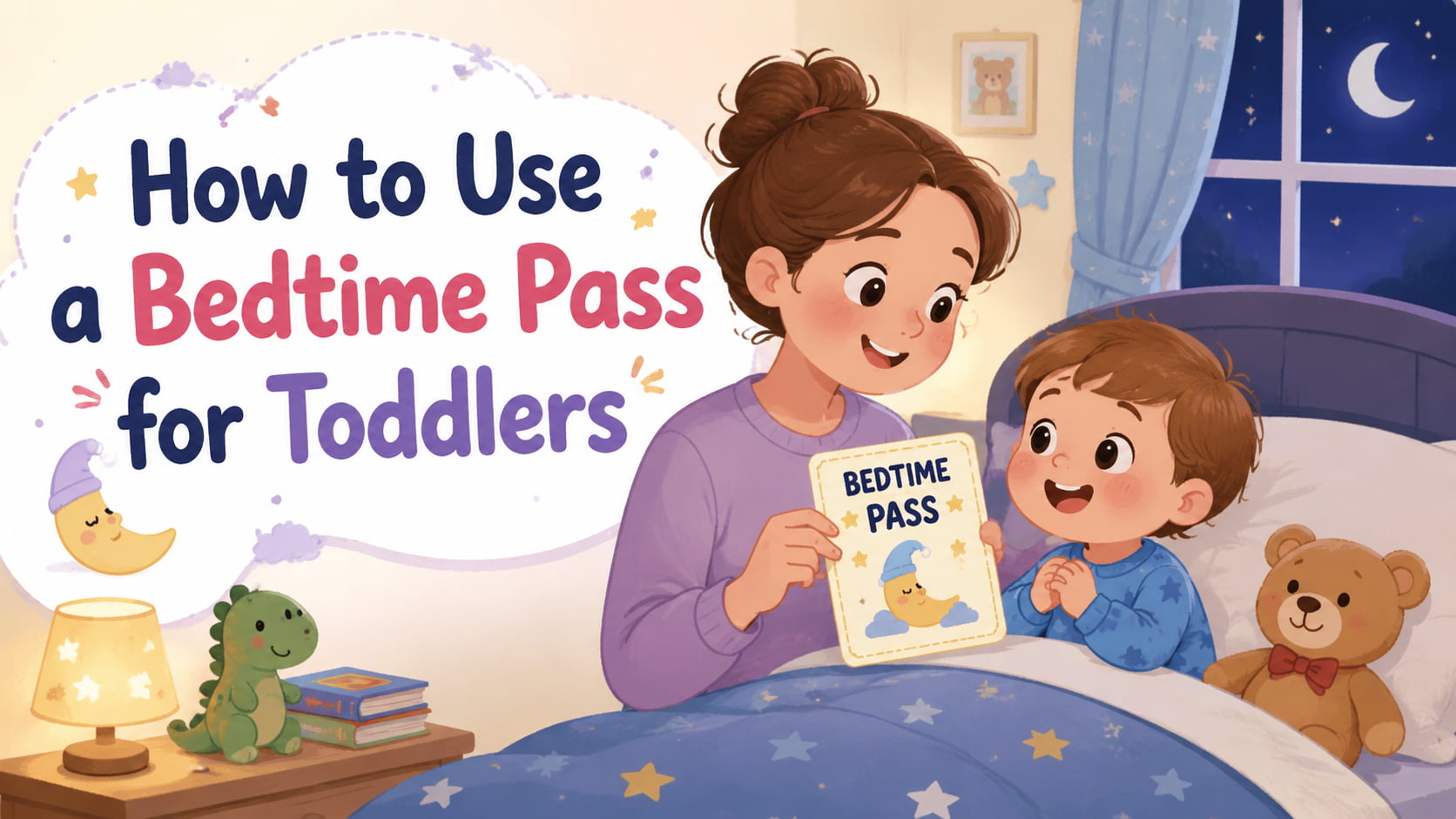
How to Use a Bedtime Pass for Toddlers
How to Use a Bedtime Pass for Toddlers
Learning how to use a bedtime pass for toddlers empowers your child with a single, structured choice that effectively ends nightly stall tactics by trading power struggles for autonomy and a morning reward.
Key Takeaways
- What it is: The bedtime pass is a physical card that gives a toddler one permitted exit from bed after lights-out. When used, the child hands over the card. If kept until morning, it earns a small reward.
- Why it works: It doesn’t try to control the toddler — it gives them something to manage. This single shift, from control to autonomy, is what makes it so effective.
- What the research says: Originally published in 1999 in the Journal of Applied Behavior Analysis, the bedtime pass has been validated by multiple independent studies and endorsed by the American Psychological Association.
- Who it’s for: Children roughly aged two and a half to eight who resist bedtime through repeated exits, requests, or curtain calls.
- What it takes: Three to five nights of consistent implementation. The morning reward is non-negotiable — it is the engine that drives the entire system.
- What makes it different: Unlike “cry it out” — which asks parents to simply wait out the distress — the bedtime pass actively engages the toddler’s growing brain. It treats the child as a participant, not a subject.
A Nightly Drama Every Parent Knows
Picture this.
It is 8:15 in the evening. The toddler has been read to, tucked in, kissed goodnight, and — on particularly ambitious nights — sung to. The bedroom door closes with a soft click. For a fleeting moment, silence descends over the house like a gift. The parent exhales, sinks into the sofa, and reaches for whatever has been waiting all day: a meal, a book, a conversation with a partner, or simply the radical luxury of doing nothing.
Forty-five seconds later, the patter of small feet.
The door opens. “I need water.” Or: “I had a bad dream.” Or, with the inspired creativity that only a toddler can summon at bedtime: “I need to tell you something about a dinosaur.”
This is the curtain call — the repeated, post-bedtime-exit that parents of toddlers know with bone-deep familiarity. According to a study published in the Journal of Pediatric Psychology, somewhere between 15% and 27% of toddlers and preschool-aged children engage in significant bedtime resistance, with curtain calls ranking among the most exhausting behaviors for parents of children between the ages of two and six.
And here is what makes it so uniquely draining: it happens at the exact moment parents have nothing left. After hours of feeding, bathing, entertaining, teaching, and managing a small human being who experiences every emotion at full volume, the curtain call arrives as a kind of cruel final exam. There is no more patience in the tank. No more creativity. And yet the little person at the door needs something — even if neither party can quite name what it is.
This article is about a tool called the bedtime pass: a deceptively simple, research-validated method that ends curtain calls — not by silencing children or wearing them down, but by giving them something unexpected. A choice.
Understanding why that matters requires a brief detour into the toddler brain. And that journey, it turns out, explains everything.
Why Toddlers Do This: The Surprising Science Behind the Stall
Most parents, in their more frustrated moments, will privately confess to wondering whether their child is doing this on purpose. Whether there is some calculating intelligence behind the nightly parade of requests.
The honest answer is: not exactly. But also, not entirely not.
To understand what is really happening at bedtime, it helps to understand what is happening inside the toddler’s brain and body during these years — because the curtain call is not misbehavior. It is, in a very real sense, development doing its job.
Why “No” Becomes Their Favorite Word
Between the ages of roughly two and five, children undergo what developmental psychologists describe as an autonomy surge — a biologically programmed drive to assert independence, resist external control, and begin building a sense of a separate self. The famous psychologist Erik Erikson identified this as the “Autonomy vs. Shame and Doubt” stage of development, a period during which children are, neurologically speaking, designed to push back.
Think of it this way: a toddler learning to say “No!” is like a seedling pushing through soil. It looks like resistance. It is actually growth.
This autonomy drive is healthy, necessary, and ultimately the foundation of healthy adult functioning. But at 8:15 PM, when it expresses itself as the fourteenth reason the child cannot possibly remain in bed, it feels considerably less poetic.
Why They Need You More at Night
Alongside the push for independence runs an equally powerful counter-force: the pull of attachment. John Bowlby, the British psychiatrist who founded attachment theory in the mid-twentieth century, demonstrated that children maintain a deep, biologically-rooted need for proximity to their primary caregivers — particularly during periods of perceived threat or vulnerability.
Nighttime is one of those periods.
When the lights go out and the house grows quiet, the toddler’s nervous system — which has not yet developed the full capacity for self-soothing — begins to experience something researchers describe as mild separation anxiety. It does not matter that the parent is twenty feet away. To a three-year-old brain, the absence of a caregiver’s physical presence can register as a genuine threat signal.
The result is a child who is simultaneously driven to be independent and drawn back toward connection — often expressing both impulses at once, in the form of a confident stride down the hallway followed by a slightly uncertain voice asking for a hug.
Imagine being asked to sleep in an unfamiliar hotel room, alone, in the dark, with the instruction that you cannot leave or contact anyone until morning. Most adults would find that mildly uncomfortable. For a three-year-old brain, whose sense of safety is still largely built around physical proximity to loved ones, that is a reasonable approximation of bedtime every night.
Why Your Frustration Is Making It Worse
Here is the part that surprises most parents, and that behavioral scientists have studied extensively.
Every time a toddler exits their bedroom and receives any form of parental engagement — even a frustrated, exasperated engagement — that behavior is reinforced. This is the foundational principle of operant conditioning, described by psychologist B.F. Skinner: behaviors that produce a response are more likely to be repeated.
The key word in that sentence is any. Warmth, annoyance, gentle redirection, firm instruction — they all produce the same neurological outcome for the child: parental presence. And parental presence is what the toddler’s attachment system craves.
In other words: the more a parent engages with the curtain call — even to scold, even to repeat the rules — the more the behavior is inadvertently reinforced. The child is not calculating this. It is simply the way the learning brain works.
This creates a trap that is genuinely difficult to escape using conventional approaches. Saying “no” more firmly, establishing “consequences,” or explaining the rules again more clearly all share a common flaw: they require parental engagement, which is the very reward the behavior is seeking.
The bedtime pass escapes this trap entirely — and the reason it does is more elegant than it first appears.
What Exactly Is a Bedtime Pass?
The concept is, at its heart, beautifully simple.
A bedtime pass is a physical card — typically the size of an index card or a playing card — that the child receives as part of their bedtime routine. It functions like a ticket or a voucher. After lights-out, if the child wishes to exit the bedroom for any reason, they must bring the pass with them and hand it to a parent. The parent honors the request briefly and warmly, returns the child to bed, and keeps the card. The pass is spent.
If the child wakes the next morning and the pass is still on their nightstand — unspent — it can be traded in for a small, pre-agreed reward.
That is the entire system. A card, a transaction, and a morning prize.
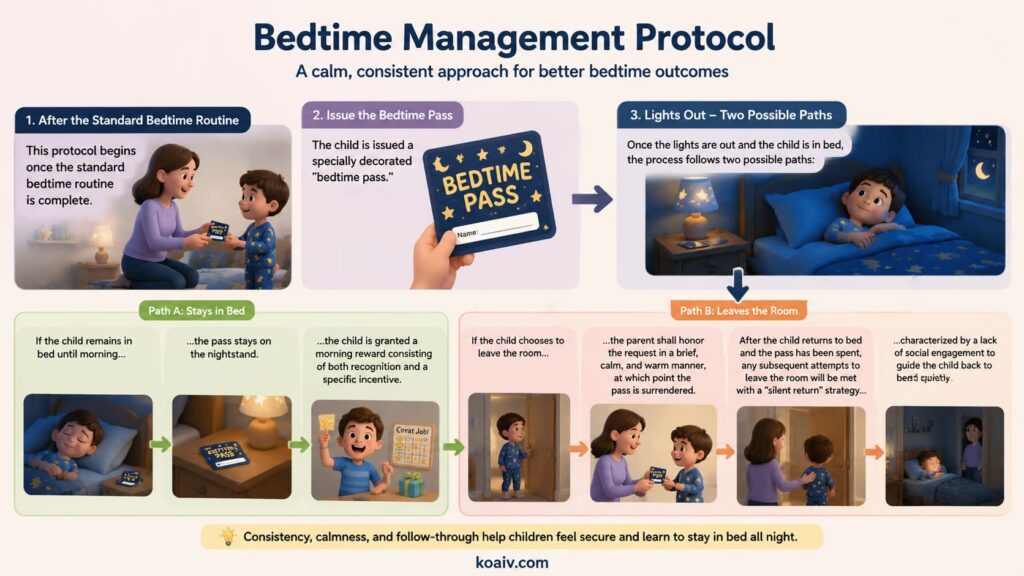
Visual Guide: How the Bedtime Pass Works
This bedtime management protocol is implemented upon the completion of the standard bedtime routine.
To begin, the child is issued a specially decorated “bedtime pass.” Once the lights are out and the child is in bed, the process follows two possible paths: If the child remains in bed until morning, the pass stays on the nightstand, and the child is granted a morning reward consisting of both recognition and a specific incentive.
Conversely, if the child chooses to leave the room, the parent shall honor the request in a brief, calm, and warm manner, at which point the pass is surrendered. After the child returns to bed and the pass has been spent, any subsequent attempts to leave the room will be met with a “silent return” strategy, characterized by a lack of social engagement to guide the child back to bed quietly.
So why does something this simple work so reliably?
The answer lies not in the card itself, but in what the card represents — a shift in the psychological architecture of bedtime.
In most bedtime struggles, the parent holds all the power (setting the time, making the rules, enforcing the boundaries) and the child holds none. This power imbalance is, paradoxically, what makes the conflict so persistent. When children feel they have no agency in a situation, they resort to the only tools available to them: emotional escalation, boundary-testing, and the relentless pursuit of the one thing they can reliably obtain — their parent’s attention.
The bedtime pass changes this dynamic by giving the child a unit of power to manage. Instead of asking “Will you stay in bed?” — a question the parent cannot truly enforce without constant intervention — the system asks: “How will you use your pass?” That is a question only the child can answer. And in answering it, the child steps into the role of decision-maker.
This is what behavioral economists call choice architecture: the strategic design of options to guide behavior without removing freedom. The bedtime pass does not tell the child what to do. It gives them the tools, the incentive structure, and the freedom to figure it out themselves.
Imagine giving a child a single piece of their favorite candy at the start of a long car journey, with the information that if it is still uneaten when they arrive at the destination, they will receive three more. Suddenly, the question is not “Will you eat the candy?” but “When?” — and the child is doing the cognitive work of self-regulation, not the parent.
How to Use a Bedtime Pass for Toddlers: The Complete Step-by-Step Guide
Knowing what the bedtime pass is and understanding why it works are two different things from knowing how to implement it correctly. The details matter enormously. The following is a complete, nuanced guide to each stage of the process.
Step 1: Design the Pass Together — Why Co-Creation Is Not Optional
The first step is the one most parents are tempted to skip, because it seems decorative rather than functional. It is not. It is arguably the most important step of all.
Before the first night of implementation, sit down with the toddler and create the pass together. Provide materials: crayons, stickers, markers, whatever the child enjoys. Let them draw on it, write their name (or scribble an approximation of it), and decorate it however they wish.
The behavioral rationale for this is well-established in psychological research. It is called the IKEA Effect — a term coined by researchers Dan Ariely, Michael Norton, and Daniel Mochon in a 2012 paper in the Journal of Consumer Psychology, which found that people assign significantly more value to things they have personally built or created. When the child decorates the pass, it becomes their object — something they have invested in, something they care about, something worth protecting.
This is not a metaphor. The act of creation generates genuine psychological ownership, and psychological ownership generates compliance. A child who has poured their personality into a card is far less likely to treat that card carelessly.
The creation session should be relaxed, unhurried, and framed positively. Something like: “Tonight we are making something special — your very own bedtime pass. Most kids don’t have one of these.” Let the child ask questions. Explain the system simply and honestly. Invite enthusiasm.
Step 2: Define the Rules — Setting the Exchange Rate of the Currency
A currency without defined value is meaningless. Before the first night, the rules of the pass must be established clearly, simply, and — this is critical — during the daytime.
Nighttime is the worst possible moment to teach the rules of a new behavioral system. Emotions are elevated, both the child’s and the parent’s. Cognitive bandwidth is low. What feels like a teachable moment at 8:30 PM is almost always a recipe for escalation.
Instead, have the rule-setting conversation at the kitchen table, during a calm afternoon moment. Keep it short and concrete. The three essential rules are:
The Three Rules of the Bedtime Pass
Rule 1 — One trip only.
The pass is good for one exit after lights-out. One. Not one more after that, not one “quick question” before handing over the pass.Rule 2 — Keep it brief.
Whatever the request is — a sip of water, a bathroom visit, one hug — the interaction should be short. Two minutes, maximum. This is not a second bedtime visit. It is a transaction.Rule 3 — Once spent, it’s spent.
The moment the pass is handed to the parent, it is gone. No refunds, no extensions, no exceptions. This is the part that feels hard but matters most.
After explaining the rules, role-play the scenario. “Pretend it’s bedtime and you want to come out. What do you do?” Walk the child through the physical steps: picking up the pass, bringing it to the parent, making the request, handing over the card, returning to bed. The more familiar the script, the more smoothly it will run under the real conditions of nighttime, when the child is tired and operating on instinct rather than careful thought.
Step 3: The Pass Exchange — Executing the Transaction with Warmth and Precision
The moment the child arrives at the door, pass in hand, the parent’s response is the hinge on which the entire system turns.
Honor it. Immediately. Warmly. And briefly.
This sequence matters. “Immediately” because hesitation signals uncertainty about the rules. “Warmly” because the child is doing exactly what the system asked them to do — they are using the currency correctly, and that deserves positive acknowledgment. “Briefly” because the exchange must feel like a completed transaction, not an extended reconnection.
Attend to the request. Say a calm goodnight. Walk the child back to bed. Exit the room. The entire exchange should take no more than ninety seconds.
What the parent must not do in this moment is lecture, renegotiate, express frustration, or extend the interaction in any direction. Not because warmth is inappropriate, but because extension is the trap. Every minute added to the exchange is a minute of parental attention that the child’s attachment system registers as a reward — and a reinforcement of the very behavior the system is designed to gradually extinguish.
After the pass is spent, if the child exits the room again, the dynamic shifts completely. From this point forward, the parent becomes what sleep researchers describe as a “warm but unreinforcing presence.” Walk the child back to bed. Do not make eye contact. Do not speak. Do not express frustration. Simply and calmly return the child to the bed, say a very brief goodnight (“It’s time to sleep now”), and exit.
This is the hardest part of the system for most parents, because it feels cold. It is not. It is, in fact, the most caring response available — because it removes the inadvertent reward that has been sustaining the problematic behavior, and replaces it with a consistent, predictable, safe boundary.
What’s happening in the child’s brain during this stage?
When a behavior that has reliably produced a result (exiting the room → getting a parent’s attention) suddenly stops producing that result, the child’s brain initially responds by increasing the behavior — trying harder, calling louder, making more exits — in an attempt to restore the expected outcome. Behavioral scientists call this an extinction burst: a temporary spike in the behavior before it begins to decline.
The extinction burst is predictable, normal, and time-limited. Most parents who abandon the bedtime pass do so during the extinction burst — right at the moment the system is actually beginning to work. Knowing it is coming, and that it passes, is often the difference between success and giving up.
Step 4: The Morning Reward — The Dividend That Drives the Entire System
Of all the components of the bedtime pass, the morning reward is the most frequently underestimated — and its omission is the single most common reason the strategy fails.
Consider what the pass is asking of a toddler: to resist an impulse (leaving the room), tolerate discomfort (lying in bed alone in the dark), and delay gratification until the next morning. For a two- or three-year-old brain, this is a genuinely significant cognitive challenge. In the famous Stanford Marshmallow Experiment of 1972, psychologist Walter Mischel found that even older children found delayed gratification extraordinarily difficult — and the children who were most successful were those who had concrete, reliable, desirable rewards to anticipate.
The morning reward must meet three criteria:
1. It must be genuinely desirable. Parents often default to a sticker, which works beautifully for some children and falls entirely flat for others. The reward should be calibrated to the individual child. Some possibilities: a small toy from a “treasure box,” ten minutes of screen time, a favorite special breakfast, a trip to a playground, or the privilege of choosing the afternoon’s activity.
2. It must be delivered immediately and reliably. The moment the child wakes with the pass still on the nightstand, the reward happens. Not “later today.” Not “if you’re good this morning.” Now. The immediacy is essential because the toddler brain has limited capacity to connect distant consequences to present behavior. The closer in time the reward is to the night’s behavior, the more powerful the learning.
3. It must be celebrated, not merely administered. “Oh, you still have your pass! You did it! You earned your reward!” The celebration is not theater — it is neurological. Positive parental attention activates the brain’s dopamine system, which consolidates the learning and builds the emotional motivation to repeat the behavior. The pride the child experiences in this moment is, over time, more powerful than any physical reward.
Troubleshooting: What to Do When the Plan Meets Real Life
Even the most carefully designed system encounters the friction of reality. Here are the most common implementation challenges and their evidence-informed solutions.
Challenge 1: The Child Uses the Pass and Then Exits Again
What’s happening: The child has used the currency, returned to bed — and then exited again, empty-handed, with a new request or complaint.
The solution: This is the moment for the calm, wordless return. Walk the child back to bed. Minimal eye contact. A very brief, quiet “Time to sleep.” Exit. Repeat as many times as necessary, with the same response every time.
Consistency is everything here. The moment a parent engages differently — even once — the child’s brain receives a signal that persistence is still a viable strategy. The behavioral pattern resets.
What to expect: The first two nights, this may happen frequently. By night three or four, if the response has been consistent, the frequency drops significantly. By week two, most families report the child no longer exits after the pass is spent.
Challenge 2: The Child Is Too Anxious to Use the Pass at All
What’s happening: This is the opposite of the expected challenge, and it is more common than most parenting guides acknowledge. Some children — particularly those with higher anxiety baselines — become so worried about “wasting” their pass that they lie awake in distress, not wanting to use it even when genuinely uncomfortable.
The solution: Introduce the system with two passes for the first three nights. This lowers the stakes of any single decision, gives the child the safety net of a second resource, and ensures they experience success. Once the child is handling the passes with ease — using them without excessive deliberation — taper to one.
This is like a new employee who is told they have three personal days per year. They are much more likely to use one confidently when they know two more remain. The security of surplus enables comfortable decision-making.
Challenge 3: The Child Loses the Physical Pass
The solution: Environmental design. Give the pass a home — a consistent, dedicated location that ritualizes its existence. Tape it to the inside of the bedroom door. Place it in a small tray on the nightstand. Hang it on a special hook. The physical location of the pass should be as consistent and familiar as the child’s toothbrush.
When the pass has a home, losing it becomes a non-event rather than a flashpoint.
Challenge 4: The Child Tries to Negotiate a Replacement Pass
What’s happening: The child has used the pass, been returned to bed, and now stands at the door explaining, with remarkable persuasive conviction, why the rules should not apply to their current situation.
The solution: Do not engage with the negotiation. A toddler’s capacity for argument is not to be underestimated, but the bedtime pass system depends entirely on the rule being non-negotiable. Respond once, briefly and warmly: “I know you want to come out. The pass is spent. I love you. Time to sleep.” Then exit and implement the silent return for any subsequent exits.
Engaging with the negotiation — even to explain the rules again — is a form of parental attention that rewards the behavior.
The Bedtime Pass vs. “Cry It Out”
For parents who have heard of the “cry it out” method, or who are comparing sleep training approaches, it is worth taking a moment to understand how the bedtime pass relates — and where it diverges significantly.
The “cry it out” method (CIO), also known as extinction sleep training, involves placing the child in their crib or bed at bedtime and allowing them to cry without parental intervention until they fall asleep. It has a substantial evidence base for infants and very young toddlers (typically under 18 months), and multiple long-term studies have found it safe, effective, and not harmful to the parent-child attachment bond when implemented appropriately for this age group.
However, its application to children aged two, three, four, and beyond introduces a developmental complication that the bedtime pass is specifically designed to address.
Comparison Table: Bedtime Pass vs. Cry It Out
| Bedtime Pass | Cry It Out | |
|---|---|---|
| Best age range | 2.5 – 8 years | 4 months – ~18 months |
| Child’s cognitive role | Active participant | Passive recipient |
| Teaches | Self-regulation, decision-making | Self-soothing |
| Parental engagement | Brief, structured | Minimal |
| Handles separation anxiety | Directly (via the pass) | Indirectly |
| Evidence base | Strong (Friman et al., 1999; APA) | Strong (for infants) |
| Typical timeline | 3–7 nights | 3–7 nights |
By age two or three, the toddler brain has developed what developmental psychologists call mental time travel — the ability to think forward and backward in time, to anticipate future events, and to ruminate on past experiences. This cognitive capacity, which is a genuine developmental achievement, means that a toddler left to cry without any form of agency or explanation can experience something quite different from an infant in the same situation: not simply undifferentiated distress, but something more like helplessness — the felt sense that their actions have no effect on their environment.
Research published in the Journal of Child Psychology and Psychiatry has found that prolonged, unresolved distress at bedtime in children over two is associated with elevated cortisol (the body’s primary stress hormone) and, in some temperamentally anxious children, heightened anxiety sensitivity in later childhood.
The bedtime pass sidesteps this entirely. Rather than asking the toddler to endure helplessness, it gives them control — a resource to manage, a decision to make, and a system that responds predictably to their choices. The pass engages the very cognitive capacities (planning, anticipation, decision-making) that make toddlerhood difficult — and puts them to work as assets.
This is not a critique of CIO for infants. It is a recognition that different developmental stages call for different tools.
What the Bedtime Pass Is Really Teaching
It would be easy to read this article as a guide to a bedtime trick — a clever hack for parents who want their evenings back. And it is that. But it is also something more.
The bedtime pass, implemented well, is one of a child’s earliest lessons in bounded autonomy: the experience of having real freedom within a defined structure. The child learns that choices have consequences, that resources are finite, that self-restraint can be rewarding, and that the world responds predictably to their decisions. These are not trivial lessons. They are, in fact, among the foundational competencies of healthy adult functioning.
Walter Mischel’s marshmallow research — which followed participants for decades — found that children who demonstrated greater capacity for delayed gratification at age four went on to show higher academic achievement, better emotional regulation, and more stable relationships in adulthood. The causal mechanisms are complex, and the research has been nuanced by subsequent studies, but the core finding holds: early practice at self-regulation builds the cognitive infrastructure for lifelong self-regulation.
The toddler lying in bed, holding a small decorated card, deciding whether the urge for one more hug is worth spending their only resource — that child is not just learning to stay in bed. They are practicing the cognitive architecture of restraint, planning, and self-awareness.
That is a remarkable thing to be happening at 8:30 PM on a Tuesday.
Conclusion
Change rarely arrives dramatically. It comes in small, consistent repetitions — in the daily accumulation of a new pattern over an old one.
The bedtime pass will not transform the household on the first night. It may not even show dramatic results on the second. The extinction burst (that temporary spike in behavior described earlier) may make night two feel like a step backward. This is normal. This is, in fact, the signal that the system is working.
Stay with it through night three. Night four. Night five.
The research is consistent on what parents typically find by the end of the first week: fewer exits, shorter interactions, a child who is learning — slowly, messily, but genuinely — to self-settle. And with that shift comes something that may have felt permanently out of reach: an evening.
The framework, briefly restated, is this: Create the pass together. The co-creation generates ownership. Set the rules during the day. The daytime conversation prevents nighttime conflict. Honor the pass warmly and briefly. The integrity of the exchange is what makes the currency valuable. Return without engagement after the pass is spent. The absence of reward removes the incentive for extra exits. Celebrate the morning dividend immediately. The celebration consolidates the learning and motivates the next night.
This is not magic. It is behavioral science, applied with consistency and love. And the children for whom it works do not merely sleep better. They learn something about themselves: that they can do hard things, that self-control is possible, and that the world rewards it.
That is worth staying up for.
Sources & Further Reading:
- The bedtime pass: an approach to bedtime crying and leaving the room
- American Psychological Association — Helping children get a good night’s sleep
- American Academy of Pediatrics (AAP) — Healthy Sleep Habits: How Many Hours Does Your Child Need?
- Centers for Disease Control and Prevention (CDC) — How Much Sleep Do Children Need?
- Harvard Graduate School of Education / Center on the Developing Child — The Science of Early Childhood Development
- National Institute of Child Health and Human Development (NICHD) / NIH — Safe Sleep and Child Development Research
- Mischel, W., Shoda, Y., & Rodriguez, M.L. (1989). Delay of Gratification in Children. Science, 244(4907), 933–938.

October 25, 2026
October 25, 2026
October 25, 2026