
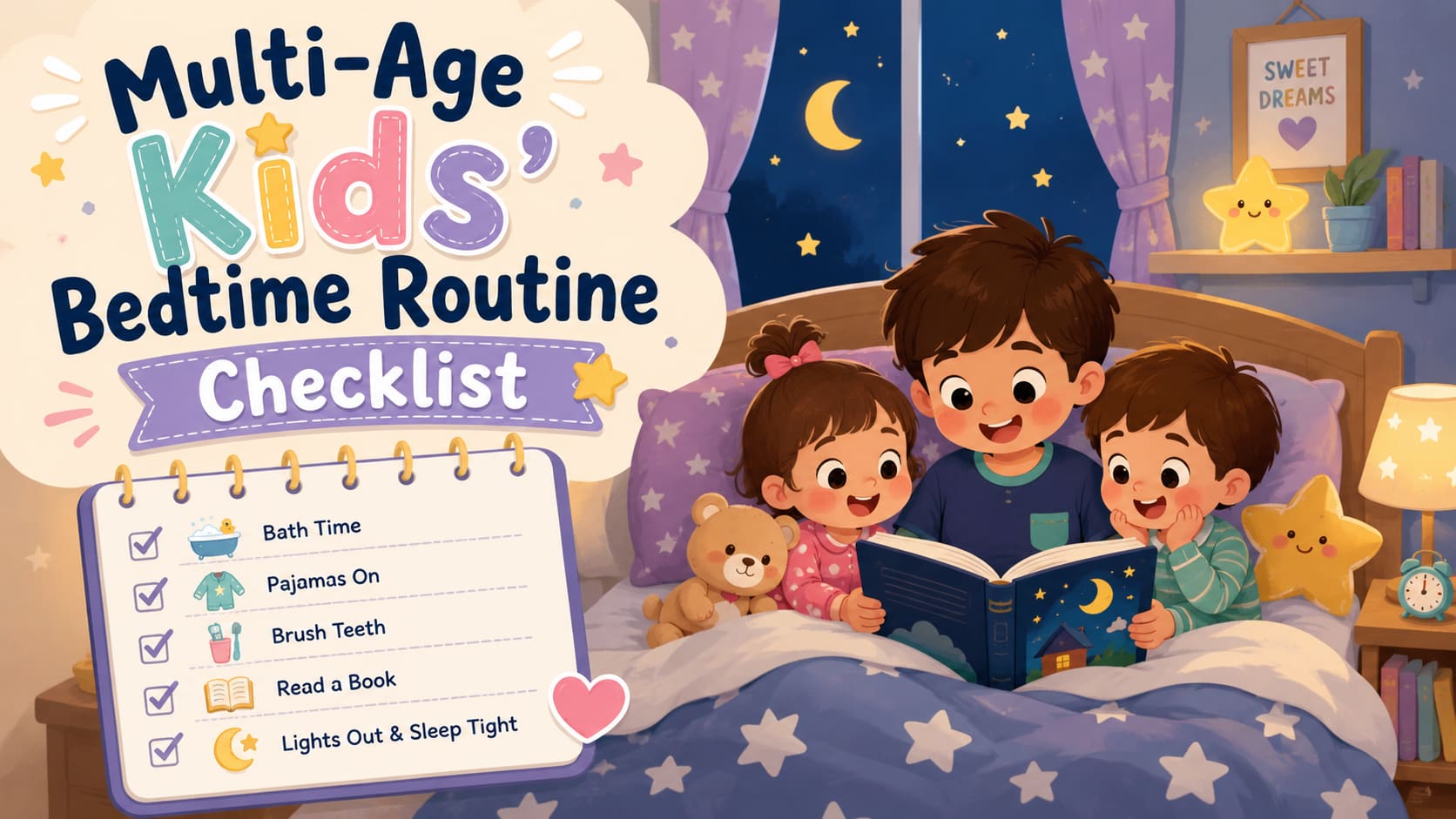
Multi-Age Kids' Bedtime Routine Checklist
Multi-Age Kids’ Bedtime Routine Checklist
This article provides a basic kids’ bedtime routine checklist, designed as a starting point for families seeking guidance. As every household and child has different needs, this template should be used as a general reference rather than a rigid rule. We recommend tailoring the routine to suit your own habits while prioritizing consistency, as a predictable pattern is essential for a child’s sleep success.
Key Takeaways
- Children who follow consistent bedtime routines fall asleep faster, wake less frequently, and accumulate significantly more total sleep time than those without structured evenings.
- A child’s nighttime routine is not a one-size-fits-all prescription — it must be thoughtfully calibrated to developmental stage, with distinct strategies for infants, toddlers, preschoolers, and early school-age children.
- The physical environment (temperature, light, sound) is a powerful and underutilized lever for improving sleep quality at every age.
- Parental emotional regulation is arguably the most critical — and most overlooked — ingredient in a successful bedtime routine.
- Small, sustainable changes compound over time: introducing even one new habit tonight can meaningfully shift a family’s sleep culture within weeks.
The Architecture of a Peaceful Night
Picture two households at 7:30 PM on a Tuesday.
In the first, the television is blaring, children are chasing each other down the hallway, and a parent is shouting increasingly desperate variations of “It’s bedtime!” from the kitchen. The youngest is overtired and wailing. The oldest is still in school clothes. The family will not reach anything resembling peace for another two hours.
In the second, the lights have been dimmed since 6:30. The youngest just climbed into bed with a stuffed elephant. The oldest is reading quietly, with a backpack already packed by the door. A parent finishes the last page of a picture book and slips out of the room into the soft silence of an evening restored.
The difference between these two households is not luck, temperament, or some elusive parenting gift. It is architecture — the deliberate, age-calibrated design of a nighttime routine.
Sleep is not a passive state that children simply fall into when exhausted enough. It is an active biological process that requires the right physiological and environmental conditions to begin. According to the American Academy of Sleep Medicine (AASM), children aged 1–2 years need 11–14 hours of sleep per 24-hour period; children aged 3–5 need 10–13 hours; and those aged 6–12 need 9–12 hours.
Why Routine Trumps Rigidity
Circadian Rhythms and the Developing Brain
The human body runs on an internal biological clock — the circadian rhythm — that governs when we feel alert and when we feel sleepy. In children, this system is still maturing, which makes it both more malleable and more vulnerable than in adults. The sleep hormone melatonin, produced by the pineal gland, begins to rise naturally in the early evening hours, signaling the body to prepare for rest. Concurrently, cortisol — the stress hormone that drives alertness and activity — should be declining.
The critical insight from sleep science is this: behavioral consistency is the language the developing brain uses to calibrate this hormonal rhythm. When a child engages in the same sequence of activities at the same approximate time each evening, the brain learns to anticipate sleep. Melatonin production advances. Cortisol drops on cue. The biological conditions for restful sleep are met — not by force, but by expectation.
Dr. Judith Owens, Director of Sleep Medicine at Boston Children’s Hospital and one of the leading voices in pediatric sleep research, has long emphasized that the regularity of bedtime rituals matters as much as their content. The brain doesn’t just respond to what happens; it responds to the reliable pattern of what happens.
The 90-Minute Wind-Down Window
Think of the nervous system as a gyroscope. During the day, it spins at high velocity — processing stimulation, managing social interactions, regulating emotions, absorbing information. That kind of kinetic energy doesn’t stop the moment a parent declares bedtime. Physics, and neuroscience, simply don’t work that way.
Research on autonomic nervous system regulation suggests that children need approximately 60 to 90 minutes to transition meaningfully from the sympathetic state — the alert, active “fight-or-flight” mode — to the parasympathetic state, sometimes called “rest and digest,” where genuine sleep can occur. Cramming that transition into ten minutes of rushed tooth-brushing is the physiological equivalent of asking a freight train to stop on command.
The 90-minute wind-down window is not a luxury. It is the minimum viable runway for restful sleep.
The Digital Dilemma
No modern discussion of children’s sleep can sidestep the role of screens. The mechanism of harm is well-established: the blue-wavelength light emitted by tablets, smartphones, and televisions directly suppresses melatonin synthesis, effectively tricking the brain into believing it is still midday. A 2015 study published in PNAS by researchers at Harvard Medical School found that exposure to blue-light-emitting devices in the evening delayed melatonin onset by approximately 1.5 hours compared to those reading printed books.
For children, whose circadian systems are especially responsive to light cues, the recommendation from the American Academy of Pediatrics (AAP) is unambiguous: screens should be turned off at least one hour before bedtime, and devices should be charged outside of the bedroom overnight.
The Sleep Runway: A New Mental Model
Here is a metaphor worth holding onto: a commercial aircraft does not land by cutting its engines mid-flight and dropping from the sky. It begins a long, gradual, carefully managed descent — reducing speed, adjusting altitude incrementally — so that touchdown is smooth, controlled, and safe. A child’s brain requires the same architectural consideration.
The Sleep Runway reframes the evening not as a countdown to a single bedtime moment, but as a sustained, progressive deceleration that begins well before the last light is turned off. Every element of the routine — the dimmed lights, the warm bath, the quiet story — is another degree of descent. By the time the child’s head meets the pillow, the landing is almost inevitable.
The Foundational Elements: Universal Principles for Every Age
Before diving into age-specific checklists, it is worth establishing the core principles that underpin every effective nighttime routine, regardless of whether the child is six weeks or six years old.
Consistency Over Perfection
The single greatest obstacle to implementing a bedtime routine is the pursuit of flawless execution. Life intervenes: dinner runs late, guests arrive, a child has a meltdown over the wrong-colored cup. The research is reassuring here. What matters most is not that the routine is executed identically every night, but that the sequence and predictabilityare preserved. A child who learns that bath always precedes books, and books always precede lights-out, will carry that neurological expectation even when the timing shifts by thirty minutes.
Consistency is the signal. Rigidity is the noise.
Optimizing the Physical Environment
The bedroom environment is one of the most powerful and underutilized tools in the bedtime toolkit. Three variables are particularly significant:
- Temperature: Sleep scientists consistently identify an ambient temperature of 65–68°F (18–20°C) as optimal for initiating and maintaining sleep. This is counterintuitive for many parents, who instinctively want a warm room for a young child. In fact, a slightly cool environment facilitates the core body temperature drop that the brain uses as a biological cue to initiate sleep onset.
- Light: Transitioning to warm-toned, low-intensity lighting (2700K or “soft white” bulbs) in the hour before bed sends a powerful signal to the circadian system. Overhead fluorescent lighting should be avoided entirely in the wind-down period.
- Sound: For infants and young children, white noise machines have strong empirical support. A consistent ambient sound level of approximately 65 decibels — comparable to a gentle shower — masks household sounds that might cause arousals and cues the brain toward sleep. As children age, the need for white noise typically diminishes, though some children continue to benefit from it well into school age.
Nutritional Strategy
What a child eats — and when — in the hours before bed has a measurable impact on sleep quality. High-sugar snacks and caffeine-containing foods (chocolate, certain teas, and, notably, some children’s medications) should be avoided after approximately 4 PM. A small, protein-rich evening snack — a few crackers with nut butter, a small piece of cheese — can help stabilize blood glucose overnight, reducing the likelihood of early morning waking.
Hydration management deserves particular attention for parents of toddlers and preschoolers: offering a final drink of water as part of the “last call” ritual, rather than allowing ongoing access, dramatically reduces the frequency of middle-of-the-night water requests.
Connection Before Correction
The evening hours are the primary opportunity many parents and children have to reconnect after a day spent largely apart. Children who feel emotionally regulated and securely connected at bedtime fall asleep more readily and sleep more soundly than those who carry unresolved emotional tension into the night. Attachment research, pioneered by John Bowlby and expanded by subsequent scholars, consistently shows that the quality of parent-child connection in the evening hours directly influences a child’s overnight emotional processing.
This means that bedtime is not the right moment to address behavioral issues, revisit conflicts, or deliver critical feedback. Those conversations have their place — and their place is not the last ten minutes before a child’s lights go out. The principle of connection before correction positions the nighttime routine as a space for warmth, attunement, and relational repair, creating the felt safety that the nervous system needs to release into sleep.
Kids’ Bedtime Routine Checklist: Age-by-Age Guide
The most important thing to understand about children’s sleep routines is that they are not static. A routine calibrated perfectly for a six-month-old is wildly inappropriate for a six-year-old — and what works beautifully at three may collapse entirely at five. The following checklists are built on developmental science and should be treated as living frameworks, not fixed prescriptions.
Babies & Infants (0–12 Months): Establishing the Foundation
Strategic Focus: Sleep associations, soothing, and adapting to biological rhythms.
The infant brain is wiring itself at a pace that will never be matched again in the human lifespan — nearly a million new neural connections per second in the first years of life, according to the Harvard Center on the Developing Child. Sleep is not incidental to this process; it is central to it. The slow-wave and REM sleep cycles of infancy are when memory consolidation, emotional processing, and neural pruning occur.
At this stage, the goal is not discipline — it is pattern recognition. The infant brain learns to anticipate sleep through the reliable repetition of sensory cues.
The Infant Nighttime Checklist:
| Activity | Purpose |
|---|---|
| Dim household lights | Triggers environmental melatonin cue |
| Warm bath (5–10 mins) | Sensory calming; initiates body temp drop |
| Gentle massage + pajamas + fresh diaper | Tactile soothing; routine signal |
| Final feed (bottle or nursing) | Satiation; association with calm |
| Soft lullaby or white noise | Auditory wind-down cue |
| Place in crib drowsy but awake | Builds independent sleep initiation |
For infants, bedtime isn’t about a fixed clock time—it’s all about Wake Windows. To avoid the “overtired” zone and ensure a smooth transition to sleep, we recommend calculating your baby’s ideal bedtime based on their last nap.
To make it easier for you, we’ve put together a detailed Wake Windows Guide and a handy Wake Window Calculator to help you pinpoint the ideal bedtime for your baby’s specific age and needs.
The “Drowsy But Awake” Principle
This is perhaps the single most consequential detail in infant sleep science. When a baby is placed in the crib in a drowsy-but-awake state — rather than fully asleep in a parent’s arms — the baby learns to complete the journey to sleep independently. This matters enormously for overnight wake-ups: a baby who falls asleep independently at 7 PM is far more likely to return to sleep independently at 2 AM than one who has been rocked or fed to complete unconsciousness each night.
This is not about “sleep training” in any particular methodological sense. It is simply about allowing the brain to practice the skill of self-settling — a skill that, once acquired, benefits the entire family for years.
Toddlers (1–3 Years): The Anchor of Predictability
Strategic Focus: Security, concrete visual cues, and building fundamental associations.
The toddler years are defined by a developmental paradox: a fierce drive for independence colliding with an equally fierce need for security. Every parent of a toddler knows the specific exhaustion of a child who cannot decide between two options but is furious at having no options at all. A well-designed bedtime routine resolves this tension elegantly — it provides the predictable structure that satisfies the security need while building in small, age-appropriate choices that honor the independence drive.
The Toddler Nighttime Checklist:
| Time | Activity | Key Detail |
|---|---|---|
| 6:00 PM | Final energy burn | Low-impact play (puzzles, building blocks); avoids re-stimulating |
| 6:30 PM | Bath time | Warm water initiates the body temperature drop critical for sleep onset |
| 7:00 PM | Pajamas + hygiene | Offer a binary choice: “Do you want the star pajamas or the stripe pajamas?” |
| 7:15 PM | Storytime | 1–2 books; consistent titles help build anticipation |
| 7:30 PM | Last call + lights out | Water, potty, final hug — then the routine is complete |
The Power of Visual Schedules
For toddlers, abstract time (“five more minutes!”) is neurologically meaningless. A visual schedule — a simple laminated card with pictures of each bedtime step — transforms the routine from a parental directive into a shared external structure. Rather than the parent becoming the “enforcer,” the schedule becomes the authority. “What does our chart say comes next?” is a far more effective question than “I said it’s time for your bath.” Research in behavioral psychology consistently shows that externalized systems produce better compliance and less relational friction than direct parental instruction alone.
Preschoolers (3–5 Years): Building Autonomy and Boundaries
Strategic Focus: Minimizing boundary testing, leveraging transitional objects, and using cooperative choice architecture.
The preschool years introduce a new and formidable bedtime adversary: the curtain call. The child who is tucked in at 7:45 and reappears at 8:00 with an urgent need for water, a philosophical question about dinosaurs, or a suddenly urgent stomachache is a universal parenting experience — and, frustratingly, often a sign of a developmentally healthy child testing the limits of autonomy.
The preschooler’s routine must account for this reality by building closure into its architecture.
The Preschooler Nighttime Checklist:
| Time | Activity | Key Detail |
|---|---|---|
| 6:30 PM | Tidy up toys | Physical cue that the active day is ending |
| 7:00 PM | Bath + teeth brushing | Offer a controlled choice (“blue or red toothbrush?”) to build cooperation |
| 7:30 PM | Quiet connection time | Reading, or a brief “what was your favorite part of today?” conversation |
| 7:45 PM | Tuck-in with transitional object | Favorite stuffed animal or blanket; provides felt security after parent leaves |
| 8:00 PM | Lights out | Nightlight acceptable; room door slightly ajar if it reduces anxiety |
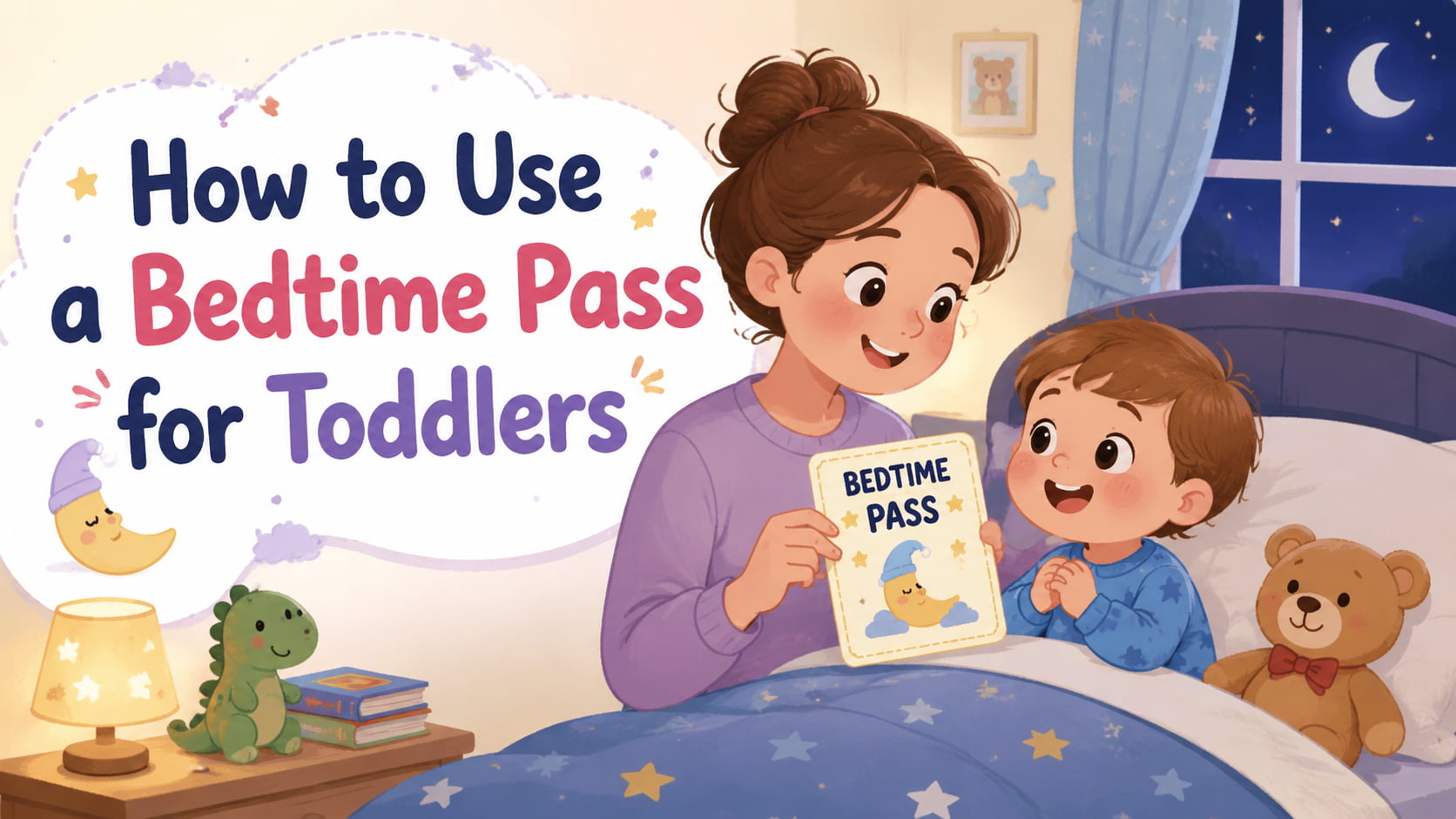
The Bedtime Pass: A Research-Backed Innovation
In a landmark 2006 study published in Sleep by Patrick Friman and colleagues at Creighton University, researchers introduced a simple intervention called the “Bedtime Pass” — a physical card given to the child at tuck-in that could be exchanged once for one post-bedtime request: a hug, a glass of water, a brief conversation. Once the pass was used, the child was expected to remain in bed.
The results were striking: children given the Bedtime Pass showed significant reductions in curtain-call behavior, fewer tears at bedtime, and — critically — less parental stress, without any measurable increase in the child’s anxiety. The pass works because it doesn’t eliminate autonomy; it channels it. The child still has agency. The boundaries are simply made legible.
Early School-Age (6–8+ Years): Fostering Independence
Strategic Focus: Transitioning responsibility, cognitive decompression, and processing the day.
By age six, children are capable of managing significant portions of their bedtime routine independently — and, crucially, they want to. The wise approach at this stage is to gradually transfer ownership of the routine to the child, positioning the parent more as a consultant and connector than a manager.
The school-age child also brings a new complexity to the equation: the day now contains genuine academic and social stressors. Unprocessed worries about a friendship conflict, an upcoming test, or an embarrassing moment can become ruminative loops that delay sleep onset and compromise its quality.
The Early School-Age Nighttime Checklist:
| Time | Activity | Key Detail |
|---|---|---|
| 7:00 PM | Homework wrap-up + backpack prep | Reduces next-morning anxiety; closes the loop on the school day |
| 7:30 PM | Independent hygiene | Bath/shower + teeth brushing, managed by the child |
| 8:00 PM | “Highs and Lows” | A 5-minute structured conversation: one high point, one low point, one thing to look forward to |
| 8:15 PM | Independent reading or family read-aloud | No screens; builds literacy and marks the final wind-down |
| 8:30 PM | Lights out |
The Worry Box: Externalizing Anxiety
Child psychologists have long used the concept of “worry time” — a bounded, designated period for acknowledging anxious thoughts rather than suppressing them. At the practical level of a bedtime routine, this can take the form of a simple physical box on the nightstand. Before lights out, the child can write or draw their worries on a slip of paper and place it in the box. The symbolic act of physically containing the worry outside of the body creates a felt sense of closure. “The worry is in the box now; it will be there in the morning if you still need it.” Many children never open the box again. The act of releasing it was sufficient.
Troubleshooting Common Bedtime Roadblocks
The Curtain Call
Perhaps the most universal bedtime frustration, the post-tuck-in curtain call is developmentally predictable and — with the right tools — eminently manageable. The Bedtime Pass, described above, is the most rigorously evidence-backed intervention. For older children, establishing a clear “last call” ritual (water, bathroom, final hug, goodnight) creates a ceremonial close to the parent-child interaction that signals, unambiguously, that the social portion of the evening is over.
It is also worth recognizing that some curtain calls reflect genuine need — specifically, anxiety. Children who consistently reemerge citing fear of the dark, worry about nightmares, or a need to check that a parent is “still there” may benefit from targeted anxiety support beyond routine adjustments.
Night Terrors vs. Nightmares
These two sleep disturbances are frequently confused, yet they require fundamentally different parental responses.
Nightmares occur during REM sleep — typically in the second half of the night — and the child will wake, be fully oriented, and be able to describe and remember the dream. The appropriate response is warm, calm reassurance, brief comfort, and a return to sleep.
Night terrors occur during the transition from deep non-REM sleep — typically 1–3 hours after sleep onset — and the child will appear awake (eyes open, screaming, thrashing) but is, in fact, still asleep. Crucially, the child will have no memory of the episode in the morning. The appropriate response is not to wake the child or attempt to engage them, but simply to ensure they are physically safe, speak calmly and quietly, and wait for the episode to resolve — typically within 5–15 minutes. Attempting to wake a child mid-night terror often prolongs and intensifies it.
Disruptions
The greatest threat to an established routine is not defiance — it is disruption. Travel, illness, holidays, and schedule changes can unravel weeks of progress in a single night. The key insight from sleep research is that the sequence of the routine is more portable than its timing. Recreating the familiar sequence — dim lights, bath, book, lullaby — in a hotel room, at grandparents’ house, or during recovery from illness activates the same neurological associations, even when the environment is different. Bringing two or three familiar routine anchors (the child’s usual bath wash, a beloved book, a transitional object) dramatically eases the adjustment.
Sibling Dynamics and Staggered Bedtimes
Managing multiple children with different developmental needs and bedtimes is a genuine logistical challenge. The recommended approach is to treat each child’s bedtime as a discrete, protected ritual rather than a simultaneous event. The practical mathematics often favor a sequential model: the youngest is put down first, while the eldest has a defined “quiet time” in their room (reading, drawing), followed by their own abbreviated wind-down sequence.
The Parent’s Role: Co-Regulation and Managing Our Own Stress
There is an irony at the heart of children’s sleep that is rarely named directly: the most powerful determinant of a child’s ability to settle at bedtime is not the child at all. It is the parent.
The Thermostat, Not the Thermometer
The neuroscience of co-regulation — the process by which a child’s nervous system literally synchronizes with and is regulated by a caregiver’s nervous system — has been documented extensively since the work of Allan Schore and Daniel Siegel in the 1990s. In plain terms: children borrow their calm. A parent who approaches bedtime with tension, urgency, and frustration will biochemically transmit that state to a child who is trying to down-regulate. The child’s cortisol rises in response to the parent’s cortisol. Sleep becomes physiologically harder.
The reframe is this: be the thermostat, not the thermometer. A thermometer simply reflects the temperature of its environment. A thermostat sets it. The parent who deliberately slows their own pace, lowers their own voice, and softens their own movements in the final hour before bed is not being passive. They are exercising the most sophisticated form of sleep intervention available — one that requires no gadget, no app, and no specialized training.
Modeling Healthy Sleep Hygiene
There is a consistency that children are exquisitely sensitive to: the gap between what they are told and what they observe. Telling a child to put away screens while answering emails on a laptop two feet from their pillow is a message the child will register — and disregard. Modeling the behaviors expected of a child — winding down, disconnecting from devices, treating sleep as a priority rather than a concession — is both the most effective and most frequently overlooked dimension of childhood sleep hygiene.
Conclusion
The airplane analogy that opened the science section of this guide bears one final extension. A pilot who commits to a long, smooth descent lands safely — every time, with passengers intact, cargo unspilled. A pilot who ignores the approach path and attempts a last-minute correction is fighting physics and losing.
Every child sleeping peacefully tonight is the result of someone, somewhere, choosing the longer runway.
A nighttime routine is not a rigid protocol to be executed under duress. It is a living framework — one that must breathe, flex, and evolve as a child grows from an infant who cannot yet hold their head up to a school-age person with a fully packed backpack and a worry box on the nightstand. The specifics will change. The underlying principles — consistency, environmental design, connection, and the gradual transfer of ownership to the child — remain constant.
The long-term return on this investment is difficult to overstate. A child who develops the capacity for independent, restorative sleep gains a foundational life skill that will serve them through adolescence, through university exams, through professional deadlines, through the stresses of adult life in all its complexity. Building that skill during the early years, when the brain is most malleable and the relationship with caregivers is most formative, is not simply good parenting strategy. It is a gift with a horizon that extends decades into the future.
Start tonight. Not with a complete overhaul. Not with a laminated chart and a new white-noise machine and a complete dietary audit. Start with one change — dimming the lights an hour earlier, initiating a three-minute “highs and lows” conversation, or simply slowing down and lowering the voice as the evening progresses. Small changes, sustained consistently, are the architecture from which peaceful nights — and resilient children — are built.
Sources and Further Reading:
- American Academy of Pediatrics (AAP) — Healthy Sleep Habits: The official pediatric guidance on sleep duration, screen time, and bedtime best practices.
- Harvard T.H. Chan School of Public Health — Harvard Medical School — Blue Light and Sleep: An overview of the science behind blue light’s effect on melatonin and circadian rhythms.
- Harvard Center on the Developing Child — Brain Architecture: Foundational science on early childhood neural development and the role of sleep.
- National Sleep Foundation — Children and Sleep: Research, guidelines, and polling data on children’s sleep patterns across the United States.
- NIH National Institute of Neurological Disorders and Stroke — Brain Basics: Understanding Sleep: A foundational explainer on sleep science, sleep stages, and the biology of circadian rhythms.
- Chang, A.M., et al. (2015) — “Evening use of light-emitting eReaders negatively affects sleep” — PNAS, Harvard Medical School: The foundational study on blue light and melatonin suppression referenced in this article.

October 25, 2026

October 25, 2026
October 25, 2026