
The Science of Slow-Wave Sleep
Do Kids Grow When They Sleep? The Science of Slow-Wave Sleep
If you have ever wondered do kids grow when they sleep, the answer is a resounding biological yes, as up to 80% of their daily growth hormone is released during the deep, slow-wave sleep cycles of the early night, which simultaneously build their physical, cognitive, and immunological architecture.
Key Takeaways
- The 80% Rule: Up to 70–80% of a child’s daily Human Growth Hormone (HGH) is released in concentrated pulses specifically during slow-wave deep sleep — not during meals, not during exercise, and not during waking hours.
- The First-Third Window: The deepest, most restorative slow-wave sleep cycles are front-loaded into the first 2–3 hours of the night. A late bedtime does not merely shift this window — it compresses and degrades it irreversibly.
- Children Are Deep Sleep Champions by Design: Children spend up to 30% of their total sleep time in slow-wave sleep, compared to roughly 15% in adults. This is not coincidence — it is nature’s blueprint for building bodies and brains during the years of fastest growth.
- Growth Is Multidimensional: Slow-wave sleep simultaneously drives physical growth (bones and muscles), cognitive architecture (memory, learning, and attention), and immune system strength — three pillars that together define a child’s developmental trajectory.
- Three Silent Disruptors Threaten Modern Children’s Deep Sleep: Blue light from screens, airway obstructions (mouth breathing and sleep apnea), and cortisol overload from over-scheduled evenings are the primary modern threats — and each is modifiable.
- Actionable Optimization Is Simple: Consistent bedtimes, a 60-minute screen-free wind-down, a cool bedroom (65–70°F / 18–21°C), and sleep-supportive nutrition are evidence-based levers any parent can act on immediately.
The Most Productive Hours of a Child’s Day Are Spent Unconscious
Every parent has done it. Standing at a sleeping child’s doorway at half past ten, watching the soft rise and fall of small shoulders, the unclenched fists, the total surrender of a body that ran hard all day. The instinct — natural, universal, and entirely understandable — is to see this scene as stillness. As rest. As a biological pause button pressed at the end of an exhausting day.
That instinct, it turns out, is profoundly wrong.
What looks like stillness is, in fact, a state of extraordinary biological activity. Behind those closed eyelids and beneath that quietly rising chest, one of the most metabolically intense, structurally productive, and neurologically complex operations of the entire 24-hour cycle is running at full capacity. Bones are being lengthened. Neural pathways are being pruned and reinforced. Immune soldiers are being manufactured and deployed. Growth hormones are flooding the bloodstream in massive, coordinated pulses — pulses that will not occur again until tomorrow night, during this same vulnerable window.
The old adage “you grow when you sleep” has been passed down by grandmothers, repeated by pediatricians, and generally accepted as one of those pieces of folk wisdom that sounds nice but probably oversimplifies things. Except that modern sleep science has not merely confirmed it — it has revealed the mechanism to be far more specific, far more time-sensitive, and far more consequential than the folk version ever suggested.
The engine driving childhood growth during sleep has a precise scientific name: Stage 3 Non-REM sleep, known to researchers as slow-wave sleep (SWS) and to parents as simply deep sleep. It is one specific phase of the sleep cycle — not all sleep equally — and it is the phase during which the overwhelming majority of physical growth, cognitive consolidation, and immune defense construction occurs.
What Sleep Actually Looks Like Inside a Child’s Brain
Before diving into the biology of growth during sleep, it helps to understand what sleep actually is — because most people think of it as a single, uniform state (consciousness off, body charging, like plugging in a phone), when the reality is far more dynamic and structured.
The Four Stages: Sleep as a Repeating Cycle
Sleep is not one thing. It is a structured, repeating sequence of four distinct stages, and the brain cycles through them in a predictable pattern approximately every 80 to 100 minutes throughout the night. Think of it as a playlist on repeat — the same four songs, in the same order, playing again and again from the moment a child falls asleep until the alarm goes off in the morning.
Here is what each “song” sounds like:
| Stage | Scientific Name | What’s Happening | Duration per Cycle | Analogy |
|---|---|---|---|---|
| Stage 1 | N1 (Light Sleep) | The brain is drifting from wakefulness. Muscles relax. The child can still be easily woken. | 1–5 minutes | Easing off the highway onto the exit ramp |
| Stage 2 | N2 (Stable Sleep) | Heart rate slows. Body temperature drops. Brief bursts of brain activity called “sleep spindles” appear on an EEG. | 10–25 minutes | Pulling into the parking garage — slowing down, but not yet parked |
| Stage 3 | N3 (Slow-Wave / Deep Sleep) | The deepest Non-REM stage. Brain waves slow to massive, synchronized delta waves. Blood pressure drops. Blood flow to muscles surges. Growth hormone floods the bloodstream. The child is very difficult to wake. | 20–40 minutes | The factory floor — the building itself is quiet, but inside, the construction crews are working at maximum capacity |
| REM | Rapid Eye Movement | Brain activity spikes back to near-waking levels. Eyes move rapidly behind closed lids. Dreaming occurs. Muscles are temporarily paralyzed (to prevent acting out dreams). Critical for emotional processing and creative problem-solving. | 10–60 minutes (lengthening as night progresses) | The editing room — the day’s footage is being reviewed, reorganized, and woven into the bigger story |
A child sleeping 10 hours will cycle through this sequence approximately six to seven times in a single night. But — and this is the critical insight that shapes everything that follows — not all cycles are created equal.
The Tilt: Why the First Half of the Night Is Structurally Different from the Second
If sleep were a perfectly symmetrical process, each 90-minute cycle would contain equal portions of every stage. It does not. The distribution is dramatically skewed:
- The first half of the night is dominated by slow-wave deep sleep (N3). The earliest cycles contain the longest, deepest, most hormonally active SWS episodes of the entire night.
- The second half of the night is dominated by REM sleep. As the night progresses, SWS episodes shrink and REM episodes expand, becoming longer and more vivid.
Imagine a seesaw. At the start of the night, the deep-sleep end is pressed firmly to the ground, heavy with growth hormone pulses and physical restoration. As the hours pass, the seesaw gradually tilts — the REM end descends, bringing dreaming, emotional processing, and creative consolidation. By the final cycles before waking, slow-wave sleep has almost entirely receded, and REM dominates.
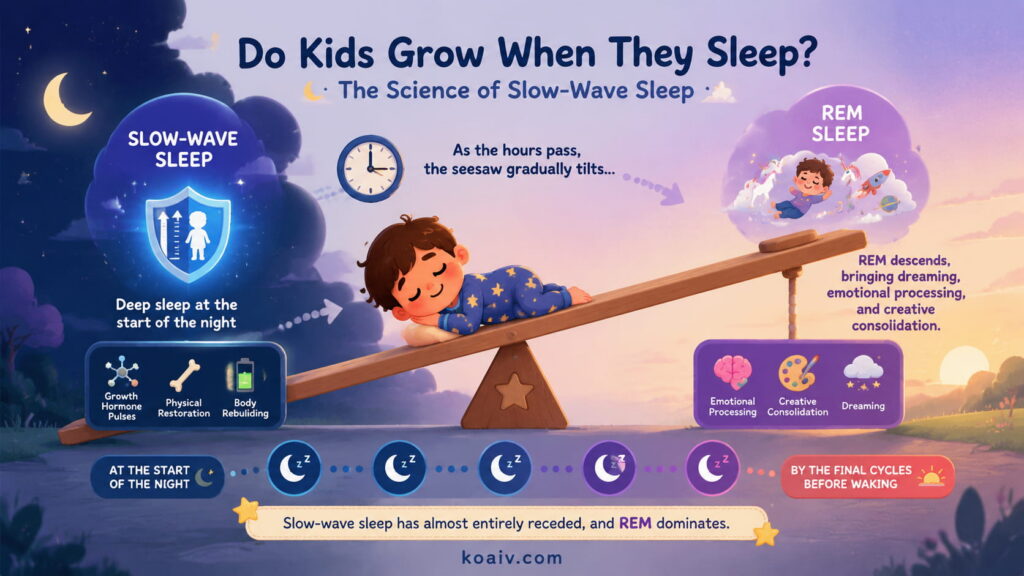
This tilt has a profound implication that most parents have never been told: the single most important hours for a child’s physical growth are the first two to three hours after falling asleep. Miss that window — through a late bedtime, a disrupted evening, or difficulty falling asleep — and no amount of “sleeping in” the next morning can fully compensate. The body cannot simply reschedule its deep-sleep construction shift to 7 AM. The architecture does not work that way.
With this map of sleep’s terrain in hand, we can now zoom into the stage that matters most for growing children — and examine exactly what makes it so irreplaceable.
How Deep Sleep Literally Becomes Height, Muscle, and Bone
What Is Growth Hormone, and Why Should Parents Care?
To understand why children grow when they sleep, it is necessary to meet the principal architect of that growth: a protein called Human Growth Hormone (HGH), produced by a tiny endocrine gland called the pituitary.
The pituitary gland is roughly the size and shape of a garden pea, and it sits in a small bony cradle at the base of the brain, just behind the bridge of the nose. Despite its modest dimensions, it functions as the body’s master hormonal control center — a biological command post that issues chemical instructions to nearly every organ system in the body.
Among the most important of those instructions is HGH. When released into the bloodstream, growth hormone travels throughout the body and triggers a cascade of construction activity:
- In bones: HGH stimulates the liver to produce a secondary hormone called Insulin-like Growth Factor 1 (IGF-1). IGF-1 then travels to the growth plates — thin layers of cartilage located near the ends of every long bone in a child’s arms, legs, and spine. At these growth plates, specialized cartilage cells called chondrocytes receive the IGF-1 signal, begin to multiply rapidly, and are gradually replaced by hardened, mineralized bone tissue. Every millimeter of height a child gains in a year is the direct result of this process occurring at these specific locations.Think of the growth plates as the construction zones at the tips of every major bone. IGF-1 is the work order that tells those construction zones to keep building. Without the work order, the crews sit idle — regardless of how much raw material (food, nutrients, calcium) is available on site.
- In muscles: HGH signals muscle cells to repair the micro-tears created during the day’s physical activity — running, climbing, playing — and to lay down new, stronger fibers in their place. This is how children grow not just taller, but physically stronger and more capable over time.
- In tissues: HGH accelerates cellular reproduction across the body, supporting skin repair, organ growth, and the maintenance of connective tissues (tendons and ligaments) that must keep pace with rapidly lengthening bones.
The 80% Rule: The Discovery That Changed Pediatric Sleep Science
Here is where the story takes its most consequential turn.
For decades, researchers assumed that growth hormone was released in a relatively steady, low-level drip throughout the day — a slow IV feed that the body tapped into more or less continuously. The discovery that overturned this assumption came from endocrinology labs in the 1960s and 1970s, and was refined through landmark work by Eve Van Cauter and colleagues at the University of Chicago.
What the research revealed was startling in its specificity: the pituitary gland does not release HGH in a steady stream. It releases it in discrete, concentrated bursts — and the largest, most potent of those bursts are timed, with remarkable biological precision, to coincide with the onset of slow-wave deep sleep.
The numbers are striking. Studies published in the Journal of Clinical Endocrinology & Metabolism established that between 70% and 80% of a child’s total daily growth hormone output occurs during sleep, with the single largest pulse typically triggered within the first 60 to 90 minutes after sleep onset — squarely within the first cycle of slow-wave deep sleep (Van Cauter & Plat, 1996; Takahashi et al., 1968).
To put this in perspective: during waking hours — even during vigorous physical exercise, which does trigger modest HGH secretion — the pituitary produces only a fraction of what it manufactures in those first deep-sleep hours of the night. The majority of a child’s daily growth “budget” is spent in a window most parents are not even aware exists.
The implication is direct and significant: a child who consistently fails to achieve adequate slow-wave deep sleep is not merely tired the next day. That child is biochemically under-investing in their own skeletal and muscular development — a deficit that no amount of calcium supplements, protein shakes, or athletic training can fully offset. The building materials may be available, but the work orders are not being issued.
Why This Matters More for Children Than for Adults
Adults produce growth hormone too, of course — it continues to play a role in muscle maintenance, fat metabolism, and cellular repair throughout life. But the stakes are categorically different for children, for one simple reason: growth plates close.
During childhood and adolescence, the growth plates at the ends of long bones remain open — made of soft, active cartilage that is responsive to HGH and IGF-1 signals. This is the window during which bones can lengthen. Once a child passes through puberty and reaches skeletal maturity (typically between ages 14 and 18, depending on sex and genetics), these cartilage zones ossify — they harden into solid bone and permanently close. No amount of growth hormone, sleep, or nutrition can reopen them.
This means that the years of childhood represent a biologically time-limited opportunity. The nightly growth hormone pulses driven by slow-wave sleep are building within a window that will, eventually, close. Optimizing those pulses during the years they can make a structural difference is not merely good parenting hygiene — it is a developmental investment with a hard expiration date.
Inside Slow-Wave Sleep — The Biological Sweet Spot Where Growth Happens
The term slow-wave sleep sounds clinical, even sterile. But what it describes is one of the most dramatic physiological transformations the human body undergoes on a daily basis — and understanding what happens during this phase, even at a basic level, transforms the way parents think about bedtime.
What “Slow Waves” Actually Are
The name comes from what scientists see when they attach electrodes to a sleeping person’s scalp and monitor brain activity using an electroencephalogram (EEG) — a device that records the electrical patterns produced by billions of neurons firing in the cerebral cortex.
During wakefulness, an EEG shows rapid, irregular, low-amplitude activity — a busy, chaotic signal reflecting the brain’s constant multitasking: processing visual information, generating language, planning movements, managing emotions, monitoring the environment. It looks, on a screen, like static.
As a child descends through Stage 1 and Stage 2 sleep, the signal begins to slow and organize. But when Stage 3 arrives — slow-wave sleep — the transformation is unmistakable. The chaotic static resolves into massive, rhythmic, high-amplitude waves rolling slowly across the cortex at a frequency of just 0.5 to 4 cycles per second. These are delta waves, and they represent something extraordinary: the simultaneous, synchronized firing of vast populations of neurons across the brain.

Imagine a sports stadium. During a normal game, 80,000 people are talking, eating, texting, and cheering at different moments — a cacophony of independent activity. Now imagine that same stadium performing a perfectly synchronized “wave” — every person standing and sitting in precise sequence, one smooth ripple of coordinated motion traveling around the entire arena. That is the neural equivalent of delta-wave activity during slow-wave sleep: the entire cortex moving in unison, in a state of profound, organized coherence.
This synchronization is not incidental to the biological work of growth and repair — it is the mechanism that enables it. When the brain’s neurons fire in this slow, unified rhythm, the cortex effectively takes itself offline from external processing. It stops interpreting sensory information. It stops planning and problem-solving. And by doing so, it frees up an enormous amount of metabolic energy — energy that is immediately redirected to the body’s internal construction, repair, and defense systems.
This is why a child in slow-wave deep sleep is so profoundly difficult to wake. The brain has, quite literally, disconnected from the outside world to focus entirely on internal work. Rousing a child from this state — as any parent who has tried to carry a sleeping five-year-old from the car to the bed can attest — produces a groggy, disoriented state called sleep inertia, a period of confusion that can last several minutes as the brain struggles to re-engage its external processing systems.
What the Body Does During Deep Sleep
While the brain is generating those synchronized delta waves, the body is executing a highly coordinated set of physiological operations:
- Blood pressure drops to its daily low. The cardiovascular system enters its most relaxed state, reducing strain on the developing heart and vascular system.
- Core body temperature decreases by 1–2°C. This cooling is not a side effect — it is a prerequisite. The body must lower its thermostat to enter and sustain slow-wave sleep effectively, which is why bedroom temperature matters so much (more on this later).
- Blood flow to muscles increases substantially. With the brain consuming less metabolic fuel, the circulatory system redirects oxygen- and nutrient-rich blood to skeletal muscles, facilitating repair of the micro-damage sustained during the day’s physical activity.
- The pituitary gland releases its largest growth hormone pulse of the day. As discussed in Part II, this is the primary hormonal event that drives bone elongation, muscle development, and tissue repair.
- The glymphatic system activates. This is a relatively recent discovery (first described by Maiken Nedergaard’s team at the University of Rochester in 2013) and one of the most fascinating findings in modern neuroscience. During slow-wave sleep, the spaces between brain cells expand by up to 60%, and cerebrospinal fluid floods through these widened channels, flushing out metabolic waste products — including beta-amyloid and tau proteins — that accumulate during waking hours. Think of it as the brain’s internal pressure-washing system, and it operates almost exclusively during deep sleep.
- The immune system ramps up production of key defensive proteins. Cytokines, T-cells, and natural killer cells are synthesized and deployed at their highest rates during SWS (detailed in Part IV below).
Each of these processes operates concurrently, creating a synchronized window of biological productivity that no other sleep stage — and no waking state — can replicate. This is why sleep researchers increasingly describe slow-wave sleep not as a passive state of rest, but as the body’s primary maintenance and construction shift.
Why Children Are Built for Deep Sleep
If slow-wave sleep is nature’s construction shift, then children are nature’s most heavily scheduled building sites — and their sleep architecture reflects it.
A comprehensive meta-analysis published in the journal Sleep by Ohayon and colleagues (2004), synthesizing data from 65 studies and nearly 3,600 subjects, established the following age-related pattern in slow-wave sleep:
| Age Group | Approximate % of Night in SWS | Biological Rationale |
|---|---|---|
| Children (5–10 years) | 25–30% | Peak period of linear bone growth, neural pathway development, and immune system maturation |
| Adolescents (11–17 years) | 15–20% | Growth rate decelerating; pubertal hormones supplementing HGH |
| Young Adults (18–30 years) | 13–17% | Growth plates closing; SWS shifts to tissue maintenance and repair |
| Middle-Aged Adults (31–60 years) | 8–12% | Declining growth needs; SWS continues for cellular repair and immune function |
| Older Adults (60+ years) | 3–7% | Minimal structural growth; SWS loss contributes to increased illness susceptibility and cognitive decline |
The pattern is clear: nature allocates its deepest, most restorative sleep disproportionately to the years of most rapid development, then gradually withdraws it as the body’s structural needs diminish. A child’s exceptional capacity for deep sleep is not a quirk of youth — it is an adaptive design feature, calibrated by millions of years of evolution to maximize the developmental return on every hour spent asleep.
And it is precisely this exceptional capacity that modern lifestyles are now threatening.
The Three Pillars of Growth That Depend on Deep Sleep
The popular conversation about children’s sleep and growth is almost always framed in terms of physical height — “eat your vegetables and get to bed early so you grow tall.”This framing, while not incorrect, is dangerously incomplete. It reduces slow-wave sleep to a single output metric (inches on a growth chart) while overlooking two other developmental domains that are equally dependent on deep sleep and arguably even more consequential for a child’s long-term trajectory.
Slow-wave sleep is not a height supplement. It is a holistic developmental platformoperating simultaneously across three interconnected pillars.
Pillar 1: Physical Architecture — Building Bones, Muscles, and the Body’s Structural Frame
The HGH-driven bone elongation and muscle repair discussed in Part II represent the most visible and measurable output of slow-wave sleep, but several additional physical processes deserve attention.
Tissue repair and adaptation. Every day, a physically active child generates thousands of micro-injuries — tiny tears in muscle fibers, minor stress fractures at cellular levels in bone, wear on connective tissues like tendons and ligaments. These are normal, healthy byproducts of physical activity and, in fact, are the stimulus the body requires to grow stronger. But the repair of these micro-injuries — the process by which the body rebuilds damaged tissue to be more resilient than before — occurs predominantly during slow-wave sleep, when blood flow to muscles peaks and HGH saturates the repair environment.
This is why a child who plays intensely and sleeps deeply grows stronger and more capable over time: the stress-recovery cycle is completing. And it is equally why a chronically under-slept child participating in the same sport program will plateau earlier, sustain more overuse injuries, recover more slowly, and adapt less effectively — not from a lack of effort or talent, but from a structural deficit in the repair half of the cycle.
Metabolic regulation. Slow-wave sleep also plays a critical role in glucose metabolism and insulin sensitivity. Research published in The Lancet by Spiegel, Leproult, and Van Cauter (1999) demonstrated that experimental suppression of slow-wave sleep in healthy subjects — even without reducing total sleep time — led to significant decreases in glucose tolerance and insulin sensitivity within just three nights. For growing children, whose bodies require enormous metabolic resources to fuel development, this metabolic disruption adds another layer of cost to deep-sleep deprivation.
Pillar 2: Cognitive Architecture — How Deep Sleep Builds Smarter, More Focused Brains
If Pillar 1 is about building the physical container, Pillar 2 is about building what goes inside it. The cognitive functions of slow-wave sleep are among the most actively researched areas in modern neuroscience, and the findings have direct, practical relevance for every parent who has ever worried about a child’s performance in school.
Memory consolidation: The nightly filing system. During waking hours, every experience a child has — a math lesson, a conversation on the playground, a new word encountered in a storybook, the physical sensation of learning to catch a ball — creates temporary neural connections in the hippocampus, a seahorse-shaped structure deep in the brain that serves as a kind of biological “inbox.” These connections are fragile, easily overwritten, and metabolically expensive to maintain.
During slow-wave sleep, the brain systematically reviews the day’s inbox. Important, frequently reinforced connections — the ones that represent genuine learning — are selectively transferred from the hippocampus to the neocortex (the brain’s long-term storage system), where they are integrated into existing knowledge networks and become permanent. This process, called memory consolidation, is the neurological equivalent of moving documents from a cluttered desk into an organized filing cabinet.
Imagine a librarian who works the night shift. Every evening, the library’s return cart is overflowing with books that patrons dropped off throughout the day — some valuable first editions, some outdated pamphlets, some duplicates of titles already on the shelves. The night-shift librarian’s job is to sort through the pile: catalog and shelve the important acquisitions, discard the junk, and reorganize the existing collection to make room for tomorrow’s arrivals. That librarian is slow-wave sleep. Without the night shift, the cart overflows, the stacks become disorganized, and the library becomes increasingly difficult to navigate.
A groundbreaking study from the University of Tübingen found that children who slept well after learning a new task showed dramatically superior retention the following day compared to children who were sleep-restricted, even when the sleep-restricted group was given additional practice time to compensate. More remarkably, the well-rested children didn’t merely remember the information — they showed evidence of insight: the ability to recognize hidden patterns and rules that they hadn’t been explicitly taught, suggesting that slow-wave sleep enables a form of offline learning that goes beyond simple memorization (Wilhelm et al., 2013).
Synaptic pruning: The art of strategic forgetting. Equally important is what the brain removes during slow-wave sleep. Throughout the day, the brain creates new synaptic connections in response to every stimulus — a process that, left unchecked, would quickly overwhelm the neural network with noise. During SWS, a process called synaptic homeostasis (the “SHY” hypothesis, proposed by Giulio Tononi and Chiara Cirelli at the University of Wisconsin) selectively weakens and eliminates connections that are redundant, irrelevant, or insufficiently reinforced.
Think of pruning a rose bush. An unpruned bush grows in every direction — chaotic, resource-starved, and unable to produce strong blooms. A well-pruned bush concentrates its energy on fewer, stronger branches and produces dramatically better flowers. Synaptic pruning during slow-wave sleep performs the same function for the developing brain: it removes the neural “dead wood” so that the connections that remain are stronger, faster, and more efficient.
This is why many children with chronic sleep problems struggle not just with memory, but with attention and focus. Their brains are carrying the accumulated, un-pruned synaptic weight of days or weeks of inadequately processed experiences — a form of neural clutter that makes concentration effortful and distractibility almost inevitable. In some cases, these symptoms are misidentified as ADHD when the root cause is insufficient slow-wave sleep.
The Immunological Shield — How Deep Sleep Builds the Body’s Defense Force
The third pillar is the least discussed in popular parenting media but is no less consequential: the immune system’s reliance on slow-wave sleep for its nightly manufacturing and maintenance operations.
During deep sleep, the body synthesizes and deploys several categories of immune defense agents at their peak daily rates:
- Cytokines — signaling proteins that coordinate the immune response, directing defensive cells to sites of infection or inflammation. Certain cytokines, including interleukin-1 and tumor necrosis factor, are produced preferentially during slow-wave sleep and actually promote deeper SWS in a self-reinforcing feedback loop (which is partly why illness makes children — and adults — so sleepy: the immune system is demanding more deep sleep to ramp up its production lines).
- T-cells — a class of white blood cells that identify and destroy infected cells. Research published in the Journal of Experimental Medicine demonstrated that even a single night of restricted sleep reduced T-cell adhesion capacity (their ability to attach to and neutralize threats) by a measurable margin (Dimitrov et al., 2019).
- Natural Killer (NK) cells — specialized lymphocytes that patrol the body for virus-infected cells and early-stage tumor cells. NK cell activity drops significantly after sleep deprivation, a finding with direct implications for children navigating the constant viral exposure of school environments.
A landmark review in Pflügers Archiv – European Journal of Physiology (Besedovsky, Lange & Born, 2012) synthesized decades of research and concluded that sleep, and slow-wave sleep in particular, is not merely supportive of immune function — it is a required operational condition. The immune system does not merely “work better” with good sleep; key components of its machinery literally do not operate at full capacity without it.
The chronically under-slept child who catches every cold circulating through the classroom, who takes longer to recover from routine illnesses, who seems perpetually runny-nosed from September through March — that child is not simply “unlucky” or “prone to getting sick.” That child’s immunological shield is, in many cases, operating at reduced manufacturing capacity because its primary production shift — slow-wave deep sleep — is being cut short.
Three Modern Threats to Children’s Slow-Wave Sleep
Understanding what builds slow-wave sleep is only half the equation. The other half — and arguably the more urgent one for contemporary families — is understanding what destroys it. The modern domestic environment, despite its comforts and conveniences, has produced a trio of highly efficient sleep disruptors that few parents are specifically aware of, and fewer still have been given the tools to counter.
Disruptor 1: The Blue Light Melatonin Blockade
The biology: The brain determines when it is time to sleep by monitoring light exposure through specialized cells in the retina called intrinsically photosensitive retinal ganglion cells (ipRGCs). These cells are particularly sensitive to light in the blue-spectrum range (wavelengths around 460–480 nanometers) — the wavelength most prevalent in natural daylight. When blue light is present, these cells send a signal to the suprachiasmatic nucleus (the brain’s master clock) that says, effectively: “It’s daytime. Stay alert.”
As evening approaches and blue light diminishes, this signal fades, and the pineal glandbegins secreting melatonin — the hormone that initiates the cascade toward sleep. Melatonin does not cause sleep directly, but it opens the gate: it lowers core body temperature, reduces alertness, and creates the physiological conditions under which slow-wave sleep can commence. Without a natural, timely rise in melatonin, the entire sleep architecture of the night is delayed and degraded.
The modern problem: Tablets, smartphones, LED televisions, and most modern screens emit light that is heavily concentrated in exactly the blue-spectrum range that suppresses melatonin. A child watching a tablet in bed at 8:30 PM is unwittingly sending their brain the biological equivalent of a “midday sun” signal — telling the master clock that it is nowhere near time to sleep.
Research from Harvard Medical School’s Division of Sleep Medicine, published in Proceedings of the National Academy of Sciences (Chang et al., 2015), found that screen exposure in the hour before bed suppressed melatonin onset by 1.5 to 3 hours, reduced total slow-wave sleep duration, and impaired next-morning alertnesscompared to reading a physical book under warm, non-LED light. In children, whose circadian systems are still maturing and are therefore more sensitive to light cues, the effect is likely even more pronounced.
Imagine trying to start a campfire while someone stands next to it with a fire extinguisher, giving the logs a quick spray every few minutes. The fire never fully catches. That is what blue light does to the melatonin-driven sleep initiation process — it doesn’t prevent sleep entirely, but it prevents the deep, efficient ignition that leads to high-quality slow-wave sleep.
The practical consequence: The child eventually falls asleep, but the onset of their first slow-wave cycle is delayed. Because the First-Third Window is time-sensitive and cannot be rescheduled, the total duration and depth of deep sleep across the night is structurally reduced — even if the child sleeps for the “right” number of hours.
Disruptor 2: The Airway Bottleneck — Mouth Breathing, Snoring, and Sleep-Disordered Breathing
This disruptor operates silently, often goes undetected for years, and is frequently misattributed to behavioral or psychological causes.
The mechanism: Children with enlarged tonsils or adenoids, chronic nasal congestion from allergies, a deviated septum, or structural narrowing of the upper airway often compensate by breathing through their mouths during sleep. Mouth breathing, compared to nasal breathing, reduces blood oxygen saturation, increases airway resistance, and — most critically for the purposes of this discussion — generates micro-arousals: brief, subconscious moments during which the brain transitions from deep sleep back to light sleep to restore airway patency.
These micro-arousals typically last only a few seconds. The child rarely wakes fully, and usually has no memory of them the next morning. But each one fragments the continuity of slow-wave sleep, preventing the brain from sustaining the long, unbroken delta-wave episodes that are required for full growth hormone pulses, effective memory consolidation, and complete immune system maintenance.
Imagine trying to fill a bathtub, but every few minutes, someone pulls the drain plug for five seconds before replacing it. The tub never completely empties, but it also never fills to the level needed for a proper bath. Micro-arousals do the same thing to slow-wave sleep — they don’t eliminate it, but they prevent it from reaching the depth and duration the body requires.
The misdiagnosis problem: The daytime presentation of a child with sleep-disordered breathing is frequently misread. Chronic slow-wave sleep fragmentation produces a child who is not just tired — but irritable, inattentive, emotionally volatile, and paradoxically hyperactive (the body compensates for exhaustion by ramping up cortisol and adrenaline, producing a wired-but-exhausted state). These symptoms overlap substantially with the diagnostic criteria for ADHD, and pediatric sleep researcher Dr. Karen Bonuck at the Albert Einstein College of Medicine has published extensively on the frequency with which sleep-disordered breathing in children is misattributed to behavioral or neurodevelopmental conditions. Her research demonstrated that early treatment of airway issues — including adenotonsillectomy in appropriate cases — produced measurable improvements in both behavioral and academic outcomes (Bonuck et al., 2012).
Warning signs parents should watch for: habitual mouth-open sleeping, loud or irregular snoring, audible pauses in breathing during sleep, bed-wetting (which occurs predominantly during disrupted deep sleep), chronic morning headaches, and persistent daytime behavioral issues despite adequate time in bed.
Disruptor 3: Cortisol Overload — When Modern Childhood Stress Poisons the Deep-Sleep Window
The third disruptor is the most insidious because it operates through the very systems that parents are often trying to optimize. It is the paradox of the over-scheduled, over-stimulated child.
The hormonal conflict: Cortisol, the body’s primary stress hormone, operates on a circadian rhythm that is designed to complement the sleep-wake cycle. In a well-regulated system, cortisol peaks in the early morning (generating the alertness and metabolic energy needed to start the day) and declines steadily through the afternoon and evening, reaching its daily nadir around the time of sleep onset. This cortisol taper is not merely convenient — it is a physiological prerequisite for slow-wave sleep initiation. Elevated cortisol is a direct biological antagonist to the delta-wave synchronization that defines deep sleep.
The modern problem: A child whose evening is filled with homework pressure, competitive extracurricular activities, family conflict, social media anxiety, or the relentless stimulation of fast-paced digital content carries elevated cortisol levels into the bedroom. The biological gate to slow-wave sleep — which requires cortisol to be low and melatonin to be high — is partially blocked.
This creates a profoundly counterproductive feedback loop:
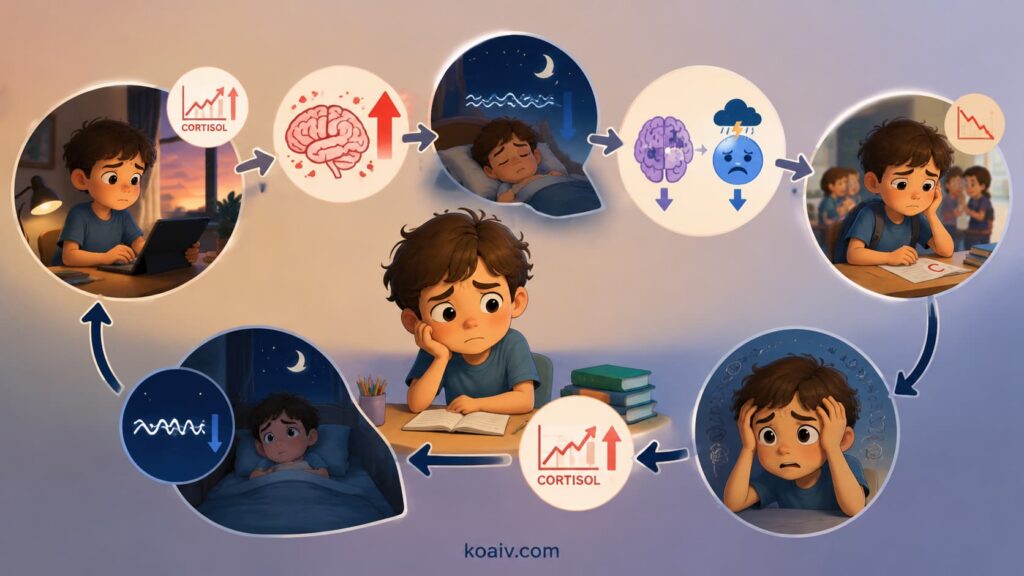
Evening stress → Elevated cortisol → Delayed/reduced slow-wave sleep →
→ Impaired memory consolidation + reduced emotional regulation →
→ Worse academic/social performance the next day →
→ More stress → Higher evening cortisol → Even worse slow-wave sleep
The child trapped in this cycle appears, from the outside, to be struggling with attention, motivation, or emotional maturity. The underlying issue, however, is often architectural: the biological foundation — deep, restorative slow-wave sleep — on which attention, motivation, and emotional regulation are built is being eroded night after night.
The Executive Action Plan — Engineering the Optimal Slow-Wave Sleep Window
The science presented in this article, dense as it may seem, converges on a set of practical interventions that are remarkably straightforward. Protecting and optimizing a child’s slow-wave deep sleep does not require specialized equipment, pharmaceutical intervention, or dramatic lifestyle overhaul. It requires consistency, intentionality, and an informed commitment to treating bedtime not as a daily negotiation, but as the structural investment it actually is.
Strategy 1: Protect the First-Third Window with Non-Negotiable, Consistent Bedtimes
Because the deepest, most hormonally productive SWS cycles occur in the first 2–3 hours after sleep onset, the timing and consistency of bedtime are as important as total sleep duration.
Maintaining bedtimes within a 30-minute window — the same window, seven days a week, including weekends — stabilizes the circadian release of melatonin and the biological timing of SWS onset. Irregular bedtimes, even if total sleep hours remain adequate, produce a form of social jet lag that disrupts circadian rhythm efficiency and reduces deep-sleep quality throughout the subsequent week.
The American Academy of Pediatrics recommends the following total sleep durations (including naps where applicable):
| Age Group | Recommended Total Sleep |
|---|---|
| 3–5 years | 10–13 hours |
| 6–12 years | 9–12 hours |
| 13–18 years | 8–10 hours |
These figures represent total sleep. The quality and depth of that sleep — specifically the proportion spent in restorative slow-wave sleep — is the variable that determines whether those hours are doing their full biological work.
Strategy 2: Build a “Melatonin Runway” — The 60-Minute Screen-Free Wind-Down
Beginning 60 minutes before the target sleep time, screens should be completely eliminated. This is not an aspirational guideline — it is a biochemical requirement for allowing melatonin levels to rise naturally and trigger the slow-wave sleep cascade on schedule.
The final hour should function as a melatonin runway — a deliberate, low-stimulation transition from the brightness and activity of the day to the dim, calm state required for sleep initiation. Effective runway activities include:
- Reading physical books (not backlit e-readers) under warm, low-wattage light
- Listening to calm audio stories or quiet music
- Taking a warm bath (the paradoxical cooling effect — as the body loses the bath’s heat through vasodilation after exiting the water — actively lowers core temperature and facilitates sleep onset)
- Gentle, imaginative play
- Brief, age-appropriate relaxation exercises (deep breathing, progressive muscle relaxation)
The transition from high-stimulation digital activity to this calm environment is the critical bridge. Abrupt transitions — “turn off the iPad and go to bed right now” — are biochemically counterproductive. The brain needs a gradient, not a cliff edge, to reach the melatonin levels required for efficient slow-wave sleep onset.
Strategy 3: Optimize the Thermal Environment
The human body must reduce its core temperature by approximately 1–2°C to initiate and sustain slow-wave sleep effectively. A bedroom that is too warm actively impedes this thermoregulatory process, keeping core temperature elevated and preventing the brain from descending fully into delta-wave deep sleep.
The National Sleep Foundation recommends a bedroom temperature of 65–70°F (18–21°C) for optimal sleep quality — cooler than many parents instinctively set, particularly for younger children. Lightweight, breathable bedding and avoiding overdressing (the temptation to add an extra blanket “just in case”) are complementary measures.
The goal is a sleeping environment with three qualities: cool, dark, and quiet. Blackout curtains to eliminate ambient light (streetlights, early-morning sun) are among the highest-return, lowest-cost investments a parent can make in a child’s sleep quality. Consistent, low-level white noise (a fan, a dedicated white-noise machine) can mask variable household sounds that might otherwise cause micro-arousals during lighter sleep stages, protecting the integrity of slow-wave sleep transitions.
Strategy 4: Leverage the Dietary Growth Foundation
Certain nutrients directly support the neurological and endocrine conditions for deep sleep onset and maintenance:
- Magnesium (found in bananas, pumpkin seeds, dark leafy greens, almonds, and whole grains): Supports the GABAergic neurotransmitter system — the brain’s primary “calming” network — and helps suppress cortisol activity in the evening. Magnesium deficiency, which is common in children with limited vegetable intake, has been associated with restless sleep and difficulty maintaining slow-wave sleep.
- Tryptophan (found in warm milk, turkey, chicken, oats, eggs, and cheese): An essential amino acid that the body converts, through a two-step process, into serotonin (a calming neurotransmitter) and then into melatonin (the sleep-onset hormone). A small tryptophan-containing snack 30–60 minutes before the melatonin runway begins provides the biochemical raw materials for the body’s natural melatonin production.
- Complex carbohydrates (whole-grain crackers, oatmeal, sweet potatoes): When consumed in small quantities at dinner, complex carbohydrates facilitate tryptophan’s transport across the blood-brain barrier by triggering a mild insulin response that clears competing amino acids from the bloodstream, giving tryptophan preferential access to the brain.
The counterpart: High-sugar snacks or beverages consumed in the two hours before bed generate insulin spikes that disrupt the hormonal environment needed for efficient growth hormone release during SWS. The pre-bed dietary environment is, in a very real sense, as architecturally significant as the bedroom environment itself.
Conclusion
There is a quiet cultural bias at work in how childhood potential is measured. The metrics by which children are evaluated — test scores, athletic statistics, behavioral assessments — are daytime metrics. They capture the output of performance, the visible expression of what a child can demonstrate while conscious and under observation.
But the foundation upon which all of that output is built is constructed elsewhere entirely. It is built in silence. In darkness. In the slow, rhythmic oscillation of delta waves rolling across a young cortex at three o’clock in the morning — a process invisible to parents, invisible to teachers, invisible to the child themselves, and yet more consequential for their development than any lesson, practice, or curriculum they will encounter during waking hours.
The bones that carry a child forward are elongated in slow-wave sleep. The memories that become academic competence are consolidated there. The immune defenses that protect them through crowded classrooms and flu seasons are manufactured there. The emotional regulation that makes them resilient, adaptable, and socially capable is restored there.
When slow-wave deep sleep is protected — through consistent bedtimes, a screen-free wind-down, a cool and dark bedroom, and a diet that supports rather than disrupts endocrine function — it is not merely a sleep-hygiene win. It is a compounding biological investment that accrues returns across every dimension of a child’s development, night after night, year after year, throughout the irreplaceable window of growth-plate openness that defines childhood.
The most productive hours of a child’s life are the ones spent unconscious. Treating them accordingly — with the same intentionality and seriousness that adults bring to education, nutrition, and safety — may be one of the most consequential and underappreciated parenting decisions available.
The construction crews are ready. The blueprints are drawn. The only question is whether the factory will be given its full shift to build.
Frequently Asked Questions
Q: Do kids actually grow overnight in a way that can be physically measured?
Physical height gain is a gradual, cumulative cellular process — bones lengthen at the microscopic level of individual chondrocyte division. A single night’s growth is far too small to measure with a ruler. However, the hormonal pulses that drive that growth are concentrated during nighttime slow-wave sleep, meaning the biological mechanism of growth is, in fact, a nightly event — even if the visible result accumulates over weeks and months.
Q: What are the warning signs that a child isn’t getting enough deep sleep?
The most common indicators include: persistent morning grogginess despite spending adequate time in bed; paradoxical hyperactivity or emotional volatility during the day (often mistaken for behavioral issues); difficulty concentrating or retaining information at school; frequent illness or slow recovery from routine infections; chronic bed-wetting; and morning headaches. Notably, a child can exhibit all of these symptoms while appearing to sleep “enough” hours — because the issue is often not total sleep time but insufficient slow-wave sleep within that time.
Q: How much deep sleep does a child actually need?
While there is no universal prescription (individual variation exists), children should spend approximately 20–30% of their total sleep in slow-wave sleep. For a child sleeping 10 hours, this translates to roughly 2–3 hours of deep SWS — the majority concentrated in the first half of the night. These figures decrease naturally with age.
Q: Can lost deep sleep be “caught up” on weekends?
Partially, but not fully. Research consistently shows that irregular weekend sleep schedules that differ by more than two hours from weekday patterns — a phenomenon researchers call “social jet lag” — disrupt circadian rhythm stability and reduce SWS efficiency throughout the following week. The body’s circadian system responds best to consistency, not compensation. The most effective strategy is maintaining a stable bedtime seven nights a week rather than alternating between deprivation and recovery.
Q: Is all sleep equally important for growth, or is deep sleep specifically more important?
They serve different functions. Slow-wave deep sleep (N3) is the primary stage for growth hormone release, physical tissue repair, and memory consolidation. REM sleep, which dominates the second half of the night, is critical for emotional processing, creative problem-solving, and the integration of new information into existing knowledge networks. Both are essential — but for the specific question of physical growth, slow-wave sleep is where the overwhelming majority of the biological action occurs.
Sources & Further Reading:
- NIH / National Heart, Lung, and Blood Institute — Sleep Deprivation and Deficiency
- Van Cauter, E., & Plat, L. (1996). Physiology of Growth Hormone Secretion During Sleep.
- Ohayon, M.M., et al. (2004). Meta-Analysis of Quantitative Sleep Parameters from Childhood to Old Age.
- Chang, A.M., et al. (2015). Evening Use of Light-Emitting eReaders Negatively Affects Sleep.
- Besedovsky, L., Lange, T., & Born, J. (2012). Sleep and Immune Function.
- Wilhelm, I., et al. (2013). Sleep Selectively Enhances Memory Expected to Be of Future Relevance.
- Xie, L., et al. (2013). Sleep Drives Metabolite Clearance from the Adult Brain.
- CDC — How Much Sleep Do Children Need?
- Sleep Foundation — Stages of Sleep (N1, N2, N3, REM)
October 25, 2026

October 25, 2026

October 25, 2026

October 25, 2026