
Baby-Bottle-Tooth-Decay
Baby Bottle Tooth Decay: Causes & Prevention
Baby bottle tooth decay (also called nursing bottle caries or early childhood caries from bottle use) is rapid tooth decay in infants and toddlers caused by prolonged exposure to sugary liquids like milk, formula, or juice—especially when babies fall asleep with a bottle, allowing sugars to pool on teeth overnight.
It is well past midnight, and the house has finally gone quiet. A bleary-eyed parent, running on four hours of fragmented sleep, reaches for a bottle of warm formula and tucks it into the crook of a fussing baby’s arms. Within minutes, the infant drifts off—cheeks flushed, breathing steady, the bottle still resting gently against soft, parted lips. For the parent, this is a moment of hard-won peace. It feels, in every way, like the right thing to do.
But inside that sleeping mouth, something else entirely is unfolding.
While the household rests, a microscopic ecosystem is wide awake. Colonies of bacteria lining the baby’s newly erupted front teeth are encountering a feast: the residual sugars from formula, pooling unchecked in the warm, quiet chamber of the mouth. These bacteria metabolize those sugars and excrete acid—a corrosive byproduct that etches into enamel the way vinegar slowly eats through limestone. And because saliva production, which normally acts as the mouth’s natural rinse cycle, drops by as much as 80 percent during sleep, there is nothing to wash the acid away. No buffering agent. No mechanical flushing. Just teeth soaking, undefended, in a bath of slowly intensifying acid, night after night after night.
This is the mechanism behind Baby Bottle Tooth Decay—known in clinical settings as Early Childhood Caries, or ECC—and it is, by a significant margin, the single most common chronic disease in young children worldwide. To put that in perspective: according to the American Academy of Pediatric Dentistry, roughly 28 percent of children between the ages of two and five in the United States already have at least one cavity. That makes early childhood tooth decay approximately five times more prevalent than asthma in the same age group. Globally, the World Health Organization classifies it as a major public health challenge, affecting hundreds of millions of children across both developing and industrialized nations.
The condition can be devastating. It can also be almost entirely prevented. And the distance between those two realities often comes down to a handful of small, daily habits—habits that are far easier to adopt than most parents imagine, once the underlying science is understood.
This article is not about assigning blame. Parenting is hard enough without guilt. It is about translating the best available evidence into practical, actionable knowledge—the kind that transforms a frightening statistic into a solvable problem.
What Happens Inside a Baby’s Mouth
To understand why baby teeth are so vulnerable, it helps to think of a tooth as a tiny, layered fortress.
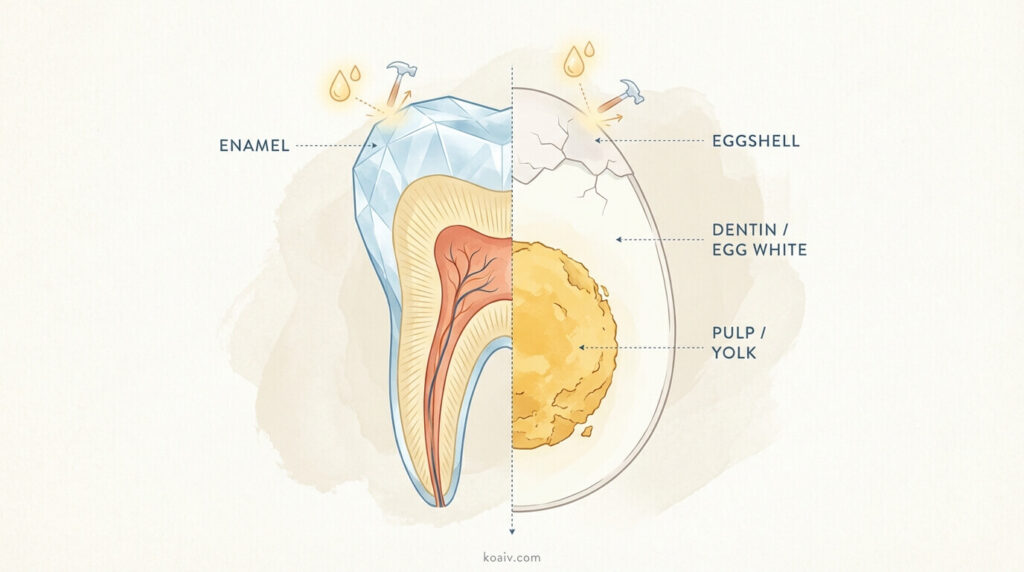
The outermost wall of that fortress is enamel, the hardest substance the human body produces—harder, in fact, than bone. Beneath the enamel sits a softer, yellowish layer called dentin, which provides structural support. And at the very center, protected by those outer layers, is the pulp—a delicate chamber filled with nerves and blood vessels that keeps the tooth alive and sensitive.
In an adult tooth, this fortress is formidable. But in a baby tooth, the walls are thinner in a very literal sense: baby tooth enamel is roughly half the thickness of adult enamel and substantially less mineralized. If an adult tooth is a brick wall, a baby tooth is drywall. It provides structure, but it cannot withstand sustained assault.
The assault, in the case of Baby Bottle Tooth Decay, comes from a bacterium called Streptococcus mutans. This microscopic organism lives naturally in the human mouth—it is part of the oral ecosystem—but it has one particularly destructive habit. When it encounters sugar, it feeds voraciously and produces lactic acid as a waste product. That acid is corrosive enough to dissolve enamel with remarkable efficiency, particularly when exposure is prolonged.
Under normal circumstances, the body has a built-in defense system: saliva. Saliva does three critical things. First, it physically rinses food debris and bacteria away from the teeth, much like a gentle stream washing over rocks. Second, it contains bicarbonate, a natural buffering agent that neutralizes acid and brings the mouth’s pH back toward neutral—think of it as the body’s own antacid. Third, and perhaps most remarkably, saliva carries dissolved calcium and phosphate ions that actually redeposit into areas of enamel that have been softened by acid, in a process called remineralization. In simple terms, saliva doesn’t just clean the mouth; it actively repairs early damage to the teeth throughout the day.
This is why the overnight hours are so dangerous. During sleep, saliva production drops dramatically—by up to 80 percent, according to research published in the Journal of Dental Research. The mouth becomes, in effect, a stagnant pond. When a baby falls asleep with a bottle of milk, formula, or juice, the liquid pools between teeth and along the gum line, and saliva is no longer present in sufficient volume to wash it away, neutralize the acid, or initiate repair. The bacteria feast uninterrupted, the acid accumulates, and the thin enamel of baby teeth begins to dissolve—slowly, silently, and without any outward sign that anything is wrong.
The pattern of destruction that results is so characteristic that pediatric dentists can often identify Baby Bottle Tooth Decay at a glance, even from across the room. It almost always strikes the upper front teeth first—these are the teeth most directly bathed by liquid flowing from a bottle’s nipple. The damage then tends to spread to the upper back teeth and, in more severe cases, the lower molars. Interestingly, the four lower front teeth are usually spared. The reason is anatomical: during bottle-feeding, a baby’s tongue naturally rests over the bottom front teeth, shielding them from prolonged liquid contact.
The “Healthy Sugar” Trap: Why Natural Doesn’t Mean Harmless
If the science of decay seems straightforward so far, here is where it takes a turn that catches many well-informed, health-conscious parents off guard.
Most parents understand intuitively that soda and candy are bad for teeth. That connection is practically part of the cultural furniture. What is far less widely understood—and far more relevant to infant dental health—is that the problem is not junk food sugar specifically. The problem is any fermentable carbohydrate, left in prolonged contact with tooth enamel.
The word “fermentable” is key here. It refers to any sugar or starch that oral bacteria can break down and convert into acid. And the list of fermentable carbohydrates includes substances that most parents consider not just harmless but actively beneficial: whole cow’s milk (which contains lactose, a naturally occurring sugar), infant formula (which contains a blend of lactose and other sugars), fruit juice (which contains fructose), and, perhaps most surprisingly to many families, breast milk.
This last point deserves careful framing, because it is often misunderstood or presented in a needlessly alarming way. Breastfeeding is, by overwhelming scientific consensus, one of the most beneficial things a parent can do for a child’s health—immunologically, nutritionally, and developmentally. The World Health Organization recommends exclusive breastfeeding for the first six months of life and continued breastfeeding alongside complementary foods up to age two and beyond. Nothing in the research on Baby Bottle Tooth Decay contradicts or undermines that guidance.
What the research does show, however, is nuanced. Breast milk contains lactose, and Streptococcus mutans metabolizes lactose into acid just as efficiently as it metabolizes any other sugar. A 2017 systematic review published in the International Journal of Paediatric Dentistry concluded that while breastfeeding during the first year of life is generally protective or neutral for oral health, frequent, unrestricted nighttime nursing beyond the eruption of the first teeth—particularly when the infant uses the breast as a pacifier, remaining latched for extended periods through the night—can contribute to an elevated risk of early decay.
The takeaway is not that breastfeeding is dangerous. It is that no liquid containing sugar, however natural or wholesome, should be left pooling against teeth during sleep without some form of oral hygiene intervention. The sugar’s origin—whether from a cow, a formula canister, a fruit, or a breast—is irrelevant to the bacteria. What matters is duration of exposure.
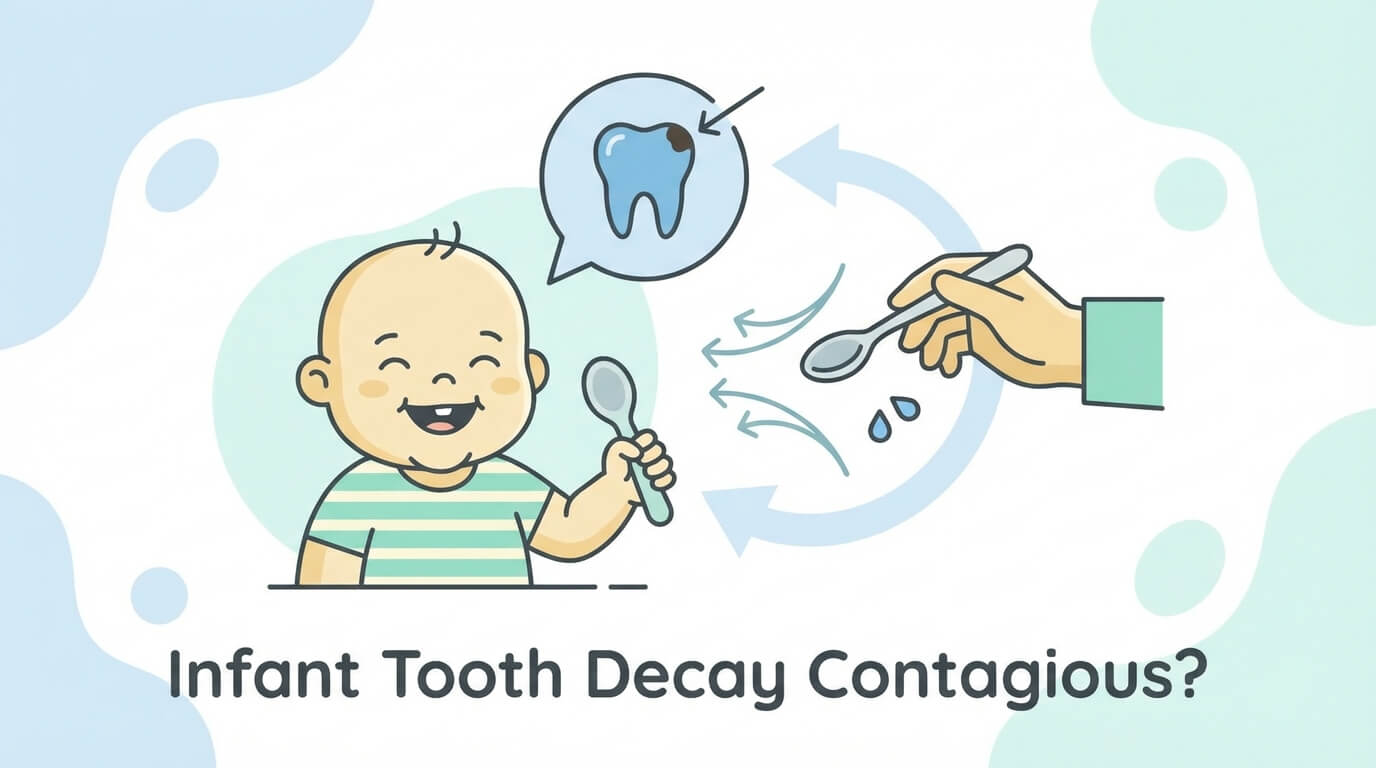
A Contagious Smile: How Cavity-Causing Bacteria Travel from Parent to Child
If the idea that breast milk can contribute to decay surprised some readers, the next concept may prove even more counterintuitive: cavities are, in part, an infectious disease.
To appreciate what this means, it helps to understand a fundamental fact about newborn biology. Babies are born with essentially sterile mouths. The oral cavity of a newborn contains no Streptococcus mutans—none at all. These decay-causing bacteria must be introduced from an external source. And decades of microbiological research have conclusively identified the primary source: the baby’s closest caregivers, most often the mother.
A landmark study by Dr. Page Caufield’s team at New York University used DNA fingerprinting to compare the strains of Streptococcus mutans found in children’s mouths with those found in their mothers’ mouths. The result was striking: in the vast majority of cases, the bacterial strains were genetically identical. The children had not independently acquired these bacteria from the environment. They had received them, directly, from their mothers.
The transmission routes are not exotic or unusual. They are the unremarkable, everyday moments of caregiving that most families never think twice about: tasting a spoonful of baby food on the same spoon before offering it to the child, blowing on hot food to cool it down (which sends aerosol droplets from the mouth toward the food), placing a dropped pacifier in one’s own mouth to “clean” it before returning it to the baby, or kissing the child directly on the lips.
None of these gestures are wrong in themselves—they are expressions of care, affection, and the universal parental instinct to protect. But they are, from a microbiological standpoint, delivery mechanisms. And the implications for prevention are profound.
If Streptococcus mutans must be transmitted from caregiver to child, then the caregiver’s own oral health becomes the child’s first line of defense. A parent with active, untreated cavities, inflamed gums, or a high bacterial load carries more bacteria and transmits them more readily. Conversely, a parent who has their own dental health under good control—through regular dental visits, good hygiene, and treatment of any existing decay—reduces the volume of bacteria available for transmission.
This reframing—treating parental dental health not as a separate adult concern but as a direct pediatric preventive strategy—represents one of the most important and still underutilized insights in modern family healthcare. In the same way that a parent might get a flu vaccine partly to protect a newborn too young to be vaccinated, maintaining good oral health is, in a very real sense, something a parent does for their baby.
Why Baby Teeth Matter Far More Than Most People Think
There is a sentence that pediatric dentists hear so frequently they could set their watches by it: “They’re just baby teeth. They’ll fall out anyway, right?”
The sentiment is understandable. It is also, unfortunately, one of the most consequential misconceptions in all of children’s healthcare—a single misunderstanding that, more than almost any other factor, enables Baby Bottle Tooth Decay to progress from a treatable early stage to a full-blown crisis.
Baby teeth are not placeholders. They are not disposable rehearsal teeth awaiting replacement by the “real” permanent set. They are active, load-bearing infrastructure that serves a constellation of functions throughout the first decade of a child’s life—functions whose importance is difficult to overstate.
They are architectural space maintainers. Think of baby teeth as reserved parking spots in the jaw. Each primary tooth holds a precise position for the permanent tooth developing in the bone beneath it. When a baby tooth is lost prematurely—extracted because of severe decay, or crumbling apart on its own—the neighboring teeth begin to drift into the empty space, much like cars in a parking lot gradually encroaching on an unoccupied spot.
When the permanent tooth finally attempts to erupt months or years later, its reserved space has been colonized. It comes in crooked, rotated, or impacted—unable to find room. The result, in many cases, is orthodontic treatment that can span years and cost thousands of dollars. The American Association of Orthodontists has estimated that as many as 70 percent of orthodontic alignment cases have a component related to premature loss of baby teeth.
They are speech architects. The front teeth, which are the teeth most commonly ravaged by Baby Bottle Tooth Decay, play a surprisingly precise role in the physics of human speech. Pronouncing the sound “F” requires the lower lip to press against the upper front teeth. The “TH” sound requires the tongue to touch or protrude past the upper front teeth. The “S” sound requires air to be channeled over the tongue toward the back of the front teeth with exacting precision.
When those teeth are missing, broken, or painful, children develop compensatory patterns—workarounds that allow them to approximate sounds without the correct anatomical contact points. These compensations can calcify into persistent articulation errors, sometimes manifesting as lisps or unclear speech that persists even after permanent teeth arrive, occasionally requiring speech therapy to correct.
They are nutritional gatekeepers. A toddler experiencing dental pain does what any rational being would do: avoids activities that cause pain. In practical terms, this means rejecting hard, crunchy, fibrous foods—raw carrots, apples, whole-grain bread—in favor of soft, processed, easy-to-chew alternatives. Over time, this avoidance reshapes dietary habits in ways that extend far beyond the mouth. The child consumes fewer fresh fruits and vegetables, less dietary fiber, more refined carbohydrates and processed sugars—a nutritional trajectory that, ironically, feeds the very bacteria causing the decay in the first place, creating a vicious cycle.
They are connected to whole-body health. The mouth is not an isolated compartment. It is the entry point to the digestive, respiratory, and circulatory systems. Untreated dental infections—abscesses at the root of a decayed tooth, for instance—can introduce bacteria into the bloodstream, a condition called bacteremia.
While serious systemic complications from dental infections in children are rare, they do occur and have resulted in hospitalizations and, in a small number of tragic and well-documented cases, fatalities. More commonly, chronic dental pain disrupts sleep, impairs concentration, reduces appetite, and depresses mood. Studies in the Journal of Public Health Dentistryhave shown that children with untreated dental decay are three times more likely to miss school than their cavity-free peers—and when they are in school, they are more likely to be distracted, withdrawn, and underperforming.
Reading the Warning Signs: How to Catch Decay Before It’s Too Late
One of the most insidious features of Baby Bottle Tooth Decay is that it begins silently. There is no fever, no rash, no behavioral change to signal that something is going wrong. By the time a child is crying in pain or a parent notices a dark spot on a tooth, the disease has often been progressing for months.
Understanding the stages of decay is essential, because the earliest stage—the one most parents miss—is also the only stage that is fully reversible.
The process begins with demineralization, which appears as faint, chalky white spots or a matte white band along the gum line of the upper front teeth. These spots represent areas where acid has begun leaching minerals out of the enamel surface, weakening it but not yet breaking through it. Think of it as a hairline crack in a windshield: the structural integrity is compromised, but the glass hasn’t shattered. At this stage, the damage can be completely reversed. Fluoride treatments, improved hygiene, and the elimination of prolonged sugar exposure allow saliva to redeposit minerals back into the weakened areas, effectively healing the enamel from within.
If the white spots go unnoticed—and they frequently do, because they are subtle, because infants resist having their mouths examined, and because most parents are not trained to look for them—the disease moves into its second phase. The white patches darken to light yellow or brown as the enamel surface begins to break down. The texture of the tooth may become noticeably rough or pitted. At this stage, the damage is irreversible; enamel, unlike bone, cannot regenerate once its surface has been breached. However, the decay can still be halted and managed conservatively, often without the need for traditional drilling.
Left unchecked, the condition progresses to active cavitation: distinct brown or black spots, visible holes in the tooth structure, and a child who flinches or cries when cold, hot, or sweet foods contact the affected teeth. At its most advanced stage, teeth may be broken down to stumps, gums may be visibly swollen or infected, and the child may refuse to eat, wake screaming at night, or develop a low-grade fever from chronic infection.
The gap between stage one and stage four can span months or even a year or more, depending on the child’s diet, hygiene, and individual susceptibility. That gap represents a window of opportunity—one that every parent can learn to exploit.
The tool for doing so is astonishingly simple. Pediatric dental organizations in the United States, Australia, Canada, and the United Kingdom have all promoted what they call the “Lift the Lip” routine: once a month, a parent gently lifts the child’s upper lip in good lighting—natural daylight or a bright bathroom light—and examines the front surfaces of the upper teeth and the area where the teeth meet the gum line. The entire check takes less than 30 seconds.
It requires no equipment, no training, and no medical background. What it does require is awareness that those faint white spots—easy to dismiss, easy to mistake for normal tooth coloring—are not cosmetic variations. They are an alarm bell, and one that, if heard early enough, can spare a child significant pain and a family significant expense.
Building the Defenses: A Practical Framework for Prevention
The good news—and it is very good news—is that preventing Baby Bottle Tooth Decay does not require heroic effort, expensive products, or radical changes to daily life. It requires understanding five interconnected principles and weaving them, gradually and sustainably, into a family’s existing routines.
Rethinking the Bedtime Bottle
The single highest-impact change a family can make is ensuring that no child goes to sleep with a bottle containing anything other than plain water. This does not mean depriving a child of comfort or nutrition; it means restructuring the sequence of events during the bedtime routine. The feeding happens before the sleep-preparation ritual, not as its conclusion. After the last feeding of the evening, a gentle wipe of the gums or a quick brush of any erupted teeth signals to both parent and child that feeding time is over, and the transition to sleep can begin.
For families where the bedtime bottle is already a deeply ingrained habit—and for many families, particularly those with difficult sleepers, it absolutely is—abrupt elimination is rarely practical and almost never sustainable.
A more effective approach, widely recommended by pediatric dentists, is the gradual dilution method. Over the course of two to three weeks, the parent incrementally increases the proportion of water to milk or formula in the bedtime bottle. A bottle that is three-quarters milk on Monday becomes half milk by the end of the week, one-quarter milk the following week, and pure water by the third week. Most children adjust with minimal protest, because the change is slow enough that no single night feels dramatically different from the last. By the end of the process, the bottle has become what it should have been all along: a source of hydration and soothing, without the sugar payload.
Starting Oral Hygiene Before the First Tooth
One of the most common misconceptions about infant oral care is that it begins when the first tooth appears. In reality, the window of optimal oral health opens at birth.
Before any teeth have erupted, parents can begin wiping the baby’s gums after every feeding with a clean, damp washcloth or a soft silicone finger cot—a small rubber sleeve that fits over the index finger, available at most pharmacies.
This practice removes the bacterial film that begins forming on the gums almost immediately after birth, and it serves a second, equally important purpose: it acclimates the baby to having the mouth touched and cleaned. Babies who experience regular, gentle oral care from their earliest weeks tend to accept toothbrushing with far less resistance when the time comes—a seemingly minor advantage that becomes enormously practical when a parent is trying to brush the teeth of a squirming, opinionated toddler.
When the first tooth erupts—typically between four and seven months, though the range is wide and there is no cause for concern if teeth appear earlier or later—brushing should begin immediately.
The recommended tool is a soft-bristled, infant-sized toothbrush, paired with a rice-grain-sized smear of fluoride toothpaste. Many parents hesitate at the mention of fluoride for an infant, worried about the child swallowing the toothpaste. Both the American Academy of Pediatrics and the American Dental Association have addressed this concern directly: at this minute quantity, fluoride toothpaste poses no health risk even if swallowed entirely, and it delivers meaningful cavity-prevention benefits from the moment it contacts the tooth surface. By age three, when a child has developed some ability to spit, the amount can be increased to a pea-sized dab.
Managing the Transition from Bottle to Cup
The shift from bottle to cup is more than a developmental milestone—it is a meaningful intervention in the architecture of dental risk. Most pediatric health organizations recommend beginning this transition around 12 months of age, with the bottle fully retired by 18 months.
Not all cups, however, are created equal from a dental perspective. Traditional sippy cups with hard spouts function hydrodynamically much like bottles: they direct liquid toward the front of the mouth, where it pools against the upper front teeth. A better choice, from the standpoint of tooth exposure, is an open cup or a straw cup. Open cups develop the motor skills needed for mature drinking, while straw cups direct liquid toward the back of the mouth, bypassing the front teeth almost entirely.
Equally important is what goes into the cup and when it is available. A sippy cup of water, accessible throughout the day between meals, is entirely appropriate. A sippy cup of juice or milk, carried around as a constant companion and sipped intermittently over several hours, is one of the most efficient delivery systems for sustained acid exposure that a parent could inadvertently provide.
Restructuring When and How Children Eat
There is a critical insight in pediatric dentistry that often surprises parents: when it comes to tooth decay, the frequency of sugar exposure matters at least as much as—and arguably more than—the quantity consumed.
The reason has to do with the timeline of the acid cycle. Every time sugar enters the mouth, oral bacteria produce acid for approximately 20 to 30 minutes before saliva buffers the pH back to a safe level. After that buffering period, saliva begins the slow work of redepositing minerals into any enamel that was softened during the acid attack—the remineralization process described earlier. This cycle of damage and repair is natural and, under normal conditions, keeps the teeth in equilibrium.
The math changes entirely, however, when a child consumes sugar not in discrete meals but in a continuous trickle. A toddler who drinks a small cup of apple juice in a few minutes at snack time triggers a single 20-minute acid cycle. A toddler who carries that same cup around for three hours, sipping every few minutes, triggers a nearly unbroken acid exposure spanning the entire morning. The same volume of sugar, consumed in a different temporal pattern, produces a dramatically different outcome for the teeth.
The practical application is to establish structured meal and snack times—typically three meals and two snacks for toddlers—with water as the only beverage between those eating windows. Each interval between eating sessions gives saliva the time it needs to neutralize acid, clear debris, and repair early enamel damage. Constant grazing, by contrast, keeps the mouth perpetually acidic and robs saliva of any opportunity to do its restorative work.
Cultivating a Healthier Oral Ecosystem
Traditional dental advice has long been framed in adversarial terms: fight the bacteria, kill the germs, wage war on plaque. This framing is not wrong, exactly, but it is increasingly incomplete. Modern microbiome science—the same field that has revolutionized thinking about gut health over the past decade—is beginning to reshape the way researchers and clinicians think about the mouth.
The human oral cavity is home to more than 700 species of bacteria, the vast majority of which are harmless or actively beneficial. These commensal organisms compete with Streptococcus mutans for space and resources on the tooth surface, and a diverse, well-balanced oral microbiome is naturally more resistant to domination by any single harmful species—much like a diverse grassland ecosystem is more resistant to invasion by a single aggressive weed.
What supports this microbial diversity in a child’s mouth? Many of the same practices that support overall health: a varied diet rich in whole foods and fiber, adequate hydration with plain water (which physically rinses the oral environment and maintains saliva flow), limited exposure to highly processed, high-sugar foods that selectively feed Streptococcus mutans, and—perhaps less obviously—prudent use of antibiotics. Broad-spectrum antibiotics, while sometimes medically necessary, can disrupt microbial communities throughout the body, including the mouth, potentially creating an opening for decay-causing bacteria to flourish in the aftermath.
This ecological perspective does not replace the fundamentals of brushing, fluoride, and dietary management. Rather, it adds a complementary layer—a recognition that the goal is not a sterile mouth (which is neither achievable nor desirable) but a balanced one.
The First Birthday Dental Visit: Why Early Matters
Among the most underappreciated recommendations in pediatric healthcare is the guideline, endorsed by the American Academy of Pediatric Dentistry, the American Academy of Pediatrics, and dental associations in virtually every developed nation, that a child should see a dentist by the first birthday, or within six months of the eruption of the first tooth—whichever comes first.
Many parents, hearing this for the first time, react with genuine surprise. A dentist? For a baby with three teeth? The idea can seem premature, even absurd. And so the appointment gets pushed to age two, then three, then four—often only arriving when a problem has already declared itself.
This delay is understandable, but costly. The first birthday dental visit is not the cleaning-and-drilling experience most adults associate with the dentist’s chair. For most infants, it consists of a brief, gentle examination conducted in what is called a “knee-to-knee” position: the parent sits facing the dentist, the child reclines in the parent’s lap with their head resting on the dentist’s knees, and the dentist examines the mouth using nothing more invasive than a small mirror and a gloved finger. The entire clinical examination typically takes less than five minutes.
The real value of the visit lies in what surrounds the exam. The dentist assesses the child’s individual risk factors for decay: feeding habits, oral hygiene practices, fluoride exposure, family dental history, and the condition of the caregiver’s teeth (reflecting the bacterial transmission risk discussed earlier). Based on this assessment, the family receives personalized, evidence-based guidance tailored to their specific situation—guidance far more precise and practical than anything a generic pamphlet or internet article can provide.
For children who are already showing early signs of demineralization—those faint white spots—the dentist can intervene immediately with fluoride varnish, a concentrated fluoride solution painted directly onto the teeth. The procedure takes seconds, causes no discomfort, and requires no cooperation from the child beyond being held still for a moment. A Cochrane systematic review—the gold standard of evidence-based medicine—found that fluoride varnish reduces the incidence of new cavities in high-risk young children by up to 43 percent.
For children in whom decay has already progressed beyond the white-spot stage, an increasingly transformative option is available: Silver Diamine Fluoride, commonly abbreviated as SDF. This liquid compound, approved by the U.S. Food and Drug Administration in 2014, combines the antimicrobial properties of silver with the remineralizing power of fluoride in a single application. A tiny drop, brushed onto an active cavity with a micro-applicator, kills the bacteria within the lesion and hardens the surrounding enamel—effectively arresting the decay in its tracks. No needle. No drill. No sedation. No tears. The entire treatment can be completed in under a minute, even on a two-year-old.
SDF does come with a cosmetic trade-off: the treated area of the tooth turns permanently black, which some families find aesthetically concerning, particularly on visible front teeth. In practice, however, most families—once they understand the alternative, which often involves general anesthesia for a toddler too young to sit still for traditional restorative work—consider the discoloration an acceptable and even welcome price. The lesion is arrested, the tooth is preserved, and the child’s next encounter with a dental professional is not a source of fear.
The Compound Interest of Small Habits
There is a concept in personal finance that captures something essential about Baby Bottle Tooth Decay: compound interest. Just as small, regular deposits into a savings account accumulate quietly into significant wealth over time, small, daily oral health habits compound into a lifetime of strong teeth. And just as small, recurring debts—left unaddressed—compound into an overwhelming financial burden, small, daily insults to a child’s teeth accumulate into irreversible damage.
A child’s oral health is not determined by a single catastrophic decision. It is shaped by thousands of small, daily choices—the bottle placed or not placed in the crib, the pacifier reflexively cleaned in a caregiver’s mouth or rinsed under the tap, the sippy cup of apple juice left within all-day reach or offered only at snack time, the first dental appointment scheduled at twelve months or postponed indefinitely.
This is simultaneously the sobering reality and the deeply hopeful truth of this condition. Because if decay is built one small habit at a time, it can also be prevented—and in its earliest stages, reversed—one small habit at a time.
Wiping a newborn’s gums at ten o’clock at night, after the fourth feeding and the second diaper change and the third lullaby, does not feel like a meaningful act. It feels like one more thing to do in an already relentless day. But that small ritual, practiced consistently, acclimates a baby to oral care, disrupts the early establishment of bacterial colonies, and initiates a pattern—however humble—that will serve as the foundation for a lifetime of dental health.
The first dental visit at twelve months may feel premature, even unnecessary. Pediatric dentists hear the refrain constantly: “Nothing is even wrong yet.” But that is precisely the point. The most effective medicine in dentistry is prevention, not repair. The goal is to build a relationship with a dental team before there is a crisis, to catch the faintest white-spot lesions before they become cavities, and to equip caregivers with personalized, evidence-based guidance that no article—however thorough—can fully replace.
Conclusion
A healthy mouth in childhood is not merely a dental achievement in isolation. It is the foundation for clear speech, confident nutrition, uninterrupted sleep, sustained focus in school, social confidence among peers, and a lifelong relationship with healthcare built on comfort rather than fear. It is, in the truest and most measurable sense, an investment in a child’s entire developmental trajectory—one that pays dividends long after those twenty baby teeth have given way to their thirty-two permanent successors.
The smile is small. The stakes are not.
Sources and further reading:
- Policy on Early Childhood Caries (ECC): Consequences and Preventive Strategies
- Global oral health status report: towards universal health coverage for oral health by 2030
- Initial acquisition of mutans streptococci by infants: evidence for a discrete window of infectivity
- Breastfeeding and the risk of dental caries: a systematic review and meta-analysis
- Fluoride varnishes for preventing dental caries in children and adolescents
- UCSF Protocol for Caries Arrest Using Silver Diamine Fluoride: Rationale, Indications, and Consent
- Maintaining and Improving the Oral Health of Young Children

October 25, 2026
October 25, 2026
October 25, 2026
October 25, 2026