

How-Much-Natural-Sugar-Does-Your-Baby-Actually-Need
How Much Natural Sugar Does Your Baby Actually Need?
To ensure optimal growth and brain development, parents should focus on how much natural sugar for babies is provided through breast milk, formula, and whole foods while strictly avoiding added sugars and fruit juices until age two to build a healthy, lifelong relationship with food. For guidance on responsive feeding as solids begin, see responsive spoon-feeding and introducing allergenic foods.
Somewhere between the third late-night feeding and the seventh unsolicited opinion from a well-meaning relative, nearly every new parent arrives at the same anxious question: Am I giving my baby too much sugar?
It is a reasonable fear. The modern conversation around sugar is saturated with alarm—headlines warning of childhood obesity epidemics, dental decay crises, and metabolic disorders that begin before a child can walk. Parenting forums overflow with guilt and confusion. A mother second-guesses offering a ripe banana. A father wonders if the lactose in breast milk is somehow doing harm. The word “sugar” has become so reflexively associated with danger that many caregivers have lost sight of a basic biological fact: sugar, in its natural form, is not the enemy of infant health. It is the engine of it.
This is not a soft concession or a nutritional loophole. It is biochemistry. The same molecule that makes candy harmful in excess is, in its natural context—locked inside the cellular structure of breast milk, fruit, and whole grains—the single most critical fuel source for the most energy-intensive organ a baby possesses: the developing brain.
The challenge, then, is not eliminating sugar from an infant’s diet. It is learning to distinguish the sugar that builds from the sugar that harms, understanding how much of the beneficial kind a baby actually requires, and navigating the first two years of feeding with clarity rather than dread.
What Does “Natural Sugar” Actually Mean?
Before any conversation about quantities and timelines can be productive, one foundational concept needs to be crystal clear, because the entire discussion rests upon it.
When nutrition scientists use the term natural sugar (also called intrinsic sugar), they are referring to sugars that exist as an inseparable part of a whole food’s cellular architecture. Think of it like this: the fructose in a strawberry does not simply sit on top of the fruit like frosting on a cake. It is woven into a complex matrix of water, fiber, vitamins, minerals, and antioxidants. When the body digests that strawberry, it must work through all of that surrounding material to access the sugar inside—a slow, regulated process that releases energy gradually and gently.
The most common natural sugars in an infant’s world include:
- Lactose — the sugar naturally present in breast milk and cow’s milk
- Fructose — the sugar naturally present in whole fruits and some vegetables
- Glucose — found in grains, starchy vegetables, and as a building block of more complex carbohydrates
Added sugar (sometimes called free sugar) is a fundamentally different proposition. It refers to any sugar that has been extracted from its natural source and introduced into a food during manufacturing, cooking, or preparation. Table sugar, corn syrup, honey, agave nectar, maple syrup, and fruit juice concentrates all fall into this category. Stripped of the fiber and co-nutrients that once surrounded them, these sugars flood the bloodstream rapidly, spike insulin, and deliver calories without any accompanying nutritional value. Imagine removing the bricks from a building and scattering them on the ground—they are the same material, but they no longer serve a structural purpose.
This distinction is not semantic. It is the single most important concept in infant nutrition, and every major health organization in the world—the American Academy of Pediatrics (AAP), the World Health Organization (WHO), the American Heart Association (AHA), and the U.S. Department of Agriculture (USDA)—draws the same bright line: added sugars have no place in the diet of a child under two years old. Natural sugars, present in whole foods, are not merely permitted. They are essential.
Why Babies Are Born Craving Sweetness: The Evolutionary Logic
Many parents observe, with a mixture of amusement and concern, that their baby will happily devour a pureed pear but clamp their mouth shut at the sight of pureed peas. This is not a character flaw. It is not early-onset pickiness. It is evolution—and understanding the biological reasoning behind it removes a great deal of unnecessary parental guilt.
The Breast Milk Blueprint
Human breast milk is, by any measure, the most finely calibrated food in existence. Every component has been shaped by hundreds of thousands of years of natural selection to optimize infant survival. And one of its most defining characteristics is its pronounced sweetness.
Lactose accounts for roughly 7% of breast milk by weight, making it the most abundant solid component after water. To put that in tangible terms, breast milk is actually sweeter than cow’s milk (which contains about 4.7% lactose). Nature, in its unsentimental practicality, ensured that the substance babies need most urgently tastes exactly like the flavor they are hardwired to prefer. A newborn who instinctively seeks sweet-tasting nourishment is a newborn who reliably seeks breast milk—and by extension, survival itself.
The Brain’s Extraordinary Appetite
A newborn’s brain represents approximately 12% of total body weight—six times the proportion in an adult. This small organ is growing at a pace it will never match again: forming roughly 1 million new neural connections every single second in the first year of life. That kind of construction demands an enormous amount of fuel.
The brain’s preferred fuel source is glucose, the simplest form of sugar. Unlike muscles, which can burn fat or protein in a pinch, the brain operates almost exclusively on glucose. In the first twelve months of life, an estimated 60% of all the energy a baby consumes goes directly to brain development—building the neural pathways that will eventually support language, movement, memory, emotion, and every cognitive function that defines human experience.
When understood in this light, a baby’s craving for natural sugar is not an inconvenient preference to be managed. It is the brain’s way of requisitioning the raw materials it needs to build itself.
Phase 1: Birth to 6 Months
The nutritional architecture of the first six months of life is remarkable in its simplicity. One food—breast milk, or when unavailable, iron-fortified infant formula—delivers everything a baby’s body requires: protein, fat, vitamins, minerals, immune factors, and yes, every gram of natural sugar the rapidly developing system demands.
Lactose: More Than Just Energy
Lactose is often introduced in nutrition articles as simply “the sugar in milk,” which, while accurate, dramatically undersells its biological importance. Lactose is a disaccharide, meaning it is composed of two simpler sugars—glucose and galactose—bonded together. (Think of it as two Lego bricks snapped into a pair; the body must separate them during digestion before it can use either one.) This two-step digestion process is inherently slower than absorbing a single, free-floating sugar molecule, which means lactose delivers a steadier, more sustained stream of energy rather than a sharp spike.
But energy delivery is only the beginning of what lactose does. Its contributions are remarkably multifaceted:
| Function | How It Works | Why It Matters for Babies |
|---|---|---|
| Energy provision | Breaks down into glucose (brain fuel) and galactose (brain-building material) | Powers the brain during peak growth |
| Calcium absorption | Creates an acidic environment in the gut that enhances calcium uptake | Supports rapid bone mineralization |
| Gut microbiome development | Selectively feeds beneficial bacteria like Lactobacillus bifidus | Builds the infant’s immune defenses from the inside out |
| Galactose supply | Galactose is used to build galactolipids, a critical component of the myelin sheath | Helps insulate nerve fibers, enabling faster neural communication |
That final row deserves particular attention, because it is rarely discussed in mainstream parenting resources. Galactose, one of the two sugars released when lactose is digested, is not merely burned for energy. It is a structural building block for myelin, the fatty coating that wraps around nerve fibers like insulation around an electrical wire. Without adequate myelin, neural signals travel slowly and inefficiently. In this sense, lactose is not just fueling the baby’s brain—it is literally helping to build the wiring.
How Much Natural Sugar in This Phase?
According to the Dietary Reference Intakes (DRIs) established by the National Academies of Sciences, the adequate intake of carbohydrates for infants aged 0–6 months is approximately 60 grams per day, derived entirely from the lactose in breast milk or formula. This represents roughly 37–44% of total caloric intake—the largest single macronutrient category.
For parents reading this and wondering whether they need to measure, track, or limit their baby’s natural milk sugar intake, the answer is reassuringly straightforward: no.Infants are remarkably sophisticated self-regulators. A breastfed baby who detaches from the breast has consumed precisely what the body requested. A formula-fed infant who turns away from the bottle has reached satiety. There is no scenario in which the lactose naturally present in human milk or standard infant formula is “too much.”
The only imperative in this phase is responsive feeding: offering the breast or bottle when hunger cues appear (rooting, sucking motions, hand-to-mouth gestures), and doing so frequently—typically 8 to 12 times per day for breastfed newborns, tapering gradually to 6–8 times by the fourth month as stomach capacity increases.
Phase 2: 6 to 12 Months
The six-month milestone is a turning point recognized by virtually every pediatric health authority on the planet. The WHO, the AAP, Health Canada, and the European Society for Paediatric Gastroenterology, Hepatology and Nutrition (ESPGHAN) all converge on the same recommendation: at approximately six months of age, when the baby shows signs of developmental readiness (sitting with support, showing interest in food, loss of the tongue-thrust reflex), it is time to begin introducing complementary solid foods alongside continued breastfeeding or formula.
This transition is significant for natural sugar intake because it introduces a new player to the nutritional stage: fructose, the sugar found in fruits and some vegetables. Navigating this phase wisely requires understanding not just what to offer, but how the form of that food changes everything about the way the body responds.
Why Whole Fruit and Fruit Juice Are Not the Same Thing
Imagine two identical cars pulling onto a highway. One enters the road gradually via a long, curving on-ramp, merging smoothly into traffic. The other is catapulted directly into the fast lane at full speed. Both cars arrive at the same destination—but the journey is radically different, and one is far more likely to cause a collision.
This analogy captures, with reasonable accuracy, the difference between how the body processes whole fruit versus fruit juice.
Whole fruit contains fructose embedded within a web of dietary fiber, water, and cellular material. When a baby eats mashed banana, the digestive system must methodically break through that fibrous structure to access the sugar—a gradual process that releases glucose into the bloodstream slowly and evenly. The result is sustained energy, stable blood sugar, and a natural sense of fullness.
Fruit juice, even 100% pure, no-sugar-added juice, has had its fiber entirely removed. The sugar that was once bound within the fruit’s cellular architecture is now free-floating in liquid form. It enters the bloodstream rapidly, produces a sharp insulin spike, and delivers a caloric payload with virtually none of the fiber, satiety signals, or nutritional complexity of the original fruit. A cup of apple juice contains roughly the same amount of sugar as a cup of cola—approximately 24 grams—with none of the fiber that would have accompanied those sugars in a whole apple.
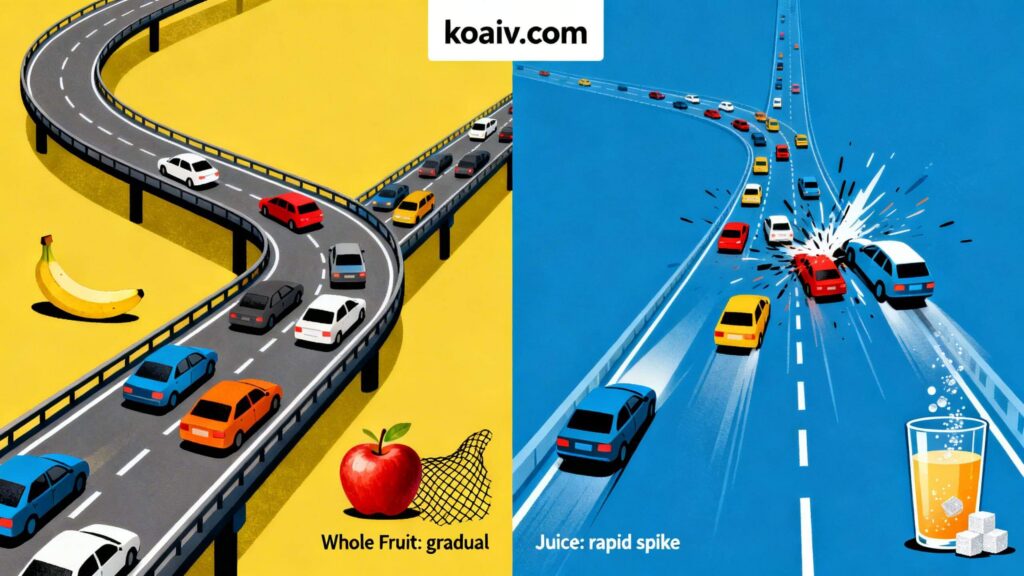
This is precisely why the AAP revised its guidelines to recommend that no fruit juice be given to infants under 12 months of age, and that intake be limited to a maximum of 4 ounces per day for children aged 1 to 3.
The Macronutrient Pairing Strategy
Here lies an insight that transforms everyday baby meals from adequate to genuinely strategic. One of the most effective ways to optimize a baby’s response to natural fruit sugar is a technique nutritionists call macronutrient pairing: combining fructose-containing fruit with a source of protein or healthy fat.
Why does this matter? Protein and fat are digested more slowly than carbohydrates. When eaten together with fruit, they act as a kind of metabolic brake—further slowing the absorption of fructose, smoothing out the blood sugar curve, and extending the window of sustained energy. For a baby, this means a longer stretch of stable mood and alertness between feedings—and for parents, it often means fewer inexplicable meltdowns.
Practical pairing ideas that work beautifully at this age:
| Fruit Component | Paired With | Why It Works |
|---|---|---|
| Mashed banana | Thin layer of peanut or almond butter | Healthy fat slows sugar absorption; adds vitamin E |
| Apple puree | Full-fat plain Greek yogurt | Protein + fat stabilize blood sugar; introduces tangy flavor |
| Pureed mango | Pureed or shredded chicken | Protein provides iron; vitamin C in mango enhances iron absorption |
| Smashed blueberries | Oatmeal porridge | Fiber in oats compounds the fiber in berries for very gradual energy release |
| Avocado + banana mash | (Self-contained pairing) | Avocado’s healthy fats naturally moderate banana’s fructose |
Quantity Guidelines for Natural Sugar from Fruit
While there is no universally mandated daily limit for natural fruit sugar in this age group—because the fiber in whole fruit makes genuine overconsumption quite difficult—a practical guideline is approximately 2 to 4 tablespoons of fruit per meal, offered as one component of a balanced plate that also includes vegetables, a protein source, and an iron-rich food.
The iron consideration is worth emphasizing. Around six months of age, the iron stores a baby accumulated in utero begin to deplete. Iron-rich foods (fortified infant cereals, pureed meats, lentils, and beans) become nutritionally urgent. A plate dominated by fruit at the expense of these foods could, over time, contribute to iron deficiency—one of the most common nutritional shortfalls in the second half of infancy. The practical solution is not to restrict fruit, but to ensure it shares the plate generously with other nutrient-dense foods.
Phase 3: 12 to 24 Months
The transition from infancy to toddlerhood is, metabolically speaking, like upgrading from a small engine to a larger one. A child who was recently stationary is now walking, climbing, exploring, and—most energy-intensive of all—continuing to build a brain at extraordinary speed. The fuel system must expand accordingly.
By the first birthday, carbohydrates should represent approximately 50 to 55% of total daily caloric intake, up from the 37–44% range typical of exclusive breastfeeding. For a toddler consuming roughly 1,000 calories per day (a common estimate for this age group), that translates to approximately 125 to 138 grams of carbohydrates daily—sourced from natural sugars, starches, and complex carbohydrates across all meals and snacks.
Beyond Fruit: Introducing Complex Carbohydrates
At this stage, the natural sugar conversation expands beyond simple sugars—lactose and fructose—into the broader world of complex carbohydrates. These are long chains of glucose molecules bonded together, found in foods like sweet potatoes, brown rice, oats, whole wheat bread, lentils, and peas. The body breaks these chains apart during digestion, ultimately releasing glucose—the same fundamental fuel the brain requires—but does so in a prolonged, time-release fashion that sustains energy for hours rather than minutes.
If simple sugars are like kindling that catches fire quickly and burns hot but brief, complex carbohydrates are the slow-burning hardwood logs that keep a fire going steadily all evening. A toddler’s diet should include generous amounts of both—quick-energy fruits and slow-release starches—to maintain the stable, continuous glucose supply that supports sustained attention, emotional regulation, and physical stamina.
Navigating the Dairy Aisle with Precision
At 12 months, whole cow’s milk becomes an appropriate addition to the diet, and its lactose continues to serve as an important natural sugar source. Plain whole-fat yogurt and mild cheeses are excellent choices that provide calcium, protein, and beneficial probiotics alongside their natural sugars.
However, the dairy aisle presents one of the most common nutritional traps of the toddler years—and it wears a very convincing disguise. Flavored yogurts marketed specifically to children, with their cheerful cartoon packaging and claims of containing “real fruit,” can harbor staggering quantities of added sugar. A single small container of a popular children’s yogurt can contain 20 to 25 grams of added sugar—more than the entire recommended daily maximum of 25 grams set by the AHA for children over two years old, and delivered to a child who should, by medical consensus, be consuming zero added sugar at all.
The label-reading habit cultivated during infancy becomes genuinely indispensable here. When selecting dairy products for a toddler, the operative strategy is simple: choose plain, full-fat, and unsweetened, then add natural sweetness at home with mashed banana, pureed berries, or a sprinkle of cinnamon.
Why Toddlers Need to Eat So Often
Parents of toddlers frequently express bewilderment at how often these small people seem to need food. The answer lies in a mismatch between demand and capacity. A toddler’s stomach is roughly the size of their clenched fist—capable of holding perhaps one to two cups of food at a time—yet their energy requirements, relative to body weight, are among the highest across the entire human lifespan.
The solution is not larger meals (which overwhelm small stomachs and lead to discomfort) but greater frequency: three small structured meals punctuated by two to three nutrient-dense snacks throughout the day. This cadence maintains a steady, uninterrupted supply of glucose to the brain, preventing the blood sugar valleys that manifest as irritability, poor concentration, and the explosive emotional outbursts that parents colloquially call “tantrums” but that are often, at their physiological root, metabolic events—a brain running low on its preferred fuel.
Why “Natural” Sweeteners Are Not Safe for Babies
Few areas of infant nutrition are more prone to well-intentioned misinformation than the category of so-called “natural sweeteners.” The growing consumer demand for clean labels and whole-food ingredients has produced a generation of products sweetened with honey, maple syrup, agave nectar, coconut sugar, date paste, and fruit juice concentrates—all marketed under the implicit assumption that “natural” means “harmless.”
For an adult choosing between refined table sugar and raw honey, the distinction may carry marginal nutritional relevance. For a baby under two years old, the distinction is functionally nonexistent—and in one critical case, genuinely dangerous.
The Botulism Risk: Non-Negotiable
Honey, in any form—raw, pasteurized, baked, or blended into a sauce—must not be given to an infant under 12 months of age. This restriction is not about sugar content. It is about Clostridium botulinum, a naturally occurring bacterium whose spores can survive in honey and, once inside the immature infant gut (which lacks the established bacterial colonies needed to suppress them), can germinate, produce a potent neurotoxin, and cause infant botulism—a rare but potentially fatal condition characterized by progressive muscle weakness, breathing difficulty, and paralysis.
An adult’s mature gut flora neutralizes these spores effortlessly. An infant’s does not. The age threshold of 12 months is not arbitrary; it reflects the point at which the gut microbiome has developed sufficient competitive diversity to prevent C. botulinum from gaining a foothold.
The Metabolic Reality of “Natural” Sweeteners
Beyond the specific botulism risk of honey, the broader category of natural sweeteners—maple syrup, agave, coconut sugar, date syrup—all share a common metabolic profile when consumed by an infant. Regardless of their marketing, origin story, or artisanal credentials, they are concentrated sources of free sugar that the body processes in essentially the same way as refined white sugar. They spike blood glucose, trigger insulin responses disproportionate to an infant’s metabolic capacity, displace nutrient-dense calories, and—perhaps most consequentially—begin shaping taste preferences toward intense sweetness at a time when the palate is maximally impressionable.
The U.S. Dietary Guidelines for Americans (2020–2025) are explicit: foods and beverages with added sugars should be avoided for children younger than age two, and this prohibition includes sweeteners that consumers may perceive as more wholesome.
The Flavor Window: A Once-in-a-Lifetime Opportunity
Among the most powerful concepts in developmental nutrition science is one that remains surprisingly underappreciated in mainstream parenting culture: the critical flavor window.
Spanning roughly from four months to eighteen months of age, this period represents a phase of extraordinary neurological plasticity in the taste and smell centers of the brain. During this window, the brain is uniquely—almost eagerly—receptive to new flavors, textures, and aromatic profiles. Exposures during this window do not merely introduce a baby to new foods; they fundamentally shape the neural architecture of flavor preference with a depth and durability that later interventions can only partially replicate.
The Strategic Insight Most Parents Miss
The natural parental instinct during the introduction of solids is to lean into what the baby already enjoys—and because babies are biologically primed to love sweetness, this often means heavy reliance on fruit purees, sweet potato, and banana. These are nutritious foods, and there is nothing wrong with offering them. But this approach, taken exclusively, misses the profound strategic opportunity that the flavor window presents.
Because babies already possess an innate preference for sweetness (a gift from the evolutionary logic discussed earlier), they do not need the flavor window to learn to love fruit. They will love it regardless. The far more valuable use of this fleeting neurological window is to systematically introduce the flavors that the brain is not pre-wired to accept: bitter, sour, savory, and umami.
Broccoli. Spinach. Plain lentils. Unseasoned fish. Liver pâté. Herbs. Mild spices.
Research published in Current Biology and the Journal of the American Dietetic Association consistently shows that infants who are repeatedly exposed to a wide variety of flavors—particularly vegetables and non-sweet foods—during the first eighteen months develop broader, more resilient food preferences that persist into childhood, adolescence, and even adulthood. Conversely, infants whose early diets are dominated by sweet-tasting foods develop a narrower palate and are significantly more likely to become “picky eaters” later.
The practical takeaway is both simple and powerful: introduce vegetables and savory foods first and frequently, use fruits as complements rather than centerpieces, and trust that sweetness does not need a head start—it has one already.
A Practical Skill for Every Parent
One of the most immediate, actionable skills any caregiver can develop—and one that pays dividends across years, not just months—is the ability to decode a food label with discrimination.
The modern grocery store is, from a baby nutrition standpoint, a landscape of mixed signals. Products featuring pastoral artwork, words like “organic,” “natural,” and “wholesome,” and images of smiling infants can, upon closer inspection, contain ingredients that directly contradict pediatric guidelines. The label is the only reliable arbiter.
The Two Lines That Matter Most
On the Nutrition Facts panel mandated on all packaged foods, two adjacent lines tell the entire story:
- Total Sugars: This figure captures all sugars present in the product—both naturally occurring and added. A jar of pureed peaches will show a nonzero number here because peaches naturally contain fructose. This is completely expected and completely fine.
- Added Sugars: This is the critical line. If it reads 0g, every gram of sugar in the product comes from the whole food itself. If it reads anything above zero, sugar has been introduced during processing—and for a child under two, that product should be reconsidered.
The Ingredients List: A Secondary Checkpoint
Because the “Added Sugars” line on Nutrition Facts labels was only mandated in the United States beginning in 2020, some smaller brands or imported products may not display it prominently. In these cases, the ingredients list becomes the essential detective tool. Sugar hides under a remarkable number of aliases:
| Common Aliases for Added Sugar | Where They’re Often Found |
|---|---|
| Cane sugar, cane juice, evaporated cane juice | Baby cereals, teething biscuits |
| Corn syrup, high-fructose corn syrup | Jarred baby foods, flavored drinks |
| Brown rice syrup | “Natural” baby snacks, puffs |
| Fruit juice concentrate | Pouches, puree blends, “no added sugar” products |
| Honey, agave, maple syrup | Toddler snacks, granola bars |
| Dextrose, maltose, sucrose | Processed toddler meals |
The term “fruit juice concentrate” deserves special attention. It appears on an enormous number of products marketed directly to babies—often with a front-of-package claim of “no added sugar” or “sweetened only with fruit.” This wording is technically legal but functionally misleading. Fruit juice concentrate is fruit that has been reduced to its sugar content with the water and fiber removed. The body processes it identically to any other added sugar. Its presence in an ingredients list is a reliable signal to put the product back on the shelf.
Common Questions Parents Ask
“Can a baby eat too much whole fruit?”
In the context of whole, intact fruit—mashed, pureed, or offered as soft pieces—genuine overconsumption is difficult to achieve. The water and fiber content of whole fruit creates natural satiety signals well before harmful quantities are reached. Most infants will simply stop eating when satisfied.
The more meaningful concern is one of displacement rather than excess. A baby who fills up entirely on fruit at every meal may be leaving insufficient room on the plate (and in the stomach) for iron-rich foods, healthy fats, and proteins that are equally critical during this developmental period. The goal is not to restrict fruit, but to position it as one member of an ensemble cast—not the soloist.
“What about baby teething biscuits and puffs?”
Many commercial teething biscuits and baby puffs—products that line entire supermarket aisles and are nearly ubiquitous in diaper bags—dissolve on contact with saliva into a starchy paste that behaves metabolically like simple sugar inside the mouth. This creates a thin film of fermentable carbohydrate across the surfaces of emerging teeth, providing fuel for the cavity-causing bacteria Streptococcus mutans. Furthermore, a careful reading of the ingredients list often reveals items like “organic brown rice syrup” or “organic cane sugar”—added sugars wearing wholesome-sounding costumes.
When whole-food alternatives are available—a chilled cucumber spear, a wedge of cold watermelon, a strip of ripe pear, a frozen banana—they are almost always the more nutritious, more tooth-friendly, and more economical choice.
“Is the natural sugar in baby food pouches okay?”
Squeezable puree pouches have become one of the most popular convenience foods for infants and toddlers, and many of them do contain only whole fruit and vegetable purees with no added sugar. In these cases, the natural sugars present are intrinsic and nutritionally appropriate.
However, two systemic concerns arise with over-reliance on pouches. First, many pouches list fruit puree (typically apple or pear) as the primary ingredient, even when the front of the package features a vegetable like kale or spinach. The actual vegetable content may be minimal, meaning the child is consuming mostly fruit sugar under the impression of eating vegetables. Second, continuous sucking on a pouch bathes the teeth in natural sugar for an extended period—a pattern that, over time, can contribute to dental decay even in the absence of added sugars. The healthier practice is to squeeze pouch contents onto a spoon rather than allowing sustained oral contact with the pouch nozzle.
Putting It All Together
| Age Range | Primary Natural Sugar Sources | Approximate Daily Carb Need | Key Guidelines |
|---|---|---|---|
| 0–6 months | Lactose (breast milk / formula) | ~60 g/day (37–44% of calories) | Feed responsively, 8–12 times/day; no supplemental foods needed |
| 6–12 months | Lactose + fructose (whole fruits) + starch (intro to solids) | Gradually increasing toward ~95 g/day | Whole fruit only (no juice); pair fruit with fat/protein; prioritize iron-rich foods |
| 12–24 months | Lactose + fructose + complex carbohydrates (grains, starches, legumes) | ~125–138 g/day (50–55% of calories) | 3 meals + 2–3 snacks daily; choose plain dairy; read all labels; zero added sugar |
Building a Lifetime Relationship with Food
There is a temptation, in the intensity of the first two years, to view infant nutrition as a purely technical problem—a matter of grams, percentages, and developmental milestones to be tracked and optimized. And to some extent, the technical details do matter; they form the scaffolding of informed decision-making.
But beneath the numbers lies something more expansive. The way a baby experiences food in the first two years—the flavors offered, the textures explored, the calm or anxiety that surrounds mealtimes, the diversity or monotony of the plate—shapes not just nutritional outcomes but the child’s entire emotional and psychological relationship with eating. A baby who learns to enjoy the natural sweetness of a ripe peach alongside the earthiness of lentils and the bitterness of broccoli is not just meeting macronutrient targets. That child is building a flexible, curious, and resilient palate that will navigate school cafeterias, social meals, and independent food choices with confidence for decades to come.
Sugar, in this larger context, is not a villain to be vanquished or a vice to be managed. It is a biological reality to be understood—a molecule that, in its natural form, is as essential to infant development as oxygen or sleep. The parent who understands where natural sugar belongs and where added sugar does not is not merely avoiding harm. That parent is actively constructing the metabolic, neurological, and gustatory foundation upon which an entire life of healthy eating will be built.
The sweet truth, it turns out, really is quite sweet.
References & Further Reading

October 25, 2026

October 25, 2026

October 25, 2026