
Responsive-Spoon-Feeding-The-Modern-Parent’s-Guide-to-Starting-Solids
Responsive Spoon-Feeding: The Modern Parent’s Guide to Starting Solids
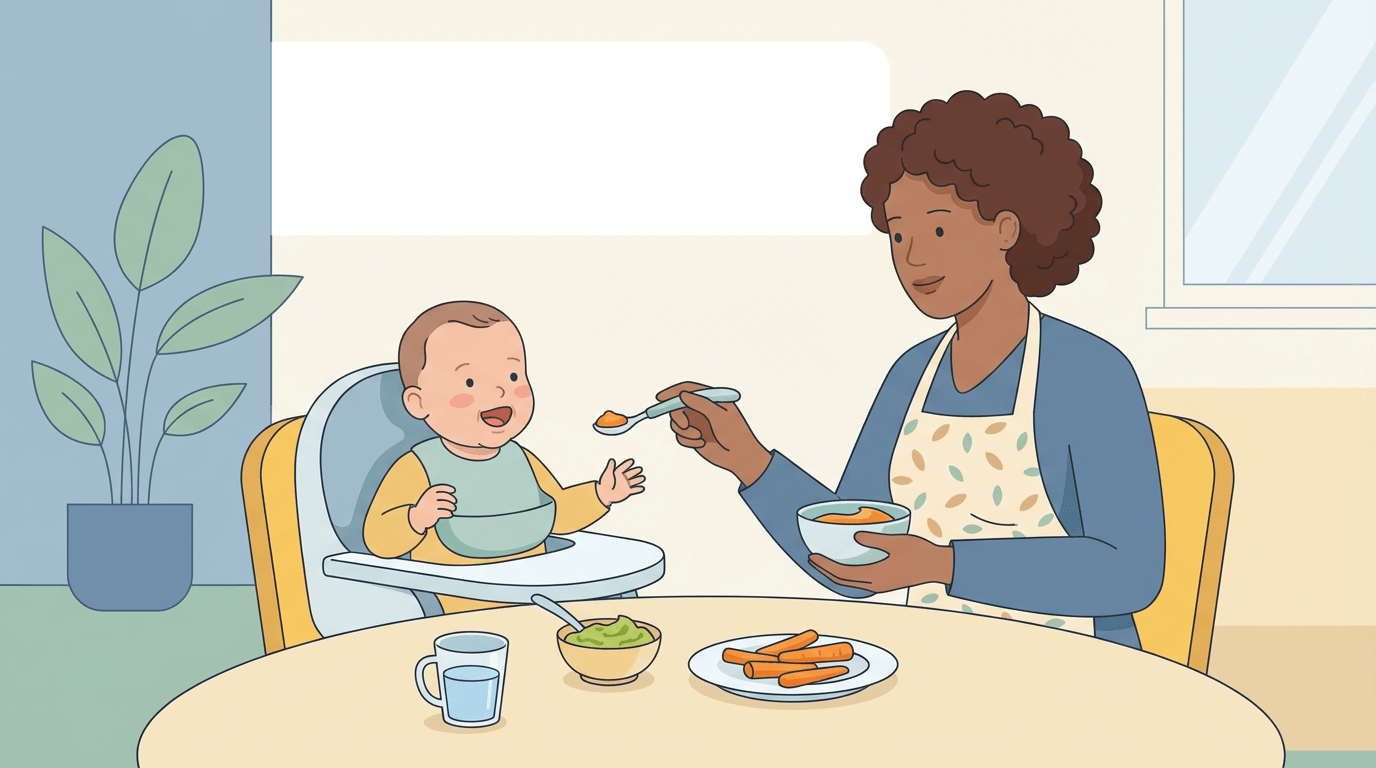
In a parenting culture saturated with acronyms, trending philosophies, and Instagram-worthy feeding aesthetics, it has become almost fashionable to dismiss the humble spoon. Baby-Led Weaning (BLW) — a method in which babies skip purees entirely and feed themselves soft finger foods from the very start — dominates feeding forums, mommy blogs, and pediatric influencer content with the kind of evangelical fervor usually reserved for tech product launches. Meanwhile, millions of parents quietly continue doing what generations of families have done before them: reaching for a soft-tipped spoon, a jar of sweet potato puree, and the gentle ritual of feeding their baby one tiny mouthful at a time.
Here is the truth that the algorithm rarely surfaces: traditional spoon-feeding, when practiced responsively and progressively, is not outdated. It is not inferior. It is, for a great many families, the safest, most practical, and most connecting feeding journey available.
This guide is for those families. It is also for the undecided parent sitting in the middle — weighing options, wondering whether the “old way” still holds up against modern science. The answer, as this article will demonstrate, is an unequivocal yes. With one important evolution: the shift from mechanical, volume-focused feeding to what feeding specialists now call Responsive Spoon-Feeding.
Think of the difference this way: the old model of spoon-feeding was like filling up a car’s petrol tank — you kept going until the tank was full, regardless of whether the car wanted more. Responsive spoon-feeding is more like a conversation — you offer, the baby responds, and together you find the natural stopping point. Same spoon. Completely different relationship.
If you are brand new to this topic, reading start to finish will serve you well. If you are searching for a specific answer, the section headers will guide you directly there.
What Traditional Weaning Actually Means (And Why It Still Works)
Let’s Start With the Word “Weaning” — It Means Something Different Than You Might Think
Many parents hear the word “weaning” and assume it means stopping breastfeeding. In everyday conversation, that is a common usage — “we’re weaning off the breast” — but in the clinical and scientific world of infant nutrition, it means something quite different.
In the context of this guide, “weaning” means the process of introducing solid foods alongside breast milk or formula. The World Health Organization (WHO) and the American Academy of Pediatrics (AAP) prefer the term complementary feeding, which is more precise: solid foods complement — that is, add to and support — the milk nutrition a baby is already receiving. They do not replace it, at least not in the first year.
Understanding this distinction matters because it reframes the entire endeavor. You are not withdrawing something from your baby. You are adding something new, gradually, while keeping the nutritional foundation of milk firmly in place.
The Logic of Traditional Weaning
Traditional weaning follows a graduated progression that moves in lockstep with a baby’s physical development:
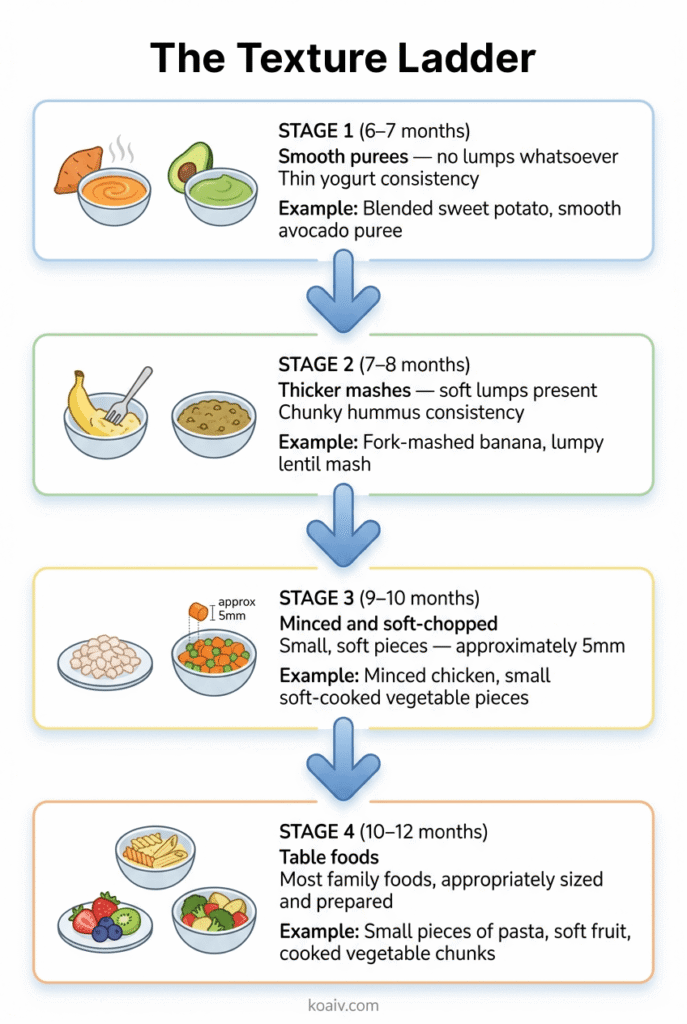
- Smooth, single-ingredient purees come first — think blended sweet potato the consistency of thin yogurt.
- Thicker mashes follow — like fork-mashed banana with soft lumps.
- Minced and soft-chopped foods come next — small pieces of cooked vegetable, finely shredded chicken.
- Full table foods arrive last, around the first birthday.
This is a scaffolded approach — a term borrowed from education that means building complexity in deliberate, manageable steps. A scaffold on a building allows construction to happen at height that would otherwise be impossible; in infant feeding, the scaffold of progressive textures allows the baby’s oral motor system (the muscles and coordination of the mouth, tongue, and jaw) to develop in a safe, supported sequence.
Think of it like learning to swim. You do not drop a non-swimmer into the deep end and hope for the best. You start in shallow water, build confidence and skill, and progress gradually toward deeper challenges. Purees are the shallow end of the pool.
What Needs Updating — And What Doesn’t
Parents gravitate toward traditional spoon-feeding for reasons that are entirely rational:
- Volume tracking is more straightforward. Knowing that a baby has consumed four tablespoons of iron-rich lentil puree provides concrete reassurance that nutritional needs are being addressed — something harder to gauge when a baby is flinging finger food from a high chair tray.
- Perceived safety is higher. For caregivers understandably anxious about choking, purees offer a texture that reduces that risk considerably.
- Practicality wins in households where time, cultural tradition, or the absence of dedicated floor-cleaning resources makes baby-led approaches less appealing.
None of these reasons are lesser than the philosophical tenets of baby-led weaning. They are simply different — and difference, in infant feeding, is not a deficiency.
What does require updating, however, is the execution. The old model — spooning food into a passive baby’s mouth on a fixed schedule, regardless of whether the baby showed signs of hunger or fullness — has been rightfully challenged. In its place, feeding scientists and pediatric dietitians advocate for a dynamic, baby-responsive approach that preserves the structure of spoon-feeding while honoring the infant’s innate ability to regulate how much they eat.
This evolved approach is what we mean by Responsive Spoon-Feeding, and it is the thread running through every section of this guide.
Knowing When to Begin — Developmental Signs Over Calendar Dates
The Single Most Important Decision in the Weaning Journey
Of all the choices a caregiver makes about starting solids — what food to try first, which bowl to use, how much to offer — the timing question carries the most weight. Start too early, and you risk real harm. Start at the right time, and the whole process becomes significantly easier and safer.
The AAP currently recommends introducing solid foods around 6 months of age, while acknowledging a window of 4 to 6 months for certain infants — a nuance that is frequently lost in translation and has caused considerable confusion among parents.
Here is the clearest way to understand this guidance: the calendar is a rough map, not the destination. Six months is an approximation of when most babies become developmentally ready — but babies are not all on the same schedule, and calendar age alone is an unreliable guide. Developmental readiness is the real compass.
A Note on Corrected Age for Premature Babies: If your baby was born prematurely, discuss timing with your pediatrician. Developmental milestones should generally be assessed against corrected age (the age your baby would be if born at term), not chronological age. A baby born two months early may not be developmentally ready for solids until closer to 8 months of calendar age.
The Physical Readiness Checklist
Think of these physical milestones as the “green lights” that tell you a baby’s body is ready for the new challenge of eating solid food. All three should ideally be present before you begin.
Green Light #1: Steady Head Control
The baby can hold their head upright without support.
Why it matters: Swallowing is a surprisingly complex chain of muscular events involving the mouth, throat, and esophagus. If the head is wobbling, the airway cannot be properly protected during swallowing — which dramatically increases the risk that food will go down the wrong way (into the airway rather than the esophagus). A baby with strong, consistent head control has the neuromuscular development needed to keep the airway safe.
The test: Hold your baby in a supported seated position. If their head lolls forward or to the side, they are not ready. If it stays upright and stable, that is a positive sign.
Green Light #2: Supported Sitting
The baby can sit with minimal external support, maintaining an upright posture.
Why it matters: Feeding in a slumped or reclined position significantly increases the risk of aspiration — the medical term for food or liquid entering the airway rather than the stomach. Think about how much harder it is to swallow when you are lying flat compared to sitting upright. Gravity is your ally during swallowing, but only when the body is properly positioned.
The test: Place your baby in a high chair or on your lap with light support. If they can maintain a broadly upright posture, even with some wobble, they meet this criterion.
Green Light #3: Loss of the Tongue-Thrust Reflex
The tongue-thrust reflex is a fascinating piece of infant biology. Newborns are hardwired to push their tongue forward and out of the mouth when something touches it. This is a protective mechanism designed to prevent non-milk substances from entering the airway before the baby is ready to handle them. It is, quite literally, the body’s “no soliciting” sign for solid food.
As babies approach 6 months, this reflex naturally diminishes, allowing them to move food backward toward the throat and initiate the swallowing process.
The test: Try offering a tiny bit of puree on a spoon. If the baby consistently pushes it straight back out with their tongue before even attempting to swallow, the reflex is likely still active. Wait one to two weeks and try again.
Important Clarification: Many parents confuse the tongue-thrust reflex with simply not liking the taste of a food. The difference is in the nature of the movement: a reflexive tongue thrust happens almost immediately upon contact with the spoon, before the baby has had any time to process the taste. If the baby tastes the food, makes a face, and then pushes it away — that is preference, not reflex, and is entirely normal.
The Behavioral Readiness Checklist
Physical capability alone is insufficient. The baby should also demonstrate behavioral signs that they are interested in and curious about food. These signs cannot be forced or manufactured — they emerge naturally when a baby is genuinely ready.
Visible curiosity about food: Does your baby watch intently when you eat? Do they reach toward your plate or track the movement of a spoon with focused attention? This curiosity is a neurological sign that the brain’s interest in new sensory experiences is switching on.
Responsive mouth-opening: When a spoon is brought close, does the baby open their mouth in anticipation? This is a profoundly important behavioral signal — it demonstrates that the baby is actively inviting the feeding interaction, not simply having something done to them.
The Gear — Simplicity Wins
The feeding industry has an uncanny ability to transform a simple human act into a complex procurement exercise. Browse any baby store and you will encounter ergonomically engineered spoons, motorized puree makers, purpose-built freezer trays, and high chairs with more adjustable components than a professional office chair.
The reality is this: successful spoon-feeding requires remarkably little equipment. What it does require, it requires specifically. Here is what actually matters, and why.
The Essential Equipment Guide
| Item | What to Look For | Why It Matters |
|---|---|---|
| High Chair | Footrest, adjustable tray, upright seat angle (90° hip position), easy-to-clean surfaces | A footrest provides postural stability; grounded feet support oral motor coordination; upright angle protects the airway |
| Spoon | Soft-tip silicone, shallow bowl depth, long handle for caregiver control | Gentle on emerging gums and sensitive palates; shallow spoons prevent over-loading and reduce gag risk |
| Bib | Silicone catch-all (pocket bib) for early stages; full-coverage smock bib for messier mash phase | Catch-all bibs collect falling food; smocks protect clothing when babies begin self-feeding with pre-loaded spoons |
| Bowl | Suction base, wide rim, bright contrasting color | Suction prevents the bowl becoming a projectile; wide rim allows easy one-handed scooping; bright colors support visual tracking |
| Blender or Food Processor | Adequate power for smooth blending; easy to clean | Smooth, lump-free purees are critical at Stage 1; blenders that are difficult to clean get used less |
The How-To — A Practical Guide to Responsive Feeding
This section is the heart of the modern approach. Responsive Spoon-Feeding is not a technique so much as a philosophy translated into micro-behaviors — a series of small, attentive choices that collectively communicate to the baby: you are in control of your body, and I am listening.
Understanding Responsive Feeding: The Underlying Philosophy
To understand why each element of the feeding sequence matters, it helps to understand the philosophy beneath it.
Babies are born with a sophisticated, finely tuned ability to regulate their own food intake. They feel hunger, and they signal it. They feel fullness, and they signal that too. Unlike adults, whose hunger and fullness signals have often been confused or overridden by years of social eating, dieting, and emotional relationships with food, babies operate on pure biological instinct.
Responsive feeding is, in essence, a commitment to protecting that instinct. Every choice in the feeding sequence — from how you position your chair to how you hold the spoon — is designed to keep the baby in the driver’s seat of their own appetite.
Research consistently shows that feeding practices which override a baby’s satiety cues (such as using distraction to sneak in extra bites, or pressuring a baby to finish a portion) are associated with disrupted appetite regulation in later childhood. In plain language: babies who are trained to ignore their “I’m full” signal are more likely to struggle with overeating as they grow. Responsive feeding is, from this perspective, one of the most meaningful long-term health investments a caregiver can make.
Step 1: Creating the Right Environment
Feeding is communication — a back-and-forth exchange between caregiver and baby that requires both parties to be tuned in to each other. Anything that disrupts that attentional connection makes responsive feeding harder.
Screens: Turn them off, or at minimum, turn them away from the baby. Research in infant attention and learning consistently shows that background television disrupts the quality of caregiver-child interaction, even when the screen is not the focus of attention. A baby who is watching coloured movement on a screen cannot simultaneously be attending to their own hunger signals.
Positioning the caregiver: Sit at eye level with your baby. This is not a small nicety — it is functionally important. A caregiver looming above a baby creates a social dynamic in which the adult is dominant and the baby is passive. Eye-level positioning creates a face-to-face, equal interaction that invites the baby to participate actively rather than simply receive.
Noise level: Moderate noise is fine, but chaotic environments — loud music, shouting siblings, a busy kitchen at rush hour — can overwhelm a baby’s sensory processing and make it harder for them to attend to the internal signals of hunger and fullness. Calm does not have to mean silent; it means manageable.
Step 2: The Responsive Feeding Sequence
Think of this sequence as a slow, respectful dance. The caregiver leads gently; the baby follows when ready.
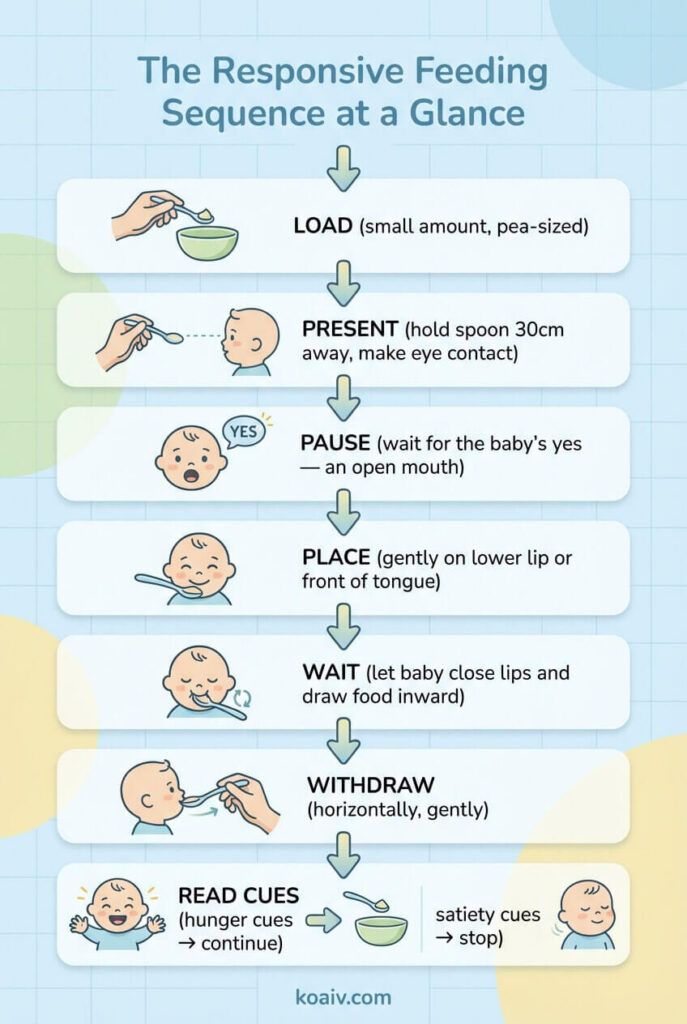
1. Load a small amount onto the spoon.
For the first weeks of feeding, “small amount” means literally pea-sized — approximately half a teaspoon. The instinct to load a fuller spoon is understandable but counterproductive at this stage. A heavily loaded spoon overwhelms the baby’s still-developing ability to manage food in their mouth, increases gag risk, and can create a negative association with the spoon before the baby has had the chance to develop confidence.
2. Hold the spoon approximately 30 cm (12 inches) from the baby’s face and pause.
This pause is the invitation. It gives the baby the visual information — here comes something — and the time to process and respond. Moving the spoon directly to the baby’s mouth without this pause removes the baby’s opportunity to consent to the bite.
An analogy: Imagine a friend offered you a piece of food by pushing it toward your mouth without warning. Even if it was delicious, the experience would feel intrusive. Now imagine they held it out, made eye contact, and waited for you to lean in. Same food, entirely different dynamic.
3. Wait for the baby to open their mouth.
This is the most important — and most frequently skipped — step in responsive feeding. The open mouth is the baby’s “yes.” It is an active signal of readiness, and waiting for it keeps the baby as the decision-maker in the interaction.
If the baby does not open their mouth after a comfortable pause (five to ten seconds), lower the spoon and wait. Try again shortly, or accept that this meal may be ending. Resist the strong parental urge to nudge the lips, make airplane sounds, or otherwise persuade — these strategies are well-intentioned but ultimately teach the baby that their “not yet” signal will be ignored.
4. Place the food gently on the lower lip or tongue.
Once the baby opens, bring the spoon to the lower lip or front of the tongue — not deep into the mouth, and not scraped against the upper gum or roof of the mouth.
Why does this matter? Scraping food off the spoon against the upper palate is a common habit that inadvertently removes the baby’s role in the swallowing process. The natural and developmentally correct movement is for the baby to use their upper lip to close over the spoon and draw the food inward. When the caregiver scrapes, that active closure never happens — the baby becomes a passive recipient rather than an active eater. Over time, this can reduce the development of the lip and tongue coordination needed for self-feeding.
5. Let the baby close their lips and pull the food inward.
Wait. Let the baby do the work. This momentary pause after placing the food gives the baby the time to close their upper lip over the spoon, feel the food, and initiate the swallowing sequence at their own pace.
Then gently withdraw the spoon horizontally — straight out, not scraped upward or downward. The bowl of the spoon should be clean when you withdraw it; if food is left on the top of the spoon, the entry angle was too shallow. If the spoon feels resistance, the baby may not yet have taken the food — do not force it.
Reading the “Stop” Signs — Satiety Cues
The ability to self-regulate food intake is one of the most precious capacities a caregiver can protect in an infant. Research consistently shows that feeding practices that override satiety cues are associated with higher rates of overeating and obesity in later childhood (Farrow & Blissett, 2006).
When a baby is done, the body communicates clearly. Learn to recognise these signals:
| Cue | What It Looks Like | What It Means |
|---|---|---|
| Head turning | Baby turns head away from the approaching spoon, to one or both sides | “I need a break or I’m done” |
| Lips pressed shut | Baby keeps mouth closed despite the spoon being presented | “Not taking this bite” |
| Hands pushing away | Baby pushes the spoon, bowl, or caregiver’s hand away | “I’m actively declining” |
| Gaze wandering | Baby looks away, loses interest in the interaction | “My attention — and appetite — is elsewhere” |
| Arching backward | Baby leans or pushes backward in the chair | “I want out of this situation” |
| Increased distress | Fussiness, crying, facial distress during feeding | “This is overwhelming or I’m done” |
These are not negotiating tactics. They are physiological signals as real and as honest as any adult’s feeling of fullness after a meal. Honoring them — ending the meal gracefully rather than attempting “one more bite” — builds a lifetime of healthy hunger awareness.
A useful reframe: Instead of thinking about how much food your baby consumed in a single sitting, think about average intake across the week. Appetite in babies is genuinely variable — influenced by teething, growth spurts, illness, mood, and developmental changes. A baby who eats enthusiastically on Monday and barely opens their mouth on Wednesday is almost always exhibiting perfectly normal appetite variation, not a feeding problem requiring intervention.
The Pre-Loaded Spoon: Bridging to Self-Feeding
One of the most elegant innovations in modern spoon-feeding practice is the pre-loaded spoon technique, and it is worth explaining in some detail because its developmental benefits are significant.
The concept is simple: rather than delivering every bite directly into the baby’s mouth, the caregiver loads the spoon and then either hands it to the baby or places it within their reach, allowing the infant to bring the spoon to their own mouth.
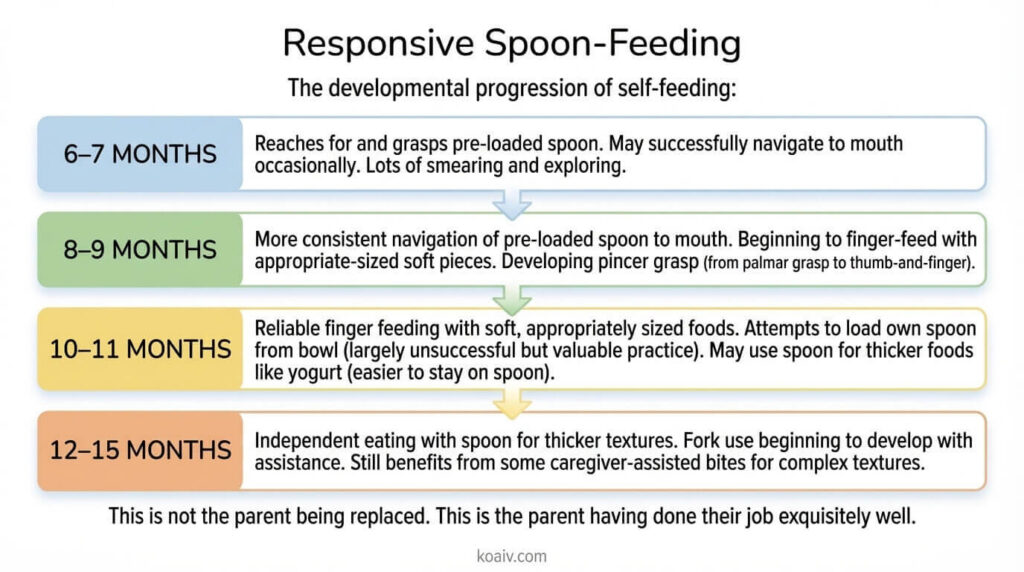
Babies as young as 6 to 7 months often have sufficient hand control to grasp a loaded spoon and navigate it (approximately) toward their mouth, even if the landing is imprecise. The smearing, the fumbling, and the occasional upside-down delivery are not failures — they are the practice through which hand-eye coordination develops.
Why this matters beyond the immediate moment:
- It introduces the concept of utensil use months earlier than conventional caregiver-only spoon-feeding
- It reinforces the baby’s sense of agency at the table — a psychological experience of “I can participate in feeding myself” that research links to more positive food relationships
- It bridges the gap between caregiver-led feeding and self-directed eating, making the eventual transition to finger foods and independent eating smoother
A practical tip: have two spoons available at each feeding. You keep one for loading and directing bites; the baby keeps one to grasp, explore, and practice with. This way, the baby’s developmental urge to grab the spoon does not constantly interrupt the feeding flow.
The Menu — What to Feed and How Texture Evolves
First Tastes (Around 6 Months)
The inaugural purees should be single-ingredient and completely smooth — a consistency that slides easily off the spoon without any lumps, strings, or fibrous pieces. Think of the texture as somewhere between thin yogurt and apple sauce.
The single-ingredient rule is important: it allows you to identify the source if an allergic reaction occurs. If you introduce a mixed puree containing five ingredients and your baby develops hives, you have no way of knowing which ingredient caused the response. Single-ingredient purees give you that diagnostic clarity.
Reliable, nutritious first food choices include:
| Food | Nutritional Highlight | Preparation Note |
|---|---|---|
| Sweet potato | Beta-carotene, vitamin A, gentle fiber | Steam or roast, then blend with breast milk or water to thin |
| Avocado | Monounsaturated fats for brain development | Blend or fork-mash to smooth; no cooking required |
| Banana | Natural sweetness, potassium, easy to prepare | Blend with a little water; thickens quickly so serve promptly |
| Iron-fortified oatmeal | Critical iron at the 6-month stage | Mix to thin, smooth consistency with breast milk or formula |
| Butternut squash | Beta-carotene, mild flavor, excellent first taste | Steam and blend; naturally sweet |
| Pear | Gentle on the digestive system, mild flavor | Steam and blend; good early introduction for texture variation |
| Pureed chicken | High-quality protein, heme iron (most absorbable form) | Cook thoroughly, blend with cooking liquid or water to very smooth |
A word on flavor: There is no reason to restrict early purees to bland, unseasoned food. Babies who are exposed to a wide variety of flavors — including vegetables like broccoli, bitter greens, and savory proteins — during the early weaning window develop broader food acceptance as toddlers. A baby who only experiences sweet fruit purees in the early months may find savory vegetables a harder sell later on. Variety is the goal from the very first week.
The Iron Priority — A Non-Negotiable Nutritional Focus
Iron deserves special attention because it is the most frequently overlooked nutritional priority in early complementary feeding — and the consequences of inadequacy are serious.
Here is the physiological background: during the final trimester of pregnancy, babies accumulate a store of iron in their bodies — a prenatal “bank account” of iron that sustains them through the first months of life when breast milk (which contains relatively low but highly absorbable iron) is their primary nutrition. By approximately 6 months of age, those stores begin to deplete.
This timing is not coincidental — it is precisely why complementary feeding begins at 6 months. Iron-rich solid foods are not optional extras; they are the biological reason for starting solids when we do.
Iron deficiency in infancy is associated with cognitive and motor development delays that can persist well into childhood and beyond (Lozoff et al., 2006). The developing brain depends on iron for myelination — the process of coating nerve fibers with the insulating sheath that allows fast, efficient electrical transmission. Iron deficiency disrupts this process during a critical window of brain development that cannot be fully recovered.
Iron-rich puree options:
| Food | Iron Type | Absorption Notes |
|---|---|---|
| Pureed chicken or beef | Heme iron (from animal sources) | Most readily absorbed form of iron; absorption not affected by other foods |
| Lentil puree | Non-heme iron (from plant sources) | Absorption enhanced significantly by vitamin C |
| Pureed kidney beans | Non-heme iron | Pair with vitamin C source for best absorption |
| Iron-fortified single-grain cereal | Non-heme iron (fortified) | Check label for iron content per serving |
The Vitamin C Partnership: Non-heme iron (the type found in plant foods and fortified cereals) is less readily absorbed than heme iron from meat. However, its absorption is dramatically enhanced when eaten alongside vitamin C. This means pairing lentil puree with a small amount of pureed mango, pureed tomato, or even a splash of orange juice in the bowl can meaningfully increase the iron your baby actually absorbs from a plant-based meal.
The Texture Ladder — A Developmental Imperative
Perhaps the most underappreciated aspect of traditional weaning is texture progression. Many parents, comfortable with the smoothness and simplicity of Stage 1 purees, are reluctant to introduce lumps. The baby seems happy. Why change what’s working?
The answer lies in developmental biology. The oral motor system — the complex network of muscles and nerves governing the mouth, tongue, jaw, and throat — does not develop to its full capacity by practicing on smooth purees alone. It needs progressively challenging textures to develop the coordination required for eating family foods, speaking clearly, and managing the full range of food textures for a lifetime.
Think of it like exercise: running easy laps around a track builds some fitness, but to develop true strength and coordination, you need progressively greater challenges. Smooth purees are the easy laps. Lumps, mashes, and soft pieces are the progressive training.
Professional Insight — The Danger of Staying on Purees Too Long: Research published in the British Medical Journal (Coulthard et al., 2009) found that infants not introduced to lumpy textures by 9 months had significantly higher rates of texture aversion and feeding difficulties at 7 years of age. The developing oral motor system requires progressively challenging textures to mature — a principle as fundamental as tummy time is to gross motor development. Extended puree feeding is not the “safe” choice it might seem; it carries its own developmental risks. If your baby is approaching 9 months and is still only accepting smooth purees, discuss texture progression with your pediatrician or a pediatric feeding specialist.
How to Thicken Textures Gradually: A Practical Approach
The transition from smooth to lumpy does not need to be abrupt. Here is a method that works well for hesitant babies:
- Start with your usual smooth puree.
- Add a very small amount of the same food in a slightly lumpier form — for example, a small fork-mashed piece of the same sweet potato you have blended.
- Over several days, gradually increase the ratio of lumpy to smooth.
- If the baby consistently gags or rejects the lumpy version, take a step back and try a slightly less lumpy consistency.
The goal is gradual progression, not a single dramatic texture jump.
Allergen Introduction and Food Safety
Understanding Food Allergies: The Basics
A food allergy occurs when the body’s immune system incorrectly identifies a food protein as a threat and mounts a defensive response. In mild cases, this produces hives, rash, or vomiting. In severe cases, it produces anaphylaxis — a potentially life-threatening systemic reaction involving airway swelling, blood pressure drop, and cardiovascular collapse.
Food allergies affect approximately 5–8% of young children — a significant minority, but still a minority. The question of how and when to introduce allergenic foods is therefore one that affects every family, whether or not their child ends up having an allergy.
The Big 9 Allergens
The FDA recognizes nine major food allergens responsible for the vast majority of allergic reactions:
Peanuts • Tree Nuts • Eggs • Dairy • Soy • Wheat • Fish • Shellfish • Sesame
The Science That Changed Everything: The LEAP Study
For many years, conventional wisdom — based on expert opinion rather than strong evidence — counseled parents to delay the introduction of allergenic foods. The logic seemed sound: if the immune system is not ready, avoid the trigger until it is.
Then came the LEAP study (Learning Early About Peanut Allergy, Du Toit et al., 2015) — arguably one of the most practice-changing pieces of infant nutrition research of the past two decades.
The study enrolled over 600 infants considered at high risk for peanut allergy (those with severe eczema, egg allergy, or both) and randomly assigned them to one of two groups: one group avoided peanuts until age 5; the other group consumed peanut products regularly from infancy. The results were dramatic:
Early, regular peanut introduction reduced peanut allergy development by 81% compared to avoidance.
This finding turned decades of conventional guidance on its head and triggered a cascade of updated recommendations from the AAP, the European Academy of Allergy and Clinical Immunology (EAACI), and the Australasian Society of Clinical Immunology and Allergy (ASCIA). The updated guidance: introduce allergenic foods early, in age-appropriate forms, and do not delay without a specific medical reason.
The underlying biological mechanism is known as oral tolerance — the immune system’s ability to learn that a food protein is harmless through repeated exposure via the gut. Introducing allergens early and regularly appears to train the immune system to recognize these proteins as safe rather than threatening.
Hygiene Note — The Double-Dip Problem
This is a small but important food safety point that often surprises parents.
When you dip a feeding spoon into the baby’s food jar and then into the baby’s mouth, and then back into the jar, you are introducing saliva into the food. Saliva contains amylase, a digestive enzyme that begins breaking down starches, as well as bacteria from the mouth. Once introduced into the food jar, this enzyme-and-bacteria combination:
- Begins enzymatic breakdown of the food, changing its texture and nutritional composition
- Accelerates bacterial proliferation, making the food unsafe to store and reheat
Best practice: Before feeding, spoon the portion you intend to offer into a separate bowl. Feed from the bowl. Discard any food remaining in the bowl after the meal. The original jar — which the feeding spoon never entered — can be refrigerated per manufacturer guidelines (typically 2–3 days for homemade purees, or as labeled for commercial jars).
Milk, Water, and the Complementary Feeding Balance
Why Milk Remains the Nutritional Anchor — At Least for Now
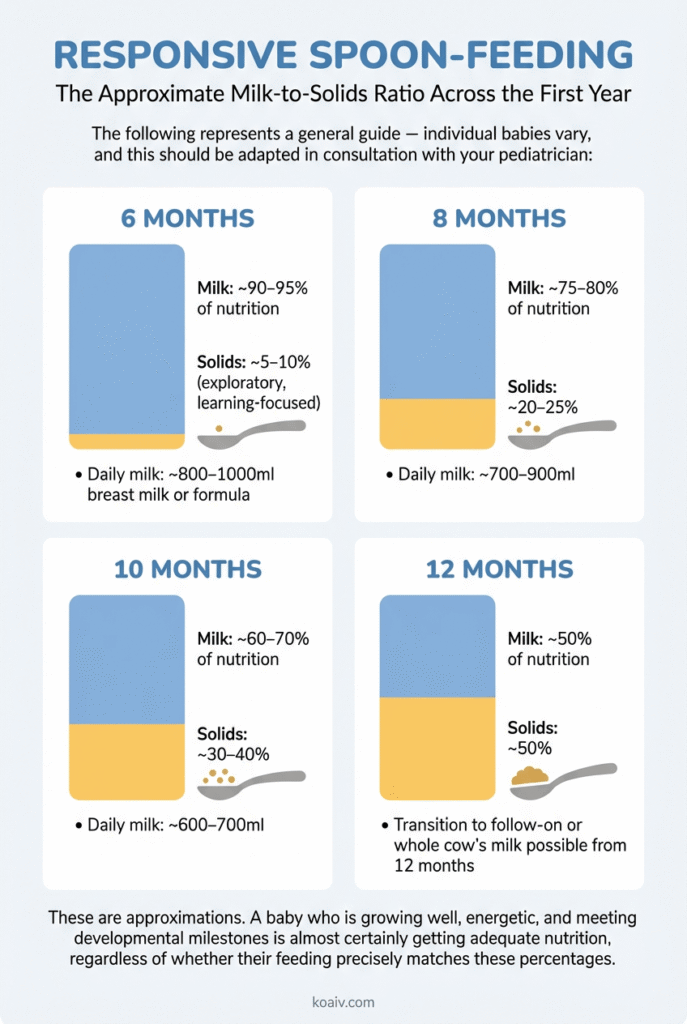
Here is something that surprises many new parents: even the most enthusiastic, adventurous eater at 7 or 8 months is still getting the vast majority of their nutrition from breast milk or formula — not from solid food.
This is intentional and correct. Breast milk and infant formula are nutritionally complete — they provide the precise balance of macronutrients (fats, proteins, carbohydrates), micronutrients (vitamins and minerals), and immunological factors (antibodies and protective proteins) that an infant’s rapidly developing body requires. No puree, however carefully prepared, can replicate this nutritional density and bioavailability.
Solid foods play a complementary role — filling specific nutritional gaps (most notably iron and zinc, which deplete from prenatal stores around 6 months) and introducing the baby to the tastes, textures, and social rituals of family eating. They are the supporting actors; milk is the lead.
The AAP recommends continuing breastfeeding alongside complementary foods for at least 12 months, and the WHO recommends up to 2 years or beyond. There is no upper limit on the nutritional benefits of breast milk — it continues to provide immune factors, comfort, and meaningful nutrition well into the second year of life.
How to Sequence Milk and Solids at Each Meal
A question that genuinely puzzles many parents: should I offer milk before or after solid food?
The answer changes as weaning progresses, and the logic is grounded in appetite management.
In the early weeks of weaning (approximately 6–7 months):
Offer milk first, then offer solids 30–60 minutes later, or at a separate time of day.
Why: A baby who approaches their first solid food experiences already hungry and frustrated is less likely to engage patiently with the novel, inefficient process of learning to eat from a spoon. A baby who has had their milk and is content but curious is in a much better state to explore new food.
As weaning progresses (approximately 7–8+ months):
Gradually transition to offering solids first, then milk afterward.
Why: As the baby’s solid food intake increases and the nutritional role of complementary foods becomes more meaningful, you want the baby to approach mealtime with maximum appetite for solids. Offering milk first at this stage risks reducing the appetite for the solid foods that are now carrying more nutritional importance — particularly for iron.
Introducing Water — The Cup Skill Opportunity
Once solid foods begin, small amounts of water can be introduced — no more than 60–120ml (2–4 oz) per day in the first year.
This is less about hydration (breast milk and formula address this adequately) and more about two other purposes:
1. Digestive support: A small amount of water with or after meals helps the digestive system process the new fibrous foods being introduced and can help prevent the constipation that commonly accompanies early weaning.
2. Cup skill development: Offering water via an open cup or soft-straw cup (rather than a bottle) introduces the baby to a completely different set of oral motor movements — the sucking-and-releasing pattern of cup drinking, rather than the rhythmic sucking of bottle or breast. These oral motor patterns contribute to the development of the fine muscle coordination that also underpins speech development.
Avoid Juice in the First Year: Fruit juice — even 100% fruit juice — offers no nutritional benefit over whole fruit purees and introduces concentrated sugar without the fiber that makes whole fruit nutritionally valuable. The AAP recommends avoiding juice entirely in the first year of life.
Troubleshooting Common Challenges
Challenge 1: When the Baby Refuses
Food refusal is one of the most anxiety-provoking experiences of early parenting. The vision of a carefully prepared sweet potato puree being met with sealed lips and a turned head can feel like rejection — of the food, of the effort, and sometimes, on the harder days, of the caregiver themselves.
A useful reframe: food refusal in early weaning is developmentally normal and statistically expected. Research on food acceptance in infants consistently shows that it can take 10 to 15 exposures to a new food before a baby accepts it. Not 10 to 15 consecutive successful spoonfuls — 10 to 15 separate meal encounters with that food. Each encounter, even one that ends in a turned-away head, is building familiarity in the baby’s sensory system.
Think of it like a new piece of music. The first time you hear an unfamiliar song, it may not appeal. The third time, it is starting to feel familiar. By the tenth time, you might find yourself humming it. The baby’s sensory system works similarly — familiarity breeds acceptance.
The responsive feeding framework offers a prescription that is both research-backed and counterintuitive: do not force it.
The work of feeding researcher Ellyn Satter, formalized in the “Division of Responsibility in Feeding” model (Satter, 1986), is foundational here. The principle is elegant: the caregiver decides what, when, and where food is offered. The baby decides whether to eat and how much. This division of labor is not passive parenting — it is an evidence-based approach that protects the baby’s self-regulation capacity and prevents the power struggles that can turn early food refusal into entrenched feeding difficulties.
When a baby refuses:
- End the meal calmly and without commentary. Avoid expressions of disappointment, frustration, or urgency.
- Do not offer an alternative food in its place — this unintentionally teaches the baby that refusal produces a better option.
- Reintroduce the rejected food at a future meal with the same neutrality. Try different preparations — the baby who rejects puréed broccoli might accept it mixed into a potato mash.
- If refusal is consistent across multiple food categories and multiple weeks, discuss with your pediatrician.
Challenge 2: Managing Constipation
The digestive system’s introduction to fiber, complex carbohydrates, and varied food proteins is not always smooth. Constipation — defined not just by frequency but by the consistency of stools (hard, pellet-like stools that are difficult to pass) — is common in the early weeks of weaning.
Why it happens: Breast milk and formula are almost entirely absorbed, leaving very little digestive residue. When solid foods are added, the digestive system is suddenly managing significantly more fiber, starch, and protein, and it takes time to adjust. Additionally, some early foods — particularly banana and iron-fortified cereals — can be constipating.
The “P Foods” Solution: A handful of foods are known to contain sorbitol (a naturally occurring sugar alcohol) and fiber combinations that gently stimulate intestinal motility:
- Pears
- Prunes (prune puree is particularly effective)
- Peaches
- Peas
- Plums
These foods are not laxatives — they are gentle dietary supports that work with the digestive system’s natural processes.
Additional strategies:
- Ensure adequate milk intake (constipation sometimes signals insufficient fluid)
- Offer small amounts of water with meals (as discussed in Section 7)
- Gentle abdominal massage in a clockwise direction can stimulate intestinal movement
- Brief tummy time between meals supports overall digestive motility
If constipation is severe, persistent, or accompanied by blood in the stool, consult your pediatrician.
Challenge 3: Reframing the Mess
Messy eating is not a failure of discipline or technique. It is sensory learning — and understanding this distinction can meaningfully reduce parental stress at mealtimes.
Research in sensory processing development indicates that tactile exploration of food — squishing, smearing, rubbing, examining — is a precursor to acceptance. The baby who touches the puree, even while grimacing, is building the neural familiarity that will make that food feel safe in their sensory vocabulary.
An analogy: Think of a toddler approaching a new playground. They often observe from a distance first, then touch cautiously, then gradually engage more fully. Food is the same — a baby who handles food, even without eating it, is progressing through the stages of sensory acceptance. A baby who is never allowed to touch their food, or who is immediately wiped clean every time they make contact with it, loses important opportunities for this sensory learning.
Practical mess management:
- A silicone splat mat under the high chair protects the floor and allows food to be recovered easily
- A full-coverage smock bib protects clothing better than a standard bib once the baby begins handling their own pre-loaded spoon
- Accept that some meals will look like a Jackson Pollock painting, and that this is a sign of healthy developmental engagement
Challenge 4: Gagging vs. Choking — A Critical Distinction
This is perhaps the most important safety knowledge a feeding caregiver can have. The ability to distinguish between gagging and choking can prevent unnecessary panic at the former and dangerous inaction at the latter.
The gag reflex is a protective mechanism built into every human. When an object reaches further back in the mouth than the baby is ready to manage, the gag reflex triggers — a retching motion that propels the material forward. It can sound alarming and look alarming. But it is working exactly as designed, protecting the airway by pushing the food away from the throat.
In young babies, the gag reflex is triggered quite far forward in the mouth — making early gagging common. As oral motor skills develop and the baby gains experience with managing food, the reflex gradually triggers further back, at the more posterior position where it sits in adults.
How to tell the difference:
| Gagging | Choking | |
|---|---|---|
| Face color | Flushed or red — normal circulation | Blue, grey, or pale — oxygen compromised |
| Sound | Coughing, sputtering, retching, crying | Silent or very quiet — airway is blocked |
| Eye appearance | May water; baby looks distressed but alert | Panicked, wide eyes; baby may look confused |
| Body movement | Active retching motion, leaning forward | Stiff, reaching toward throat, or going limp |
| Breathing | Present — may be noisy | Absent or severely compromised |
| Action needed | Stay calm; observe; do not intervene | Call emergency services immediately; begin infant choking response |
What to do during a gag:
Stay calm and do not physically intervene. Leaning forward to pat the baby’s back, reaching into the mouth, or expressing alarm can make the situation worse — it may startle the baby, cause them to inhale, or push the food further back. Allow the gag reflex to do its job. In almost every case, the food will be expelled forward within seconds.
What to do during a choking emergency:
Call emergency services immediately. If trained in infant choking response (back blows and chest thrusts), begin immediately while waiting for help. Taking a paediatric first aid course before beginning solid foods is strongly recommended for all caregivers — knowledge that is rarely needed but irreplaceable when it is.
Myth-Busting: The “Sleeping Through the Night” Fallacy
One of the most persistent myths in parenting culture — passed through generations of well-meaning grandparents and tired forums — is that a baby waking frequently at night is sending a hunger signal that solid food can solve.
The logic seems intuitive: baby wakes at night → baby must be hungry → solid food is more filling → solid food will fix the night waking. Unfortunately, the evidence simply does not support this chain of reasoning.
A landmark randomized controlled trial published in JAMA Pediatrics (2011) — one of the most rigorous types of studies in medical research, in which participants are randomly assigned to different conditions to reduce bias — found no significant improvement in infant sleep with the early introduction of solids.
Why? Because frequent night waking in infancy is primarily a neurological and developmental phenomenon, not a hunger problem. Babies sleep in shorter cycles than adults. They have a biological need for nighttime contact and feeding that is entirely age-appropriate. Purees cannot change the architecture of infant sleep; they can only introduce the risks of starting solids before the body is ready.
Those risks include:
- Increased allergy sensitization — the gut’s immune system is still maturing, and early exposure to solid proteins before the gut is ready may increase the likelihood of allergic responses
- Digestive stress — enzymes needed to break down starches and complex carbohydrates are not yet fully active in early infancy
- Aspiration risk — without adequate head control and the loss of tongue-thrust reflex, solid food is significantly more dangerous
If night waking is exhausting you, the solution is support — from a partner, family member, or sleep consultant — not an early introduction of rice cereal.
The Transition to Finger Foods — The Case for Combo-Feeding
Dissolving a False Binary
One of the most liberating insights in modern complementary feeding practice is this: the choice between spoon-feeding and baby-led weaning is a false binary.
The feeding culture wars — with their hashtags, their philosophies, their competing claims about choking rates and food relationships and developmental outcomes — have created the impression that caregivers must pick a side and stay on it. Spoon-feeding families sometimes worry they are doing their baby’s development a disservice. Baby-led weaning families sometimes worry about iron intake and whether enough food is actually being consumed.
Both worries are legitimate. And the resolution is simpler than either camp often acknowledges: do both.
What practitioners increasingly refer to as combination feeding or combo-feeding recognizes that most families naturally use elements of both approaches — and that this flexibility is not a compromise, it is good practice.
A typical combo-feeding day at 8 months might look like this:
- Breakfast: Iron-fortified oatmeal delivered via caregiver-loaded spoon, with a pre-loaded spoon offered for baby to practice self-feeding alongside
- Lunch: Lentil and vegetable puree (spoon-fed by caregiver) alongside a soft piece of roasted sweet potato for self-feeding exploration
- Dinner: Minced chicken with soft-cooked vegetable pieces — primarily finger food, with a spoon available if needed
The same meal can honor both the parent’s comfort with volume monitoring and the baby’s developing self-feeding capability. There is no rule that says every bite must come from either a spoon or a hand.
Fading the Spoon — A Gradual and Natural Exit
By approximately 10 to 12 months, most babies demonstrate sufficient pincer grasp development (the ability to pick up small objects between thumb and forefinger) and hand-eye coordination to manage soft table foods independently. The caregiver’s role naturally diminishes — from active spoon operator to food preparer, table companion, and occasional assistant.
This transition is not linear and not the same for every baby. Some 10-month-olds enthusiastically grab every bite themselves; others prefer a more supported approach well into the second year. Follow the baby’s lead rather than an arbitrary timeline.
By 12 to 15 months, the spoon typically transitions fully into the baby’s own hands, though the utensil skill itself continues developing well into the toddler years — the ability to successfully load a spoon and navigate it to the mouth without spillage typically consolidates around 18–24 months.
Preparing Safe Finger Foods Alongside Purees
As combo-feeding begins, here is a quick reference guide for preparing safe finger foods:
| Food | Safe Preparation for Self-Feeding |
|---|---|
| Banana | Soft ripe pieces; palm-sized “log” for younger babies, pea-sized pieces for those with pincer grasp |
| Avocado | Soft strips or cubes; no preparation needed |
| Cooked carrot | Must be cooked until completely soft — can be pressed between fingers and yields; raw carrot is a choking hazard at this age |
| Broccoli | Small, soft-cooked florets with a stem “handle” for grasp |
| Pasta | Soft-cooked, larger shapes (penne or rigatoni work well); avoid thin spaghetti |
| Chicken | Small, soft-cooked shredded pieces; never round or coin-shaped chunks |
| Eggs | Soft scrambled; well-cooked and soft — avoid hard-boiled whole eggs |
Foods to Avoid Until Age 4: Round, firm foods that are the exact diameter of a child’s airway represent the highest choking risk. These include: whole grapes, whole cherry tomatoes, whole blueberries, raw carrot rounds, chunks of hot dog, whole nuts, and hard candy. These foods should be quartered, halved, or prepared in altered forms (grapes quartered lengthwise, carrots cooked until soft) before offering.
Conclusion: The Spoon as a Connection, Not Just a Utensil
Feeding a baby is one of the most intimate acts of early parenthood. In the daily ritual of loaded spoon meeting open mouth, something more than nutrition is being exchanged — there is attunement, trust, language without words, and the slow construction of the relationship a child will carry into every future meal they ever share with another human being.
The spoon is not a relic. It is not a compromise. When wielded with patience, responsiveness, and a healthy disregard for feeding dogma, it is one of the most powerful developmental tools in a caregiver’s hands.
The journey from smooth sweet potato puree to the family dinner table is shorter than it appears, and far more remarkable than it gets credit for. It does not require a particular philosophy, a particular technique, or a particular aesthetic. It requires only a caregiver who is paying attention — to their baby’s cues, to the texture progression, to the iron needs, to the mess, and to the quiet magic of watching a new human discover that the world, on the whole, tastes rather wonderful.
There is no perfect method. There is only the method that nourishes the child and sustains the parent — and that, wherever a spoon is involved, is entirely enough.
Quick Reference: The Responsive Spoon-Feeding Cheat Sheet
Print this out and keep it on the fridge for the early weeks.
Before you begin — the readiness checklist:
- ☐ Baby can hold head upright without support
- ☐ Baby can sit with minimal support
- ☐ Tongue-thrust reflex has diminished
…..
References & Recommended Reading
- American Academy of Pediatrics. (2022). Policy Statement: Breastfeeding and the Use of Human Milk. .
- Coulthard, H., Harris, G., & Emmett, P. (2009). Delayed introduction of lumpy foods to children during the complementary feeding period affects child’s food acceptance and feeding at 7 years of age. Maternal & Child Nutrition, 5(1), 75–85.
- Du Toit, G., et al. (2015). Randomized trial of peanut consumption in infants at risk for peanut allergy. New England Journal of Medicine, 372(9), 803–813.
- Farrow, C. V., & Blissett, J. (2006). Does maternal control during feeding moderate early infant weight gain? Pediatrics, 118(2), e293–e298.
- Lozoff, B., et al. (2006). Long-lasting neural and behavioral effects of iron deficiency in infancy. Nutrition Reviews, 64(5 Pt 2), S34–S43.
- Satter, E. (1986). The feeding relationship. Journal of the American Dietetic Association, 86(3), 352–356.
- World Health Organization. (2003). Global Strategy for Infant and Young Child Feeding. WHO Press.
Share this article with a new parent navigating the wonderful, bewildering world of starting solids. And if there is a memorable first-food reaction story — a shocked expression at avocado or an enthusiastic lunge at sweet potato — the comments section was made for exactly that kind of story.

October 25, 2026
October 25, 2026

October 25, 2026

October 25, 2026