
Fluoride-for-Preventing-Infant-Tooth-Decay
Fluoride for Baby Teeth: A Parent’s Guide
Fluoride is a safe and effective way to help prevent tooth decay in infants and young children. It strengthens tooth enamel, supports remineralization, and lowers the risk of cavities. With age-appropriate use—such as a rice-grain-sized amount of fluoride toothpaste from the first tooth, supervised brushing, and professional fluoride varnish when needed—fluoride can play an important role in protecting baby teeth.
There is a particular kind of parental guilt that arrives not in dramatic moments, but in achingly ordinary ones: a routine pediatric appointment that takes an unexpected turn, a toddler who winces and pulls away from a cold sippy cup, or a dentist’s casual remark—almost too casual—about “some early signs we should watch.” In those moments, an uncomfortable truth crystallizes: something preventable has already begun.
Tooth decay in infants and toddlers is not a minor inconvenience or a cosmetic footnote. It is, according to the Centers for Disease Control and Prevention, the single most common chronic childhood disease in the United States—more prevalent than asthma, more widespread than childhood obesity, and far more preventable than either.
The numbers carry genuine weight: roughly 20% of children between the ages of 2 and 5 already have at least one cavity, and the American Academy of Pediatric Dentistry (AAPD) estimates that more than 16 million children in the U.S. suffer from untreated dental decay each year. Globally, the World Health Organization reports that oral diseases affect nearly half of the world’s population—approximately 3.5 billion people—making them the single most common health condition on Earth.
The clinical name for this pattern in very young children is Early Childhood Caries, or ECC. “Caries” is simply the medical term for cavities—areas where acid has eaten through the hard outer shell of a tooth, creating holes that deepen and worsen without intervention. When the word appears, it does not describe a different disease from the cavities adults experience. It describes the same process, happening in a smaller, more vulnerable mouth, with consequences that can reverberate across years of development.
And yet, despite the alarming prevalence, here is the genuinely remarkable counterpoint that reframes the entire story: the vast majority of these cases are entirely preventable.
At the center of that prevention story stands fluoride—a naturally occurring mineral that mainstream science has studied for nearly a century, that public health authorities have championed since the 1940s, and that a vocal corner of the internet has, perhaps inevitably, misunderstood. This article is not intended to preach or dismiss. It is written to close the information gap with the kind of clarity every parent deserves—before that first tiny tooth pushes through the gum line and the clock starts ticking.
Why Baby Teeth Are Not Disposable
Before exploring the solution, it is worth spending a moment on a surprisingly stubborn misconception—because it shapes nearly every decision parents make about infant dental health.
The belief is simple and widespread: baby teeth are temporary. They fall out. They are replaced by permanent, “real” teeth. So why invest time, money, or anxiety in protecting something that nature has already scheduled for removal?
The logic feels intuitive, which is precisely what makes it so dangerous.
Baby teeth are not placeholders. They are the architectural foundation of the entire dental future.
To understand why, imagine constructing a bridge. The temporary scaffolding that holds the structure in place during construction is not the bridge itself—but remove it prematurely, and the bridge collapses. Baby teeth function as precisely this kind of biological scaffolding. They hold specific positions in the jaw, maintaining the spacing and alignment that the developing permanent teeth will eventually need. When a baby tooth is lost too early—whether to decay, infection, or extraction—the neighboring teeth drift into the vacant space. When the permanent tooth finally attempts to erupt months or years later, it finds the doorway partially blocked, leading to crowding, misalignment, and orthodontic complications that can persist for a lifetime.
Beyond the structural role, baby teeth serve functions that parents experience daily, even if they rarely connect those functions to dental health:
- Speech Development. The tongue, lips, and teeth work together as a precision instrument for producing sounds. The “th” in “three,” the “f” in “four,” the “s” in “six”—these sounds require the tongue to make specific contact with specific teeth. A child missing front teeth to decay may develop speech patterns that require professional intervention to correct, sometimes long after the permanent teeth arrive.
- Nutrition. A toddler with painful, decayed teeth avoids chewing. Avoidance of chewing leads to avoidance of exactly the foods—raw vegetables, whole fruits, lean proteins—that fuel healthy development. The dietary shift toward softer, processed, higher-sugar alternatives creates a destructive feedback loop: the very foods that are easiest for a mouth in pain to consume are the foods most likely to worsen the decay.
- Self-Esteem and Social Development. This dimension is less discussed in clinical literature but deeply felt in everyday life. Young children who are visibly missing teeth, or whose front teeth are discolored by decay, frequently experience social hesitation, reluctance to smile, and diminished confidence during precisely the developmental period when social skills are being formed.
What Actually Causes Infant Tooth Decay?
To appreciate what fluoride does, it helps to first understand the process it interrupts—because infant tooth decay is not caused by what most parents assume.
Sugar, by itself, does not cause cavities. This is a crucial distinction. What sugar does is feed the bacteria that cause cavities—an important difference, and one that changes the way families should think about prevention.
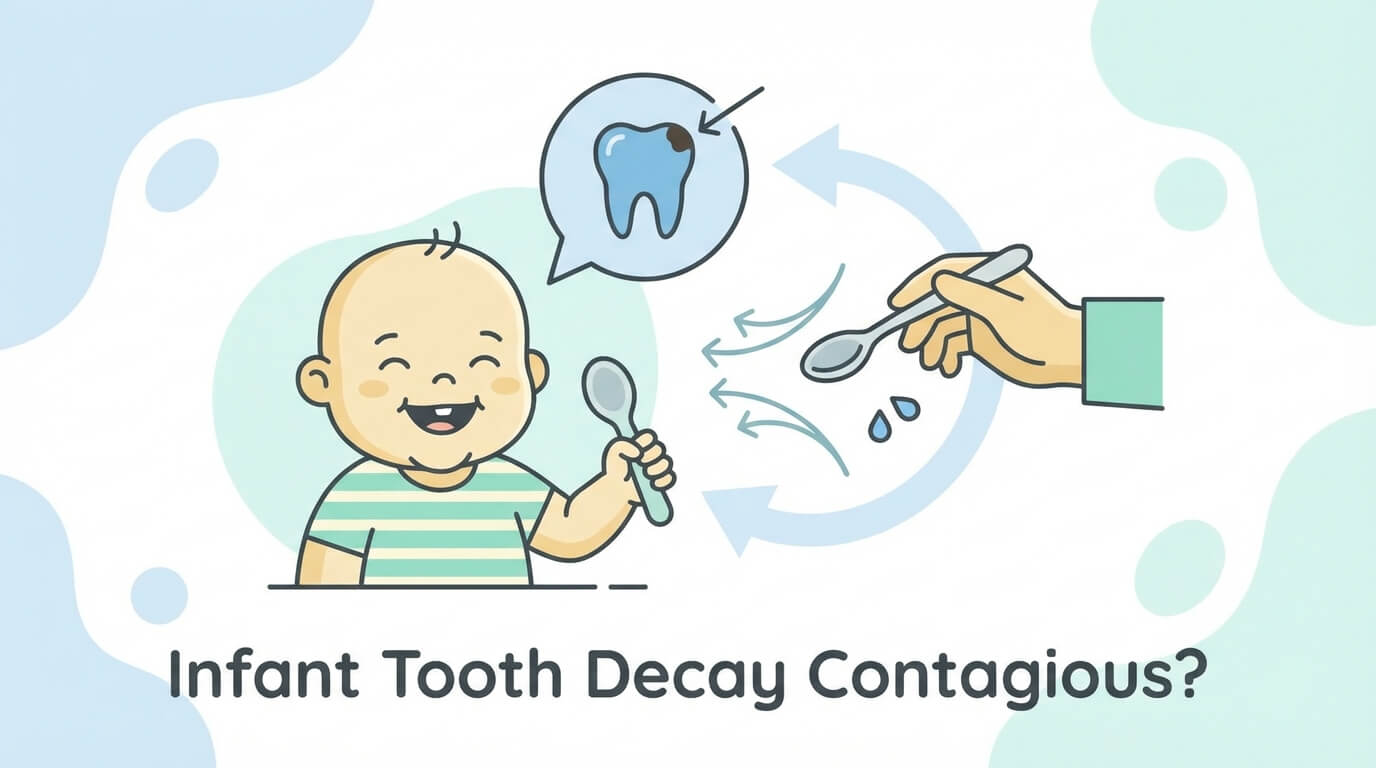
The human mouth, even a newborn’s, is a teeming ecosystem. Within weeks of birth, an infant’s mouth is colonized by hundreds of bacterial species, most of them benign or beneficial. Among them, however, is a species called Streptococcus mutans—the primary villain in the cavity story. S. mutans is not born with the baby; it is transmitted, usually from a primary caregiver, through everyday acts of love and convenience: sharing a spoon, testing the temperature of food with a taste, cleaning a dropped pacifier in the parent’s mouth.
Once established, S. mutans operates with simple, relentless efficiency. Every time the baby feeds—whether on breast milk, formula, pureed fruit, or a cracker—the bacteria in the mouth consume the residual carbohydrates and produce lactic acid as a metabolic byproduct. That acid is the true cavity-causing agent. It attacks the mineral scaffolding of tooth enamel—the hardest substance in the human body, but one that is nonetheless vulnerable to sustained chemical assault.
This attack is called demineralization: the acid dissolves calcium and phosphate ions out of the enamel’s crystalline structure, creating microscopic weak points in the tooth’s surface. Imagine a marble countertop exposed to repeated splashes of vinegar—each individual exposure seems negligible, but over time, the surface dulls, pits, and eventually degrades.
Fortunately, the body has a built-in repair mechanism. Saliva—one of the most underappreciated fluids in human biology—naturally carries calcium, phosphate, and bicarbonate ions that flow back toward the damaged enamel and begin rebuilding it. This natural repair process is called remineralization.
In a healthy mouth with reasonable dietary habits, demineralization and remineralization exist in a rough equilibrium—a continuous war with no clear winner. A cavity forms only when the balance tips decisively toward destruction: too much acid, too often, with too little time for saliva to mount a repair.
Think of it as a seesaw. On one side sits acid production, fueled by every carbohydrate exposure. On the other side sits the body’s repair crew, fueled by saliva and mineral availability. A cavity is not a single event—it is a seesaw stuck in the wrong position for too long.
This is exactly where fluoride enters the story—not as a foreign chemical imposed on the body, but as a powerful reinforcement to its own natural repair system.
How Fluoride Tips the Balance
Fluoride is not a synthetic pharmaceutical. It is a naturally occurring mineral—the ionic form of fluorine, the 13th most abundant element in the Earth’s crust. It exists in soil, rocks, groundwater, and in trace amounts in many foods, including brewed tea, ocean fish, and certain cereals. The discovery of its dental benefits was, fittingly, an accident of nature.
In the early 20th century, a dentist named Dr. Frederick McKay noticed something peculiar about residents of Colorado Springs. Many of them had strangely mottled, brown-stained teeth—a condition that was cosmetically unappealing but medically fascinating, because those same teeth were almost completely resistant to cavities. After three decades of investigation, McKay and his collaborators traced the cause to naturally elevated fluoride levels in the local water supply. The staining was a result of excessive fluoride during tooth development (a condition now called dental fluorosis), but the cavity protection was undeniable—and it suggested that a lower, carefully controlled dose might deliver the protection without the cosmetic side effects.
That hypothesis proved correct, and it launched one of the most extensively studied public health interventions in human history.
What Fluoride Does at the Molecular Level
When fluoride ions are present in the mouth—whether dissolved in saliva from drinking water or deposited directly onto the tooth surface from toothpaste—they are absorbed into the damaged enamel alongside the calcium and phosphate ions that saliva provides. But here is the critical difference: the mineral that forms when fluoride is incorporated into the repair process is not the same as the original enamel.
Original tooth enamel is composed primarily of a mineral called hydroxyapatite. When fluoride participates in remineralization, it creates a related but structurally superior mineral called fluorapatite. Fluorapatite has a tighter crystalline structure, a higher density, and—most importantly—a significantly lower solubility in acid. In practical terms, this means that the repaired enamel is harder to dissolve during the next acid attack than the original enamel was.
Imagine repairing a wooden fence after a storm. Ordinary repair means replacing the damaged boards with identical boards—functional, but no more storm-resistant than before. Fluoride repair is the equivalent of replacing the wooden boards with composite planks: same shape, same fit, but fundamentally more durable against the next storm.
Fluoride also provides a second, less appreciated benefit: it inhibits bacterial metabolism directly. In the presence of fluoride ions, S. mutans produces less acid, less efficiently. The attacker is weakened at the same time the defender is strengthened—a two-front advantage that compounds over time.
Two Channels of Protection Working in Concert
Fluoride reaches the teeth through two distinct pathways, each contributing something the other cannot:
| Protection Type | How It Works | Primary Benefit | Key Sources |
|---|---|---|---|
| Systemic(ingested) | Fluoride consumed in water or food enters the bloodstream and is incorporated into developingteeth still forming beneath the gums | Strengthens the internal structure of permanent teeth before they even erupt | Fluoridated tap water, certain foods |
| Topical(applied) | Fluoride applied directly to the surface of teeth already present in the mouth | Remineralizes existing enamel damage and creates an acid-resistant surface layer | Fluoride toothpaste, professional varnish |
For infants, this dual-channel system is especially relevant. A seven-month-old who has just cut a first lower incisor is simultaneously growing permanent teeth deep within the jawbone—teeth that will not erupt for another five or six years. Systemic fluoride from drinking water strengthens those hidden teeth from the inside; topical fluoride from toothpaste protects the visible teeth from the outside. The two are not redundant. They are complementary—different tools addressing different vulnerabilities at the same development stage.
The Timeline Every Parent Needs: When to Start and What Has Changed
One of the most significant—and least publicized—sources of parental confusion around fluoride stems from the fact that the official recommendations changed, and many families never received the update.
For decades, the prevailing guidance told parents to avoid fluoride toothpaste until a child turned two years old, and some conservative sources pushed that threshold to age three. The reasoning, rooted in concerns about young children swallowing toothpaste, was well-intentioned. But as the epidemiological data accumulated, a painful pattern emerged: children were developing severe cavities before age two, in the very window when fluoride was being withheld.
In response, the American Academy of Pediatrics (AAP), the American Academy of Pediatric Dentistry (AAPD), and the American Dental Association (ADA) all converged on a revised, unified recommendation: fluoride toothpaste should be introduced the moment the first tooth erupts, regardless of the child’s age—and the dose should be a “smear” or “grain of rice” sized amount.
This was not a casual revision. It reflected a careful recalculation of risk: the risk of fluorosis from a microscopic dose of toothpaste was judged to be far less consequential than the documented risk of rampant decay in an unprotected mouth. The evidence base supporting this shift includes multiple systematic reviews published in the Cochrane Database of Systematic Reviews, the gold standard for evidence synthesis in medicine.
Here is a practical, stage-by-stage framework for families:
Before the First Tooth Appears (0–6 months)
No toothpaste is needed during this phase, but oral care begins nonetheless. Wiping the gums with a clean, damp cloth or gauze pad after feedings accomplishes two things: it removes the bacterial film that begins accumulating on gum tissue immediately after birth, and—perhaps more importantly—it begins building the habit of oral care as a normal, expected part of the daily routine. A baby who is accustomed to having the mouth gently touched and cleaned is far less likely to resist a toothbrush six months later.
There is also a less obvious consideration during this period: maternal oral health. A growing body of research demonstrates that mothers (or primary caregivers) with high levels of S. mutans in their own mouths are significantly more likely to transmit those bacteria to their infants during normal caregiving activities. A landmark study published in Pediatric Dentistry found that children whose mothers had untreated dental caries were more than twice as likely to develop ECC themselves. The implication is clear: a parent who prioritizes their own dental care during pregnancy and the postpartum period is directly reducing their baby’s cavity risk.
The Golden Window: First Tooth Eruption (typically 6–12 months)
This is the inflection point—the moment fluoride toothpaste enters the equation. For most infants, the first tooth (usually a lower central incisor) erupts between six and ten months of age, though the range is wide and variation is entirely normal.
The eruption of that first tooth is the clinical cue to begin twice-daily brushing with a soft-bristled infant toothbrush and a fluoride toothpaste in a smear, or “grain of rice” sized amount. This quantity—approximately 0.1 milligrams of fluoride—has been carefully evaluated against published toxicological thresholds. Even if the infant swallows every trace (which, at this age, is virtually certain), the dose remains comfortably within safe parameters. For context, a child would need to ingest the equivalent of an entire tube of standard toothpaste in one sitting to approach levels associated with acute toxicity—a scenario so implausible as to be effectively impossible with normal use.
Early Toddlerhood (1–3 years)
This phase introduces a significant escalation in caries risk that many parents do not anticipate. The dietary landscape shifts dramatically: solid foods proliferate, snacking frequency increases, crackers and fruit pouches appear in diaper bags and car seats, and milk or diluted juice is frequently offered in sippy cups that travel everywhere. Each carbohydrate exposure is a fresh round of ammunition for S. mutans.
At the same time, toddlers are developing autonomy and opinions—including, frequently, strong opinions about having their mouths touched. The brushing habit established in infancy pays its first dividends here: a child whose oral care routine has been consistent since the first tooth is far more likely to tolerate (if not enjoy) brushing during the toddler years than a child for whom the toothbrush is a sudden, unwelcome novelty.
The toothpaste amount remains at a grain-of-rice size until approximately age three, at which point children are typically developing the motor coordination and cognitive readiness to learn spitting. At three, the recommended amount increases to a “pea-sized” dose—approximately 0.25 mg of fluoride.
Building a Multi-Layered Defense
No single source of fluoride provides complete protection in isolation. The most effective prevention relies on four complementary pillars, each covering a gap the others leave open. Understanding each one empowers families to construct what pediatric dentists sometimes call a “fluoride safety net”—a layered system in which no single point of failure leaves the child unprotected.
Fluoride Toothpaste — The Everyday Guardian
The daily brushing ritual is the cornerstone of infant oral care, and the toothpaste on the brush is its most potent ingredient. But precision matters enormously here, because the margin between a therapeutically effective amount and a visually “normal” amount (as depicted in advertising) is dramatic.
The thick, colorful, decorative swirl of toothpaste shown in virtually every toothpaste commercial covers the full length of the brush head and contains roughly 1.0 to 1.5 mg of fluoride—an amount designed for an adult mouth. For an infant, the correct amount—a grain of rice—is so small it barely covers one or two bristles. The visual gap between what advertising normalizes and what clinical guidelines recommend is one of the most underappreciated sources of inadvertent over-dosing in pediatric oral care.
Practical Visualization: Squeeze the slightest hint of toothpaste onto a fingertip. If it forms a visible mound, it is already too much. The correct amount for an infant resembles a thin smear—a translucent film that barely tints the bristles.
Parents should look for the ADA Accepted seal on fluoride toothpaste packaging. This seal is not a marketing badge; it indicates that the product’s fluoride concentration (typically 1,000 ppm for children’s toothpaste), stability, and flavor have been independently verified through laboratory testing. Not all toothpastes marketed for children carry this seal, and some “natural” or “training” toothpastes contain no fluoride at all—a detail that requires careful label reading.
One final practical note: infant toothpaste should be stored out of reach. Many children’s toothpastes are fruit-flavored specifically to improve compliance, but that same pleasant taste can lead to toothpaste being treated as a snack if left accessible.
Professional Fluoride Varnish — The Concentrated Boost
Fluoride varnish is a thick, resin-based fluoride preparation that a healthcare provider paints directly onto the teeth in a procedure that takes less than two minutes and causes no discomfort. It is not the same as the foam trays or rinses that older readers may remember from childhood dentist visits—those methods required holding a mouthful of gel for minutes at a time and were poorly suited to young children.
Varnish, by contrast, is designed for compliance: it adheres to the teeth on contact, hardens almost immediately upon exposure to saliva, and remains in place for several hours, slowly releasing fluoride directly into the enamel. Its fluoride concentration—22,600 parts per million (ppm)—is far higher than any toothpaste (which typically contains 1,000–1,500 ppm), but because the amount applied is tiny and the varnish is essentially immobile once set, the actual systemic fluoride exposure is minimal and well within safety parameters.
The AAPD recommends fluoride varnish applications every 3 to 6 months for children at elevated caries risk, beginning at the eruption of the first tooth. Perhaps most important from an access standpoint, fluoride varnish is no longer confined to the dental office. In a significant policy development, the AAP now endorses and trains pediatricians to apply fluoride varnish during routine well-child visits—typically at the 6-, 9-, 12-, 18-, and 24-month checkups. This integration into pediatric primary care has dramatically expanded the reach of preventive dental treatment, ensuring that children receive at least baseline fluoride protection even in communities where pediatric dentists are scarce.
Fluoride Supplements — The Targeted, Prescribed Option
Fluoride supplements—available as liquid drops for infants and chewable tablets for older children—exist to fill a specific, verified gap: documented low fluoride in a child’s primary water source. They are not broadly indicated and are never appropriate as a first-line or over-the-counter option.
The AAP publishes a supplementation schedule that cross-references two variables: the child’s age and the verified fluoride concentration of their water supply. Only when the water fluoride level falls below 0.3 mg/L does supplementation become recommended, and even then, only by prescription and only after the water has been formally tested.
The temptation to treat fluoride supplements as a “more is better” vitamin—similar to vitamin D drops or iron supplements—should be firmly resisted. Unlike vitamins, where a modest excess is typically excreted harmlessly, sustained excess fluoride intake during the years of enamel formation can contribute to dental fluorosis. Medical precision, guided by a professional, is the only safe approach.
Confronting the Fear: A Thoughtful Look at Safety and Misinformation
No responsible article about fluoride can avoid the topic of controversy—not because the science is ambiguous (it is not), but because the anxiety is real, widespread, and rooted in concerns that deserve respectful engagement rather than dismissal.
Where Does the Fear Come From?
Much of the modern hesitation around fluoride exists at the intersection of two broader cultural phenomena: a growing distrust of institutional public health recommendations (accelerated by the pandemic era) and the rise of “clean living” and “toxin-free” parenting movements on social media. In this environment, fluoride has been characterized—sometimes by well-meaning bloggers, sometimes by commercially motivated “natural” product brands—as a harmful additive, a neurotoxin, or an unnecessary chemical imposed on children without consent.
These characterizations typically rely on a specific rhetorical sleight of hand: citing studies that examined fluoride exposure at concentrations dramatically higher than any therapeutic recommendation, and then applying those findings to the controlled, low-dose applications recommended by clinical guidelines. This is analogous to citing the genuine dangers of water intoxication (hyponatremia) to argue that children should not drink water—a conclusion that is technically rooted in a real risk but collapses under the weight of dosing context.
What Does the Weight of Evidence Actually Show?
The safety profile of fluoride at recommended levels is supported by an extraordinary depth and breadth of research—far exceeding that of many substances parents use routinely and without concern:
- The Cochrane Collaboration (an independent, internationally respected body that produces systematic reviews of healthcare evidence) has published multiple reviews confirming the efficacy and safety of fluoride toothpaste and water fluoridation at recommended levels.
- The World Health Organization, the American Medical Association, the American Academy of Pediatrics, and virtually every major health authority in the world endorse community water fluoridation.
- The U.S. Environmental Protection Agency sets the maximum contaminant level for fluoride in drinking water at 4.0 mg/L—nearly six times the recommended optimal concentration of 0.7 mg/L. This margin exists specifically to provide a substantial buffer of safety.
Dental Fluorosis: The Real Risk, in Proper Context
Dental fluorosis is the one genuine, documented adverse effect of fluoride—and it deserves honest, unexaggerated explanation.
Fluorosis occurs when a child ingests more fluoride than the developing enamel can incorporate smoothly, during the specific period when enamel is forming (roughly birth to age eight for most permanent teeth). The result is a disruption in the enamel’s mineralization pattern, which becomes visible when those teeth eventually erupt.
What does it actually look like? In the vast majority of cases—the mild form, which accounts for the overwhelming majority of all fluorosis observed in the U.S.—it appears as faint, white streaks or small, chalky spots on the teeth. These marks are often so subtle that only a dental professional examining the teeth under bright light would notice them. They do not weaken the tooth. They do not indicate systemic poisoning. They are a cosmetic variation, not a medical condition.
Severe fluorosis, by contrast—characterized by pitting, brown staining, and compromised enamel integrity—is exceedingly rare in developed countries and is associated with fluoride exposures far above recommended levels, typically from naturally occurring environmental sources in certain geological regions.
The key insight, and the one that transforms this conversation from fearful to empowered, is a shift in framing:
The question is not “Is fluoride safe?” (It demonstrably is, at recommended levels.)
The question is “How precisely can the dose be calibrated?”—and the answer is: very precisely, using the grain-of-rice rule, verified water data, and professional guidance.
Consider the analogy to another mineral that every pediatrician recommends for infants: iron. Iron is essential for brain development. Iron deficiency in infancy can cause irreversible cognitive impairment. And yet, iron overdose is one of the leading causes of fatal poisoning in young children. Nobody responds to that risk by removing iron from infant formulas—the response is careful, measured dosing. Fluoride operates by exactly the same principle.
The Daily Practice: Making Good Science Work in Real Life
The molecular elegance of fluorapatite formation means nothing if the toothbrush never makes it into the baby’s mouth. The gap between clinical knowledge and daily practice is where many families struggle—and where practical, non-judgmental guidance matters most.
Winning the Brushing Battle
Any parent who has attempted to brush the teeth of an opinionated nine-month-old understands that the experience bears little resemblance to the serene, smiling babies depicted in toothbrush advertisements. Babies clamp their mouths shut, turn their heads, grab the brush, and occasionally employ their newest teeth on the well-intentioned fingers attempting to help them.
The knee-to-knee technique, widely endorsed by pediatric dentists, transforms this daily skirmish into something manageable. Two caregivers sit facing each other, knees touching, and lay the child across their laps with the child’s head resting in the brusher’s lap and legs extending toward the second caregiver. This position provides stability, gentle restraint, and—crucially—a clear sightline into the child’s mouth. For solo caregivers, a workable adaptation involves laying the child on a changing pad or firm pillow on the floor, kneeling behind the child’s head, and brushing from above—a position that mimics the angle of a dental hygienist.
The key psychological insight, often overlooked: consistency matters more than perfection. A thirty-second brush that happens every single night is vastly more protective than a meticulous two-minute brush that happens sporadically. Parents struggling with compliance should give themselves permission to prioritize the habit over the technique in the early months.
Why the Nighttime Brush Is Non-Negotiable
If only one brushing session happens each day—a reality many exhausted parents live with—it must be the one before bed.
The reason is rooted in saliva biology. During waking hours, the salivary glands produce a continuous flow of saliva—roughly 0.5 to 1.5 liters per day—that rinses the teeth, dilutes acids, delivers repair minerals, and physically flushes bacteria toward the back of the throat. Saliva is, in effect, the mouth’s built-in cleaning system.
During sleep, saliva production drops by approximately 90%. The mouth becomes a drier, more stagnant, more acidic environment—ideal conditions for S. mutans to thrive and produce acid without opposition. Residual sugars or carbohydrates left on the teeth from an evening snack become an overnight buffet for bacteria operating in a mouth with almost no salivary defense.
Fluoride applied before bed lingers on the teeth throughout this vulnerable window, continuing to promote remineralization and inhibit bacterial acid production during the hours when the mouth’s natural defenses are at their lowest. The pre-sleep brush is not merely one of two equal brushing opportunities—it is the single most impactful oral hygiene moment of the day.
The “Spit, Don’t Rinse” Principle
This recommendation surprises nearly every parent who encounters it, because it contradicts a lifetime of personal habit. Most adults rinse vigorously with water after brushing—a behavior so automatic it barely registers as a choice.
For children (and adults), this well-intentioned rinse washes the residual fluoride off the teeth before it has had adequate time to be absorbed into the enamel and do its protective work. Pediatric dental guidelines increasingly recommend a simple alternative: after brushing, simply spit out the excess toothpaste (or, for very young children who cannot spit, wipe the excess from the mouth with a damp cloth). The thin film of fluoride that remains on the teeth continues its remineralization work for an extended period—particularly overnight, when reduced saliva means reduced dilution.
This single behavioral adjustment—so small as to seem trivial—can meaningfully increase the effective dose of fluoride that reaches the enamel over months and years of daily brushing.
The Bottle-at-Bedtime Trap
Fluoride is powerful, but it is not invincible. Placing an infant to bed with a bottle containing breast milk, formula, cow’s milk, or juice creates a scenario in which sugars pool around the teeth for hours while the child sleeps—precisely the period when salivary defense is at its lowest and bacterial acid production is at its highest.
The clinical pattern that results—severe, rapid decay of the upper front teeth, often progressing to visible brown or black discoloration—has historically been called “bottle rot” or “nursing caries.” It is among the most aggressive and heartbreaking forms of ECC, frequently requiring extraction of multiple teeth under general anesthesia.
The preventive step is straightforward: if a bottle is needed for sleep comfort, it should contain only water. This single change removes the most significant behavioral risk factor for severe infant tooth decay. Combined with consistent fluoride use, it creates a protective environment in which the mineral can do its best work.
Building the Right Healthcare Team
Optimal dental health for infants is not a solo endeavor. It is the product of coordinated effort among three players—parent, pediatrician, and pediatric dentist—each contributing something the others cannot.
The First Dental Visit: Earlier Than Most Parents Expect
The AAPD’s recommendation is clear and unambiguous: the first dental visit should occur by the child’s first birthday, or within six months of the eruption of the first tooth, whichever comes first. This timeline startles many parents, who associate dental visits with older children who can sit in a dental chair and open their mouths on command.
The purpose of the “Age One” visit is not treatment. It is prevention, education, and relationship-building. The dentist performs a gentle oral examination (often with the child seated in the parent’s lap), assesses caries risk factors, provides tailored guidance on oral hygiene and dietary habits, and—perhaps most importantly—establishes a “dental home” for the child before fear or negative associations have had the opportunity to develop.
A 2020 study in the Journal of Dental Research found that children who had their first dental visit by age one had 40% lower dental costs over the following five years compared to children whose first visit occurred after age two. Early prevention, it turns out, is not only better medicine—it is better economics.
The Pediatrician as Dental Partner
The integration of oral health screening and fluoride varnish application into pediatric primary care has been one of the most important—and most quietly transformative—developments in child health policy over the past decade.
In many communities, particularly underserved ones, a child may see a pediatrician six or eight times in the first two years of life but never visit a dentist. Recognizing this access gap, the AAP now trains and reimburses pediatricians for performing oral health risk assessments and applying fluoride varnish during routine well-child visits. This means that even in the absence of a dental home, a child can receive baseline fluoride protection through the healthcare system the family is already actively using.
Personalized Prevention: The Caries Risk Assessment
Not every infant carries the same level of risk for tooth decay, and fluoride recommendations should reflect that individuality. A pediatric dentist or trained pediatrician can perform a formal Caries Risk Assessment (CRA), which evaluates factors including:
- The fluoride content of the family’s water supply
- The child’s dietary patterns, especially frequency of sugar exposure
- The child’s oral hygiene habits
- The dental health history of the primary caregiver(s)
- Whether the child was born prematurely or has developmental conditions affecting oral coordination
Based on this assessment, the provider can recommend a tailored fluoride program—whether that means standard measures are sufficient, whether more frequent varnish applications are warranted, or whether supplements should be considered. This personalized approach replaces generic advice with a strategy calibrated to one specific child’s needs—a model that aligns with the broader trend toward precision medicine in pediatrics.
Conclusion
There is something quietly extraordinary about the scale of intervention this article describes. The unit of action is almost comically small: a smear of paste on an infant-sized toothbrush, a mineral dissolved in water at parts-per-million concentrations, a two-minute varnish application during a checkup. In a parenting landscape dominated by large decisions—schools, neighborhoods, screen time policies, dietary philosophies—it would be easy to overlook these tiny gestures as too minor to matter.
The evidence says otherwise.
Preventing a cavity in a two-year-old is not merely about avoiding one dental filling. It is about preventing a cascade of consequences: the sleepless nights of a toddler in pain, the restricted diet of a child who cannot chew comfortably, the speech delays that follow premature tooth loss, the missed preschool days and lost parental work hours, the costly and deeply frightening prospect of surgery under general anesthesia, and the emotional weight that a child in chronic pain carries into a world that demands the full range of their attention and energy.
Fluoride, understood and used correctly, is none of the things its detractors claim. It is not a toxin, not a conspiracy, not an unnecessary medication imposed on the unwilling. It is a mineral—understood through decades of rigorous science, dosed with deliberate precision, and available to virtually every family in some accessible, affordable form.
The path forward is neither complicated nor expensive:
- ✅ Start fluoride toothpaste at the first tooth, in a grain-of-rice amount—no earlier, no later, no more.
- ✅ Know the fluoride level of the household water supply, and account for it in the overall fluoride strategy.
- ✅ Schedule the first dental visit by the first birthday, and establish a dental home before problems develop.
- ✅ Ask the pediatrician about fluoride varnish at every well-child visit from six months onward.
- ✅ Make the bedtime brush sacred—the one daily ritual that cannot be skipped, shortened, or substituted.
The mouth is the gateway to the body—the portal through which every calorie, every word, and every smile must pass. Protecting it from the first erupting tooth is not an exercise in parental perfectionism. It is a small, deliberate, deeply practical act of love—one whose returns, invisible at first, compound across a lifetime.
Key Sources & Further Reading:
- Policy on Early Childhood Caries (ECC): Consequences and Preventive Strategies
- Fluoride Use in Caries Prevention in the Primary Care Setting
- Fluoride toothpastes of different concentrations for preventing dental caries
- Global oral health status report: towards universal health coverage for oral health by 2030
- Silver diamine fluoride–associated delays in procedural sedation in young children
October 25, 2026
October 25, 2026
October 25, 2026
October 25, 2026