Does-Xylitol-Prevent-Baby-Cavities
Does Xylitol Prevent Baby Cavities?
Xylitol can help reduce a baby’s risk of cavities by lowering cavity‑causing bacteria, but it’s not a standalone solution and must be used alongside good oral hygiene and regular dental care.
It starts, as most parenting battles do, with the best of intentions. The bath is done. The pajamas are on. The final bedtime story has been negotiated down from three to one. And now, standing at the bathroom sink with a pea-sized dollop of toothpaste balanced on a tiny brush, a parent faces the nightly standoff: a toddler whose mouth is clamped shut with the determination of a bank vault. There is squirming. There is negotiation. There is, on some nights, outright defeat.
Behind this familiar comedy, though, sits a quiet and serious fear — one that parents rarely voice aloud but carry constantly. Are my child’s teeth okay? Am I doing enough?The anxiety is not unfounded.
According to the Centers for Disease Control and Prevention (CDC), approximately 20% of children between the ages of two and five in the United States already have at least one cavity, making Early Childhood Caries (ECC) — the clinical term for tooth decay in children under six — nearly five times more common than childhood asthma. It is, in fact, the single most prevalent chronic disease among young children, and it can lead to pain, infections, difficulty eating and speaking, and costly dental procedures that no family wants to endure.
Most parents know the basics: brush twice a day, limit sugary snacks, schedule dental checkups. But what if there were an additional, scientifically validated tool hiding in plain sight — something naturally derived, sweet-tasting, and capable of disrupting the very biological process that causes cavities in the first place? What if that tool had been studied for decades, endorsed by major dental organizations, and yet remained largely unknown to the families who need it most?
That tool exists. It is found naturally in birch trees, strawberries, corn cobs, and plums. It tastes virtually identical to table sugar. And it goes by the unassuming name Xylitol.
Why Baby Teeth Are More Vulnerable Than Most Parents Realize
Before diving into the solution, it helps to understand the problem in its full depth — because the mechanics of tooth decay are more specific, more biological, and more preventable than most people assume.
Many parents think of cavities as something that simply “happens” when a child eats too much candy. The reality is both more interesting and more nuanced. A cavity is not directly caused by sugar itself. Rather, it is the end result of a precise biological chain reaction — one that involves specific living organisms, chemical byproducts, and the physical structure of the tooth.
Here is how that chain reaction works, step by step. The human mouth is home to a vast and complex community of bacteria — hundreds of different species coexisting in a warm, moist environment. Among these species, one particular organism plays an outsized role in the cavity story: Streptococcus mutans, commonly abbreviated as S. mutans. This bacterium has evolved an exceptionally effective survival strategy. It feeds on dietary sugars — particularly sucrose (table sugar) and glucose — and as it metabolizes those sugars, it produces lactic acid as a waste product. Think of S. mutans as a tiny factory: sugar goes in, acid comes out.
That acid is where the damage begins. Tooth enamel — the hard, white outer shell of a tooth — is made primarily of a crystalline mineral called hydroxyapatite, which is composed of calcium and phosphate. Enamel is, in fact, the hardest substance in the human body, stronger even than bone. But it has a critical vulnerability: it dissolves in acid. When S. mutans produces lactic acid, the pH in the mouth drops (becomes more acidic), and the acid begins to leach calcium and phosphate ions out of the enamel surface. Dentists call this process demineralization — the gradual, microscopic erosion of tooth structure.
Now, the mouth has a natural defense against this. Saliva is slightly alkaline and contains dissolved calcium and phosphate ions. Between meals, when acid production drops, saliva can reverse some of the damage by redepositing those minerals back onto the tooth — a process called remineralization. A healthy mouth exists in a constant, delicate tug-of-war between demineralization and remineralization. A cavity forms only when the balance tips too far, too often, in the direction of acid — when the damage from repeated acid attacks outpaces the mouth’s ability to repair itself.
Adult enamel, while not invincible, is relatively thick and has been hardened over years of mineral exchange with saliva. Baby teeth, by contrast, have enamel that is 40 to 60 percent thinner than adult enamel. Their mineral composition is less dense, their surface area relative to thickness is larger, and they are, in every measurable way, less equipped to withstand repeated acid assault. If adult enamel is a thick stone wall, baby enamel is more like a screen door — structurally present, but offering far less resistance.
Compounding this structural vulnerability is the dietary reality of infancy and toddlerhood. Breast milk contains lactose. Formula contains sugars. Pureed fruits, crackers, juice, flavored yogurt — the staples of an early childhood diet — deliver a near-continuous supply of fermentable carbohydrates to the bacterial communities living on tooth surfaces. And because young children rarely have the dexterity (or willingness) to brush thoroughly, those sugars linger longer, giving S. mutans more time to produce more acid.
The result is a perfect storm: thin, vulnerable enamel under constant bombardment by acid, with inadequate mechanical cleaning to disrupt the process. It is a storm that claims one in five children before they reach kindergarten.
Enter Xylitol: The Trojan Horse That Starves Cavity-Causing Bacteria
Against this backdrop of biological vulnerability, Xylitol enters the picture — and its mechanism of action is nothing short of elegant.
Xylitol belongs to a chemical family called sugar alcohols (also known as polyols). Despite the name, sugar alcohols are neither sugars nor alcohols in the way most people understand those words. They are carbohydrate compounds that occur naturally in small quantities in many fruits and vegetables, and they share some structural features with sugar molecules — enough to taste sweet on the human tongue — but differ in critical ways at the molecular level. Among sugar alcohols (which include sorbitol, erythritol, and mannitol), Xylitol is unique in its potency against oral bacteria.
To understand why, consider the molecular architecture. Regular table sugar (sucrose) is built on a six-carbon ring structure. Xylitol, by contrast, has a five-carbon chain. To human taste buds, this difference is imperceptible — Xylitol tastes about as sweet as sugar, without the bitter or cooling aftertaste that plagues many sugar substitutes. But to S. mutans, this single missing carbon atom is catastrophic.
The best way to understand what happens is through an analogy. Imagine S. mutans as a factory equipped with highly specialized machinery designed to process one specific raw material: six-carbon sugar. The factory’s loading dock — its transport proteins — recognizes Xylitol’s shape and eagerly pulls it inside, because the molecular silhouette looks close enough to the real thing. But once inside, the machinery jams.
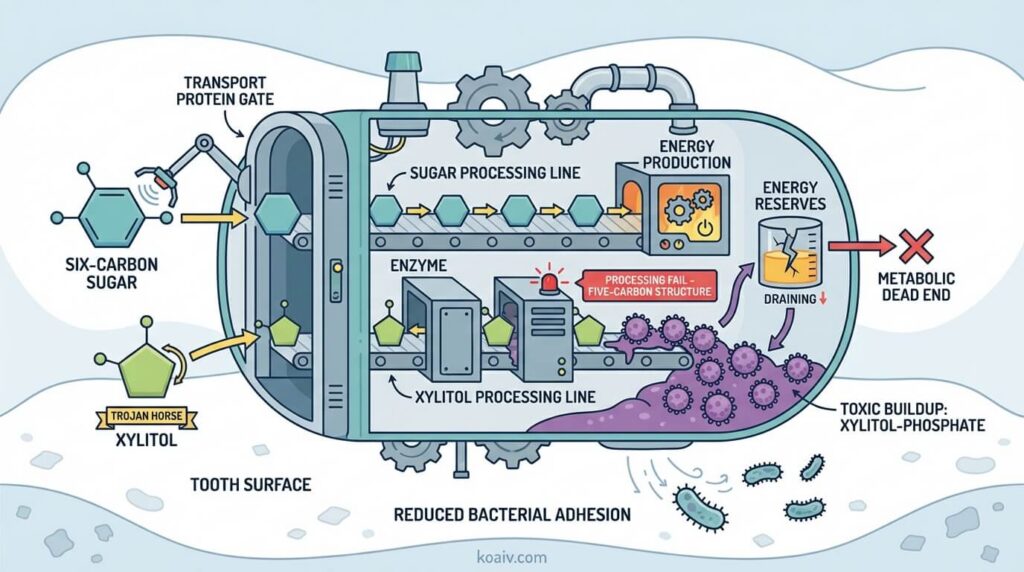
The enzyme system that would normally break down six-carbon sugar and extract energy from it simply cannot process Xylitol’s five-carbon structure. The result is a metabolic dead end. The bacterium has spent energy importing a molecule it cannot use, and the partially processed Xylitol-phosphate compound that accumulates inside the cell actually becomes toxic to it, draining energy reserves without producing anything in return.
This is the Trojan Horse effect in action. The bacteria invite the enemy inside their walls, believing it to be a gift — and the consequences are devastating. Individual bacterial cells are weakened. Their ability to adhere to tooth surfaces (a prerequisite for forming the sticky biofilm known as plaque) is diminished. And over time, with repeated Xylitol exposure, the population of S. mutans in the mouth drops significantly.
Clinical research has quantified this decline with impressive precision. A landmark series of studies conducted in Finland — a country that has been at the forefront of Xylitol research for decades — found that habitual Xylitol use reduced S. mutans counts in saliva by 50 to 75 percent over periods of sustained use, as published in the journal Caries Research. Crucially, this effect appears to be cumulative and durable: the longer and more consistently Xylitol is used, the more pronounced and lasting the bacterial suppression becomes.
But Xylitol’s benefits extend beyond simply starving bacteria. Because S. mutans cannot ferment Xylitol, no lactic acid is produced during or after Xylitol consumption. This means the mouth’s pH remains neutral or even slightly alkaline — precisely the conditions under which remineralization thrives. In other words, Xylitol simultaneously reduces the forces of destruction (fewer bacteria, less acid) while amplifying the forces of repair (higher pH, enhanced mineral redeposition). It tilts the tug-of-war decisively in favor of the tooth.
Beyond Germ Warfare: Xylitol and the New Science of the Oral Microbiome
There is something instinctive — and deeply human — about framing health in terms of warfare. Germs are “invaders.” Antibiotics are “weapons.” The immune system is a “defense force.” This language is vivid, memorable, and, in many contexts, useful. But when it comes to oral health, the war metaphor can actually lead families astray.
The mouth is not meant to be a sterile environment. A healthy oral cavity teems with life — hundreds of bacterial species coexisting in a dynamic, interdependent community that scientists call the oral microbiome. Most of these species are harmless. Many are actively beneficial, contributing to digestion, immune regulation, and the suppression of truly dangerous pathogens. The goal of good oral health is not to eliminate all bacteria — that would be neither possible nor desirable — but to maintain a balanced community in which protective species flourish and harmful ones are kept in check.
This ecological perspective — borrowed from environmental science and increasingly embraced by microbiologists — transforms the way researchers think about cavity prevention. The question is no longer “How do we kill all the bad bacteria?” but rather “How do we create conditions in which the bad bacteria cannot dominate?”
Xylitol, viewed through this lens, is less like an antibiotic and more like a targeted environmental intervention — the oral equivalent of reintroducing wolves to Yellowstone to restore a balanced ecosystem. When S. mutans populations decline under the selective pressure of repeated Xylitol exposure, the ecological niche they once dominated does not simply sit empty. It is gradually colonized by other, less harmful bacterial species — particularly Streptococcus sanguinis and other commensal organisms that are associated with dental health rather than disease. These organisms do not produce significant quantities of acid. They coexist peacefully with tooth enamel. And their presence makes it harder for S. mutans to reestablish dominance, even if Xylitol use is temporarily interrupted.
This is a genuinely exciting shift in thinking, because it suggests that Xylitol’s benefits may be not just additive but transformative — capable of reshaping the oral microbiome in ways that produce lasting protection. It is the difference between constantly bailing water out of a leaking boat and actually repairing the hull.
What the Clinical Evidence Actually Says
Science, at its best, is not a collection of claims but a conversation — one conducted through carefully designed studies, peer review, replication, and healthy skepticism. The evidence on Xylitol and pediatric cavity prevention is substantial, and it deserves to be presented with both confidence and candor.
The most influential research comes from Finland, where Xylitol has been studied and used in public health programs since the 1970s. The Ylivieska studies, conducted over multiple years and involving hundreds of families, produced results that reshaped the field.
In one of the most cited trials, children whose mothers regularly chewed Xylitol gum — beginning shortly after delivery and continuing through the child’s first two years — showed a 70% reduction in cavity rates when assessed at age five, compared to control groups whose mothers received either fluoride varnish treatments or chlorhexidine (an antimicrobial rinse). The magnitude of this difference was striking, and its implications — which will be explored in detail in the next section — opened an entirely new front in pediatric dental prevention.
Subsequent studies have reinforced the core findings. A randomized controlled trial published in the Journal of Dental Research found that children who consumed Xylitol-sweetened syrup three times daily experienced significantly fewer new cavities over a two-year period compared to children receiving a placebo syrup. Research from Belize, Estonia, and several other countries has contributed additional data points, collectively painting a picture of consistent — if sometimes variable in magnitude — protective effects.
It would be intellectually dishonest, however, to present the evidence as uniformly unambiguous. A 2015 Cochrane Review — the gold standard of systematic evidence evaluation in medicine — examined available trials and concluded that while the evidence was “suggestive” of benefit, many existing studies suffered from methodological limitations: small sample sizes, inconsistent Xylitol doses, short follow-up periods, and high dropout rates. The review called not for the abandonment of Xylitol recommendations, but for more rigorous, larger-scale randomized controlled trials designed to establish optimal dosing, frequency, and delivery methods.
What, then, is the responsible conclusion? The American Academy of Pediatric Dentistry (AAPD) has reviewed the totality of evidence and currently recognizes Xylitol as a “beneficial adjunct to caries prevention” — language that is deliberately measured. It means: this is not the only thing families should do, but it is a real, evidence-supported addition to the toolkit. Major dental associations in Finland, Sweden, and Japan have gone further, actively incorporating Xylitol into public health programs. And the World Health Organization has acknowledged the growing evidence base in its own assessments of caries-preventive interventions.
The weight of evidence, in aggregate, points in a clear direction. Xylitol is not a silver bullet — no single intervention is — but it is a meaningful, biologically plausible, and clinically supported tool whose benefits have been demonstrated across multiple populations and study designs.
The Counterintuitive Strategy: Protecting the Baby by Treating the Parent
Of all the insights in this article, the one that most consistently surprises parents — and the one with perhaps the most immediate practical implications — is this: one of the most effective ways to protect a baby’s teeth is to improve the parent’s own oral health.
To understand why, it is necessary to grasp a concept that many parents find startling. Babies are not born with cavity-causing bacteria. A newborn’s mouth is essentially a blank canvas, microbiologically speaking. The bacterial communities that will eventually populate a child’s oral cavity are acquired from the environment — and the single most important source of that acquisition is the primary caregiver.
Researchers have identified a critical developmental window, typically between 6 and 30 months of age, during which infants are most susceptible to initial colonization by S. mutans. Scientists call this the “window of infectivity.” During this period, the ordinary, loving interactions of daily caregiving — tasting a spoonful of food before offering it to the baby, blowing on a hot bite to cool it down, sharing a cup, kissing the child on or near the mouth — serve as transmission routes for bacteria. The parent’s S. mutans, carried in saliva, find their way into the infant’s mouth and, if conditions are favorable, establish permanent colonies. Microbiologists call this process vertical transmission, borrowing a term from infectious disease epidemiology.
Here is the crucial connection: the timing and intensity of initial S. mutanscolonization appear to have lasting consequences. Children who acquire high levels of S. mutans early in life tend to develop more cavities throughout childhood and into adolescence. Children who experience delayed or reduced colonization — because their caregivers carried fewer S. mutans to transmit — tend to have measurably better dental outcomes years later. The first bacterial settlers, in a sense, shape the landscape of the oral microbiome for years to come, much like the first plants to colonize a bare patch of ground determine what kind of ecosystem will eventually grow there.
This is where maternal (and paternal, and grandparental) Xylitol use becomes so powerful. When primary caregivers chew Xylitol gum regularly — particularly during the perinatal period (late pregnancy and the child’s first two years) — their own S. mutanscounts drop, as the Trojan Horse mechanism described earlier takes effect. Fewer bacteria in the caregiver’s mouth means fewer bacteria available for transmission. Fewer transmitted bacteria means a lower probability of early, heavy colonization in the infant. And lower colonization means fewer cavities — not just in the short term, but potentially across the full arc of childhood.
A systematic review published in Pediatric Dentistry found that maternal Xylitol gum use, initiated during the perinatal period, was associated with significantly lower ECC rates in children at age five — even in cases where the children themselves never directly consumed Xylitol products. The implication is profound: a parent chewing gum with the right sweetener can, through the simple biology of shared daily life, alter the bacterial destiny of a child’s mouth.
This is not to suggest that parents should feel guilty about kissing their babies or sharing meals — these are deeply important bonding behaviors that no one should abandon. Rather, the insight is an empowering one: by taking a simple, proactive step to manage their own oral bacterial load, caregivers can meaningfully reduce risk for their children. It is one of the most elegant examples in pediatric health of how one generation’s habits quietly shape the next generation’s outcomes.
Fluoride and Xylitol: Understanding Why They Work Better Together
The rise of Xylitol has, unfortunately, been accompanied by a false dichotomy in some parenting communities — a belief that families must choose between Xylitol and fluoride, as if the two were competing ideologies rather than complementary tools. This framing, while understandable in an era of information overload and strong opinions about children’s health products, fundamentally misunderstands how each substance works.
Fluoride and Xylitol target the cavity process at entirely different stages and through entirely different mechanisms. To illustrate, consider the analogy of defending a medieval castle.
Fluoride is the process of reinforcing the castle walls. When fluoride ions are incorporated into the enamel’s mineral structure, they replace some of the hydroxyl groups in hydroxyapatite, creating a compound called fluorapatite. Fluorapatite is significantly more resistant to acid dissolution than regular enamel — in chemical terms, it has a lower critical pH, meaning it can withstand a more acidic environment before demineralization begins. Fluoride varnishes applied by a dentist and fluoride toothpastes used at home achieve this hardening effect, and decades of research have made fluoride one of the most thoroughly validated preventive interventions in all of healthcare.
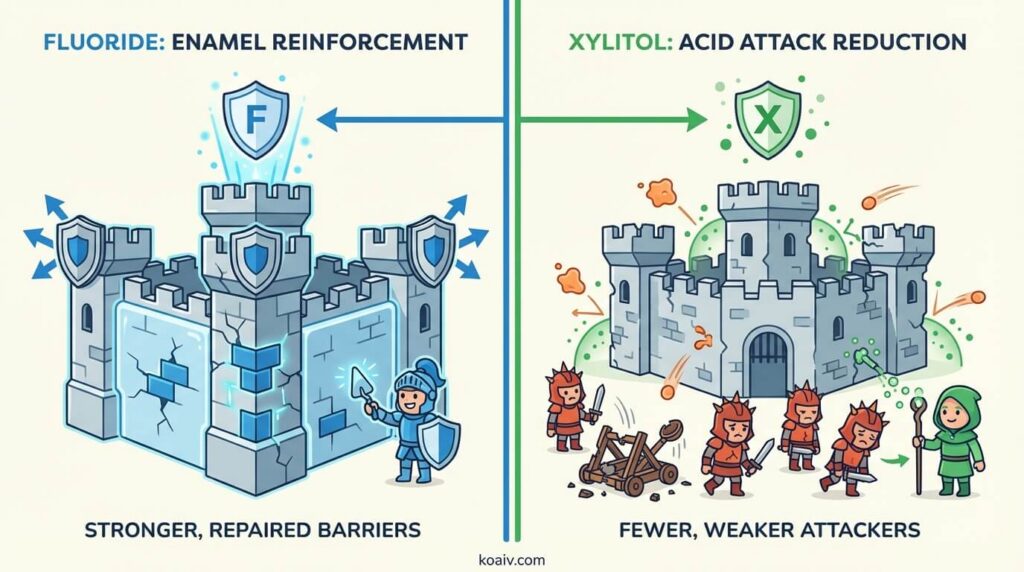
Xylitol, by contrast, is not about reinforcing the walls at all. It is about reducing the size and ferocity of the attacking army. By starving S. mutans, reducing bacterial adhesion, and preventing acid production, Xylitol diminishes the assault that the walls must withstand in the first place.
The logic of combining these two approaches is self-evident: fewer attackers producing less acid against a structurally stronger defense. Multiple clinical studies have confirmed that the combination produces additive protective effects — meaning that the level of protection achieved by using both fluoride and Xylitol together is greater than what either provides alone. One study published in BMC Oral Health found that children using both a fluoride toothpaste and Xylitol-containing products showed significantly lower new cavity rates over a three-year period compared to groups using either intervention in isolation.
For families, the practical message is reassuring: there is no need to choose sides. A child can brush with a fluoride toothpaste, receive fluoride varnish during dental visits, and benefit from Xylitol exposure — and in doing so, receive a layered, multi-mechanism defense against a disease that is, at its core, driven by a single biological chain reaction.
A Practical Guide: Integrating Xylitol Into Family Life, Stage by Stage
Evidence and mechanisms, however compelling on paper, matter only insofar as families can translate them into action. The most common question pediatric dentists hear after explaining Xylitol’s benefits is a practical one: “Okay, but what exactly do I buy, and how do I use it?”
The answer varies by the child’s age, because the appropriate delivery format and the locus of intervention shift as children grow.
During pregnancy and the newborn period, the most impactful step is for the primary caregiver — not the baby — to begin using Xylitol. Chewing Xylitol-sweetened gum is the simplest and most well-studied approach. The target dose, based on the clinical literature, is approximately 6 to 10 grams of Xylitol per day, distributed across three to five chewing sessions (for example, after each meal and before bed).
When reading product labels, it is important to verify that Xylitol is listed as the first ingredient — many “sugar-free” gums contain only trace amounts of Xylitol and rely primarily on other sweeteners like sorbitol, which do not share Xylitol’s anti-cariogenic properties. For the newborn directly, the intervention is gentler: Xylitol-infused dental wipes — soft, textured pads designed to be swiped across the gum line — provide a way to clear milk sugars after feeding while introducing a small amount of Xylitol to the oral environment. This also begins establishing a cleaning routine that will become increasingly important as teeth erupt.
Between the ages of one and three, the stakes rise, because this period overlaps directly with the window of infectivity — the phase during which the child’s oral microbiome is most actively being shaped by environmental exposure.
This is the stage at which direct Xylitol exposure for the child becomes most critical. Xylitol-containing infant toothpastes, specifically formulated for young children and safe to swallow (an important feature, since reliable spitting is a skill most children do not master until around age three), should be used in a grain-of-rice-sized amount during twice-daily brushing. Xylitol oral gels or drops, which are typically pleasant-tasting and can be applied directly to the gums or mixed into a small quantity of water after meals, offer a supplementary delivery mechanism. Throughout this period, caregivers should continue their own Xylitol gum regimen as well.
From age three onward, the range of available options broadens considerably. Children who can spit reliably can begin using Xylitol-containing toothpastes that also include age-appropriate levels of fluoride — combining both protective mechanisms in a single product. Xylitol lollipops and gummy bears, formulated specifically for pediatric dental use (and available from brands like Dr. John’s, Zollipops, and others), offer a child-friendly format that turns cavity prevention into something a child actively wants to do. For older children and adults, Xylitol chewing gum remains the most convenient, best-studied, and most portable option.
| Age Range | Recommended Xylitol Format | Key Notes |
|---|---|---|
| Newborn – 12 months | Caregiver gum chewing; infant dental wipes | Focus on reducing caregiver’s S. mutans |
| 1 – 3 years | Infant toothpaste, oral gel/drops | Safe-to-swallow; grain-of-rice application |
| 3+ years | Xylitol toothpaste, lollipops, gum | Teach spitting; pair with fluoride |
One principle runs consistently through all of these recommendations, regardless of age: frequency of exposure matters more than total daily quantity. The goal is to maintain a consistently Xylitol-rich oral environment that suppresses S. mutans throughout the day, not to deliver a single overwhelming dose. Small exposures distributed across the day — particularly after meals and before sleep, when bacterial activity is highest — are substantially more effective than one large exposure. Think of it as the difference between watering a garden with a gentle sprinkler running intermittently throughout the day versus dumping a single bucket of water on it in the morning: the total volume might be the same, but the sustained approach produces far better results.
Safety, Dosage, and a Warning That Cannot Be Overstated
Xylitol has been used in food products and dental applications for decades, and its safety profile in humans is well-established. Regulatory agencies including the U.S. Food and Drug Administration (FDA) classify it as Generally Recognized as Safe (GRAS). At the quantities typically used in dental hygiene products — wipes, gels, toothpastes, gums — side effects are rare and mild.
That said, because Xylitol is a sugar alcohol, it does have one property that families should be aware of: in large quantities, it can draw water into the large intestine through a process called osmosis (the same mechanism by which prunes have their well-known laxative effect). This can cause loose stools, gas, or bloating. For infants and toddlers, the amounts present in dental wipes or a tiny smear of toothpaste are far below any threshold of gastrointestinal concern. However, parents introducing Xylitol for the first time should do so gradually, starting with small amounts and observing their child’s response before increasing frequency.
There is, however, one safety warning that demands its own paragraph, its own emphasis, and no hedging whatsoever.
⚠️ Xylitol is acutely and rapidly lethal to dogs. Even very small amounts — as little as 0.1 grams per kilogram of body weight, roughly the amount in a single piece of Xylitol gum — can trigger a massive release of insulin in dogs, causing a dangerous and potentially fatal drop in blood sugar (hypoglycemia). Larger doses can cause irreversible liver failure. The onset of symptoms can be rapid, occurring within 15 to 30 minutes of ingestion. There is no safe dose of Xylitol for dogs.
For families with both young children and dogs — which is to say, a very large number of families — this means that Xylitol-containing products must be stored with the same care as medications: on high shelves or in latched cabinets, out of reach of both children and pets. Used Xylitol dental wipes should be discarded in pet-proof trash receptacles. Tubes of Xylitol toothpaste should never be left on low counters or bathroom floors. And every member of the household old enough to understand should be aware of the danger.
This is not an afterthought or a footnote. It is essential household safety information, and it is the one non-negotiable caveat of any responsible discussion of Xylitol use in family homes.
The Bigger Picture: A Powerful Tool Within a Larger Framework
There is a temptation, when encountering a substance as elegant and well-supported as Xylitol, to elevate it to the status of a cure-all — to imagine that a piece of gum or a dental wipe can, by itself, guarantee a cavity-free childhood. That temptation should be resisted, not because Xylitol falls short of its promise, but because Early Childhood Caries is a multifactorial disease — a condition shaped by the interplay of diet, hygiene practices, bacterial exposure, socioeconomic factors, access to dental care, genetics, and even the mineral content of the local water supply. No single intervention, however powerful, can fully address a problem of that complexity.
What Xylitol offers is something genuinely valuable but appropriately bounded: it is a clinically validated, biologically sophisticated layer of protection that addresses the cavity process at a point — bacterial metabolism — that brushing and fluoride do not directly reach. Its greatest strength lies not in replacing existing preventive measures, but in completing them.
The metaphor that best captures its role is architectural. A strong dental health routine is a well-constructed building. Twice-daily brushing with proper technique provides the structural walls — the mechanical removal of plaque and food debris that is the foundation of oral hygiene. Flossing (which becomes relevant once a child has two teeth that touch) addresses the spaces between teeth that a brush cannot reach, like sealing the gaps between wall panels. Fluoride provides the fortified exterior — the chemically hardened enamel surface that resists acid attack. A diet thoughtfully limited in frequent sugary snacks reduces the supply lines that feed the bacterial army. Regular dental checkups provide professional surveillance, catching problems early and reinforcing home care.
Xylitol, in this framework, is the early-warning system and the environmental control — the layer that monitors the bacterial population, suppresses the most dangerous organisms, and maintains the conditions under which all the other defenses function at their best. Remove any single layer, and the building still stands — but it stands less securely. Include all of them, and the structure becomes genuinely formidable.
For families navigating the overwhelming landscape of pediatric health advice — where every product claims to be essential and every headline warns of a new danger — this kind of layered, evidence-based thinking offers real clarity. Xylitol is not a substitute for brushing. It is not an excuse to skip the dentist. It is not a magic bullet. It is something better: a legitimate, well-understood, and practically accessible tool that meaningfully reduces risk when used consistently as part of a comprehensive approach.
In a world where nearly one in five young children will develop a cavity before their first day of kindergarten, “meaningfully reduces risk” is not a small thing. It is the difference between hoping for the best and actively stacking the odds in a child’s favor.
And perhaps the most quietly remarkable aspect of the Xylitol story is how simple the entry point is. A parent chewing a different brand of gum. A dental wipe after a midnight feeding. A toothpaste chosen for its sweetener rather than its cartoon character. These are small, undramatic actions — the kind that would never make a headline. But they operate at the level of microbiology, reshaping invisible ecosystems in ways that a child may never consciously know about but will carry, in the strength and health of their teeth, for decades to come.
The sweet secret, in the end, is not that such a tool exists. It is that it has been here — in birch bark, in berries, in the pages of dental journals — for longer than most parents realize, waiting to be understood, embraced, and put to use.
Sources and further reading:
- Occurrence of dental decay in children after maternal consumption of xylitol chewing gum, a follow-up from 0 to 5 years of age
- Xylitol pediatric topical oral syrup to prevent dental caries: a double blind, randomized clinical trial of efficacy
- Xylitol candies in caries prevention: results of a field study in Estonian children
- The effect of xylitol chewing gums and candies on caries occurrence in children: a systematic review with special reference to caries level at study baseline
- Policy on the Use of Xylitol in Pediatric Dentistry
- Global oral health status report: towards universal health coverage for oral health by 2030