

Why-Is-Lactose-Important-for-Babies
Why Is Lactose Important for Babies?
Why is lactose important for babies? It serves as a biological masterpiece that fuels rapid physical growth, provides essential galactose for infant brain development, acts as a prebiotic to cultivate a healthy gut microbiome, and functions as a vital mineral magnet to enhance the absorption of calcium and iron for long-term health.
In nearly every corner of the modern wellness industry, sugar has become the villain. Parents scan ingredient lists with forensic intensity, flag anything ending in “-ose,” and celebrate products stamped with the words “sugar-free.” It is a reasonable instinct in a world where childhood obesity and processed food dominate public health conversations. But there is a profound irony buried inside this well-intentioned vigilance: the single most nutritionally perfect food ever created for a human infant — breast milk — is, by any measure, sweet. Remarkably sweet, in fact. And the source of that sweetness is a sugar called lactose.
This is not a design flaw. It is, as decades of nutritional science and evolutionary biology have confirmed, one of the most elegant solutions nature has ever engineered.
Lactose does not behave like the sugars parents have been taught to fear. It does not cause tooth decay in a toothless newborn. It does not trigger the metabolic chaos of a candy bar. Instead, it quietly and relentlessly does something extraordinary: it builds babies. It fuels the body’s astonishing first-year growth spurt. It supplies raw materials for the construction of brain tissue. It seeds the invisible ecosystem of gut bacteria that will defend the child’s health for a lifetime. And it escorts critical minerals — calcium, iron, zinc — across the intestinal wall and into the bloodstream where they are desperately needed.
What Exactly Is Lactose?
Every sugar found in food belongs to a family of molecules called carbohydrates. Some carbohydrates are small and simple, like a single bead on a string. Others are long and complex, like an entire necklace. Lactose sits near the simpler end of the spectrum, but with an important twist.
Lactose is a disaccharide — a word that literally means “two sugars.” It is formed by bonding together two smaller, simpler sugar molecules:
- Glucose — the body’s universal energy currency, used by virtually every cell to power its work.
- Galactose — a less well-known sugar with a highly specialized job: building complex structures in the brain and nervous system.
Think of lactose as a two-car train. When the train arrives at its destination — the lining of the small intestine — a specific enzyme called lactase acts like a coupling mechanism in reverse, splitting the train into its two individual cars and sending each one off on a different, critically important mission. Glucose heads to muscles, organs, and cells that need immediate energy. Galactose heads, in large part, to the brain.
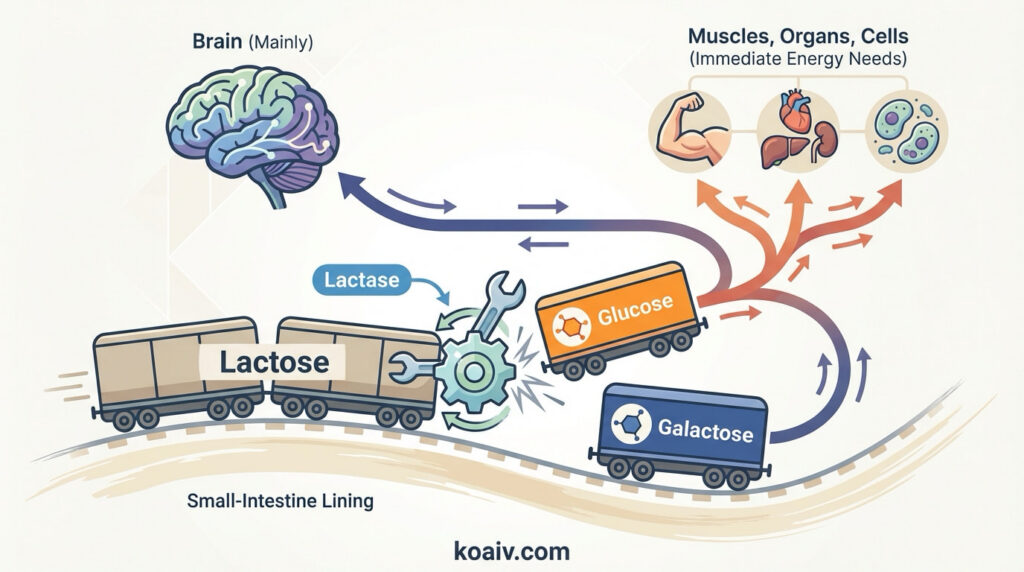
This two-part structure is not a biochemical coincidence. It is, as we will see, the secret behind lactose’s remarkable versatility. A single molecule, consumed in every sip of milk, simultaneously addresses two of the infant body’s most urgent needs: energy and neural construction.
How Much Lactose Is in Breast Milk
Human breast milk contains approximately 7 grams of lactose per 100 milliliters. To put that in perspective, cow’s milk — the basis for most standard infant formulas — contains about 4.7 grams per 100 mL. Goat’s milk has even less, at around 4.1 grams. Horse milk comes closest to human levels, at about 6.2 grams.
Here is the question worth pausing on: why does human milk contain more lactose than the milk of almost any other large mammal on Earth?
The answer, as we will explore in detail in the sections on brain development, lies in the extraordinary metabolic demands of the human infant brain — an organ that, relative to body size, is far larger and far more energy-hungry than the brain of any calf, kid, or foal. Evolution has calibrated human milk’s lactose concentration to match the unique needs of the most neurologically complex infant on the planet.
A Quick Note on Terminology:
Throughout this article, the words “sugar” and “carbohydrate” are used in their scientific sense — referring to a broad category of molecules that serve as the body’s primary energy source. This is very different from the colloquial use of “sugar” to mean added, refined sweeteners like table sugar (sucrose) or high-fructose corn syrup. Lactose is a naturally occurring sugar, present in mammalian milk precisely because infant biology demands it. Conflating it with the added sugars in processed food is a common but significant misunderstanding.
Why Babies Need So Much Energy, and How Lactose Delivers It
To truly appreciate what lactose does, one must first appreciate the sheer scale of what a baby’s body is attempting in its first year.
Consider these numbers: a healthy newborn typically weighs between 2.5 and 4.5 kilograms (roughly 5.5 to 10 pounds). By six months, most babies have doubled that weight. By their first birthday, they have tripled it. In no other period of postnatal life does the human body grow this fast.
But weight gain is only the most visible part of the story. Beneath the surface, the body is executing a construction project of staggering complexity. Bones are hardening through a process called mineralization. Organs — the liver, kidneys, lungs, heart — are maturing from functional-but-rudimentary structures into fully capable systems. The immune system is learning to distinguish friend from foe. And in the brain, millions of neural connections are being forged every single day.
All of this requires fuel. A tremendous, unrelenting supply of fuel.
Lactose: The 40 Percent Solution
According to research published by the National Institutes of Health (NIH), lactose provides approximately 40 percent of a breastfed infant’s total daily caloric intake. That is an extraordinary figure — nearly half of everything that powers a baby’s body comes from this single molecule.
For context, imagine an adult whose entire diet was structured so that 40 percent of daily calories came from one food. That food would need to be exceptionally reliable, exceptionally efficient, and exceptionally well-suited to the body’s needs. Lactose meets all three criteria.
The “Slow-Burn” Advantage: Why Lactose Energy Is Different
Not all sugars deliver energy in the same way. To understand what makes lactose special, consider an analogy.
Imagine lighting a fire. Refined table sugar (sucrose) is like crumpled newspaper — it ignites instantly, burns hot and bright, and is reduced to ash in seconds. The energy it provides is fast but fleeting, and it leaves the body scrambling to regulate a sudden spike in blood glucose.
Lactose, by contrast, is like a seasoned hardwood log. It catches more slowly, but once burning, it produces a steady, sustained warmth that lasts for hours.
The reason for this difference is mechanical. Sucrose dissolves quickly and is absorbed rapidly through the intestinal wall. Lactose, however, must first be enzymatically cleaved — split apart by the lactase enzyme — before its component sugars can enter the bloodstream. This extra processing step acts as a natural speed governor, ensuring that glucose is released gradually rather than all at once.
For an infant — whose blood sugar regulation systems, hormone responses, and metabolic feedback loops are all still developing and learning to calibrate — this slow, steady energy delivery is not a minor advantage. It is a critical safety feature. There are no glucose spikes, no reactive drops, no metabolic roller coasters. Just a calm, continuous current of fuel for a body that never stops building.
Building the Baby Brain: Why Lactose Is Rocket Fuel for Cognitive Development
If lactose’s role as an energy source were its only contribution, it would already be indispensable. But the story goes much deeper — and much more fascinating.
Recall that when lactase splits lactose, it produces two sugars: glucose and galactose. Glucose, as discussed, powers the body. But galactose — the quieter, less famous half of the pair — has a job that is arguably even more important.
Galactose is a primary building material for the human brain.
Why Human Babies Are Born “Unfinished” — and What That Has to Do with Milk
To understand why galactose matters so much, it helps to understand a peculiar fact about human infants that sets them apart from nearly every other newborn mammal.
A baby horse (foal) stands up and walks within hours of birth. A baby deer (fawn) can run from predators within days. A baby dolphin swims alongside its mother immediately. Yet a human baby cannot hold up its own head for weeks, cannot sit without support for months, and will not walk for nearly a year.
This is not because human babies are poorly designed. It is because they are running the most complex neurological operating system on the planet, and that system is too large and too intricate to be fully installed before birth.
The human brain is enormous relative to body size — and the birth canal is only so wide. Evolution’s solution to this engineering constraint was elegant: deliver the baby with a brain that is, in effect, only about 25 percent complete, and then continue the most intensive phase of brain construction after birth, fueled by the nutrients in milk.
This is why human milk is uniquely rich in lactose. Human babies are uniquely dependent on postnatal brain development, and that development requires an enormous, sustained supply of galactose.
Galactose and Myelination: Insulating the Brain’s Wiring
Inside the infant brain, billions of nerve cells (neurons) are communicating with each other through long, thin fibers called axons. These axons carry electrical signals — the language of thought, sensation, and movement — from one part of the brain to another, and from the brain to the rest of the body.
In a newborn, most of these axons are “bare” — uninsulated, like copper wires running through a house without their plastic coating. Signals travel through them, but slowly and inefficiently, sometimes losing strength or misfiring along the way. This is why newborn movements are jerky and uncoordinated, why reflexes are crude, and why sensory processing is limited.
Over the first several years of life, the body wraps these axons in a fatty, insulating layer called myelin — in a process called myelination. Myelin does for nerve signals what rubber insulation does for electrical wires: it prevents signal loss, prevents “short circuits” between adjacent fibers, and dramatically increases the speed of transmission. A myelinated nerve fiber can carry signals up to 100 meters per second, compared to roughly 1-2 meters per second in an unmyelinated fiber.
Here is where galactose enters the picture: myelin is constructed from complex fat molecules called galactolipids — and galactose, derived from lactose in milk, is an essential raw material for their synthesis. Without adequate galactose, the myelination process slows or falters, with downstream effects on motor coordination, language acquisition, memory formation, and virtually every other cognitive milestone parents eagerly await.
In other words, every time a baby drinks milk, the lactose in that milk is providing construction materials for the insulation that will allow the brain to gradually transform from a slow, imprecise instrument into the most powerful information-processing organ in the known biological world.
Beyond Galactose: Sialylated Oligosaccharides and Synapse Formation
Recent research has expanded the lactose-brain story even further. Human milk contains a family of complex sugar compounds called sialylated oligosaccharides (SL)that are structurally related to lactose. While the name sounds forbidding, the concept is straightforward: these are sophisticated sugar molecules that help build and refine the connections between neurons.
Every thought, memory, and learned behavior depends on the formation of synapses — the tiny junction points where one neuron communicates with another. The infant brain is forming synapses at an almost incomprehensible rate: an estimated one million new connections per second during the first few years of life.
Studies published in Advances in Nutrition and supported by research at the National Institutes of Health have demonstrated that sialylated oligosaccharides from human milk support this synaptic explosion. In animal models (primarily young pigs, whose brain development shares meaningful similarities with human infants), dietary supplementation with SL has been associated with measurable improvements in both myelination and ganglioside biosynthesis — the latter being a process that helps stabilize the cell membranes of neurons, making synaptic connections stronger and more reliable.
The implication is striking: lactose and its molecular relatives are not merely fueling the brain. They are helping to wire it.
How Lactose Shapes the Gut Microbiome
The story of lactose takes another fascinating turn when it moves beyond the small intestine — the place where most of it is digested — and enters the large intestine, or colon.
To understand what happens next, one must first understand a concept that has transformed modern medicine over the past two decades: the gut microbiome.
What Is the Gut Microbiome? A Brief Primer
The human digestive tract is not sterile. It is home to an estimated 38 trillion microorganisms — primarily bacteria, but also fungi, viruses, and other tiny life forms — collectively known as the gut microbiome. That is roughly as many microbial cells as there are human cells in the entire body.
Far from being passive hitchhikers, these microbes are active participants in human health. They help digest food that human enzymes cannot break down. They produce vitamins (including certain B vitamins and vitamin K). They train and calibrate the immune system. They even communicate with the brain through a network of chemical signals along what scientists call the gut-brain axis.
A baby is born with a gut that is nearly sterile — a blank garden bed with almost no microbes. Over the first weeks and months of life, that garden must be planted, fertilized, and cultivated. The composition of the microbiome that is established during this critical window will influence the child’s health for years — potentially for life.
And one of the most important fertilizers for that garden? Lactose.
Lactose as a Prebiotic: Feeding the Good Bacteria
Not all of the lactose a baby consumes is digested and absorbed in the small intestine. A measurable fraction passes through to the colon intact. Once there, it does not go to waste. Instead, it serves as a prebiotic — a substance that selectively feeds beneficial bacteria.
(A quick terminology note: a probiotic is a live beneficial microorganism, like those found in yogurt. A prebiotic is food for those microorganisms. Lactose functions as a prebiotic.)
The bacteria that feast most enthusiastically on lactose are the very species that pediatric and microbiome scientists most want to see flourishing in an infant’s gut: Bifidobacterium and Lactobacillus. These genera are the foundation of a healthy infant microbiome. They have been associated in dozens of studies with improved digestion, stronger immune function, and reduced risk of gastrointestinal infections.
The Lactic Acid Shield: How Good Bacteria Protect the Gut
As Bifidobacterium and Lactobacillus ferment lactose, they produce a byproduct: lactic acid. This shifts the pH of the intestinal environment downward, creating mild acidity.
Why does this matter? Because most disease-causing bacteria — pathogens like Salmonella, Clostridium difficile, and certain strains of E. coli — thrive in neutral or slightly alkaline environments. They struggle, and often cannot survive, in acidic conditions. The lactic acid produced from lactose fermentation essentially turns the infant’s colon into a gated community — welcoming to beneficial species, inhospitable to dangerous ones.
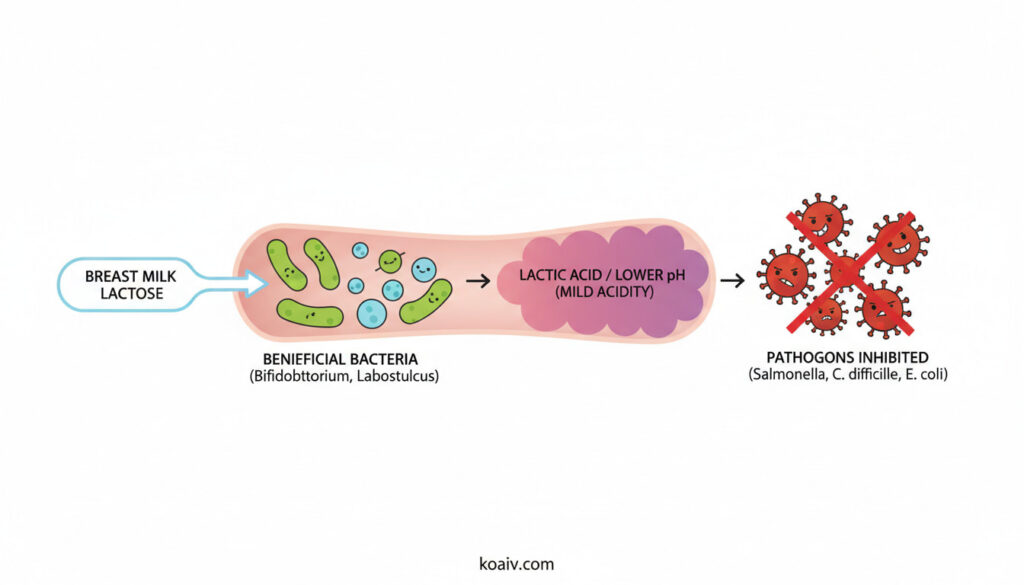
The elegance of this system is worth pausing to admire. The mother produces milk containing lactose. The lactose feeds the good bacteria. The good bacteria produce acid. The acid kills the bad bacteria. No pharmaceutical, no intervention, no conscious decision required. Just milk.
The Long-Term Immune Payoff
The microbiome established in infancy does not merely protect against acute infections in the short term. A growing body of evidence, including a landmark 2022 review in Frontiers in Microbiology, suggests that the composition and diversity of the early gut microbiome has lasting consequences for the maturation and calibration of the immune system.
The developing immune system must accomplish an extraordinarily delicate task: it must learn to attack genuine threats (viruses, pathogenic bacteria, cancer cells) while notattacking harmless substances (food proteins, pollen, the child’s own tissues). Getting this calibration wrong leads to one of two problems: immune deficiency (failing to fight real threats) or immune overreaction (allergies, asthma, autoimmune conditions).
The early microbiome — seeded in large part by the prebiotic action of lactose — appears to play a central role in teaching the immune system this distinction. Research has associated a robust, Bifidobacterium-dominated infant microbiome with reduced risk of:
- Eczema and atopic dermatitis in early childhood
- Food allergies, particularly to common allergens like peanuts and eggs
- Asthma and respiratory allergies in school-age children
- Inflammatory bowel disease (Crohn’s disease, ulcerative colitis) in later life
The investment lactose makes in the microbiome during infancy is, in essence, an investment in decades of immune competence.
How Lactose Helps the Body Absorb What It Needs Most
Lactose’s contributions do not end with energy, brain development, or microbiome cultivation. It also plays a quieter but critically important supporting role: it enhances the absorption of minerals that the infant body desperately needs but cannot always efficiently extract from food on its own.
Calcium: The Bone Builder
Calcium is the primary structural mineral in bone tissue. An infant’s skeleton — which must grow from birth size to toddler size in twelve months — has an enormous and continuous demand for calcium. Breast milk and formula both contain calcium, but simply having calcium in the milk is not enough. The body must be able to absorb it through the intestinal wall and deliver it to the bones.
This is where lactose’s relationship with calcium becomes important. The lactic acid produced when gut bacteria ferment lactose lowers intestinal pH, and this mild acidity has a direct chemical effect on calcium: it converts calcium into a more soluble form — a form that dissolves more easily and passes through the intestinal lining far more efficiently.
Think of it this way: calcium in a neutral environment is like a sugar cube sitting in cold water — it will dissolve eventually, but slowly and incompletely. Calcium in a mildly acidic environment is like a sugar cube in warm water — it dissolves quickly and thoroughly. Lactose, by fostering the conditions that produce lactic acid, effectively “warms the water” for calcium absorption.
Without this mechanism, a significant portion of the calcium in milk would pass through the digestive tract unabsorbed — a waste that the rapidly growing skeleton cannot afford.
Iron, Zinc, and Magnesium: The Trace Mineral Team
Beyond calcium, lactose has been shown to enhance the bioavailability (the proportion that the body actually absorbs and uses) of several essential trace minerals:
- Iron is required for the production of hemoglobin, the protein in red blood cells that carries oxygen to every tissue in the body. Iron deficiency in infancy leads to anemia — a condition associated with fatigue, developmental delays, and impaired cognitive function.
- Zinc is vital for cellular repair, wound healing, and the proper functioning of over 300 enzymes involved in digestion, metabolism, and immune defense.
- Magnesium supports nerve and muscle function, helps regulate heart rhythm, and contributes to bone strength.
Lactose does not contain these minerals. Rather, it creates the intestinal conditions — the right pH, the right microbial environment — that allow these minerals to be absorbed at higher rates. In this sense, lactose is less a nutrient in isolation and more a nutrient multiplier — a molecule that makes other nutrients work better.
Breast Milk, Formula, and Lactose
The science of lactose is fascinating, but parents navigating infant feeding decisions need practical clarity. Where does a baby’s lactose come from in real life, and how do different feeding choices affect lactose intake?
Breast Milk: The Self-Adjusting Gold Standard
Human breast milk is not a static liquid. It is a remarkably dynamic food that changes its composition in real time — within a single feeding session (foremilk vs. hindmilk), across the hours of a day (morning milk differs from evening milk), and over the months of lactation (colostrum differs substantially from mature milk).
Through all of these adjustments, one component remains notably stable: lactose. Its concentration remains consistently high (around 7 g/100 mL) from the early weeks through extended breastfeeding. This consistency underscores how fundamental lactose is to infant nutrition — it is the one macronutrient the body does not dial up or down based on circumstance.
Standard Infant Formulas: Replicating the Blueprint
For families who use infant formula — whether by choice, necessity, or as a supplement to breastfeeding — understanding the carbohydrate source is important. Reputable, standard cow’s milk-based formulas manufactured by major brands deliberately use lactose as their primary carbohydrate, precisely because decades of nutritional science have established that lactose is the carbohydrate best suited to infant physiology. Both the American Academy of Pediatrics (AAP) and the World Health Organization (WHO) recognize lactose-containing formula as the appropriate standard for healthy, full-term infants.
When evaluating a formula, parents can check the ingredient list: in a standard formula, lactose should appear as the first or second listed carbohydrate source — indicating that it is present in the highest quantity.
Specialty and Lactose-Free Formulas: Necessary for Some, Not for All
There are genuine medical conditions that require lactose-free feeding:
- Congenital Lactase Deficiency — an extremely rare genetic condition in which a baby is born without the ability to produce lactase. Affected infants require a lactose-free formula from birth.
- Galactosemia — a rare metabolic disorder in which the body cannot process galactose. Lactose-containing products must be completely avoided.
- Severe Secondary Lactose Intolerance — in rare cases following significant intestinal injury, temporary lactose removal may be recommended by a physician.
In these formulas, lactose is replaced with alternative carbohydrates such as corn syrup solids, maltodextrin, or sucrose. These substitutes are medically safe and nutritionally adequate for the specific populations that require them. However, they do not provide lactose’s prebiotic benefits (feeding beneficial gut bacteria), its slow-release energy profile, or its mineral absorption enhancement. For this reason, lactose-free formulas are therapeutic tools for specific medical conditions — not upgrades for healthy infants.
What “Lactose Intolerance” Actually Means in Babies
Perhaps no topic in infant nutrition generates more unnecessary anxiety — and more misguided formula-switching — than the fear of lactose intolerance. A baby cries after a feed. A baby has loose stools. A baby is gassy. And a conclusion is reached: “My baby must be lactose intolerant.”
In the vast majority of cases, this conclusion is premature — and the intervention it leads to (removing lactose from the diet) may do more harm than good. Understanding why requires distinguishing between several conditions that are frequently — and dangerously — confused.
True Congenital Lactose Intolerance: Real, but Extraordinarily Rare
Genuine congenital lactase deficiency — being born completely without the enzyme to digest lactose — exists, but it is one of the rarest genetic conditions known to medicine. It was first identified and is most prevalent in Finland, where it may affect roughly 1 in 60,000 births. In most of the world, incidence is even lower.
A baby with this condition displays severe symptoms (explosive diarrhea, dehydration, failure to thrive) from the very first breastfeed or formula feed, and diagnosis is typically made within days of birth. This is a profoundly different scenario from the garden-variety fussiness that causes parents to wonder about lactose tolerance in a two-month-old.
The More Likely Culprit: Cow’s Milk Protein Allergy (CMPA)
Many infants who appear to “react badly to milk” are not reacting to the lactose (the sugar) at all. They are reacting to the proteins — specifically casein and whey — present in cow’s milk.
Cow’s Milk Protein Allergy (CMPA) is an immune-mediated condition — the body’s defense system mistakenly identifies cow’s milk proteins as threats and mounts an inflammatory response. Symptoms can include skin rashes (eczema, hives), blood in the stool, persistent vomiting, respiratory symptoms, and irritability. CMPA affects an estimated 2-3 percent of infants in the first year of life, making it far more common than true lactose intolerance.
The distinction is not academic — it is medically critical. Switching to a lactose-freeformula will not help a baby with CMPA, because the offending proteins are still present. What these infants need is an extensively hydrolyzed or amino acid-based formula, in which the problematic proteins have been broken down into fragments too small to trigger an immune reaction. Confusing protein allergy with sugar intolerance leads to the wrong treatment, delays proper diagnosis, and prolongs the infant’s discomfort.
Lactose Overload: A Feeding Technique Issue, Not a Medical Problem
Among breastfed infants, a pattern sometimes called foremilk-hindmilk imbalance can produce symptoms that mimic lactose intolerance — but with an entirely different cause and solution.
To understand this, it helps to know that breast milk is not uniform throughout a feeding. The milk that flows first when a baby latches — called foremilk — is thinner, more watery, and relatively high in lactose. As the feeding continues and the breast empties, the milk transitions to hindmilk, which is thicker, fattier, and more calorically dense.
If a baby feeds briefly on one breast and is then switched to the other breast before the first is sufficiently drained, the baby may consume a disproportionately large volume of high-lactose foremilk from both breasts — more lactose than the available lactase enzyme can process at once. The excess lactose passes undigested into the colon, where it ferments, producing gas, bloating, and green, frothy, acidic stools.
This pattern can look alarming, but the solution is simple and does not involve eliminating lactose. It typically involves allowing the baby to finish one breast more fully before switching to the other, ensuring a more balanced intake of foremilk and hindmilk. A lactation consultant or pediatrician can provide guidance tailored to the specific situation.
Secondary Lactose Intolerance: Temporary and Self-Resolving
Following a significant gastrointestinal illness — such as rotavirus gastroenteritis (a common cause of severe stomach flu in infants) — the cells lining the small intestine can sustain damage. Because these cells are where the lactase enzyme is produced, temporary damage to the lining means temporary reduction in lactase production — and temporary difficulty digesting lactose.
The key word here is temporary. In most cases, secondary lactose intolerance resolves on its own within two to four weeks as the gut lining regenerates and lactase production returns to normal. Major pediatric guidelines, including those from the AAP, generally advise against permanently switching to a lactose-free formula on the basis of a single episode of secondary intolerance unless the situation is severe and persistent.
Frequently Asked Questions About Lactose and Babies
Will lactose cause hyperactivity in babies, the way “too much sugar” supposedly does in older children?
No — and in fact, the premise of the question is worth challenging. The idea that sugar causes hyperactivity in children has been repeatedly tested in controlled scientific studies and has not been supported by the evidence. It is one of the most persistent myths in popular nutrition. In the case of lactose specifically, its slow enzymatic breakdown ensures a gradual, sustained release of glucose — the opposite of a rapid sugar rush. There is no physiological mechanism by which lactose consumption would produce hyperactivity.
At what age does lactose become less critical for development?
Lactose is most metabolically essential during the first six to twelve months of life, when milk (breast or formula) is the sole or primary source of nutrition. As solid foods are introduced around six months and the diet gradually diversifies through the second year, the proportional importance of lactose decreases — not because it becomes harmful, but because the child gains access to a wider variety of energy sources and nutrients. Dairy products like yogurt, cheese, and whole cow’s milk (typically introduced after 12 months) continue to provide lactose through toddlerhood and beyond.
Should parents switch to a lactose-free formula at the first sign of gas or fussiness?
Most pediatricians would counsel strongly against this as a first response. Infant gassiness is extremely common and is overwhelmingly attributable to the normal immaturity of the digestive system rather than to lactose intolerance. A newborn’s gut is learning to process food for the first time; some discomfort during that learning process is expected and nearly universal. Eliminating lactose without proper medical evaluation removes one of the most biologically beneficial carbohydrates available to the infant and should be reserved for situations where a qualified pediatrician has made a specific diagnosis.
Is the lactose in formula the same as the lactose in breast milk?
Chemically, yes — lactose is lactose, regardless of its source. The lactose molecule is identical whether it originates from human breast milk or from cow’s milk (the basis for most formulas). What differs between breast milk and formula is the surrounding nutritional context: breast milk contains a highly complex mixture of antibodies, growth factors, hormones, human milk oligosaccharides, and other bioactive components that formula cannot fully replicate. But in terms of lactose’s specific roles — energy, brain building, microbiome support, mineral absorption — formula lactose performs comparably.
Conclusion
There is a particular kind of irony in the fact that the most sugar-anxious generation of parents in history is raising children on a food that is, by biochemical definition, sweet.
But the deeper truth is that lactose is not sugar as modern culture has come to understand the word. It is not empty calories. It is not a flavor additive. It is not a manufacturing shortcut. Lactose is a precision-engineered developmental tool, shaped by millions of years of mammalian evolution to accomplish things that no supplement, no pharmaceutical, and no alternative carbohydrate can replicate with equivalent elegance or efficiency.
It delivers sustained, steady energy to a body that doubles in size in six months. It provides the raw molecular materials for building the myelin insulation that makes human cognition possible. It seeds and fertilizes the garden of gut bacteria that will form the bedrock of lifelong immune health. And it creates the chemical conditions that allow calcium, iron, and zinc to cross the intestinal barrier and do their essential work.
Every feed — whether from the breast or from a bottle of well-formulated infant formula — is more than a meal. It is a developmental event, orchestrated with extraordinary biological precision, in which lactose plays a role that is nothing short of foundational.
For any parent watching a newborn nurse and wondering what, exactly, is happening in those quiet, intimate moments: a great deal is happening. A body is being built. A brain is being wired. An immune system is being calibrated. And at the center of all of it — humble, underestimated, and indispensable — sits the most important sugar most people have never thought twice about.
References & Further Reading:
- The Importance of Lactose in the Human Diet: Outcomes of a Mexican Consensus Meeting
- Lactose in Human Breast Milk an Inducer of Innate Immunity with Implications for a Role in Intestinal Homeostasis
- Guidelines for the diagnosis and management of cow’s milk protein allergy in infants
- Human Milk Oligosaccharides and Their Pivotal Role in Gut–Brain Axis Modulation and Neurologic Development: A Narrative Review to Decipher the Multifaceted Interplay
- Infant gut microbiota colonization: influence of prenatal and postnatal factors, focusing on diet
- The Complex Link and Disease Between the Gut Microbiome and the Immune System in Infants

October 25, 2026

October 25, 2026

October 25, 2026

October 25, 2026