
Baby-Lactose-Intolerance-vs.-Milk-Allergy
Baby Lactose Intolerance vs. Milk Allergy
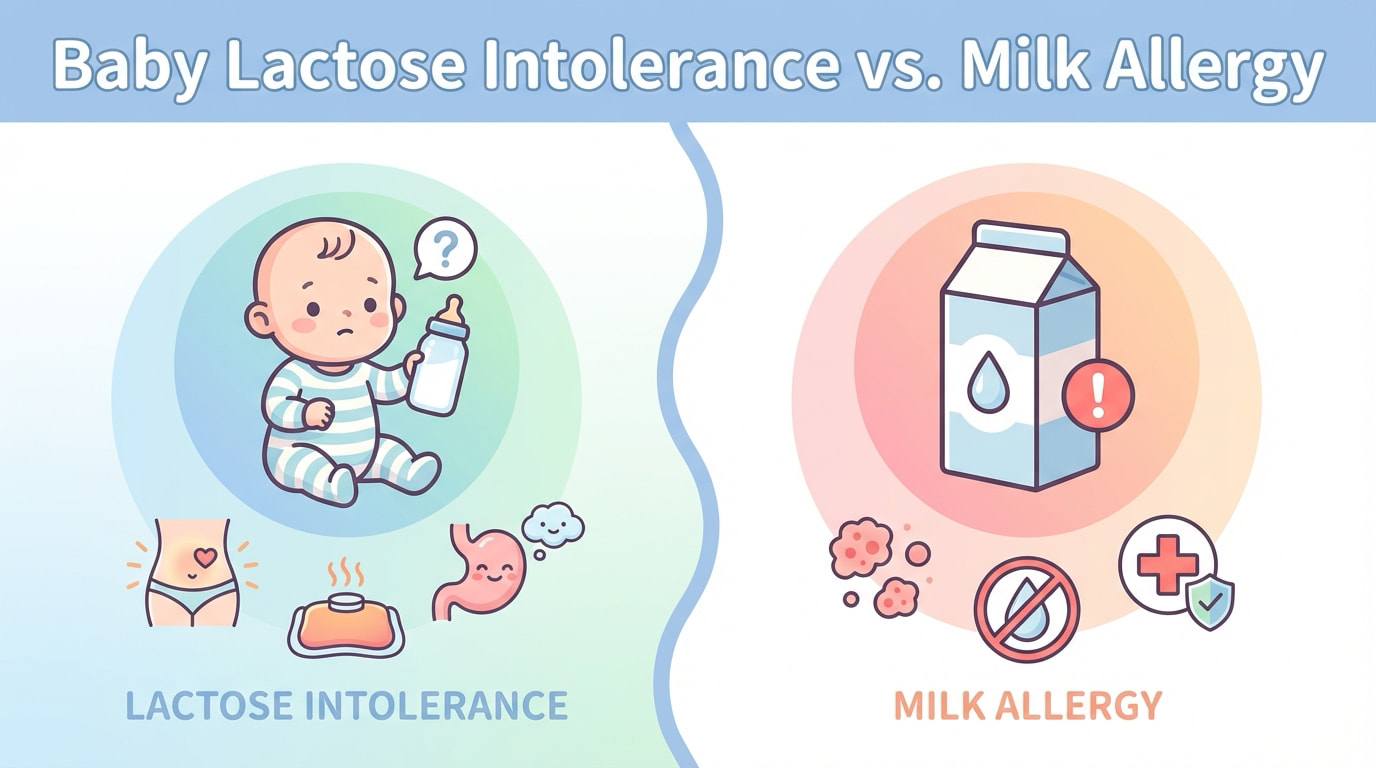
The key to understanding baby lactose intolerance vs. milk allergy is that an allergy is an immune reaction requiring total dairy elimination and often presents with skin rashes, respiratory issues, or blood in the stool, while lactose intolerance is a temporary digestive issue isolated to the gut that causes gas and acidic diarrhea.
There is a particular kind of panic that only new parenthood can produce. The baby is inconsolable. Every feed ends in crying, back-arching, and a diaper that can only be described as an event. The clock reads 3 AM; the exhaustion is bone-deep. A phone screen glows in the dark, and within seconds, a search engine delivers its verdict: lactose intolerance.
It feels like an answer. It usually isn’t.
This moment — the quiet conflation of two entirely separate medical conditions — plays out in homes across the world every single night. And in fairness, it is an extraordinarily easy mistake to make. Both baby lactose intolerance and milk allergy involve milk. Both cause screaming after feeds. Both produce disturbing diapers. From the outside, they can look almost identical.
But beneath the surface, these two conditions live in completely different biological worlds. One is the immune system sounding a false alarm. The other is a digestive enzyme that has temporarily gone missing. Confusing one for the other doesn’t just add to the stress — it can send a family down entirely the wrong treatment path for weeks or even months, all while a very simple, very different solution sits waiting.
Understanding Cow’s Milk Protein Allergy (CMPA) in Babies
What Is a Milk Allergy, Exactly?
To understand cow’s milk protein allergy — shortened in the medical world to CMPA — it helps to start with a simple analogy.
Think of the immune system as a security team guarding a building. That team’s job is to identify genuine threats — viruses, harmful bacteria — and neutralize them before they cause damage. In a perfectly functioning system, harmless substances like food proteins pass through security without triggering any alarms. The guards recognize them as safe and wave them through.
In a baby with CMPA, the security team makes a catastrophic identification error. It looks at the proteins found in cow’s milk — specifically two types called casein and whey — and flags them as dangerous invaders. It doesn’t matter that these proteins are perfectly harmless; as far as the immune system is concerned, they are a full-blown threat. Every time those proteins appear, the body mounts a defensive attack: inflammation, swelling, mucus production, skin reactions. The works.

This is a fundamentally different kind of problem than a nutritional one. CMPA is not about digesting milk poorly. It is about the body fighting milk as though it were a disease.
According to the European Academy of Allergy and Clinical Immunology (EAACI), CMPA affects approximately 2 to 3 percent of infants, making it the most common food allergy in the first year of life. Fortunately, it is also among the most commonly outgrown — research published in the Journal of Allergy and Clinical Immunology suggests that up to 80 to 90 percent of children resolve their milk allergy by age three to five.
But between diagnosis and resolution lies a stretch of time that requires clarity, patience, and an understanding of how the allergy actually operates.
How Babies Get Exposed
This is a question that catches many parents off guard, particularly those who are breastfeeding. After all, if the baby is only drinking breastmilk, how could cow’s milk protein be involved?
The answer lies in a biological process that is both elegant and, in this context, inconvenient. When a nursing parent eats dairy — a glass of milk, a slice of cheese, a splash of cream in coffee — the cow’s milk proteins from that food are broken down during digestion, absorbed into the bloodstream, and then secreted into the breastmilk itself. The proteins are small enough to survive intact through this entire chain.
So a breastfed baby can react to cow’s milk protein without ever coming near a bottle of formula — simply because the nursing parent had yogurt for lunch. The protein came through the breastmilk.
For formula-fed babies, the exposure is more direct. Standard infant formulas are predominantly made from cow’s milk, modified to match human nutritional needs. Every feed delivers a significant dose of casein and whey.
The Two Types of CMPA — And Why One Is Much Harder to Spot
Here is where the story gets more complicated, and where a substantial number of diagnoses are missed.
CMPA doesn’t show up in a single, uniform way. It has two distinct forms, and they behave so differently that they almost feel like separate conditions.
IgE-Mediated CMPA: The Fast Reactor
The term “IgE” refers to Immunoglobulin E, a type of antibody. Think of IgE as the panic button on the security system — when it fires, things happen immediately.
In IgE-mediated CMPA, the baby reacts within minutes to two hours of consuming cow’s milk protein. Symptoms tend to be dramatic and visible: hives appearing on the skin, swelling around the mouth or eyes, vomiting, and in rare but serious cases, anaphylaxis — a severe, whole-body allergic reaction that affects breathing and blood pressure.
Because the reaction is so rapid, parents can often connect the dots themselves. The baby drank the bottle at noon and was covered in welts by 12:30. The timing makes the link intuitive.
Non-IgE-Mediated CMPA: The Stealth Version
This is the form that is far more common in infants — and far more maddening to identify. In non-IgE-mediated CMPA, the immune response is driven by other components of the immune system (primarily T-cells), and the reaction is delayed by hours or even days. A baby might ingest milk protein on Monday and not display significant symptoms until Tuesday evening or Wednesday morning.
That delay makes the connection between cause and effect nearly invisible to parents operating on three hours of sleep. Instead of a clear “ate milk, got hives” pattern, what parents see is a baby who seems vaguely and persistently unwell — chronic loose stools, mucus or streaks of blood in the diaper, persistent eczema that doesn’t respond to creams, unexplained fussiness, and reflux that goes beyond the normal spit-up.
This version of CMPA is the one that masquerades as colic. It is the one that gets attributed to “just being a fussy baby.” And critically, it is the one that is most easily confused with lactose intolerance — because the symptoms overlap so heavily with purely digestive complaints.
Understanding Baby Lactose Intolerance
What Is Lactose Intolerance, Exactly?
Now shift the lens entirely — from the immune system to the digestive system. Lactose intolerance has nothing whatsoever to do with immunity, antibodies, or the body fighting anything. It is a plumbing problem, not a security problem.
Lactose is a type of sugar — the primary sugar found naturally in all mammalian milk. Cow’s milk contains it. Goat’s milk contains it. And critically, human breastmilk contains it — in fact, breastmilk contains more lactose than cow’s milk (approximately 7 grams per 100 mL versus 5 grams per 100 mL).
To digest this sugar, the small intestine must produce a specific enzyme called lactase. An enzyme is essentially a biological tool — a molecular key that fits into a specific lock. Lactase’s sole job is to break lactose apart into two simpler sugars (glucose and galactose) that the body can absorb.
When there is enough lactase, the process works seamlessly — lactose is broken down and absorbed. When there is not enough lactase, undigested lactose passes through to the large intestine. There, colonies of gut bacteria begin to ferment it — essentially consuming it themselves and producing gas, acids, and excess fluid as byproducts. That fermentation is what causes every symptom associated with lactose intolerance: the bloating, the cramping, the rumbling stomach, and the watery, acidic, often explosive diarrhea.
To return to the plumbing analogy: lactose intolerance is not the body rejecting milk. It is the body lacking the right tool to process one specific component of milk.
The Most Important Fact Most Articles Get Wrong
If there is one single piece of information that would eliminate the majority of misunderstanding about infant lactose intolerance, it is this:
True, genetic lactose intolerance from birth is one of the rarest conditions in pediatric medicine.
The condition is called Congenital Lactase Deficiency (CLD), and it involves a genetic mutation that prevents the baby from producing any lactase at all from the moment of birth. According to data from Finland — where much of the foundational research was conducted — CLD occurs in roughly 1 in 60,000 newborns. A baby with this condition would be severely ill from the very first breastfeed, rapidly losing weight and becoming dehydrated. It is a medical emergency, diagnosed almost immediately, and managed with lactose-free feeds from day one.
This is the condition most parents are unconsciously picturing when they suspect their baby is “lactose intolerant.” But it is almost certainly not what is happening.
What Is Actually Happening: Secondary (Transient) Lactose Intolerance
The form of lactose intolerance that is genuinely relevant to most families is called secondary lactose intolerance, sometimes referred to as transient lactase deficiency. The name tells the story: secondary to something else, and transient — meaning temporary.
Here is how it works. The lactase enzyme is produced by the cells that line the surface of the small intestine — specifically, the tips of tiny, finger-like projections called villi that line the intestinal wall. These villi are remarkably efficient, but also remarkably fragile. When they are damaged — most commonly by a viral gastroenteritis like rotavirus or norovirus — the enzyme-producing tips are destroyed temporarily.
Think of it like a factory where a storm has knocked out the assembly line. The building is still standing. The workers are still present. But the machinery that produces the specific tool (lactase) is offline and needs repairs. Until those repairs are complete — which typically takes four to eight weeks of intestinal healing — the baby will have difficulty digesting lactose.
The critical diagnostic clue is timing: if a baby was tolerating milk just fine and then suddenly started having problems immediately after a bout of diarrhea or a stomach bug, secondary lactose intolerance is overwhelmingly the most likely explanation. It is not a permanent condition. It is not an allergy. It is a temporary injury to the gut that will heal on its own.
Lactose Overload in Breastfed Babies
Before arriving at the symptom comparison table, there is a third scenario that deserves its own dedicated section — because it is arguably the most frequently misidentified of all, and it creates unnecessary anxiety for breastfeeding families who become convinced that something is medically wrong with their baby.
The condition is called lactose overload, and it is neither an allergy nor a true intolerance. It is a feeding dynamics issue. Understanding it requires knowing one elegant fact about how breastmilk works.
The Two-Course Meal Inside Every Breastfeed
Breastmilk is not a uniform liquid. Its composition changes dynamically during a single feed, in roughly the same way that a multi-course meal progresses.
At the beginning of a breastfeed, the milk that flows — sometimes called foremilk — is relatively higher in lactose (sugar) and lower in fat. It is thinner, more watery, and designed to quench thirst. As the feed continues and the breast drains more fully, the hindmilk arrives: thicker, richer, and significantly higher in fat content.
That fat content is not incidental. Fat slows down the speed at which milk moves through the digestive system. When hindmilk is present alongside lactose, it acts as a brake — giving the baby’s lactase enzymes adequate time to break down the lactose before it reaches the large intestine.
What Goes Wrong
When a mother has a generous oversupply of milk — or when she switches the baby to the second breast before the first breast has been fully or substantially drained — the baby ends up consuming a disproportionate amount of high-lactose, low-fat foremilk from the beginning of both breasts, without ever reaching the fat-rich hindmilk that would slow digestion.
The result is a flood of lactose arriving in the gut faster than the enzymes can process it. The baby’s lactase-producing system is working perfectly fine — there is no deficiency, no damage, no disease. The problem is purely one of volume and speed. It is the difference between pouring water into a funnel at a reasonable rate versus dumping a bucket into it all at once. The funnel overflows — not because it is broken, but because it was overwhelmed.
The symptoms of lactose overload look almost indistinguishable from true lactose intolerance: frothy, green, explosive stools; intense gas and bloating; a baby who fusses, gulps, and pulls away from the breast during active letdown. Many mothers, seeing these symptoms, conclude that their baby “can’t handle lactose” or is “intolerant of breastmilk” — a belief that can tragically lead to premature weaning.
The Fix Is Often Surprisingly Simple
The solution for lactose overload does not involve enzyme drops, formula switches, or dietary restrictions for the mother. In many cases, it involves a technique called block feeding: assigning one breast per feeding session (or even for a block of two to three hours) so that the baby fully drains that breast and reaches the high-fat hindmilk before switching sides.
The distinguishing feature to watch for is weight gain. A baby with lactose overload is typically gaining weight very well — often rapidly, because the baby is consuming a high volume of milk. By contrast, a baby with a genuine milk allergy or severe lactose intolerance may struggle with weight gain due to gut inflammation or malabsorption.
If the baby is thriving on the growth chart but having spectacular diapers and gassy fits, lactose overload is a strong possibility — and a conversation with a lactation consultant may resolve the issue entirely without any medical intervention.
Comparing Symptoms: Baby Lactose Intolerance vs. Milk Allergy Side by Side
With all three conditions now clearly defined, it becomes possible to compare them directly. The following table is designed to be a reference tool — something to return to when observing symptoms and trying to narrow down possibilities.
| Symptom | CMPA (Milk Allergy) | Lactose Intolerance | Lactose Overload |
|---|---|---|---|
| Skin reactions (hives, eczema, rash) | ✅ Very common | ❌ Not a feature | ❌ Not a feature |
| Blood or mucus in stool | ✅ Major red flag | ❌ Absent | ❌ Absent |
| Respiratory issues (wheeze, chronic congestion) | ✅ Possible | ❌ Absent | ❌ Absent |
| Excessive gas & bloating | ✅ Yes | ✅ Yes | ✅ Yes |
| Frothy, green, explosive stools | ⚠️ Possible | ✅ Characteristic | ✅ Characteristic |
| Severe diaper rash (from acidic stool) | ⚠️ Less typical | ✅ Frequent | ✅ Frequent |
| Projectile vomiting | ✅ Can occur | ❌ Uncommon | ❌ Uncommon |
| Symptoms limited to GI tract only | ❌ Multi-system | ✅ Always | ✅ Always |
| Weight gain | ⚠️ May be poor | ⚠️ May be affected | ✅ Usually excellent |
| Onset timing | Minutes to days later | 30 min–2 hours after feed | During or shortly after feed |
The Single Most Important Differentiating Sign
If one observation had to carry the full diagnostic weight, it would be this: visible blood or mucus in the baby’s stool is the clearest signal that a milk allergy — not lactose intolerance — is at play. Lactose intolerance, regardless of its cause, does not produce blood in the stool. If blood or mucus appears, CMPA must be investigated, and a pediatrician should be contacted promptly.
Conversely, if the symptoms are entirely and exclusively gastrointestinal — gas, bloating, loud stomach noises, acidic watery diarrhea — with absolutely no skin rashes, no respiratory symptoms, and no blood, then a digestive cause (either lactose intolerance or overload) becomes considerably more plausible.
What to Do About Baby Lactose Intolerance vs. Milk Allergy
When the Diagnosis Is Milk Allergy (CMPA)
For breastfed babies:
The nursing parent must adopt a strict dairy-free diet. This is more demanding than it initially sounds — cow’s milk protein hides in an extraordinary range of processed foods, from bread and crackers to sausages and salad dressings. Reading ingredient labels becomes a non-negotiable habit, with particular attention to terms like whey, casein, caseinate, lactalbumin, lactoglobulin, and milk solids.
Critically, however, the baby does not need to stop breastfeeding. In fact, breastmilk — once cleared of the offending protein — remains the optimal nutrition for the baby, providing immune factors, growth support, and gut-healing properties that no formula can fully replicate. A referral to a registered dietitian is strongly recommended to ensure the nursing parent’s own nutritional needs — particularly calcium, vitamin D, and iodine — are maintained during the elimination period.
For formula-fed babies:
Here is a point that is absolutely essential to understand, because getting it wrong is one of the most common and consequential mistakes families make:
Switching to “lactose-free” formula does NOT address a milk allergy.
Lactose-free formula has had the sugar removed, but the cow’s milk proteins — casein and whey — remain fully intact. Since CMPA is a reaction to the protein, not the sugar, a lactose-free formula changes nothing about the immune response. The baby will continue to react.
A note on soy formula: it is sometimes suggested as a plant-based alternative, but it carries an important caveat. According to research published in the Journal of Pediatric Gastroenterology and Nutrition, approximately 10 to 14 percent of infants with CMPA also cross-react with soy protein. Soy should not be the automatic first-line substitution without medical guidance.
When the Diagnosis Is Transient Lactose Intolerance
For breastfed babies:
The instinct to stop breastfeeding — driven by the logic that breastmilk contains lactose and must therefore be the problem — is understandable. It is also, in almost every case, exactly the wrong move.
Breastmilk does contain lactose, but it also contains an extraordinary array of compounds that actively promote gut healing: immunoglobulins (antibodies), epidermal growth factor (which stimulates intestinal cell repair), human milk oligosaccharides (which feed beneficial gut bacteria), and anti-inflammatory cytokines. Removing breastmilk removes these healing agents at the precise moment the gut needs them most.
The preferred approach is to continue breastfeeding and, if recommended by a pediatrician, add lactase enzyme drops (available under brand names like Colief or Lactase Drops) to a small amount of expressed breastmilk before feeds. These drops supplement the baby’s temporarily reduced enzyme supply, improving lactose digestion without any alteration to the breastmilk itself.
For formula-fed babies:
A temporary switch to a lactose-free infant formula is appropriate. The key word is temporary. The gut lining is healing; the lactase-producing cells are regenerating. After approximately four to eight weeks — guided by symptom resolution and pediatric advice — a gradual reintroduction to standard formula is usually well-tolerated.
When the Issue Is Lactose Overload
No medical treatment is required. The intervention is often a feeding practice adjustment — specifically, block feeding on one breast per session (or for a set time block of two to three hours) to ensure the baby reaches the hindmilk. A consultation with an International Board Certified Lactation Consultant (IBCLC) can be extraordinarily useful for fine-tuning feeding technique, managing oversupply, and providing reassurance.
When to Stop Searching and Call the Doctor Immediately
While dietary adjustments and feeding modifications can address the majority of cases, some symptoms are medical red flags that require prompt professional evaluation. No online resource — including this one — is a substitute for a clinician who can examine the baby directly.
Seek immediate medical attention if:
- There is visible blood in the diaper — even a small streak of red or dark maroon material.
- The baby is losing weight or failing to gain weight appropriately — a sign that the condition, whatever it is, is not being adequately managed.
- Signs of dehydration appear — fewer than six wet diapers in 24 hours, a sunken soft spot (fontanelle), no tears when crying, dry lips and mouth.
- Breathing difficulties, facial swelling, or severe hives develop after a feed — this may indicate anaphylaxis, which is a medical emergency.
- The baby is unusually lethargic, difficult to wake, or refusing all feeds.
These symptoms are non-negotiable — they warrant a call to the pediatrician or, in the case of breathing difficulties, emergency services.
Frequently Asked Questions About Baby Lactose Intolerance and Milk Allergy
Can a breastfed baby truly be lactose intolerant?
Yes, but it is almost always temporary — a condition called secondary lactose intolerance that occurs after a gut infection damages the lactase-producing cells lining the small intestine. True congenital lactase deficiency, present from birth, affects roughly 1 in 60,000 newborns and is exceptionally rare. More commonly, what appears to be lactose intolerance in breastfed babies is actually lactose overload caused by a foremilk-hindmilk imbalance.
Does soy formula work for babies with a milk allergy?
It may help some babies, but it is not a universal solution. Research indicates that approximately 10 to 14 percent of infants with CMPA also react to soy protein. Extensively hydrolyzed or amino acid-based formulas are generally the recommended first-line alternatives under medical guidance.
How long does it take for dairy to leave breastmilk completely?
Cow’s milk proteins typically clear from breastmilk within two to three weeks of the nursing parent eliminating dairy from their diet. Many families report noticeable improvement in the baby’s symptoms within the first 72 hours, but complete clearance — and full symptom resolution — often requires the longer timeframe.
Is a milk allergy the same thing as being allergic to dairy?
In the context of infant feeding, CMPA specifically refers to a reaction to the proteins in cow’s milk. It does not necessarily mean the baby will react to all forms of dairy equally — some children with CMPA tolerate baked milk products (like baked goods containing milk), where the protein structure has been altered by heat. However, this should only be tested under medical supervision, not experimented with at home.
Will a baby with a milk allergy always be allergic?
Unlikely. The prognosis is favorable: approximately 80 to 90 percent of children outgrow CMPA by age three to five, with non-IgE-mediated CMPA resolving earlier than IgE-mediated forms in most cases. Regular follow-up with a pediatric allergist can track tolerance development and determine when supervised milk reintroduction is appropriate.
What is the most reliable way to tell baby lactose intolerance and milk allergy apart?
The clearest differentiating sign is blood or mucus in the stool, which points strongly toward CMPA and warrants immediate medical evaluation. Lactose intolerance produces exclusively gastrointestinal symptoms — gas, bloating, acidic diarrhea — without systemic involvement like skin rashes, respiratory symptoms, or blood in the stool. Timing is also valuable: if symptoms began immediately after a stomach bug, transient lactose intolerance is the more probable explanation.
Conclusion
The landscape of infant feeding problems is more nuanced than any single 3 AM search result can capture. Baby lactose intolerance and cow’s milk protein allergy both make babies miserable in the presence of milk, but they live in entirely different biological neighborhoods. One is the immune system attacking a harmless protein. The other is a digestive enzyme that has temporarily gone offline. They require different diagnostic approaches, different dietary solutions, and different timelines for recovery.
Getting the distinction right has real consequences. Switching a CMPA baby to lactose-free formula leaves the allergenic protein fully intact — and the baby will continue to react. Removing all dairy from a nursing mother’s diet when the actual issue is a foremilk-hindmilk imbalance adds weeks of unnecessary burden to one of the most demanding roles in human life. And labelling a baby “lactose intolerant” after a stomach bug — without understanding that the intolerance is temporary — can lead to long-term avoidance of a nutrient that was never truly the problem.
The reassuring truth, though, is genuinely reassuring. The vast majority of babies with CMPA outgrow it by their third birthday. Secondary lactose intolerance resolves within weeks as the gut heals. Even lactose overload corrects itself as milk supply naturally regulates. The misery is real, and it deserves to be taken seriously — but in almost every case, it is also temporary.
The path forward runs through knowledge, pediatric partnership, and the quiet confidence that comes from understanding what is actually happening inside that tiny, protesting digestive system.
References & Further Reading:

October 25, 2026

October 25, 2026

October 25, 2026

October 25, 2026