
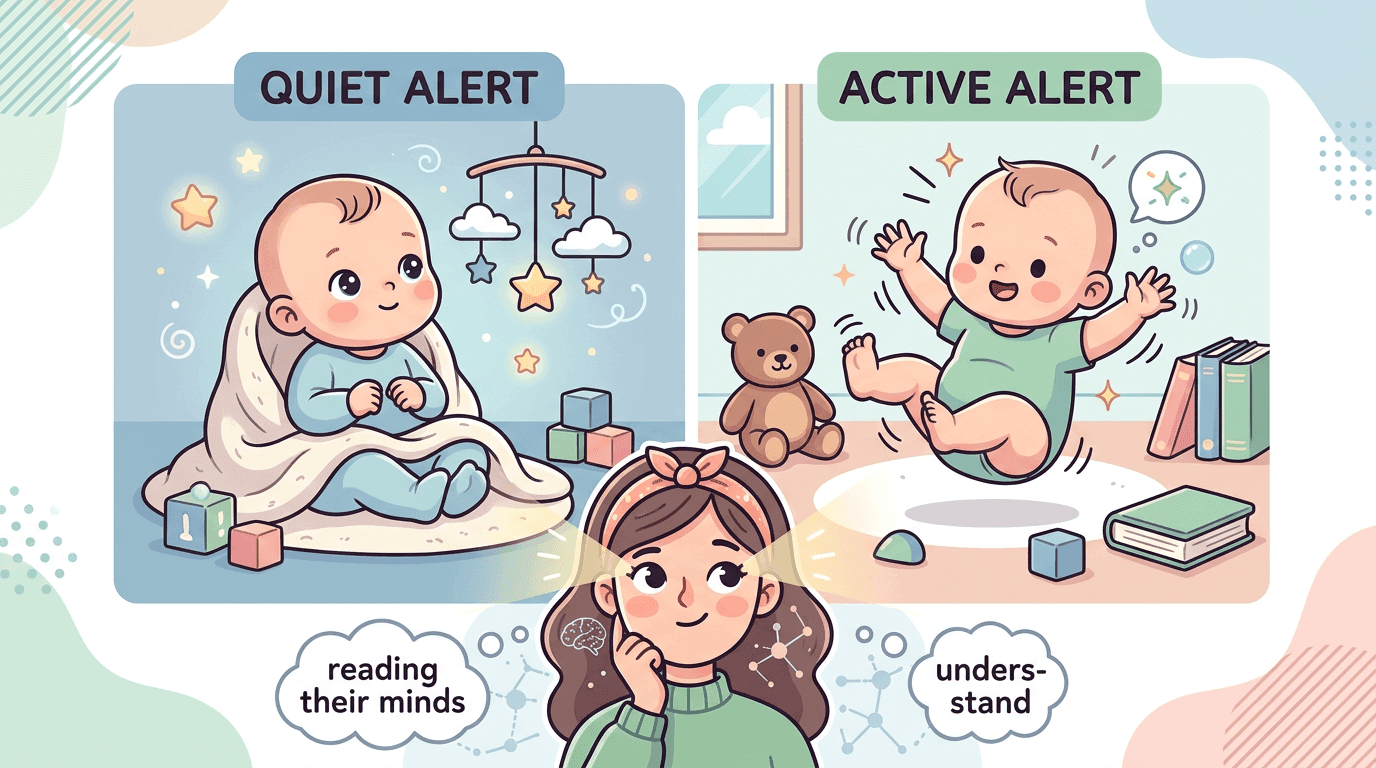
Quiet Alert vs Active Alert Newborn
Quiet Alert vs Active Alert Newborn: How to Read Your Baby’s Mind
There is a moment — it happens in the first week, sometimes the first day — when a newborn goes quiet. Not the quiet of sleep, which new parents learn immediately and gratefully. This is something different. The baby’s eyes are open, wide and dark and startlingly present, and they are looking at something. A face. A shadow on the wall. The slow rotation of a ceiling fan. The gaze is steady and deliberate, carrying a weight of concentration that seems almost impossible from a being who was, just days ago, curled in the dark of the womb.
Then, just as suddenly, the spell breaks. The small body begins to squirm. The arms, which were resting calmly a moment ago, start to flail. The legs kick in short, staccato bursts. A tiny grunt escapes, then another. The eyes, once focused like small searchlights, begin to dart — scanning, unfocused, avoiding the very face they were so recently studying. Within minutes, if nothing changes, crying fills the room. The caregiver, who was just marveling at their baby’s alertness, is now scrambling: What happened? What went wrong? Was it something I did?
The answer, usually, is that nothing went wrong. What happened was a transition — a predictable, well-documented shift between two distinct neurological states that every healthy newborn cycles through multiple times each day. Understanding those two states, and learning to tell them apart in real time, is arguably the single most practical skill a new parent can develop in the first three months of life.
The Six States of a Newborn
Before examining the quiet alert vs active alert newborn distinction specifically, it helps to place these two states within their broader context. Think of it this way: most adults recognize only two “modes” in a newborn — sleeping and crying. That framework is a bit like looking at a rainbow and seeing only “dark” and “light.” The full spectrum is considerably richer.
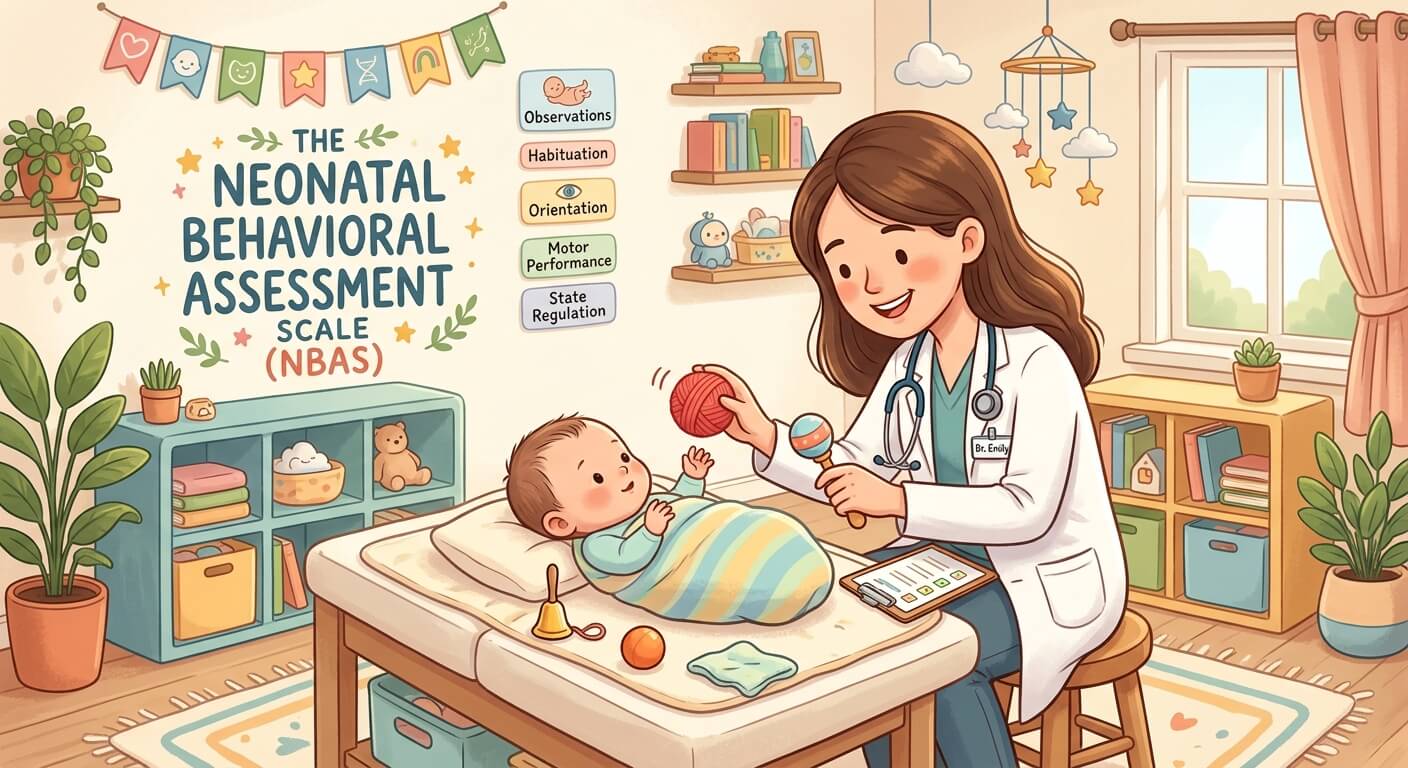
In the 1970s, Dr. T. Berry Brazelton — a Harvard-trained pediatrician whose work fundamentally reshaped how the medical community understands infant behavior — developed the Neonatal Behavioral Assessment Scale (NBAS). This clinical tool, still used in hospitals and research settings worldwide, identifies six distinct states of consciousness in newborns. Each state has its own measurable characteristics: specific patterns of eye movement, muscle tone, breathing rhythm, and responsiveness to stimulation.
Here is what the full cycle looks like:
State 1 — Deep Sleep. The baby is completely still. Breathing is slow and regular, like a metronome. Even a moderately loud noise may not cause a reaction. This is the body’s deepest recovery mode.
State 2 — Light (REM) Sleep. The eyelids flutter, and beneath them, rapid eye movement can sometimes be observed. The baby twitches, makes small sucking motions, or briefly grimaces. Breathing is irregular. (This is where dreaming likely occurs, though no one knows what a newborn dreams about — a question that remains one of neuroscience’s most charming mysteries.)
State 3 — Drowsy. A transitional state — the bridge between sleeping and waking. The eyes may open and close heavily, and movements are slow and drifting. The baby is neither fully asleep nor fully engaged with the world.
State 4 — Quiet Alert. Awake, calm, focused, and absorbing the world with extraordinary concentration. The body is still. The eyes are wide and engaged. This is the state that matters most for bonding and early learning.
State 5 — Active Alert. Awake, but agitated. The body is restless, the gaze is unfocused, and fussiness is building. The baby is signaling that something needs to change. This is the state most commonly misread by caregivers.
State 6 — Crying. Full distress. The baby has exhausted all subtler forms of communication and has escalated to the loudest signal available.
The crucial insight — the one that transforms how a caregiver experiences these early weeks — is that States 4 and 5 are not the same thing, even though they are both “awake.” They look different, mean different things, and demand completely different parental responses. Confusing them is the source of enormous, unnecessary frustration on both sides of the crib.
The following sections explore each one in depth.
What Is the Quiet Alert State in Newborns?
The Definition: Focused Stillness
The quiet alert state is, in many ways, the most remarkable thing a newborn does. It is a period of calm, focused wakefulness — a window in which the baby is fully conscious, environmentally engaged, and physiologically at rest. The body is still, not because the baby is lethargic, but because all available energy is being routed away from physical movement and toward sensory processing. The brain, in this state, is doing its most important early work.
What does it look like in practice? The physical signature is distinctive and, once learned, unmistakable:
- The eyes are wide open, bright, and clear. They track slowly, locking onto high-contrast objects or, most commonly, a human face. The gaze has a searching quality, as though the baby is studying, not merely looking.
- The body is relaxed and comparatively still. Movements, when they occur, are smooth and unhurried — the opposite of the jerky flailing that characterizes fussiness.
- Breathing is regular and even, reflecting a nervous system that is operating well within its comfort zone.
- The face may show a kind of quiet intensity, sometimes accompanied by a fleeting half-smile or raised eyebrows — early precursors to social expression.
Why This State Matters
To understand why developmental scientists consider the quiet alert state so significant, imagine a sponge that has been perfectly wrung out — dry, empty, and ready to absorb. That sponge represents a newborn’s brain during quiet alertness. Every drop of sensory information that falls on it — a parent’s voice, the contrast of light against dark, the smell of skin, the texture of a blanket — is absorbed with remarkable efficiency.
This is not a metaphor. Research from the University of Washington’s Institute for Learning & Brain Sciences (I-LABS) has demonstrated that newborns as young as 42 minutes old can imitate facial expressions — sticking out their tongues in response to an adult doing the same — but only when they are in the quiet alert state. In other states, the same baby shown the same stimulus produces no imitative response. The implication is profound: it is not just that the quiet alert state is better for learning. For certain types of early cognitive processing, it appears to be the only state in which learning occurs at all.
This finding aligns with what the American Academy of Pediatrics describes as the optimal period for early bonding and memory consolidation. During quiet alertness, the newborn brain is building the foundational neural connections — the literal wiring — that will later support language acquisition, facial recognition, emotional attachment, and spatial reasoning. It is, in the most literal sense, the construction phase of a human mind.
It Doesn’t Last Long
Here is the detail that catches most new parents off guard: the quiet alert state, especially in the earliest weeks, is extraordinarily brief. A newborn in the first week of life may sustain this state for only two to five minutes before transitioning. That is not a large window. It opens, offers a fleeting opportunity for connection, and closes again — often before a caregiver has even realized it was there.
The good news is that this window expands predictably as the infant’s nervous system matures:
| Baby’s Age | Typical Quiet Alert Duration |
|---|---|
| Birth – 1 week | 2–5 minutes |
| 2–4 weeks | 5–10 minutes |
| 4–6 weeks | 10–15 minutes |
| 6–12 weeks | 15–20+ minutes |
This expansion is a direct reflection of the developing brain’s growing capacity to manage incoming sensory information without becoming overwhelmed — a capacity that, in the first days, is almost nonexistent. Understanding this timeline allows caregivers to calibrate their expectations: asking a five-day-old baby to sustain twenty minutes of calm focus is like asking a student to read a textbook in a language they have only begun to learn. The ability is emerging, but it is not yet there.
What Is the Active Alert State in Newborns?
The Definition: Organized Agitation
If the quiet alert state is the sponge absorbing water, the active alert state is what happens when the sponge begins to overflow. The baby is still awake — still technically “alert” — but the quality of that alertness has shifted decisively. The calm, absorptive focus is gone. In its place is movement, noise, and a rising tide of physical restlessness that, to an untrained eye, can look confusingly like either playfulness or distress.
In truth, it is neither. It is communication.
The physical markers of the active alert state form a pattern that, once recognized, becomes as readable as any spoken sentence:
- The eyes are open but behaving differently. Instead of the steady, locked-in gaze of quiet alertness, they dart — scanning the environment in a way that is rapid and unfocused, as though the visual system is struggling to settle on any one thing. The baby may also look away from a caregiver’s face, a behavior called gaze aversion. (This term sounds clinical, but the concept is intuitive: imagine being in a room where the lights are too bright. The instinct is to close the eyes or turn away. The baby is doing the same thing, except the “light” is any form of sensory input — visual, auditory, tactile — that has exceeded the threshold.)
- The body moves in a way that is distinctly jerky and disorganized. Arms flail rather than reach. Legs kick in rapid, irregular bursts. The back may arch. These are not purposeful movements; they are the motor system’s equivalent of a stress response.
- Breathing becomes faster and irregular, reflecting rising physiological tension.
- Vocalizations appear — not yet crying, but precursors to it. Small grunts, squeaks, hiccup-like sounds, and a kind of experimental fussing that hovers uncertainly between complaint and conversation. The baby may also root (turning their head with mouth open, searching for a breast or bottle) or suck on their own hands, behaviors associated with hunger but also with self-soothing.
What the Baby Is Really Saying
Here is the single most important reframe for any new caregiver to internalize: the active alert state is not an invitation to play. It is a request for help.
The baby’s nervous system, having spent its small reserve of calm wakefulness in the quiet alert state, has tipped past its comfort threshold. The body’s stress response system — specifically the hypothalamic-pituitary-adrenal (HPA) axis, which governs the release of cortisol, the body’s primary stress hormone — is beginning to activate. The grunting, the flailing, the gaze aversion: these are not random. They are an organized, sequential escalation of signals that mean, in the clearest possible terms: “Something in my environment or my body needs to change. I am giving notice before I resort to screaming.”
The tragedy — and it is a small, routine, entirely forgivable tragedy — is that most caregivers initially read these signals backwards. Movement and sound, in the adult social world, mean engagement. A wiggly, vocal baby looks like a baby who wants interaction. The instinct to lean in, to offer a toy, to shake a rattle and coo enthusiastically is powerful and deeply human. But in the context of a newborn’s neurological reality, that response is like turning up the volume on music that is already too loud.
Quiet Alert vs Active Alert Newborn: The Side-by-Side Comparison
At this point, the differences between these two states deserve a clear, direct comparison. The following table distills the key distinctions into a format designed for quick reference — the kind of thing a caregiver might tape to the refrigerator during those bleary, 3 a.m. weeks.
| Feature | 🟢 Quiet Alert | 🟡 Active Alert |
|---|---|---|
| Eyes | Wide, bright, focused; seeks eye contact | Darting, glazed, or averted; avoids eye contact |
| Body | Still, relaxed; smooth movements | Jerky, flailing; arching back |
| Breathing | Slow, regular, even | Fast, irregular, shallow |
| Sound | Quiet, occasional soft cooing | Grunts, squeaks, escalating fussiness |
| Facial expression | Calm, attentive, sometimes a half-smile | Tense, grimacing, mouth working |
| What it means | “I’m ready to learn and connect” | “I need something to change” |
| Best parental response | Engage gently: talk, show a face, observe | Soothe: check needs, reduce stimulation |
| What happens next if ignored | Naturally transitions to active alert | Rapidly escalates to crying |
A useful way to remember this distinction is the traffic-light model: Quiet alert is a green light — proceed with gentle interaction. Active alert is a yellow light — slow down, read the situation, and prepare to change course. Crying is a red light — stop everything and address the distress.
The Over-Stimulation Trap: Why Good Intentions Backfire
With the two states now clearly defined, it becomes possible to examine the single most common mistake caregivers make — a mistake that is not a failure of love, but a failure of translation.
The Scene That Plays Out in Every Nursery
A baby wakes from a nap. They begin moving their arms and making small sounds. The parent, having spent the last forty-five minutes waiting for the baby to wake up, is eager to connect. They pick the baby up, hold them face-to-face, and begin talking brightly: “Hey, little one! Are you awake? Look at this! Look at the rattle!” The rattle shakes. The voice climbs in pitch. The parent’s face is animated and close.
Within sixty to ninety seconds, the baby is crying inconsolably.
The parent is baffled — and, if they are honest, a little hurt. Wasn’t that exactly what good parenting looks like? Wasn’t engagement the right thing to do?
The answer depends entirely on timing. If the baby had been in the quiet alert state — eyes focused, body still, gaze seeking — then yes, that gentle face-to-face interaction would have been not just appropriate but ideal. It would have been met with the baby’s best imitation of a smile, perhaps a moment of synchronized eye contact, the kind of exchange that forms the neurochemical basis of attachment.
But the baby was not in the quiet alert state. The movements, the sounds, the restlessness — those were the markers of active alert. The baby was not saying, “Play with me.” The baby was saying, “I’m reaching my limit.” The enthusiastic parental response, however well-intended, did not meet the baby’s need. It exceeded it. It was fuel on a fire that was already catching.
This phenomenon — the misreading of active alert as an invitation to engage — is not trivial. Repeated over days and weeks, it creates a feedback loop that can significantly increase parental stress. The caregiver begins to believe that they are “bad at this,” that their baby “doesn’t like to be held,” or that something is wrong. In reality, the issue is not the quality of the parenting. It is the calibration. A small adjustment in reading — learning to distinguish the steady gaze from the darting one, the smooth movement from the jerky — can transform the entire dynamic.
The Battery Metaphor: Why Timing Is Everything
One of the most useful mental models for understanding this transition comes from a simple analogy: the quiet alert state runs on a tiny battery. In a newborn’s first week, that battery holds perhaps a five-minute charge. When the charge runs out, the system does not simply pause and wait for a recharge. It transitions — first to the increased agitation of active alert, then, with startling speed, to full crying. The battery only recharges during sleep.
The caregiver’s job, understood through this lens, is not to extend the battery life (that is a function of neurological maturation, which proceeds at its own pace) or to prevent the transition (which is physiologically inevitable). It is simply to notice when the charge is fading and shift from engagement mode to soothing mode before the system crashes entirely. The parents who report the calmest, most manageable newborn periods are almost never parents with uniquely “easy” babies. They are parents who have learned to read the battery gauge.
Maximizing the Quiet Alert State: What to Do When the Green Light Is On
Given how brief and developmentally important the quiet alert phase is, knowing how to use it well is a genuine advantage. The following strategies are drawn from both clinical research and the accumulated wisdom of infant development specialists.
The Power of the Human Face
The human face is, by a wide margin, the most neurologically compelling thing a newborn can look at. This is not sentiment — it is measurable. Brain imaging studies show that the fusiform face area, a region of the brain that specializes in facial recognition, activates more strongly in newborns exposed to face-like patterns than to any other visual stimulus of comparable complexity. Evolution has spent millions of years tuning the infant brain to prioritize the thing most likely to keep it alive: the face of a caregiver.
During quiet alert periods, holding the baby at approximately 8 to 12 inches — the distance at which newborn vision, which is initially quite limited in focal range, resolves most clearly — and engaging with calm, slow facial expressions and a gentle, rhythmic voice creates an interaction of extraordinary neurological richness. Research published in Child Development has shown that during these exchanges, a phenomenon called physiological synchrony occurs: the heart rates and breathing patterns of caregiver and baby begin to align, rising and falling in tandem. This is co-regulation at its most fundamental — two nervous systems literally tuning to the same frequency.
High-Contrast Visual Stimulation
A common surprise for new parents: the soft, pastel-colored nursery they carefully decorated is, from the baby’s perspective, essentially invisible. Newborn vision is optimized for contrast, not color. The visual cortex in the first weeks of life responds most strongly to bold, high-contrast patterns — black and white geometric shapes, sharp edges, and strong lines. This is why many babies stare with such fascination at things like venetian blinds, striped shirts, or the dark outline of a window frame against a bright sky.
Placing a high-contrast card or a simple black-and-white picture book within the baby’s visual field during a quiet alert period provides excellent, developmentally appropriate stimulation without requiring physical handling or vocal interaction from the caregiver. It allows the baby to exercise their emerging visual tracking skills — the ability to follow a slowly moving object with their eyes — which is itself a critical milestone in early motor-visual coordination.
The Underrated Art of Doing Nothing
Perhaps the most counterintuitive — and most liberating — insight in early infant care is this: sometimes the best thing a caregiver can do during a quiet alert period is nothing at all.
If a baby is lying peacefully on their back, gazing with rapt concentration at the interplay of light and shadow on the ceiling, or studying the gentle movement of a mobile, or simply staring into the middle distance with an expression of serene focus — that baby is working. The brain is processing spatial relationships, testing early theories about light and movement, building the neural architecture for depth perception and pattern recognition. Interrupting that process with well-meaning interaction — picking the baby up, waving a toy, leaning into their visual field — is the cognitive equivalent of tapping someone on the shoulder while they are reading a difficult passage. The intention is kind. The effect is disruptive.
This does not mean caregivers should never interact during quiet alert periods. It means that independent observation is itself a form of learning, and recognizing that fact removes the subtle, pervasive pressure to entertain constantly — a pressure that, in the Instagram age, many new parents feel acutely.
Skin-to-Skin Contact: The Biological Amplifier
The World Health Organization and multiple peer-reviewed studies have established that kangaroo care — the practice of holding a baby skin-to-skin against the caregiver’s bare chest — does more than regulate temperature and heart rate (though it does both of those things remarkably well, particularly in premature infants). It also measurably extends the duration of quiet alert periods.
The mechanism is straightforward: skin-to-skin contact reduces the baby’s baseline cortisol levels (the stress hormone discussed earlier), stabilizes breathing and heart rate, and creates a sensory environment — warmth, heartbeat, familiar scent — that closely mirrors the intrauterine experience. A baby whose physiological stress is low starts from a calmer baseline, which means the “battery” of quiet alertness drains more slowly. The result is a longer, richer window for bonding and early learning.
Responding to the Active Alert State: What to Do When the Yellow Light Comes On
The transition from quiet alert to active alert is not a crisis. It is not a failure. It is a completely normal, biologically inevitable shift that occurs multiple times each day in every healthy newborn. The question is not how to prevent it — that is neither possible nor desirable — but how to respond skillfully when it arrives.
Step One: Run the Needs Checklist
Before assuming the baby is overstimulated, it is essential to rule out simple physical causes. The human body, even one that weighs seven pounds, has a hierarchy of needs, and the most common triggers for active alertness are entirely mundane:
- Hunger. When did the baby last eat? Newborns typically need to feed every two to three hours. A baby entering active alert ninety minutes after a feeding may simply be hungry again.
- Diaper discomfort. A wet or soiled diaper is a reliable trigger.
- Temperature. Is the room too warm? Too cold? Newborns are poor thermoregulators — their bodies lose heat quickly and struggle to maintain a stable temperature without external support. A general guideline: dress the baby in one more layer than what is comfortable for an adult in the same environment.
- Physical irritation. Occasionally, a hair can become wrapped around a tiny finger or toe (a phenomenon called a hair tourniquet, which is uncommon but worth knowing about), or a clothing tag can scratch sensitive skin.
Addressing a physical need is always the first priority. It is also, happily, the simplest fix.
Step Two: Check for Sleep Cues
If no physical need is apparent, the active alert state may be the baby’s way of saying something even simpler: I am tired and I need to sleep. This is particularly likely if the baby has been awake for longer than their age-appropriate wake window — the amount of time a baby can comfortably stay awake before needing to sleep again.
In the first few weeks, wake windows are shockingly short — often only 45 to 60 minutes, including feeding time. A baby who has been awake for seventy-five minutes is, by newborn standards, significantly overtired, and the active alert state may be the last stop before a full meltdown.
Early sleep cues to watch for include: a yawn (the most obvious, and the most frequently ignored), reddening of the skin around the eyebrows, a “glassy” or unfocused look in the eyes, the baby turning their face away from stimulation, and pulling at the ears. Acting on the first sleep cue — rather than waiting for the second or third — makes the subsequent transition to sleep dramatically easier.
Step Three: Reduce Stimulation Deliberately
If the baby has been fed, changed, and is within their wake window, the most likely explanation for active alert behavior is sensory overload. The remedy is intuitive once the diagnosis is understood: reduce the incoming signal.
This means turning off background noise — television, music, conversation. Dimming bright lights or moving away from a sunny window. Speaking in a low, slow monotone rather than the animated, high-pitched voice that works so well during quiet alertness. Holding the baby against the chest, facing inward rather than outward, which naturally restricts their visual field and reduces the amount of sensory data the brain must process.
These adjustments are not passive. They are skilled, responsive caregiving — the deliberate creation of an environment calibrated to a tiny nervous system’s current capacity.
Step Four: The Bridge to Sleep — The Five S’s
When the goal is to help a baby transition from active alertness through drowsiness and into sleep, the framework developed by Dr. Harvey Karp — known widely as the Five S’s— remains one of the most effective, research-supported tools available. Each element is designed to replicate a specific aspect of the intrauterine environment, activating what Karp describes as the calming reflex, a neurological circuit that, when triggered, substantially reduces arousal:
- Swaddle — A snug wrap that limits the startle reflex (the involuntary arm-fling that often wakes babies just as they are falling asleep) and provides the contained, bounded feeling of the womb.
- Side or Stomach Position — Holding the baby on their side or stomach while being held (never for unsupervised sleep, which should always be on the back) activates calming neural pathways.
- Shush — A sustained, rhythmic “shh” sound, louder than most parents initially attempt, mimics the constant whooshing of blood flow that the baby heard in utero. (Inside the womb, the ambient noise level is roughly equivalent to a running vacuum cleaner — far louder than most people imagine.)
- Swing — Small, rhythmic, jiggling movements of the head and neck (always supporting the head) replicate the constant gentle motion the baby experienced during pregnancy.
- Suck — Offering a pacifier, a clean finger, or an opportunity to nurse engages the sucking reflex, which triggers the release of calming neurochemicals.
The key is timing. The Five S’s work dramatically better during the active alert phase — before full crying has set in — than they do after the baby has escalated to full distress. This is because the calming reflex is easier to activate when the stress response is still in its early stages. Once cortisol levels have peaked, the neurological “runway” needed to bring the baby back to calm is much longer.
Frequently Asked Questions About Quiet Alert and Active Alert Newborn States
Why does a newborn seem to never enter the quiet alert state?
This concern is voiced in pediatric offices and parent forums with equal frequency, and the answer is almost always reassuring: in the first one to two weeks of life, the quiet alert state is genuinely rare. Some newborns, particularly those recovering from a difficult birth or adjusting to life outside the carefully regulated environment of the womb, may show only a few scattered minutes of quiet alertness per day. This is entirely within the range of normal development.
The most common underlying factor is accumulated sleep debt. A newborn who is not sleeping enough — or whose sleep is being inadvertently disrupted by environmental factors like noise, light, or frequent handling — may lack the neurological reserves to sustain the quiet alert state. The counter-intuitive solution is often to prioritize more and better sleep, which, paradoxically, tends to increase the frequency and duration of calm waking periods.
If, by four to six weeks, a baby still shows almost no quiet alert behavior — cycling directly from sleep to crying with no observable period of calm wakefulness — it is worth mentioning to a pediatrician. In most cases, the answer will be developmental reassurance. In a small number, it may prompt a closer look at factors like reflux, food sensitivities, or sensory processing.
How long does the quiet alert state last in a typical newborn?
The progression is roughly as follows: 2 to 5 minutes in the first week, extending to 10 to 15 minutes by six weeks, and reaching 20 minutes or more by three months. These are averages, and individual variation is substantial. Some babies, particularly those with calm temperaments and low baseline stress, may exceed these ranges. Others, especially those in high-stimulation environments, may fall short.
The overarching trend — a steady expansion of quiet alert duration over the first three months — is one of the most reliable markers of healthy neurological maturation. Tracking it informally (a mental note, not a stopwatch) can provide a reassuring sense of developmental progress.
Is gaze aversion during active alert a sign of a deeper problem?
In the context of the active alert state, gaze aversion is completely normal and adaptive. It is the baby’s most sophisticated self-regulation tool — the nervous system’s way of throttling incoming stimulation by closing the visual channel. A baby who turns away during active alertness is not rejecting the caregiver. They are protecting themselves from overload. It is, in fact, a sign of a healthy regulatory system doing exactly what it should.
Concern is warranted only if gaze aversion occurs persistently during the quiet alertstate — if the baby seems unable or unwilling to make eye contact even when calm, focused, and free of distress. In that case, a conversation with a pediatrician is appropriate, as persistent gaze avoidance during calm states can occasionally be associated with early differences in sensory processing or social development. But the emphasis here should be on persistent and during calm states. Occasional looking away, even during quiet alertness, is part of normal information processing and is not, by itself, a red flag.
Can caregivers do anything to increase the amount of quiet alert time?
Not directly — the duration of the quiet alert state is fundamentally a function of neurological maturation, which proceeds on its own biological timetable. However, caregivers can create conditions that support the fullest possible expression of a baby’s current capacity:
- Protect sleep. A well-rested baby enters wakefulness from a calmer baseline, which means the quiet alert state lasts longer before tipping into active alert.
- Control the environment. A room that is dim, quiet, and a comfortable temperature reduces the sensory load, allowing the baby to sustain focus without becoming overwhelmed.
- Use skin-to-skin contact. As discussed above, kangaroo care measurably extends quiet alert periods by lowering baseline stress.
- Avoid overscheduling. Visitors, car rides, errands, and novel environments are stimulating for adults but potentially overwhelming for newborn nervous systems. A day with fewer transitions and more predictable rhythms typically yields more — and longer — quiet alert windows.
Conclusion
The distinction between the quiet alert and active alert states in a newborn is, at its core, a lesson in translation. It asks caregivers to look past the binary of “happy baby / unhappy baby” and to see, instead, a nuanced, sequential communication system — one that operates entirely through behavior, because behavior is the only channel available to a being who cannot yet speak.
Mastering this translation does not require medical training, expensive equipment, or any particular natural talent. It requires only attention — the patient, repeated act of watching, noticing, and gradually learning to read what is being said. Some days, the reading will be accurate and the response perfectly timed. Other days, it will not. Both outcomes are normal, and neither one defines the quality of the care being given.
What matters is the trajectory. Over the first weeks and months, the caregiver who is paying attention — who is looking for the steady gaze versus the darting one, the smooth movement versus the jerky one, the even breath versus the rapid one — will find that these signals become increasingly legible. What begins as effortful, conscious analysis gradually settles into something that feels like intuition. And that intuition, once developed, becomes the foundation for every subsequent stage of parenting — toddlerhood, childhood, adolescence — because the underlying skill is always the same: reading behavior, interpreting need, and responding with calibration rather than reflex.
The newborn phase is, by any honest account, exhausting. The sleep deprivation is real. The self-doubt is real. The moments of bewildered helplessness at 2 a.m. are real. But the quiet alert state — that brief, luminous window when a five-day-old baby locks eyes with a parent and studies them with an intensity that borders on the philosophical — is also real. And it is worth every lost hour of sleep to be present for it, to recognize it when it arrives, and to know, with growing confidence, exactly what to do when it does.
Sources & Further Reading:
- American Academy of Pediatrics — Developmental Surveillance and Screening
- T. Berry Brazelton — Neonatal Behavioral Assessment Scale (NBAS) Brazelton Institute, Children’s Hospital Boston
- Zero to Three — Brain Development in the First Years of Life
- Harvey Karp, MD — The Happiest Baby on the Block (The Five S’s)
- NIH National Library of Medicine — Autonomic Cardiorespiratory Physiology and Arousal of the Fetus and Infant
October 27, 2026
October 27, 2026

October 27, 2026

October 27, 2026