
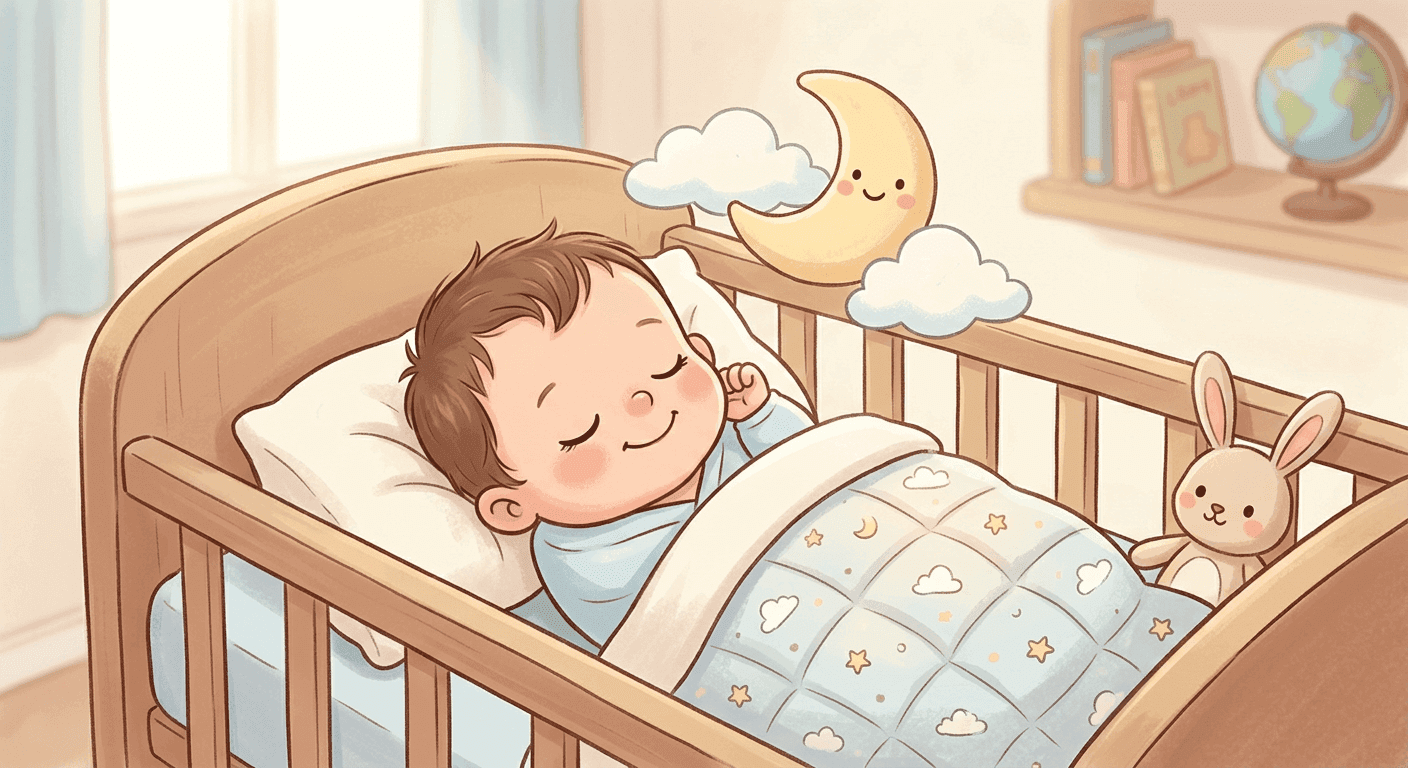
Why Do Newborns Smile in Their Sleep
Why Do Newborns Smile in Their Sleep?
- How Newborn Sleep Works — And Why It’s Nothing Like Adult Sleep
- Reflexive Smiles in Newborns
- The “Just Gas” Myth: Where Folk Wisdom Gets It Wrong
- The Developmental Journey Toward the Social Smile
- Other Newborn Sleep Behaviors That Surprise (and Sometimes Alarm) New Parents
- The Hidden Architecture of Attachment: Why Sleep Smiles Matter Beyond Biology
- Conclusion
Newborn sleep smiles are completely normal, extraordinarily common, and — far from being meaningless — they are a sign that a baby’s brain and nervous system are developing exactly as they should. These smiles occur primarily during a specific phase of infant sleep called “Active Sleep,” the newborn equivalent of the dream-stage sleep that adults experience every night.
It tends to happen when the house is at its quietest. The feeding is done. The swaddle is snug. The bassinet has stopped its gentle rocking. A new parent — running on something between adrenaline and muscle memory — leans in for one last check before attempting a few hours of sleep, and there it is: a smile. Not a twitch, not a grimace, but a real, unmistakable, radiant smile, spreading across that impossibly small face like sunlight crossing a meadow.
The phone comes out. The heart does something complicated. And then, as quickly as it arrived, the smile evaporates — leaving behind a perfectly still, perfectly sleeping infant and a parent with a question that has puzzled mothers and fathers for as long as there have been babies to watch over:
Why do newborns smile in their sleep?
It is one of the most searched parenting questions on the internet, and for good reason. The answer sits at a fascinating crossroads where neuroscience meets developmental psychology, where ancient folk wisdom bumps up against modern research, and where one of the smallest human gestures turns out to tell one of the largest stories about how people become who they are.
How Newborn Sleep Works — And Why It’s Nothing Like Adult Sleep
Before diving into the smile itself, it helps to understand the stage on which it performs. And newborn sleep, it turns out, is an entirely different production from the sleep that adults know.
A Quick Primer on Adult Sleep
Most readers are at least casually familiar with the concept of sleep cycles. Each night, an adult brain moves through a predictable sequence of stages, looping through lighter sleep, deeper sleep, and a vivid phase called REM sleep (short for Rapid Eye Movement) — the stage most closely associated with dreaming. A single cycle takes roughly 90 minutes, and across a typical night, the brain completes four to six of these cycles. For adults, REM sleep accounts for about 20 to 25 percent of total sleep time.
The architecture is well-organized, efficient, and — compared to what newborns do — remarkably calm.
Newborn Sleep: A Different Blueprint Entirely
A newborn’s brain has not yet developed the neural wiring to produce a full adult sleep cycle. Instead, it operates on a simpler, two-stage system:
- Quiet Sleep — the newborn equivalent of deep sleep. The body is still, the breathing is even, and the brain is focused on physical restoration: repairing tissue, releasing growth hormones, and consolidating the basic biological housekeeping that keeps a small, rapidly-growing body running.
- Active Sleep — the newborn equivalent of REM sleep, and the stage where our story really begins.
To appreciate why this distinction matters, consider the proportions. Where an adult spends roughly one-fifth of the night in REM, a newborn spends up to half — sometimes more — of total sleep time in Active Sleep. According to research cited by the American Academy of Pediatrics, this figure can reach 50 percent or higher in the first weeks of life, gradually tapering toward adult proportions over the first year.
That is an enormous amount of time — and the brain is not wasting a single second of it.
What Happens During Active Sleep
Active Sleep is spectacularly misnamed. There is nothing passive or restful about it. If Quiet Sleep is a factory floor at night — lights dimmed, machines humming on maintenance mode — then Active Sleep is the executive suite at midday, every department running at full capacity.
During Active Sleep, a newborn’s brain exhibits electrical activity that approaches the levels seen during full wakefulness. Neurons fire in rapid, complex patterns. The eyes dart back and forth beneath closed lids (hence the “rapid eye movement” comparison). And the body, lacking the muscular inhibition that keeps adult dreamers from acting out their dreams, moves freely: fingers curl and uncurl, legs kick softly, lips pucker into sucking motions, brows furrow and relax.
And, of course, the face smiles.
Why so much Active Sleep? The prevailing scientific explanation is elegantly simple. The first months of life represent the single most intensive period of brain development a human being will ever experience. A newborn’s brain forms up to one million new synaptic connections every second (a figure documented by Harvard University’s Center on the Developing Child). Active Sleep appears to serve as the brain’s dedicated construction shift — the period during which all those new connections are tested, strengthened, or pruned. The more building there is to do, the more time the brain needs on the job. As the brain matures and the pace of construction slows, Active Sleep gradually decreases in proportion.
This context is essential. When parents see their baby grimacing, twitching, or smiling during sleep, they are not witnessing a baby in distress or discomfort. They are watching — in real time — a brain in the act of building itself.
Reflexive Smiles in Newborns
With that foundation in place, the sleep smile itself comes into much sharper focus.
What Is a Reflexive Smile?
The smiles that appear on a newborn’s face during sleep have a clinical name: neonatal smiles or, more commonly, reflexive smiles. The term “reflexive” is key. It means that these smiles are involuntary — they arise spontaneously from within the nervous system, without any external trigger.
No one is making a funny face at the baby. No soothing voice has prompted it. The baby is, by every outward measure, deeply asleep. The smile simply appears, holds for a second or two, and fades.
In neurological terms, a reflexive smile belongs to the same broad family as the other primitive reflexes that are hallmarks of healthy newborn development:
| Reflex | What It Looks Like | What It Means |
|---|---|---|
| Rooting reflex | Baby turns head and opens mouth when cheek is stroked | Ready to find and latch onto a food source |
| Palmar grasp | Baby grips a finger placed in its palm | Motor system is intact and responsive |
| Moro (startle) reflex | Arms fling outward and then draw inward | Primitive response to perceived falling |
| Reflexive smile | Spontaneous smile during sleep | Facial motor circuits and brain are developing normally |
Each of these reflexes is a diagnostic sign — evidence that the nervous system has wired itself correctly and is ready for the next phase of development. The reflexive smile is simply the one that happens to melt hearts.
Why Reflexive Smiles Are More Than Random Twitches
For decades, the prevailing view in pediatric medicine was that reflexive smiles were essentially biological noise — random firings with no particular significance beyond confirming basic neurological function. More recent research, however, has refined this view substantially.
The emerging consensus, supported by studies in developmental neuroscience, frames reflexive smiles as something far more purposeful: a rehearsal.
An analogy may help here. Imagine a concert pianist preparing for a major performance. Weeks before the event, the pianist practices individual passages — not the full piece, not with emotion or interpretation, but isolated sequences of muscle movements repeated until they become automatic. The fingers learn the patterns. The motor memory solidifies. When the night of the performance arrives, all of that preparation flows seamlessly into the real thing.
A reflexive smile works on a remarkably similar principle. The newborn’s brain is activating the specific combination of facial muscles — the zygomaticus major (which pulls the corners of the mouth upward) and the orbicularis oculi (which will eventually create the “eye crinkle” of a genuine smile) — and running them through their paces. It is a dress rehearsal, conducted in the privacy of sleep, for the complex social performance that lies just weeks ahead.
This is not speculation. Dr. Mark S. Blumberg, a neuroscientist at the University of Iowa whose lab has extensively studied infant motor development during sleep, has demonstrated that the twitches and movements babies produce during Active Sleep are not random byproducts of dreaming (newborns almost certainly do not dream in the narrative sense that adults do — their brains lack the stored experiences to construct dream imagery). Instead, these movements appear to be part of a sensorimotor calibration process: the brain sends a signal, the muscle responds, and the feedback loop teaches the brain precisely what signal produces what movement.
Every sleep smile, in other words, is a tiny lesson the brain is teaching itself.
The “Just Gas” Myth: Where Folk Wisdom Gets It Wrong
Now for the elephant in the nursery.
Mention a newborn’s sleep smile to anyone over the age of sixty, and the response is almost guaranteed: “Oh, that’s just gas.” It is one of those pieces of folk wisdom that has achieved near-universal reach, passed from generation to generation with the confident authority of settled fact. It appears in parenting forums, family group chats, and well-meaning advice from relatives who raised children decades ago without a sleep-science textbook in sight.
And while it is not entirely without foundation, the “just gas” explanation is, by modern scientific standards, mostly wrong — and understanding why it persists is itself an instructive lesson in how humans think about coincidence.
The Kernel of Truth
It is true that the gastrointestinal system can influence a newborn’s facial expressions to a limited degree. The process of digesting breast milk or formula involves muscular contractions (called peristalsis) that move food through the tiny, still-immature digestive tract. These internal sensations can occasionally register on the face — producing what might look like a brief grimace, a look of concentration, or, in some interpretations, something resembling a fleeting smile.
Why the Science Points Elsewhere
However, the body of peer-reviewed research — including studies published through the National Institutes of Health and summarized by the National Sleep Foundation — consistently attributes the majority of genuine newborn sleep smiles to neurological activity during Active Sleep, not to digestive processes.
The critical distinction comes down to timing and context. Reflexive smiles follow a recognizable pattern: they occur during Active Sleep, they coincide with the characteristic eye-movement and body-twitch markers of REM-state brain activity, and they are part of a broader suite of facial movements (frowns, puckers, brow-raises) that collectively represent the motor cortex doing its work.
The Coincidence Trap
So why has the “gas” explanation endured for so long? The answer is a cognitive phenomenon that psychologists call the illusory correlation — the human tendency to see a meaningful relationship between two events simply because they occur close together in time.
Consider the mathematics of a newborn’s day. A baby feeds 8 to 12 times every 24 hours, meaning digestion is essentially a continuous process. Simultaneously, a newborn cycles in and out of Active Sleep roughly every 45 to 60 minutes. When two events are both this frequent, they will overlap constantly — not because one causes the other, but because they are both happening almost all the time.
A parent sees the baby smile 20 minutes after a feed and draws the intuitive conclusion: the feed caused the smile. In reality, the baby was simply entering another cycle of Active Sleep at a moment that happened to follow a feeding — which, given how often both events occur, was almost statistically inevitable.
The “gas” myth is harmless in practice. No parent has ever been led astray by believing it. But retiring it in favor of the more accurate neurological explanation does something quietly important: it elevates the sleep smile from a meaningless digestive byproduct into what it actually is — evidence of a brain in the magnificent act of becoming.
The Developmental Journey Toward the Social Smile
Understanding the reflexive sleep smile becomes even more rewarding when it is placed within its larger developmental context — as the opening chapter of a story that leads, in just a few short weeks, to one of the most emotionally significant moments in early parenthood: the first social smile.
This progression unfolds in three distinct, observable phases. Knowing what to look for — and roughly when to look for it — can transform the early weeks of parenting from a fog of exhaustion into a front-row seat at a genuinely remarkable developmental performance.
Phase 1: The Reflexive Smile (Birth Through Approximately 6 Weeks)
In the first six weeks of life, every smile a baby produces is reflexive. These smiles share a set of consistent characteristics:
- They occur predominantly during Active Sleep (though occasional reflexive smiles may occur briefly during waking periods).
- They are brief — typically lasting one to two seconds.
- They involve only the mouth and cheeks. The eyes remain still or closed; there is no “eye smile.”
- They have no external trigger. The baby is not responding to a face, a voice, or a touch.
These are smiles that belong entirely to the baby’s interior world — signals from the engine room, not the bridge.
Phase 2: The Transitional Smile (Approximately Weeks 4 Through 6)
Around the one-month mark, something subtle but meaningful begins to shift. Parents may notice that smiles start to appear occasionally while the baby is awake — not directed at anyone in particular, but seemingly connected to pleasant physical sensations: the warmth of a bath, the comfort of being held skin-to-skin, the satisfaction that follows a good feed.
These transitional smiles represent a fascinating middle ground. The motor machinery of smiling is beginning to receive input not just from internal neural firing, but from the baby’s emerging — still very primitive — capacity to process sensory experience. The smile is migrating, slowly, from the realm of reflex into the realm of response.
Think of it as the moment when the concert pianist, after weeks of practicing isolated passages, begins to play them with the faintest hint of feeling — not yet a full performance, but something unmistakably more than mechanical repetition.
Phase 3: The Social Smile (Approximately 6 to 8 Weeks and Beyond)
And then, somewhere between the sixth and eighth week — a timeline confirmed by data from both the Centers for Disease Control and Prevention (CDC) and the American Academy of Pediatrics — it happens.
The baby is awake, alert, and looking at a parent’s face. The parent smiles. And the baby smiles back. Not reflexively, not coincidentally, but intentionally — a genuine, emotionally-inflected, directed act of social communication.
The difference is visceral and unmistakable. Where a reflexive sleep smile is a mouth-only event — a brief, ghostly flicker — a social smile is a whole-face phenomenon. The cheeks rise. The mouth opens. And, most importantly, the eyes engage: they brighten, they focus, and they crinkle at the outer corners in what researchers call the Duchenne marker — a physiological signature, named after the nineteenth-century French neurologist Guillaume Duchenne, that has been shown across cultures to reliably distinguish genuine emotional smiles from polite or reflexive ones.
The social smile is something no parent needs a textbook to recognize. It is, for many, the first moment in parenthood that feels like a true conversation — the first unambiguous evidence that the small person in the crib is not only alive and growing, but present, aware, and reaching back.
Other Newborn Sleep Behaviors That Surprise (and Sometimes Alarm) New Parents
The sleep smile rarely performs solo. Parents who spend any significant time watching a sleeping newborn will encounter a full cast of supporting behaviors — many of which are startling on first encounter and all of which are, in the vast majority of cases, perfectly normal.
Understanding these behaviors in context — as part of the same Active Sleep symphony that produces the smile — can save new parents a significant amount of unnecessary anxiety.
The Moro (Startle) Reflex
Perhaps the most dramatic entry in the newborn sleep repertoire. Without warning, a peacefully sleeping baby will suddenly fling both arms outward, fingers splayed, as if startled by a loud noise that no one else heard — then slowly draw the arms back in toward the chest.
This is the Moro reflex, one of the oldest known human primitive reflexes. It is believed to be an evolutionary holdover — a survival mechanism from a time in human prehistory when infants were carried constantly, and a sudden sensation of falling needed to trigger an immediate grasping response. In modern bassinet life, the trigger is usually internal rather than external: a sudden shift in the brain’s electrical activity during the transition between sleep stages.
The Moro reflex is present at birth and typically fades by four to six months of age. Its presence is a reliable sign of normal neurological development; its absence, paradoxically, is sometimes used by pediatricians as a diagnostic marker for potential neurological concerns.
Grunting, Snuffling, and the Soundtrack of Newborn Sleep
First-time parents are almost universally unprepared for how noisy a sleeping newborn can be. The sounds — grunts, snorts, whistles, squeaks, brief whimpers, and what can only be described as tiny, dramatic sighs — are relentless and varied.
The explanation is physiological. A newborn’s respiratory system is immature. The nasal passages are narrow (newborns are obligate nose breathers for the first several months). The airway is small and soft-walled. The diaphragm, the muscle that drives breathing, is still developing its rhythm. The result is a breathing pattern that is irregular, punctuated by intermittent pauses, and accompanied by a surprisingly rich assortment of sound effects.
None of this, under normal circumstances, indicates distress. It is simply the auditory output of a respiratory system that is still very much a work in progress.
Eye-Rolling and Fluttering
Few things unsettle a new parent more quickly than looking into the bassinet and seeing the whites of their baby’s eyes beneath partially-open lids. It looks, to an untrained observer, like something has gone wrong.
It hasn’t. During Active Sleep, the eyes move rapidly beneath the lids (this is, after all, the defining characteristic of REM-type sleep). In newborns, whose eyelids do not always close fully during sleep, these movements can become partially visible — producing the unsettling appearance of eyes rolling or fluttering.
This is normal. It is harmless. And it is, like the smile, simply a visible byproduct of a brain working at full tilt.
A Framework for When to Seek Medical Guidance
While the vast majority of sleep-time movements fall well within the range of normal, there are specific patterns that should prompt a conversation with a pediatrician. The key distinction lies in the quality and responsiveness of the movement:
| Normal Sleep Movements | Potentially Concerning Movements |
|---|---|
| Irregular, varied twitches and jerks | Rhythmic, repetitive, stereotyped jerking |
| Brief — lasting a second or two | Sustained — lasting 10 seconds or longer |
| Stop or change when the baby is gently touched | Continue unchanged despite touch or repositioning |
| Occur during obvious Active Sleep (other movements, eye flutter present) | Occur during Quiet Sleep or waking with no other Active Sleep markers |
| Baby appears relaxed between movements | Baby appears rigid or unusually limp |
The distinction between a normal sleep twitch and a seizure can be genuinely difficult to assess without clinical training. The safest and most responsible approach, whenever a parent feels uncertain, is simply to record the behavior on a phone camera and show it to the baby’s pediatrician at the next visit — or sooner, if the concern feels urgent. No doctor has ever faulted a parent for being cautious.
The Hidden Architecture of Attachment: Why Sleep Smiles Matter Beyond Biology
There is one final dimension of the newborn sleep smile that purely neurological explanations tend to overlook — and it may be, in the lived experience of parenting, the most important one of all.
The Parent’s Side of the Equation
The reflexive smile is, by definition, not directed at anyone. The baby is asleep. There is no intention, no recognition, no emotion in the adult sense of the word. And yet the parent who sees it responds — with warmth, with tenderness, with a flood of oxytocin and an involuntary smile of their own. This response is not accidental. It is, in fact, precisely what millions of years of evolution designed it to be.
Dr. Daniel Stern, the pioneering developmental psychiatrist whose landmark work The Interpersonal World of the Infant transformed the scientific understanding of early parent-child relationships, argued persuasively that the emotional exchange between parent and infant is bidirectional from the very beginning — even when the infant’s contributions are reflexive rather than intentional. The parent who gazes at a sleeping baby’s smile and feels a surge of connection is not imagining things or projecting meaning onto randomness. That parent is engaging in the earliest form of attunement— the process of learning to read, interpret, and respond to another human being’s signals.
This attunement matters enormously. Research from the Harvard Center on the Developing Child has shown that responsive, attuned caregiving in the first months of life is one of the strongest predictors of secure attachment — the foundational emotional bond that influences a child’s social development, stress regulation, and even cognitive functioning for years to come.
The Feedback Loop
In this light, the reflexive sleep smile participates in a feedback loop that is as elegant as it is important:
- The baby smiles reflexively during sleep.
- The parent sees the smile and responds with warmth, attention, and emotional engagement.
- This pattern of attentive caregiving establishes a baseline of responsiveness that the baby, even at this early age, begins to absorb.
- When the social smile emerges at around six to eight weeks, the parent is already primed to receive and reciprocate it — creating the first true back-and-forth emotional exchange of the baby’s life.
The sleep smile, in other words, is not just the brain practicing how to move facial muscles. It is, in a broader and more profound sense, the opening act of the human relationship — the first, involuntary overture in what will become the longest and most complex conversation any two people can have.
Conclusion
In the grand sweep of human development, the newborn sleep smile occupies a peculiar and wonderful position. It is, by every clinical metric, a reflex — a spontaneous discharge of neural activity during Active Sleep, a motor rehearsal conducted by a brain that is building approximately one million new synaptic connections every second.
And yet it is also, simultaneously, the earliest whisper of something far larger: the capacity for social connection, emotional expression, and genuine human warmth that will define this small person’s entire life.
Understanding why newborns smile in their sleep does not diminish the beauty of the moment. If anything, it amplifies it. Because to know that that fleeting, two-second curl of the lips represents the most sophisticated biological system on Earth teaching itself to do its most essential work — to connect, to communicate, to reach across the space between one person and another — is to glimpse something genuinely awe-inspiring in an act that looks, on the surface, like nothing more than a baby dreaming.
The baby is not dreaming. Not yet. But the baby is doing something arguably more remarkable: rehearsing, one tiny smile at a time, for the moment — just weeks away — when that smile will be given to someone, and something irreplaceable will begin.
Lean in. Take the photo. What is unfolding in those quiet midnight moments is nothing less than the architecture of a human being, taking shape in the dark.
Sources & Further Reading:
- Harvard University — Center on the Developing Child – Brain Architecture: Key Concepts
- National Sleep Foundation – How Much Sleep Do Babies Need?
- Stanford Children’s Health – Newborn Sleep Patterns
- Blumberg, M. S. (2015). Developing Sensorimotor Systems in Our Sleep. Current Directions in Psychological Science, 24(1), 32–37.
- Stern, D. N. (1985). The Interpersonal World of the Infant: A View from Psychoanalysis and Developmental Psychology. New York: Basic Books.

October 25, 2026
October 25, 2026
October 25, 2026

October 25, 2026