Infant-Flavor-Training
Infant Flavor Training: How the First 18 Months Shape a Child’s Lifelong Relationship with Food
The science is clear — a narrow window of biological opportunity, hiding in plain sight between six and eighteen months of age, determines whether a child grows up embracing broccoli or barricading against it.
There is a scene that plays out in kitchens around the world with such reliability that it borders on ritual. A parent, weary but hopeful, places a carefully prepared morsel of something green and nutritious — perhaps steamed broccoli, or a lovingly mashed avocado — in front of a toddler. The toddler regards the offering with the quiet suspicion of a bank teller inspecting a questionable check. A pause. Then the full-body shudder. Then the dramatic, theatrical ejection of food from the mouth. Then the demand, delivered in the unmistakable tone of an experienced negotiator, for something else. Something beige. Something safe. Something — ideally — that rhymes with “racker” and comes in a foil sleeve.
This is the picky eating crisis, and it is not trivial. According to a widely cited 2015 meta-analysis published in the International Journal of Behavioral Nutrition and Physical Activity, roughly 20 to 50 percent of parents worldwide identify their child as a “picky eater” — a figure so staggering that it has become almost normalized, treated as an inevitable phase rather than a preventable pattern. But what if it is preventable? What if the roots of that mealtime standoff were planted not at the toddler stage but months earlier — during a window of biological opportunity that most families never even realized was open?
This is the promise and the science of infant flavor training: the intentional, evidence-backed practice of exposing babies to a wide, complex, and deliberately diverse range of flavors during the developmental period when their brains are uniquely wired to accept them. It is not a fringe philosophy or an aspirational parenting trend. It is a strategy grounded in decades of rigorous research from institutions including the Monell Chemical Senses Center in Philadelphia — the world’s preeminent laboratory dedicated to the science of taste and smell — and validated by longitudinal studies tracking children’s eating habits from highchair to high school.
And the most remarkable thing about it? It requires no special equipment, no expensive products, and no culinary expertise. It requires only knowledge, timing, and a willingness to rethink the jar of pureed peaches.
What Is Infant Flavor Training?
Before diving into the science, it helps to understand what infant flavor training actually means in practical, everyday terms — because the phrase itself, while increasingly common in parenting circles, can sound more clinical and intimidating than it needs to be.
At its simplest, infant flavor training is the deliberate introduction of a wide variety of tastes during the first months of solid food eating, with the goal of building a broad and flexible palate before the child’s biology shifts toward caution and conservatism around new foods.
Think of it this way. Imagine that every baby is born with a blank music playlist. During the first eighteen months of life, there is a window during which new songs — new flavors — can be added to that playlist almost effortlessly. The baby’s brain is in “discovery mode,” eagerly cataloguing and accepting novel sensory experiences. After about eighteen months, that playlist begins to lock. New songs can still be added, but the process becomes slower, more resistant, and significantly more effortful — like trying to convince a lifelong jazz listener to fall in love with death metal. It can happen, but it takes far more patience and repetition.
Infant flavor training is the art of adding as many diverse, nutritious “songs” to That playlist as possible while the window of effortless acceptance is still wide open.
The emphasis falls on several key dimensions of flavor:
- Savory and bitter tastes (vegetables, herbs, meats) rather than exclusively sweet ones
- Aromatic complexity (spices like cumin, cinnamon, and turmeric — without added salt or sugar)
- Textural diversity (progressing from smooth purees to mashed, lumpy, and eventually finger foods)
- Cultural breadth (drawing from global culinary traditions rather than defaulting to a narrow Western baby-food palette)
None of this requires a culinary degree. It requires only a shift in mindset: from “baby food should be bland and simple” to “baby food should be varied and interesting.” That shift, as the evidence will show, has consequences that echo for decades.
The Science Behind the Critical Flavor Window — And Why Biology Imposes a Deadline
The reason infant flavor training works — and the reason timing matters so urgently — lies in the architecture of the developing brain. Understanding this architecture is the key to understanding why the first eighteen months carry such outsized importance.
How the Baby Brain Processes New Flavors
During infancy, the brain is engaged in a period of explosive synaptic growth. To translate that from neuroscience into plain language: the brain is building, at extraordinary speed, the internal wiring that will govern how the child perceives, interprets, and responds to the world. This includes the neural circuits responsible for processing taste and smell.
An analogy helps here. Imagine the infant brain as a vast city under construction. Roads are being built in every direction. Every new experience — a sound, a touch, a taste — is like a car driving down one of those roads for the first time. The first car on a new road travels slowly and uncertainly. But every subsequent car on the same road makes the journey faster and smoother, until eventually the route becomes a well-paved highway that feels natural and automatic.
When a baby tastes broccoli for the first time, that flavor is the first car on a brand-new road. The brain registers it as novel — unfamiliar, surprising, and potentially suspect. But with repeated exposure — the second taste, the fifth, the tenth — that same neural pathway becomes smoother and more established. The flavor shifts from “unknown and alarming” to “familiar and acceptable.” Eventually, it becomes part of the child’s internal map of safe, normal food.
Here is the critical point: this road-building happens fastest and most efficiently during roughly the first eighteen months of life. After that, the construction crew begins to slow down. New roads can still be built, but the process is far more labor-intensive. The brain, having established its initial map, becomes increasingly conservative about adding new routes.
The Evolutionary Explanation: Why the Window Closes
This naturally raises a question: why would biology design a system that becomes lessopen to new experiences over time? The answer lies in evolutionary survival.
Roughly 18 to 24 months marks the age at which, in the ancestral human environment, children typically became mobile enough to walk independently, explore their surroundings, and — critically — pick up and put things in their mouths without parental supervision. In a prehistoric landscape filled with toxic plants, unfamiliar berries, and potentially dangerous substances, a toddler who indiscriminately ate everything in sight was a toddler in serious danger.
Natural selection solved this problem by installing a built-in safety mechanism: food neophobia, which is the scientific term for an intense, instinctive suspicion of unfamiliar foods. Around eighteen months, the gate of openness swings partially shut, and the child’s default setting shifts from “curious explorer” to “cautious gatekeeper.”
A helpful way to picture this: during the first year and a half of life, the baby’s brain is operating like an enthusiastic intern on the first day — eager to say yes to everything, excited by novelty, open to any assignment. After eighteen months, that intern has been promoted to security guard — skeptical, risk-averse, and inclined to reject anything that does not match the established protocol.
This is why the timing of infant flavor training is so consequential. Every flavor successfully introduced before the neophobic shift is a flavor that has already been filed under “known and safe” — and is therefore far less likely to be rejected once the toddler’s suspicion instinct activates. The race is not against the clock in a stressful sense, but there is a genuine biological deadline, and families who understand it can use it to extraordinary advantage.
Flavor Training Starts Before the First Spoon: The Prenatal and Breastmilk Connection
Perhaps the most astonishing discovery in this field is that infant flavor training does not begin at six months when solids are introduced. It begins in the womb.
In a landmark 2001 study published in Pediatrics, researchers Julie Mennella, Coren Jagnow, and Gary Beauchamp at the Monell Chemical Senses Center demonstrated something remarkable. They divided pregnant women into three groups: one group drank carrot juice regularly during the last trimester of pregnancy, one group drank carrot juice regularly while breastfeeding after birth, and one group avoided carrot juice entirely in both periods. When the babies later began eating solid foods, those whose mothers had consumed carrot juice — whether during pregnancy or breastfeeding — showed significantly greater acceptance of carrot-flavored cereal compared to the babies in the unexposed group.
The mechanism is both simple and elegant. Flavor compounds from the foods a pregnant woman eats pass into the amniotic fluid — the liquid that surrounds the baby in the womb. From about the second trimester onward, the fetus is actively swallowing this fluid, and the developing taste receptors are already registering its character. A mother who eats garlic, cumin, or fennel during pregnancy is, without realizing it, introducing her baby to those flavor signatures months before birth.
After birth, breastmilk continues this education. Unlike infant formula, which has a consistent, uniform taste from bottle to bottle, breastmilk is a dynamic, ever-changing liquid whose flavor profile shifts with every meal the mother eats. A curry dinner, a salad dressed with vinegar, a breakfast of cinnamon-spiced oatmeal — each of these subtly alters the taste of the milk the baby receives hours later. Breastmilk, in this sense, functions as a daily flavor sampler, gently and continuously expanding the infant’s repertoire of familiar tastes.
This does not mean formula-fed babies are disadvantaged in flavor training — far from it. Formula-fed infants can and do thrive magnificently with intentional flavor exposure once solids begin. But it does mean that breastfeeding parents have an opportunity many are unaware of: by eating a varied, adventurous diet themselves, they are passively priming their baby’s palate with every feeding.
The “Savory-First” Philosophy: Why Conventional Wisdom Got the Order Wrong
For generations, the standard pediatric advice for starting solids followed a comfortingly predictable script: begin with rice cereal. Then introduce sweet, mild fruits — mashed banana, pureed apple, steamed pear. Graduate to carrots and sweet potatoes. Perhaps, eventually, cautiously, try some green vegetables.
This advice was well-intentioned and rooted in a reasonable premise: sweet foods are universally accepted by babies, easy to prepare, and unlikely to cause distress. The problem is that this premise, while technically accurate, ignores a crucial neurological reality — and in doing so, inadvertently sets many families up for the very picky-eating patterns they later struggle to correct.
The Built-In Sweet Bias
Every human baby arrives in the world with a pre-installed flavor preference: sweetness. This is not a flaw or a failing; it is an evolutionary feature. Breastmilk is naturally sweet, primarily due to its lactose content. From a survival standpoint, a newborn who instinctively sought out and preferred sweet-tasting substances was a newborn who was motivated to feed — and therefore to survive. This preference is so deeply wired that studies have shown even premature infants who have never tasted breastmilk will demonstrate a positive facial response when a drop of sugar solution is placed on their tongue.
Alongside this sweet preference, babies arrive with a corresponding aversion to bitterness. Again, evolution provides the logic: in the natural world, bitter-tasting compounds are disproportionately found in toxic plants and alkaloid-producing species. A palate that instinctively recoiled from bitterness was a palate less likely to lead its owner toward poisonous substances.
These two tendencies — sweetness-seeking and bitterness-avoidance — are the factory settings of the human palate. And this is precisely why the conventional “sweet first” weaning approach is problematic.
The Reinforcement Trap
When a baby’s first weeks and months of solid food are dominated by sweet, mild flavors — banana, pear, apple, rice cereal — the developing brain receives a very specific message: “This is what food tastes like. This is normal. This is safe.” The neural pathways associated with sweet, bland flavors are reinforced and widened with every feeding. Meanwhile, the pathways for bitter, sour, savory, and complex flavors remain unbuilt — empty lots in the city of the palate, undeveloped and increasingly unfamiliar.
By the time a parent introduces broccoli or spinach at nine or ten months, the baby is not encountering a new flavor on neutral ground. The baby is encountering a flavor that stands in stark, jarring contrast to every sensory experience its palate has been trained to expect. The rejection, when it comes, is not arbitrary — it is the predictable outcome of a palate whose “normal” baseline has been set too narrow.
Imagine learning to drive exclusively on smooth, straight highways for the first six months, and then suddenly being placed on a winding mountain road in a rainstorm. The road itself is perfectly safe, but the contrast with every prior driving experience makes it feel terrifying. That is what broccoli tastes like to a baby who has been eating only sweet purees.
The Case for Savory, Bitter, and Umami as the Starting Point
The savory-first philosophy — championed by researchers including Dr. Leann Birch at Pennsylvania State University and validated by a 2022 study published in Nutrients — turns the conventional wisdom on its head. Instead of starting with the flavors babies already prefer (sweet) and hoping they will eventually accept the flavors they do not (bitter, savory), this approach begins with the challenging flavors first, precisely because the flavor window is still wide open and the baby’s brain is at peak receptivity.
The logic is sound: there is no need to “train” a baby to like sweet foods. That preference is already hardwired. What requires deliberate training — what the flavor window must be used for — is building acceptance for the tastes that do not come naturally: the bitterness of broccoli, the earthiness of spinach, the umami depth of mushrooms and slow-cooked meats, the aromatic complexity of cumin or fresh basil.
A 2022 study in Nutrients found that early and repeated exposure to bitter-tasting vegetables during the first year of life was one of the strongest predictors of vegetable acceptance at age five. The children in the study who had eaten the widest variety of bitter vegetables before their first birthday consumed measurably more vegetables as preschoolers — not because they were forced to, but because those flavors had been successfully filed under “familiar and safe” during the critical window.
The flavors that merit early, deliberate attention include:
| Flavor Profile | Examples | Why It Matters |
|---|---|---|
| Bitter | Broccoli, kale, spinach, Brussels sprouts, asparagus | Counteracts the innate sweet bias; builds vegetable acceptance |
| Sour / Acidic | Plain yogurt, kefir, lemon squeezed on avocado | Expands the range of accepted tastes; common in many cuisines |
| Umami (savory depth) | Mushrooms, meats, lentils, bone broth, soft fish | Introduces protein-rich flavors and complex savory notes |
| Aromatic / Herbal | Basil, coriander, dill, mint, gentle curry spices | Bridges to diverse global cuisines; normalizes aromatic complexity |
One essential caveat must be emphasized: no added salt, sugar, or honey should be used during the first year of life. Honey carries a risk of infant botulism. Salt places undue strain on immature kidneys. Sugar overrides the entire purpose of flavor training by amplifying the sweet bias the process aims to counterbalance. All flavor complexity should be achieved exclusively through whole foods, herbs, and spices — which is both healthier and, as it turns out, far more interesting.
The Three Core Pillars of Effective Infant Flavor Training
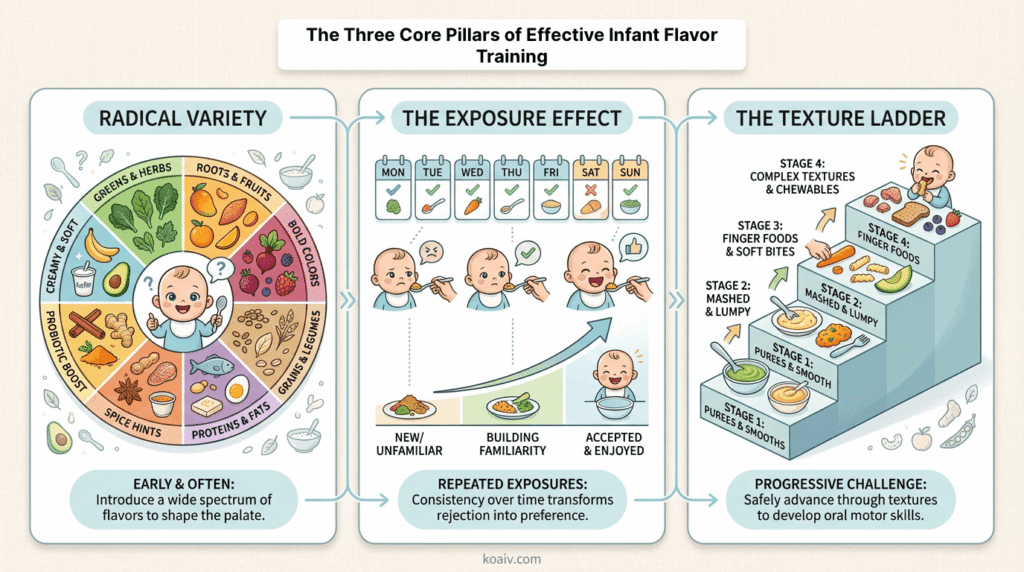
Understanding why infant flavor training matters is essential, but knowing exactly how to implement it is what transforms theory into practice. The entire process rests on three interconnected pillars, each of which reinforces the others.
Pillar 1: Radical Variety — Treating the Palate Like a Library, Not a Bookshelf
The first pillar is straightforward in principle but requires intentional effort in execution: offer the widest possible variety of flavors from the earliest possible point in the solid food journey.
The word “bland” has no legitimate place in infant nutrition. It is a cultural assumption, not a medical necessity. Baby food does not need to taste like nothing in order to be safe — a confusion that has narrowed the palates of generations of children without any nutritional justification.
Pediatric dietitians and feeding experts widely endorse the introduction of baby-appropriate herbs and spices from the very beginning of the weaning process. These are not exotic or risky additions; they are the same ingredients found in kitchens around the world, used in infant-safe quantities:
- Cinnamon stirred into oatmeal or mashed sweet potato — warm, familiar, gently sweet without sugar
- Cumin blended into lentil or black bean puree — earthy, savory, a cornerstone of dozens of global cuisines
- Turmeric mixed into butternut squash — a powerful anti-inflammatory with a mild, warm flavor
- Mint or basil pureed into peas or zucchini — bright, aromatic, a gateway to Mediterranean and Southeast Asian flavor profiles
- Mild curry powder (salt-free, age-appropriate) folded into chicken and coconut puree — an introduction to one of the world’s most nutritionally sophisticated culinary traditions
The goal is to construct what might be called a flavor atlas in the infant’s brain — a rich, diverse, continually expanding map where complexity is the baseline rather than the exception. Every new herb, every new vegetable, every new combination is a pin in that atlas, marking another territory of “familiar and safe” that the child can return to for years to come.
Pillar 2: The Exposure Effect — Why Patience Is the Most Powerful Ingredient
If Pillar 1 is about breadth, Pillar 2 is about depth. And it may be the single most important piece of practical knowledge in the entire infant flavor training framework.
The principle is this: research consistently shows that babies may need between 8 and 15 separate exposures to a new flavor before they demonstrate genuine acceptance. Some studies have documented even higher thresholds. This means that offering a food once or twice, noting the baby’s grimace, and concluding “my baby doesn’t like peas” is not a finding — it is a premature verdict, delivered after examining roughly ten percent of the available evidence.
The analogy that best captures this is hearing a song on the radio for the first time. Very few people fall in love with a new song on first listen, particularly if it is in an unfamiliar genre. The melody seems odd, the rhythm feels unnatural, the overall impression is one of mild confusion or indifference. But by the fourth or fifth listen, something shifts. By the eighth, the song has become familiar. By the fifteenth, it is genuinely liked — and by the twentieth, it might be a favorite. The baby’s palate works the same way. Familiarity does not merely breed tolerance; it breeds genuine preference.
This brings us to one of the most misunderstood moments in infant feeding: the “yuck face.”
Every parent who has offered a baby something new — particularly something bitter or sour — has witnessed the reaction: eyes widening, face scrunching, tongue pushing forward, the whole body executing a small, dramatic shudder. It is theatrical. It is unmistakable. And in the vast majority of cases, it is misinterpreted.
The yuck face is not the baby’s way of saying “I hate this and never want to see it again.” It is the baby’s way of saying, “Whoa — that is completely different from anything I have tasted before, and I need a moment to process it.” It is an expression of neurological novelty, not gastronomic rejection. The tongue-thrust reflex — a protective instinct in young infants — may also contribute to the ejection of unfamiliar textures, compounding the impression of disgust where none truly exists.
The critical variable in this exchange is the caregiver’s reaction. When a parent responds to the yuck face with visible dismay, immediately removes the food, and mentally crosses it off the list, they communicate a powerful — if unintentional — message: “Your reaction had a meaningful consequence. If you react strongly enough, this food will go away.” This begins a feedback loop that intensifies avoidance behavior rather than resolving it.
The evidence-backed response is disarmingly simple: acknowledge nothing. React to nothing. Continue the meal calmly. Offer the food again in a few days. Then again. And again. The mantra of the exposure effect is as unglamorous as it is effective: offer, accept the reaction with equanimity, and offer again next week.
Pillar 3: The Texture Ladder — Because a Flavor Without Its Texture Is Only Half the Story
The third pillar addresses a dimension of infant flavor training that is frequently underappreciated: texture. Flavor and texture are neurologically processed as a single, integrated sensory event. A baby who happily accepts avocado as a silky-smooth puree may completely reject the same avocado when mashed with small chunks — not because the flavor has changed, but because the total sensory experience is entirely different.
This is why texture progression must be intentional, deliberate, and given its own dedicated attention alongside flavor diversity.
The recommended progression looks like this:
| Stage | Approximate Age | Texture Goal | Examples |
|---|---|---|---|
| Stage 1 | 6–7 months | Smooth, thin purees | Single-vegetable or single-fruit purees blended until silky |
| Stage 2 | 7–9 months | Thicker, slightly textured purees | Mashed lentils with soft grains; purees blended less thoroughly |
| Stage 3 | 9–11 months | Mashed foods with soft lumps; early finger foods | Well-cooked diced vegetables; banana pieces; soft pasta |
| Stage 4 | 12–18 months | Chopped family foods; wide variety of textures | Whatever the family eats, cut to safe sizes and shapes |
The most important research finding regarding texture is a cautionary one: a large-scale study cited by the American Academy of Pediatrics found that infants who were not introduced to textured or lumpy foods by ten months of age were significantly more likely to develop persistent texture aversions and feeding difficulties at age seven. Prolonging the smooth-puree phase beyond its developmental usefulness — a common impulse driven by parental anxiety about choking — can inadvertently create the very feeding problems the parent is trying to avoid.
The texture ladder, in other words, is not optional. It is a parallel track that must advance alongside flavor diversity if the infant flavor training program is to achieve its full potential.
The Practical Roadmap: A Phase-by-Phase Guide to Infant Flavor Training
Theory and principles are essential, but what most parents truly need is a clear, actionable timeline — a practical guide, organized by age, that translates the science of infant flavor training into specific steps and strategies. The following roadmap provides that structure.
Phase 1: The Passive Window — Building the Foundation Before Solids (Birth to 6 Months)
During the exclusive milk-feeding period, infant flavor training is passive but profoundly meaningful. No solid foods are offered, but the groundwork is being laid with every feeding.
For breastfeeding families, this is the period to eat with deliberate, conscious variety. Every meal the nursing parent eats is, in essence, a lesson transmitted through breastmilk. A week that includes curries, roasted vegetables, fermented foods, garlic-rich pasta, fresh herbs, and diverse proteins is a week of rich, diverse flavor education for the baby — delivered effortlessly, without a single spoon.
For formula-feeding families, the passive phase centers on two strategies. First, allowing the infant to be physically present at family mealtimes — seated nearby in a bouncer or high chair, watching the adults eat, smelling the aromas of a diverse table. Research in developmental psychology has established that even observational exposure to food — seeing others eat, smelling cooking aromas — begins to build familiarity in the infant brain. Second, formula-feeding families can take particular care to maximize variety and intention once the solid-food phase begins, understanding that the work that breastmilk performs passively will need to be performed actively through diverse food offerings.
Phase 2: First Tastes Done Right (6 to 8 Months)
The introduction of solid foods — typically recommended at around six months of age, per guidance from the World Health Organization and the American Academy of Pediatrics, though the specific timing should be discussed with a pediatrician based on individual developmental readiness — represents the most precious and consequential period in the entire flavor window. The flavors introduced during these first weeks set the baseline that the baby’s brain will use as its reference point for “normal food” going forward.
This is where the savory-first philosophy meets practice. Rather than opening with sweet fruits and rice cereal, the initial weeks of solids should emphasize:
- Single-vegetable purees — broccoli, kale, green beans, zucchini — offered without sweetening agents or mixing with fruit
- Avocado mashed with a pinch of fresh cilantro or a squeeze of lemon
- Pureed lentils with a gentle touch of cumin
- Iron-rich meat purees — beef, chicken, lamb — which are nutritionally critical at this stage, as the iron stores babies are born with begin depleting around six months
- Well-cooked, pureed fish — a nutrient-dense protein and an early introduction to marine flavors
This phase also aligns with the current medical consensus on early allergen introduction. The groundbreaking LEAP (Learning Early About Peanut Allergy) study, published in the New England Journal of Medicine in 2015, demonstrated that early, regular introduction of peanut protein to high-risk infants reduced the incidence of peanut allergy by approximately 81 percent compared to avoidance. Current guidelines from the American Academy of Pediatrics recommend introducing thinned peanut butter (mixed into a puree), well-cooked scrambled egg, and other common allergens during this early weaning period — a topic that should always be discussed with a pediatrician, particularly for families with a history of food allergies.
Phase 3: Complex Combinations and the Flavor Bridge (8 to 12 Months)
By eight months, a well-trained infant palate has accumulated a growing vocabulary of individual flavors. Phase 3 is where those individual words begin forming sentences — complex, layered combinations that mirror the richness and sophistication of the world’s culinary traditions.
One particularly effective technique during this phase is the Flavor Bridge — a method that deserves its own explanation because of how powerfully it resolves one of the most common challenges in flavor training.
How the Flavor Bridge works:
Imagine a baby who reliably accepts sweet potato but consistently rejects spinach. Rather than offering spinach alone (and watching it be rejected repeatedly), the Flavor Bridge technique blends the two together in a ratio heavily weighted toward the accepted flavor — say, 90 percent sweet potato and 10 percent spinach. Over the course of successive meals, the ratio is gradually shifted: 80/20, then 70/30, then 50/50, then 30/70. The familiar flavor acts as an escort, gently introducing the unfamiliar one into territory the brain has already classified as safe and acceptable. Over time, the new flavor no longer needs an introduction — it has earned its own place on the palate’s map.
Think of it like introducing a shy friend into an existing social circle. Bringing the shy friend to a party where they know absolutely no one is overwhelming and likely to fail. But bringing them along with a close mutual friend — someone who vouches for them, who makes the environment feel safe — changes the dynamic entirely. The familiar friend is the sweet potato. The shy newcomer is the spinach. And over time, the spinach becomes a regular member of the group.
Recommended combinations during this phase include:
- Salmon and sweet potato mash with a pinch of dill
- Lentils, butternut squash, and a gentle curry spice
- Chicken poached in coconut milk with coriander
- Spinach, apple, and ginger puree (a classic Flavor Bridge blend)
- Mashed chickpeas with roasted red pepper and cumin
Phase 4: Family Table Integration — The End Goal (12 to 18 Months)
By twelve months, the goal of infant flavor training converges on a single, clarifying principle: the baby should be eating what the family eats, modified only for safe shapes and sizes, and without added salt or sugar.
This is both a nutritional milestone and a behavioral one. The era of separate “baby food” preparation — of dedicated jars, pouches, and specially blended meals — should be gradually drawing to a close. The infant becomes a participant at the family table, eating the same curry, the same roasted chicken, the same stir-fry of vegetables, served in pieces small and soft enough to be safe.
This phase is also the most critical from a behavioral perspective, because the shadow of food neophobia — that evolutionary suspicion mechanism discussed earlier — is now falling across the developmental landscape. Every flavor successfully established before the neophobic shift arrives is a flavor that will weather that shift intact. The months between twelve and eighteen represent a final push, a closing window during which the palate’s library is receiving its last easy acquisitions.
Common Roadblocks — And the Evidence-Based Workarounds That Actually Help
Even the most carefully implemented infant flavor training program will encounter friction. The difference between a family that perseveres and one that retreats to the safety of beige, familiar foods is often not determination — it is preparation. Knowing the roadblocks in advance strips them of their power to derail the process.
The Spit-Out Phase
What happens: The baby places food in the mouth, appears to chew or consider it, and then pushes it out with the tongue. This can happen repeatedly in a single meal.
What most parents assume: “The baby has rejected this food.”
What is actually happening: In many cases, the baby is simply navigating the transition from a liquid diet to a solid one. The tongue-thrust reflex — a protective mechanism that causes the tongue to push foreign objects out of the mouth — is still active in many babies during the early weeks of solids and gradually fades as oral motor coordination matures. The spit-out is mechanical and developmental; it is not editorial. In other cases, the baby is genuinely processing a novel flavor, and the expulsion is part of the acclimatization process described in the Exposure Effect section above.
The evidence-based response: Continue offering. React neutrally. Do not interpret the spit-out as a permanent verdict.
The Teething Regression
What happens: A baby who was eating adventurously and accepting new flavors suddenly reverts to refusing everything except familiar comfort foods — or refuses food altogether.
Why it happens: Teething is genuinely painful. Inflamed, tender gums make the act of eating uncomfortable, and the baby naturally gravitates toward foods that require the least oral effort or that provide soothing relief (cold, soft, familiar textures). Mealtime, previously a neutral or positive experience, becomes associated with discomfort.
The evidence-based response: Reduce texture demands temporarily — shift back to smoother options if needed. Offer cold foods (chilled cucumber sticks, refrigerated yogurt) that soothe inflamed gums. Crucially, maintain the flavor variety even as the textures simplify. The teething episode will pass — usually within a few days — and the palate’s memory of accepted flavors will endure. Abandoning flavor diversity during teething creates a gap that is harder to refill later.
Parental Anxiety and the Division of Responsibility
Perhaps the most insidious roadblock is not a developmental milestone or a biological reflex — it is the caregiver’s own anxiety. The fear that the baby is not eating enough, not gaining weight, not getting proper nutrition, leads many well-meaning parents to abandon the flavor training program in favor of “at least getting something into them” — which usually means defaulting to the sweet, bland, familiar foods the baby readily accepts.
Pediatric feeding expert Ellyn Satter, whose work has shaped clinical feeding practice for decades, provides the most useful framework for managing this anxiety: the Division of Responsibility in Feeding. Its principle is elegant:
- The caregiver is responsible for what food is offered, when it is offered, and where meals take place.
- The child is responsible for whether to eat it and how much to eat.
When parents collapse this boundary — forcing bites, bargaining (“three more peas and you can have a banana”), hiding vegetables in foods through deception, or hovering anxiously with a loaded spoon — they transfer the decision-making power in ways that almost invariably backfire. The child learns that eating is a contest of wills rather than a natural, self-regulated activity, and resistance escalates rather than diminishing.
Respecting the Division of Responsibility — offering diverse, nutritious food on a predictable schedule, maintaining a calm and pressure-free mealtime environment, and trusting the child to regulate their own intake — is one of the hardest but most rewarding disciplines of infant flavor training.
The Power of Modeling
A final roadblock that deserves frank acknowledgment: the family’s own food culture.A baby who watches the adults in the household eating exclusively processed, beige, familiar foods will not sustain adventurous eating habits regardless of how diligently diverse foods appear in their own bowl.
Children are, above all, social learners. They eat what they see eaten. They trust what they see trusted. If a parent visibly enjoys broccoli, the baby receives a powerful signal: “This food is safe, desirable, and part of normal life.” If nobody at the table touches a vegetable, the opposite signal is transmitted with equal force.
Infant flavor training, at its most effective, is not something done to the baby. It is something the entire family participates in together.
What If the Window Has Passed? Flavor Training Beyond 18 Months
There is a significant and understandable population of parents who encounter the concept of infant flavor training when their child is already two, three, or even four years old — solidly past the critical flavor window and deep in the grip of food neophobia. For these families, the first emotion is often guilt. The second is despair. Neither is warranted.
The closing of the critical flavor window does not render the palate permanent. The neural pathways associated with taste preference retain plasticity throughout life— which is why adults can and do learn to appreciate flavors they disliked in childhood (coffee, olives, and blue cheese being perennial examples). What changes after eighteen months is not the possibility of expanding the palate, but the speed and ease with which expansion occurs. The open gate becomes a locked door, but it is not a sealed wall. It simply requires a key — and that key is patience applied over a longer timeline.
Strategies that show particular effectiveness with older toddlers and preschoolers include:
- No-pressure exposure: Placing a small portion of a new food on the plate alongside familiar, accepted foods, with absolutely zero expectation or comment regarding whether the child eats it. Over time, the mere repeated visual presence of the food generates familiarity and reduces the neophobic response.
- Sensory play: Allowing the child to touch, squish, smell, and examine a food without any requirement to taste it. Sensory familiarity — knowing what something feels and smells like — frequently precedes gustatory acceptance and should be celebrated as progress in its own right.
- Involvement in food preparation: Research consistently shows that children who participate in age-appropriate cooking tasks — washing vegetables, stirring mixtures, arranging food on plates — demonstrate significantly higher rates of tasting and accepting those foods at the table.
- Family-style serving: Placing all dishes in the center of the table and allowing the child to serve themselves, in the company of adults who eat the same foods with visible enjoyment and without commentary on the child’s choices.
The toddler palate yields to patience, low pressure, and consistent role modeling. Progress is slower and more incremental than it would have been during the flavor window, but it is entirely achievable — and every step of progress has lasting value.
Conclusion: The Dinner Table as a Lifelong Gift
Infant flavor training is not an exercise in competitive parenting. It is not about producing a prodigy who requests fennel risotto at age three or critiques the seasoning on restaurant meals. It is about something far more practical and far more lasting: giving a child the neurological foundation for a broad, flexible, and joyful relationship with food — one that supports physical health through nutritional diversity, reduces family stress by eliminating mealtime battles, and provides the social ease of being able to eat readily and happily across every culture, kitchen, and table that life will present.
The science is robust. The window is real. The strategies are accessible to every family regardless of budget, culinary background, or geographic location. A pinch of cumin in a lentil puree costs nothing extra. Offering steamed broccoli before the jar of pureed peaches requires no additional preparation. Maintaining a calm, poker-faced equanimity when the spinach is ceremoniously spat across the highchair tray is free — if admittedly challenging.
The family dinner table that so many parents imagine — varied, relaxed, a place where the children eat what the adults eat, where food is a source of shared pleasure rather than mutual frustration — is not a fantasy reserved for exceptional families. For those who have leaned into infant flavor training with knowledge, patience, and consistency, it is the most ordinary thing in the world.
It is simply a Tuesday evening. And the broccoli, on this particular Tuesday, stays on the plate.
Quick Reference: The Infant Flavor Training Framework at a Glance
| Core Concept | Essential Takeaway |
|---|---|
| The Critical Flavor Window | Roughly 6–18 months; the period of peak neurological openness to new flavors |
| Savory-First Philosophy | Introduce vegetables, proteins, herbs, and umami flavors before defaulting to sweet fruits |
| The Exposure Effect | Allow 8–15+ separate exposures before drawing any conclusions about preference |
| The Yuck Face | An expression of sensory novelty, not rejection — maintain a calm, neutral response |
| The Flavor Bridge | Blend a challenging new flavor with an accepted one; shift the ratio gradually over time |
| The Texture Ladder | Progress textures proactively and on schedule to prevent oral-motor delays and texture aversions |
| Division of Responsibility | Caregivers decide what and when; the child decides whetherand how much |
| Modeling Matters | Children eat what they see the family eating — the adults’ food culture is the deepest curriculum |
Sources and Further Reading:
- Mennella, J.A., Jagnow, C.P., & Beauchamp, G.K. (2001). Prenatal and Postnatal Flavor Learning by Human Infants. Pediatrics, 107(6), e88.
- Du Toit, G., et al. (2015). Randomized Trial of Peanut Consumption in Infants at Risk for Peanut Allergy (LEAP Study). New England Journal of Medicine, 372, 803–813.
- World Health Organization — Infant and Young Child Feeding: Model Chapter for Textbooks.
- Monell Chemical Senses Center — Research on Taste Development in Infants.
- European Food Safety Authority (EFSA) — Scientific Opinions on Nutrition and Dietary Requirements for Infants and Young Children.

October 25, 2026