
Serve and Return
Serve and Return: The Simple Back-and-forth Interaction That Literally Builds Your Baby’s Brain
- What Is “Serve and Return” in Early Childhood?
- The Neuroscience of Serve and Return: What Is Actually Happening Inside a Developing Brain?
- The Five Steps of Serve and Return: Harvard’s Practical Framework
- Serve and Return at Every Age
- When Serve and Return Breaks Down
- Neurodivergent Caregivers and Children
- Building Serve and Return Into Real Life Without Adding to the Overwhelm
- Key Takeaways: What to Remember and Where to Begin
- Conclusion
Picture this: A nine-month-old sitting in a high chair reaches out toward a ceiling fan spinning lazily overhead. Her eyes grow wide. She makes a small, breathy sound — half gasp, half coo — and turns to look at her father. The entire exchange takes about two seconds. Most adults in the room would not notice it happened. But in that two-second window, an invisible question has been asked — and the answer that follows will, in its own tiny way, shape the physical structure of that child’s developing brain.
If her father follows her gaze, smiles, and says, “You see that fan? It’s going round and round!” — a neural circuit has just been reinforced. If this kind of exchange happens reliably, hundreds of times a day, across months and years, something remarkable occurs: the brain builds itself into an organ capable of language, empathy, emotional regulation, and complex thought. If it does not happen — if those two-second windows consistently close unanswered — the consequences are measurable, lasting, and, in severe cases, profound.
This is the story of serve and return — and it may be the most important idea in early childhood development that most caregivers have never heard of.
There is a quiet revolution happening in the science of how human beings become who they are, and its central finding is both disarming and deeply hopeful. It turns out that the most powerful tool for building a child’s brain is not an educational app, a baby genius program, or a carefully curated toy shelf. It is something far simpler, far older, and entirely free: the warm, responsive, back-and-forth exchange between a child and the person who cares for them.
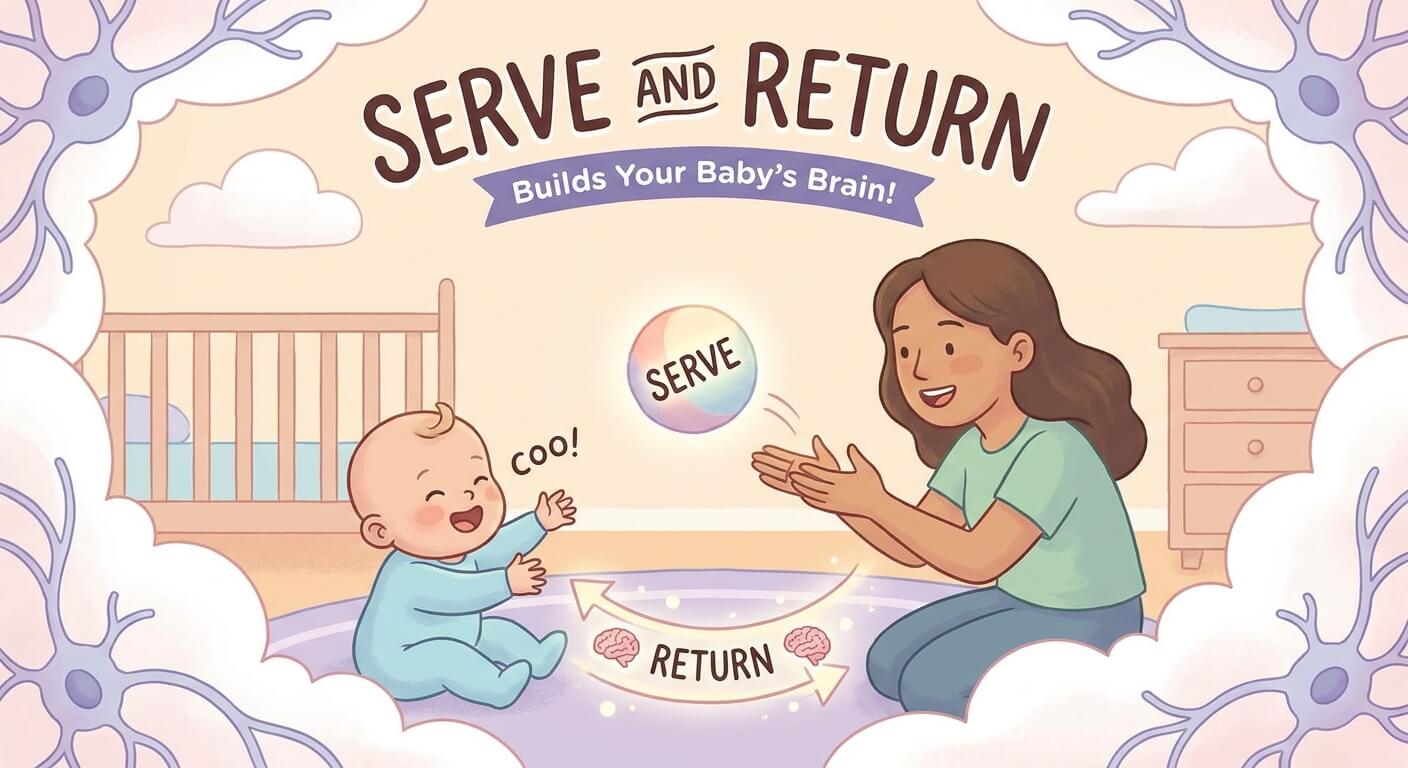
Scientists call this exchange serve and return. It describes the natural rhythm of interaction in which a child reaches out — with a look, a sound, a gesture, a word — and a caregiver responds in a way that is timely, warm, and connected to what the child just did. The term borrows from tennis: the child serves, the adult returns, and what follows is a rally — a back-and-forth volley of connection that, repeated thousands of times in ordinary daily life, physically constructs the architecture of the developing brain.
This is not a metaphor. It is neuroscience. And understanding it — really understanding it, in the bones-deep way that changes behavior — may be the single most valuable thing any parent, grandparent, educator, or childcare provider can learn about early childhood.
What Is “Serve and Return” in Early Childhood?
Where the Idea Comes From
The term “serve and return” was developed and popularized by researchers at the Center on the Developing Child at Harvard University, one of the world’s leading institutions for research on early brain development. But while the language is relatively new, the behavior it describes is ancient — as old as the first human infant who ever looked into a caregiver’s face and received a smile in return.
To understand what serve and return means, it helps to begin with what it looks like from the child’s side.
From the moment of birth, infants are not passive recipients of care. They are active communicators. Long before a baby can say a single word, they are sending signals into the world — serves, in the language of this framework — hoping those signals will be received. A serve can be almost anything:
- A newborn turning toward a voice
- A four-month-old locking eyes with a caregiver and cooing
- A seven-month-old banging a spoon on the high chair tray and then looking up expectantly
- A toddler pointing at a dog across the street
- A three-year-old holding up a crayon drawing and saying “Look what I made!”
- A five-year-old asking “Why is the sky blue?”
Each of these is a bid for connection — a signal launched outward that says, in effect: I see something. I feel something. I want to share this with another person. Is anyone there?
The return is the caregiver’s response. A good return does not need to be elaborate, eloquent, or perfectly timed. It needs to be three things:
| Quality | What It Means | Example |
|---|---|---|
| Contingent | Directly responds to what the child just did — not a generic response, but one that shows “I saw yourspecific signal” | Child points at a bird → “Yes! A bird! It’s sitting right on the fence.” (Not: “Good job pointing.”) |
| Warm | Delivered with positive emotional energy — a smile, an animated voice, eye contact, a gentle touch | Responding with genuine interest rather than going through the motions |
| Timely | Arrives while the child’s attention is still on the topic — within the child’s “attention window” | Responding in the moment, not five minutes later after finishing a text message |
When a serve is met with a good return, and the child then responds again — perhaps by babbling more, pointing at something else, or elaborating on their story — a rally has begun. That rally, that sustained back-and-forth, is where the developmental magic happens.
What Makes Serve and Return Different from Just “Paying Attention”
A reasonable person might ask: isn’t this just being a good parent? In a sense, yes — and that is precisely the point. Serve and return is not an exotic technique that requires special training. It is the natural currency of human connection. Most loving caregivers are already doing it, instinctively, many times a day.
What the research adds is specificity. It identifies why this particular behavior matters so much, how it physically changes the brain, and — critically — what happens when it is consistently absent. It also reveals that there is a meaningful difference between generic attention (being in the same room, occasionally glancing over) and contingent responsiveness (noticing the child’s specific bid and responding to that specific bidwith warmth and presence).
To illustrate the distinction: imagine a toddler who is stacking blocks and, after successfully placing the third block, looks over at the caregiver with a wide grin. A generic response might be a distracted “good job” without looking up from a phone. A contingent return might be making eye contact, matching the child’s excitement, and saying, “Three blocks! You stacked three blocks and they didn’t fall! Can you put another one on top?” The first response is technically present. The second is connected. And connection, it turns out, is the active ingredient.
Before moving on, it is worth briefly translating a few related terms that appear in the scientific literature, because encountering them in other articles or at a pediatrician’s office can be confusing:
- Contingent responsiveness — the academic term for a “good return”: a response that is directly linked to what the child just did
- Joint attention — the moment when caregiver and child are focused on the same thing at the same time, creating a shared experience
- Sensitive caregiving — the broader disposition of being consistently attuned to a child’s signals across time
- Attachment theory — the foundational framework, developed by psychologists John Bowlby and Mary Ainsworth in the mid-twentieth century, describing how the quality of early caregiver relationships shapes a child’s emotional development. Serve and return is the behavioral mechanism through which secure attachment is built — the everyday, moment-to-moment practice that makes attachment theory real.
Think of it this way: if attachment is the house, serve and return is the act of laying each brick.
The Neuroscience of Serve and Return: What Is Actually Happening Inside a Developing Brain?
Understanding why serve and return matters requires a brief but essential journey into the science of how a young brain develops. This is not an academic detour — it is the foundation of the entire argument. Once a caregiver understands what is happening at the level of neurons and synapses during a simple game of peekaboo, the significance of ordinary daily interactions shifts from nice in theory to urgent in practice.
A Brain Under Construction: The Basics
A newborn arrives in the world with a staggering endowment: approximately 100 billion neurons — roughly the same number as a fully grown adult. This sounds like a head start, but it is misleading. Neurons by themselves do not produce thought, language, emotion, or memory. What produces those capacities is the connections between neurons — junctions called synapses — and at birth, the vast majority of those connections have not yet been made.
Think of it as the difference between having all the components of a computer spread out on a table versus having them wired together into a working machine. The newborn has the parts. The wiring happens after birth — and it happens at a pace that is almost impossible to comprehend.
In the first few years of life, the brain forms new synaptic connections at a rate of up to one million per second, according to Harvard’s Center on the Developing Child. To put that in perspective: in the time it takes to read this sentence, a toddler’s brain has formed several million new neural connections. By age two, a child’s brain has roughly twice as many synapses as an adult brain — a vast, sprawling network of potential pathways, most of which are provisional.
Here is the critical point: not all of those connections will survive. The brain is not merely growing — it is sculpting itself, through a process neuroscientists call synaptic pruning. Connections that are activated repeatedly — used, reinforced, strengthened through experience — become permanent. They are coated in a fatty substance called myelin, which acts like insulation on an electrical wire, allowing signals to travel up to 100 times faster. Connections that are not used are pruned away, like unused paths in a forest slowly reclaimed by undergrowth.
This is the architectural principle: use it or lose it. And here is where serve and return becomes central to the story — because the primary way those synaptic connections get used in early life is through interaction with caregivers.
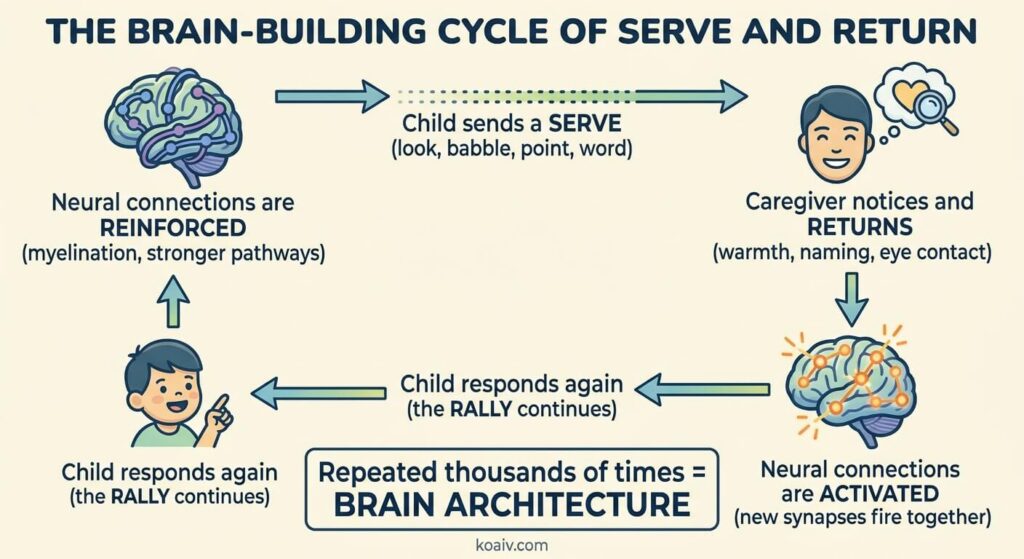
The following diagram captures this process in simplified form:
Every time an adult responds to a baby’s vocalization with animated speech, the auditory and language circuits involved in processing and producing that speech are co-activated and reinforced. Every time a caregiver follows a child’s pointing finger to a new object and names it, circuits linking perception, attention, memory, and language fire together — and, as neuroscientists are fond of saying, neurons that fire together wire together. That phrase, attributed to neuropsychologist Donald Hebb, captures the fundamental mechanism by which experience shapes brain structure.
Why the Timing Window Matters So Much
A reasonable question arises: if the brain is this adaptable, why does it matter whether these interactions happen at six months or six years — or even sixteen?
The answer lies in the concept of sensitive periods — specific windows of time during which certain brain circuits are maximally receptive to input from the environment. During a sensitive period, the relevant circuits are forming and pruning rapidly, making them highly malleable. After the window begins to close, the same circuits become progressively less responsive to new input — not locked shut, but significantly harder to shape.
| Brain Circuit | Function | Peak Sensitive Period |
|---|---|---|
| Auditory / Language circuits | Processing and producing speech, vocabulary | Birth – 3 years |
| Visual circuits | Processing sight, faces, spatial information | Birth – 2 years |
| Emotion regulation circuits | Managing stress, calming down, emotional awareness | Birth – 5 years |
| Social cognition circuits | Understanding other people’s thoughts and feelings | 2 – 6 years |
| Executive function circuits | Attention, impulse control, planning, working memory | 3 – 7 years (and beyond) |
Sources: National Scientific Council on the Developing Child; Harvard Center on the Developing Child
An analogy makes this more intuitive. Imagine the brain as wet cement. In the earliest years of life, that cement is maximally fluid — every interaction, every repeated experience, leaves an impression. As the child grows, the cement begins to set. Impressions can still be made, but they require more force, more repetition, and more effort. This is why early childhood experiences carry disproportionate weight — not because later experiences are irrelevant, but because the medium is never again as receptive.
Serve and return interactions, occurring hundreds of times per day during these sensitive periods, are the primary impressions being pressed into that cement.
The Stress Biology Connection
The neuroscience of serve and return has another dimension that is less commonly discussed but equally important: it is not just about building circuits. It is about protecting them.
To understand this, it helps to know a little about how the human stress response works. Every person — infant, child, and adult — possesses a biological alarm system called the HPA axis (short for hypothalamic-pituitary-adrenal axis). When the brain perceives a threat, this system triggers the release of stress hormones, primarily cortisol, which prepare the body to respond: heart rate increases, muscles tense, attention sharpens. In adults, this is the familiar “fight or flight” response.
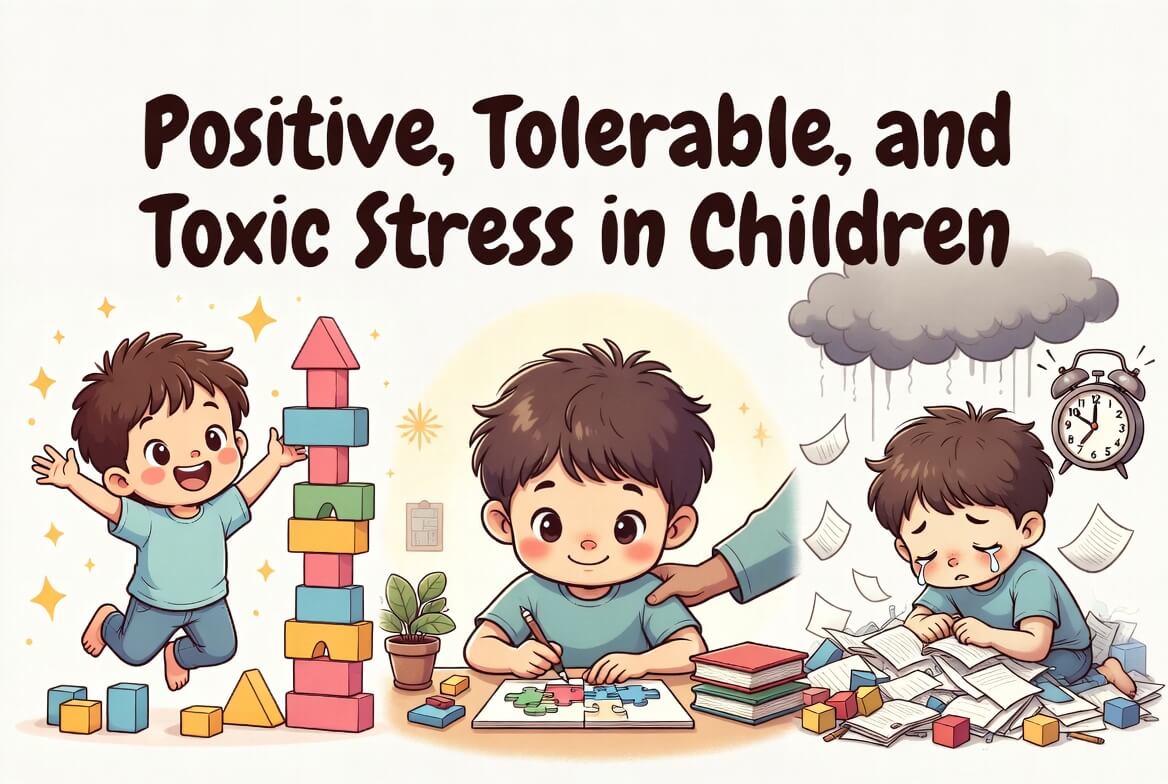
In small, brief doses, cortisol is not only harmless — it is helpful. It is what allows a child to navigate the mild anxiety of meeting a new person or starting at a new school. Harvard researchers call this positive stress: short-lived, moderate, and occurring in the context of a supportive relationship. It is a normal and even necessary part of development.
A step up from positive stress is tolerable stress: a more significant challenge — a hospitalization, a family upheaval, the loss of a pet — that could be damaging but is buffered by the presence of a reliable, responsive caregiver. The stress is real, but the child is not alone in it. The caregiver’s calm, attuned presence activates the child’s parasympathetic nervous system (the body’s “rest and recover” mode), dampening the cortisol surge and allowing the brain to return to a state where learning and connection are possible.
Then there is toxic stress — and this is where the absence of serve and return becomes not just a missed opportunity, but a physiological danger. Toxic stress occurs when the stress response is activated chronically, intensely, and without the buffering presence of a responsive adult. Prolonged cortisol exposure in a developing brain is, in a very literal sense, corrosive. It disrupts the formation of neural connections, damages existing circuits — particularly in the hippocampus (critical for memory and learning) and the prefrontal cortex (critical for decision-making and impulse control) — and can permanently alter the calibration of the stress response system itself, leaving the child with a hair-trigger alarm that fires at lower thresholds for the rest of their life.
| Stress Type | Duration | Buffered by Caregiver? | Effect on Brain |
|---|---|---|---|
| Positive stress | Brief, mild | Yes | Healthy — builds coping skills |
| Tolerable stress | Significant but time-limited | Yes — caregiver presence is the buffer | Manageable — recovery is possible |
| Toxic stress | Chronic, intense, prolonged | No — caregiver is absent, impaired, or unresponsive | Damaging — disrupts brain architecture and recalibrates the stress system |
Source: National Scientific Council on the Developing Child, Harvard University
The key insight here is that the responsive caregiver is not merely an emotional comfort. In biological terms, that caregiver is a physiological shield — a living, breathing piece of stress-regulation infrastructure that the infant’s brain depends on because it cannot yet regulate its own cortisol levels. Every warm, attuned return to a distressed child’s serve activates calming pathways in the child’s nervous system. The caregiver is, quite literally, lending the child a functioning stress-regulation system until the child’s own system matures enough to operate independently — a process that takes years.
This is why the chronic absence of serve and return is not a neutral condition. It is not simply a lack of enrichment. It is the removal of a biological safety system at the precise moment when the brain is most vulnerable.
Epigenetics
There is one more scientific dimension that deserves attention, because it elevates the significance of serve and return from important to extraordinary.
For most of the twentieth century, genetics was understood as destiny: a person inherited a fixed set of genes, and those genes dictated outcomes. The field of epigenetics — which has exploded in the last two decades — has overturned that assumption. It turns out that genes are not simply “on” or “off” in a permanent sense. They can be activated or silenced by experience, through chemical modifications to the DNA (such as methylation) that change how genes are expressed without altering the genetic code itself.
Think of DNA as a vast library of books. Epigenetics determines which books are open and being read, and which are closed and gathering dust. The same library exists in every cell, but different reading patterns produce very different outcomes.
The landmark research in this area was conducted by neuroscientist Michael Meaneyand his colleagues at McGill University. Studying rats, they discovered that pups who received high levels of maternal licking and grooming — the rodent equivalent of warm, responsive caregiving — showed measurably different gene expression compared to pups who received low levels of the same behavior. The well-groomed pups developed calmer stress responses, stronger immune function, and better cognitive performance, not because they had different genes, but because their mother’s behavior had literally changed how their genes were read.
The human parallel is not a one-to-one copy — human development is vastly more complex than that of a laboratory rat. But the principle illuminated by Meaney’s work has since been supported by human studies: the quality of early caregiving can influence gene expression patterns in ways that persist into adulthood. Serve and return interactions are not just building synapses. They are, in a very real sense, editing the instruction manual that cells use to build and maintain the body and brain.
The takeaway is both sobering and empowering: the daily, ordinary interactions between a caregiver and a young child are not trivial. They are biological events with lasting consequences. And that means every return — every moment of warmth, attunement, and presence — carries more weight than it appears.
The Five Steps of Serve and Return: Harvard’s Practical Framework
The science is compelling, but science alone does not change behavior. What changes behavior is a clear, memorable framework that can be applied in real time, in real life, without a neuroscience degree.
Harvard’s Center on the Developing Child has distilled serve and return into five actionable steps. These are not meant to be followed mechanically — no caregiver should be mentally running through a checklist during breakfast. Rather, they are designed to make an intuitive process conscious, so that caregivers who are already doing it naturally can do it more intentionally, and those who struggle with it can identify exactly where the process breaks down.
Step 1: Notice the Serve and Share the Child’s Focus
Everything begins with seeing the bid. This sounds simple, but it is the step where most serve-and-return interactions are lost — not because the caregiver is uncaring, but because many serves are subtle. A baby’s serve might be a brief shift in gaze, a slight change in facial expression, a quiet vocalization directed at no one in particular. A toddler’s serve might be a toy silently held up in the caregiver’s peripheral vision. A preschooler’s serve might be a single word dropped into a silence: “Mama… clouds.”
The skill being developed at this step is attunement — the ability to tune into the child’s frequency and notice what they are attending to. It requires a particular kind of attention: not the intense, monitoring vigilance of watching for danger, but the relaxed, receptive awareness of someone who is simply present in the same space as the child and open to what emerges.
The most common obstacle to noticing serves in contemporary life is not indifference. It is distraction — and the primary source of that distraction, research increasingly suggests, is the smartphone. More on that later.
Step 2: Return the Serve by Supporting and Encouraging
Once the serve has been noticed, the return follows. The key principle here is to acknowledge the child’s bid before redirecting it. This is where a critical error — the “corrective override” — often occurs. A toddler picks up a crayon and begins scribbling on a placemat. The immediate impulse might be to say, “No, not there — here’s some paper.” A serve-and-return approach would first acknowledge the bid: “You found a crayon! Look at those marks you’re making!” — and only then, if needed, gently redirect: “Let’s try making marks on this big piece of paper — there’s even more room.”
The difference is subtle but significant. In the first response, the child learns: “My impulse was wrong.” In the second, the child learns: “My impulse was seen, valued, and guided.” The underlying neural circuitry being built is different in each case.
Effective returns use the whole body — face, voice, posture, and gesture — not just words. Mirroring the child’s emotional tone is particularly powerful: matching their excitement when they are excited, softening when they are uncertain, calming when they are distressed. This emotional matching, called affect mirroring, is one of the earliest ways infants learn that their internal states can be shared with another person — a foundational experience for empathy.
Step 3: Give It a Name
This step is where serve and return becomes a language accelerator. Naming the object, action, emotion, or concept the child is focused on transforms a moment of shared attention into an opportunity for vocabulary and conceptual learning. The child who points at a fire truck and hears, “That’s a fire truck! It’s big and red, and listen — do you hear the siren? Wee-oo, wee-oo!” is receiving not just a label but a web of associated information — color, size, sound — all anchored to a moment of genuine interest.
The significance of this step is underscored by the landmark research of Betty Hart and Todd Risley, who in the 1990s documented what became known as the 30-million-word gap: by age three, children from the most language-rich environments had heard approximately 30 million more words than children from the most language-sparse environments. Subsequent research has refined and complicated these numbers, but the core finding remains robust — the quantity and quality of language a child hears in the early years profoundly shapes vocabulary, literacy, and academic outcomes.
What Hart and Risley’s data also revealed — and what is sometimes lost in the headline figure — is that the words that mattered most were not words spoken at children (commands, instructions, corrections) but words spoken with children, in the context of shared interaction. Serve and return is the primary delivery mechanism for that kind of language.
Step 4: Take Turns and Wait
This is the step that many well-intentioned caregivers find hardest. After returning the serve — naming the object, responding to the emotion, engaging with the child’s focus — the temptation is to keep talking, to fill the silence, to move the interaction forward. Step 4 asks for the opposite: create a pause, and let the child take the next turn.
Silence, in this context, is not emptiness. It is invitation. The child who is given time to process, formulate a response, and initiate the next serve is doing cognitive work of the highest order — integrating sensory input, retrieving relevant knowledge, planning a communicative act, and executing it. Rushing past this step by immediately introducing a new topic or asking another question short-circuits that process.
A useful practice: after returning a serve, count silently to five before speaking again. What often emerges in that silence — a new vocalization, a gesture, a facial expression, an attempt at a word — is the child’s contribution to the rally, and it is frequently more sophisticated than the caregiver expected.
Step 5: Practice Endings and Beginnings
Serve-and-return exchanges have natural lifespans. A baby’s attention might sustain a rally for thirty seconds; a preschooler’s for several minutes. Recognizing when the child’s interest has shifted — and following that shift gracefully, rather than forcing the exchange to continue — honors the child’s agency and autonomy.
Equally important is remaining alert for the next serve. The end of one rally is simply the prelude to the beginning of another. A caregiver who stays in a state of relaxed receptivity — not hypervigilant, just present — will notice far more serves than one whose attention has returned to a screen or task.
These five steps are not a formula for perfect parenting. They are a lens — a way of seeing ordinary interactions through the clarifying frame of what the brain actually needs.
Serve and Return at Every Age
One of the most useful features of the serve-and-return framework is its adaptability. The behavior evolves in form as the child develops, but its essential structure — bid, response, rally — remains constant from birth through adolescence. What changes is the medium: the language of serves shifts from cries and gazes to words and stories, but the underlying need for contingent responsiveness never disappears.
Newborns (0–3 Months): The Discovery That the World Listens
In the earliest weeks, a newborn’s serves are involuntary reflexes — rooting, crying, startling — rather than deliberate bids for connection. But they are bids nonetheless, and the caregiver’s response to them is building something fundamental: the infant’s dawning sense that their signals have power. That signals matter.
At this stage, serve and return happens during the most routine caregiving acts: feeding on cue (rather than on a rigid schedule), making eye contact during bottle or breastfeeding, speaking gently during diaper changes, mirroring the infant’s facial expressions. A newborn cannot understand words, but the prosody — the melody, rhythm, and emotional warmth of speech — is already being processed by the auditory cortex. Research shows that infants as young as two days old preferentially attend to their mother’s voice over a stranger’s, and to speech directed at them (higher-pitched, slower, more melodic — what linguists call infant-directed speech or, colloquially, “parentese”) over speech directed at adults.
The foundational lesson being inscribed in these early months is not linguistic or cognitive. It is existential: Someone is there. Someone hears me. The world responds.
Infants (3–12 Months): The Rise of Social Smiling and Intentional Communication
Between three and twelve months, a transformation occurs. Serves become purposeful. The social smile emerges — not a reflex but a deliberate facial expression designed to elicit a response. Babbling begins, and it takes on the conversational cadence of turn-taking: the infant babbles, pauses, waits for a response, then babbles again. These “proto-conversations” — exchanges that have the structure of dialogue before any actual words exist — are among the most important neurological events in a human life. They lay the foundation for language, social cognition, and the understanding of conversational rhythm.
This is also the period when joint attention emerges: the ability to follow another person’s gaze or pointing gesture, and to direct another person’s attention to something of interest. When a nine-month-old points at a dog and then looks back at the caregiver to check whether the caregiver is also looking at the dog, something cognitively remarkable has happened — the infant has demonstrated an awareness that other people have visual perspectives that can be directed and shared. Joint attention, studies show, is one of the single strongest predictors of later language development.
The caregiver’s role during this period is to follow the child’s lead: to look where the child looks, to respond to babbles as though they are meaningful conversation (because to the developing brain, they are), and to resist the urge to redirect the child’s attention to what the adult deems more interesting or educational. The child’s own curiosity is the curriculum.
Toddlers (1–3 Years): The Emotional Crucible
The toddler period introduces a dimension of serve and return that many caregivers find challenging — because the serves are no longer exclusively charming.
Between one and three years, a child’s communicative repertoire expands dramatically: first words, two-word combinations, simple sentences, questions, demands, protests. But the toddler’s emotional development has not yet caught up with their growing capacity to desire, explore, and assert. The result is a period of intense emotional volatility — the famous “tantrums” that define this stage in the popular imagination.
Here, one of the most counterintuitive and valuable insights of serve-and-return research comes into focus: a tantrum is a serve. It is not misbehavior. It is not defiance. It is a bid for help with an emotional state that has exceeded the child’s capacity to regulate alone. The toddler who collapses in tears because the banana broke in half is not being irrational — their prefrontal cortex, the brain region responsible for emotional regulation, will not be fully mature for another two decades. In that moment, the child is drowning in a feeling they cannot name, cannot understand, and cannot manage. The serve — the wail, the flailing, the desperate reaching — is a cry for co-regulation.
A caregiver who responds to a tantrum with calm acknowledgment — “You’re really upset. The banana broke and that wasn’t what you wanted” — is performing what may be the most neurologically significant serve and return of the day. By staying regulated in the face of the child’s dysregulation, the adult is lending the child a functioning nervous system, demonstrating through action that overwhelming feelings can be survived, and strengthening the very circuits the child will eventually use to regulate independently.
This does not mean permitting all behavior. It means separating the child’s feeling (which is always valid) from the child’s action (which may need redirecting). The distinction is critical, and it is where serve and return intersects with discipline — not as its opposite, but as its foundation.
Preschoolers (3–5 Years): The Age of “Why?” and the Birth of Theory of Mind
By the preschool years, serve and return enters a new phase characterized by imagination, narrative, and relentless questioning. The serves at this stage are rich: elaborate pretend play scenarios, stories both real and invented, drawings offered for inspection, and the endless “why?” questions that can exhaust even the most patient caregiver.
These questions, however exasperating, are not random. They represent the child’s active construction of a mental model of how the world works — a process that developmental psychologists call theory building. Each “why?” is an invitation for a serve-and-return rally that deepens the child’s understanding. The quality of the response matters less than its genuineness: a caregiver who says, “I actually don’t know — let’s find out together!” has modeled curiosity, intellectual humility, and the joy of collaborative inquiry, all in a single sentence.
This period also marks the emergence of theory of mind — the understanding that other people have thoughts, feelings, beliefs, and perspectives that may differ from one’s own. It is one of the most consequential cognitive achievements of early childhood, and it develops primarily through social interaction. When a caregiver enters a child’s pretend world — taking a sip from an imaginary teacup, pretending to be the patient while the child plays doctor, asking, “How does the teddy bear feel about going to bed?” — that caregiver is scaffolding the development of theory of mind. Serve and return in the context of pretend play is literally teaching the child that the universe contains other minds.
The failure mode at this age is what might be called “uh-huh” caregiving: verbal acknowledgment without genuine presence. Children at this stage are remarkably perceptive about the difference between real engagement and performative attention. The caregiver who says “that’s nice, sweetie” while scrolling through email has technically returned the serve, but the child registers — accurately — that the return was hollow. Over time, hollow returns reduce the frequency of serves.
School-Age Children and Adolescents: The Rally Continues
A common misconception is that serve and return is relevant only to babies and toddlers. The science suggests otherwise.
For school-age children (roughly 6–12 years), serves take new forms: recounting something that happened at recess, sharing a piece of creative work, asking a question that sounds casual but carries real emotional weight (“Dad, do you think I’m good at math?”). Research suggests that the first 20 minutes after school pickup represent a peak serve period — a window when children are most likely to offer bids for connection about their day. Distracted or dismissive responses during this window register in ways that accumulate over time.
For adolescents, the dynamic shifts again. Teenage serves are frequently disguised — an offhand comment, a sarcastic joke with genuine vulnerability underneath, a question asked with practiced nonchalance. The caregiver’s task becomes more nuanced: to recognize these masked bids, resist the impulse to respond with lectures or corrections, and stay curious rather than reactive. An adolescent who has stopped serving has often learned, through repeated experience, that returns are unpredictable, dismissive, or weaponized. Rebuilding serve-and-return patterns with a withdrawn teenager is possible, but it is far harder than maintaining them throughout childhood.
When Serve and Return Breaks Down
The Still Face Experiment
In 1975, developmental psychologist Dr. Edward Tronick at the University of Massachusetts Boston conducted a deceptively simple experiment that has since become one of the most cited and viewed demonstrations in all of developmental psychology.
The setup: a mother sits face-to-face with her infant and engages in normal, warm, animated interaction — the natural back-and-forth of serve and return. Then, at a signal, she stops. Her face goes blank. She continues to look at the baby but does not smile, speak, or respond to any of the infant’s bids. She becomes, in the language of the experiment, a “still face.”
What happens next is both heartbreaking and scientifically illuminating. The infant, suddenly deprived of returns, redoubles its efforts — smiling bigger, vocalizing louder, reaching out with more urgency. When those intensified serves still receive no response, the infant’s behavior shifts dramatically. The baby turns away, begins to fuss, and eventually collapses into visible distress. Physiological measurements confirm what the behavior suggests: heart rate spikes, cortisol rises, and the body enters a state of stress activation.
The experiment lasts three minutes. In most cases, when the mother resumes normal interaction, the infant recovers — but not immediately. There is a period of wariness, of checking, before trust is reestablished.
The still face experiment matters because it demonstrates, in microcosm, what chronic unresponsiveness produces over longer timescales. The three-minute disruption creates temporary distress. Months or years of chronic still-face conditions — a caregiver who is consistently unavailable due to depression, substance abuse, overwhelming stress, or other factors — create the conditions for toxic stress and its attendant damage to brain architecture.
The Developmental Consequences
The research literature on the outcomes of chronically disrupted serve and return is extensive and consistent. Children who grow up in persistently low-responsiveness environments show elevated rates of:
- Language delays — reduced vocabulary, delayed sentence formation, difficulty with narrative comprehension
- Executive function deficits — impaired attention, weaker impulse control, reduced working memory capacity
- Emotional dysregulation — difficulty identifying, naming, and managing feelings; heightened reactivity to stress
- Social challenges — trouble reading social cues, difficulty initiating and maintaining friendships, reduced empathy
- Mental health vulnerability — increased risk of anxiety, depression, and behavioral disorders in later childhood and adolescence
These are not speculative associations. They are among the most robustly replicated findings in developmental science, confirmed across decades of longitudinal research, cross-cultural studies, and neuroimaging data.
Modern Threats to Serve and Return: It Is Not Just About Neglect
It is essential to note that disrupted serve and return is not exclusively a consequence of extreme adversity. Several features of contemporary life create subtle but significant interference with responsive caregiving, even in loving, well-resourced families.
Smartphone distraction is now the most studied modern threat. Research on what developmental scientists call “technoference” — technology-mediated interference with parent-child interaction — has produced consistent findings: parental smartphone use during child interaction reduces the frequency of verbal exchanges, lowers the quality of returns, and is associated with increased child distress behaviors. A 2018 study published in Child Development found that parents absorbed in smartphones responded to their children’s bids 20% less often than undistracted parents. Critically, even the presence of a phone on a table — without active use — appears to reduce the depth of caregiver-child engagement, a phenomenon researchers have termed the “mere presence effect.”
Parental mental health is another significant factor. Postpartum depression, which affects approximately 1 in 5 mothers and a meaningful proportion of fathers (according to the American Psychological Association), directly suppresses the emotional availability and responsiveness that serve and return requires. A depressed caregiver is not choosing to be unresponsive — the illness itself diminishes the capacity for attuned interaction, creating a gap in the very system the infant depends on for brain development and stress regulation.
Structural poverty represents perhaps the greatest systemic threat. The cognitive load imposed by scarcity — the constant, exhausting mental calculus of financial survival — depletes the attentional resources that responsive caregiving demands. Unstable housing, multiple jobs, food insecurity, and unsafe neighborhoods do not make caregivers love their children less, but they make the sustained, relaxed presence that serve and return requires enormously harder to achieve. This is not a personal failing. It is a policy failure.
The Crucial Reassurance: Pattern Over Perfection
Having laid out the consequences of disrupted serve and return, it is equally important — and equally well-supported by evidence — to emphasize what the research says about resilience.
The first reassurance is mathematical: even in the most securely attached, well-studied caregiver-child dyads, serve-and-return mismatches occur approximately 30% of the time. Parents miss serves. Returns are mistimed. Moods interfere. Life intrudes. This is not a failure of the system — it is how the system works.
The second reassurance is deeper. The process of interactive repair — recognizing a missed connection and returning to the relationship with warmth — is itself a developmentally valuable experience. When a caregiver says, “I’m sorry, I wasn’t really listening just now. Tell me again — I really want to hear”, the child learns something that cannot be taught any other way: that ruptures in relationship are survivable, that the person they depend on is trustworthy enough to acknowledge mistakes, and that disconnection is always followed by reconnection. This is among the most powerful foundations for emotional security that a child can receive.
The concept has roots in the work of D.W. Winnicott, a British pediatrician and psychoanalyst who coined the phrase “the good enough mother” in the 1950s. Winnicott’s radical insight was that the child does not need — and is in fact harmed by — a caregiver who is perfectly attuned at all times. The child needs a caregiver who is reliably present, consistently warm, and willing to repair. Good enough is not a consolation prize. It is the developmental ideal.
Neurodivergent Caregivers and Children
A rarely discussed dimension of serve and return concerns neurodivergent families — and it deserves explicit attention because the silence around it can generate unnecessary guilt.
For caregivers with ADHD, the noticing step of serve and return — Step 1 — can be genuinely harder. Attention variability, a core feature of ADHD, means that bids for connection may be missed not because the caregiver is indifferent but because their attention was elsewhere at that two-second window. Practical accommodations — reducing background distractions, creating structured one-on-one time, using visual or auditory reminders to check in — can meaningfully bridge this gap.
For caregivers on the autism spectrum, interpreting the emotional meaning of a child’s serve may require more deliberate processing. This is not a deficit in caring — it is a difference in processing speed and style. Explicit frameworks (like Harvard’s five steps) can be particularly valuable for autistic caregivers because they provide the structured, step-by-step guidance that can compensate for what may be less intuitive.
For children with autism spectrum differences or sensory processing challenges, serves themselves may be subtler, less frequent, or atypical in form — a fleeting glance rather than sustained eye contact, lining up objects rather than holding them up for display, a proximity-seeking movement rather than a verbal bid. The serve-and-return framework still applies, but the caregiver’s task is to broaden the definition of “serve” and to follow any bid, however quiet or unconventional.
None of these situations represent failures of the serve-and-return model. They represent adaptations — and the willingness to adapt is, itself, a form of responsive caregiving.
Building Serve and Return Into Real Life Without Adding to the Overwhelm
If there is one message that deserves emphasis above all others, it is this: serve and return does not require extra time. It requires redirected attention within time that already exists.
The most potent serve-and-return environments are not enrichment classes or structured learning activities. They are the mundane, already-occurring routines of daily life — if approached with presence rather than efficiency:
- Diaper changes become face-to-face conversation time
- Bath time becomes a laboratory for joint attention, naming, and sensory exploration
- Meals become opportunities for turn-taking and language expansion
- Car rides become rolling conversation spaces
- Grocery shopping becomes a running, collaborative commentary on the world
The practice is not about adding serve-and-return activities to an already overwhelming schedule. It is about recognizing that serve-and-return opportunities are already embedded in the schedule — and choosing, when possible, to show up for them with a little more presence.
Several specific language practices dramatically amplify this effect:
Sportscasting — narrating shared experience in real time: “Now we’re putting on your socks. One foot… and the other foot! All done!”
Expansion — taking the child’s utterance and naturally extending it: The child says “truck.” The caregiver responds, “A big blue truck! It’s carrying something — what do you think is inside?”
Open questions — invitations to think rather than recall: “What do you think will happen if we add more water?” rather than “What color is the water?”
For caregivers navigating exhaustion, mental health challenges, or simply the relentless pace of contemporary life, the concept of micro-interactions offers permission. A thirty-second moment of genuine attunement — full eye contact, a warm smile, a real response to a real bid — registers in a child’s developing brain. Psychiatrist Stanley Greenspan’s widely cited “floor time” approach suggests that even 15 minutes per dayof fully child-led, distraction-free play produces measurable developmental benefits. The prescription is not more time. It is more presence within whatever time is available.
And for the screens that compete for that presence, a practical rather than punitive approach tends to be most sustainable: designate specific moments as phone-free (meals, bath time, the first 20 minutes after reunion), and when a lapse occurs — as it inevitably will — normalize the reset: “I was looking at my phone. I’m putting it down now. What were you telling me?” That sentence is not a failure. It is a repair — and repairs, as the research shows, have developmental value of their own.
Key Takeaways: What to Remember and Where to Begin
The architecture of a human brain is constructed not primarily in hospitals, classrooms, or therapy offices, but in the ten thousand unremarkable moments each day when a child reaches toward another person and that person reaches back. Serve and return is the name science has given to what responsive love, in its most developmentally active form, looks like in practice.
Three principles to carry forward:
- Notice — Cultivate the habit of watching for bids. They come in many forms: a look, a sound, a gesture, a question, a mood. They are always an invitation.
- Respond — Return the serve with warmth, specificity, and genuine presence. Name what the child sees. Validate what the child feels. Make eye contact. Show, through action, that the signal was received.
- Wait — After returning the serve, resist the impulse to fill the silence. Create space for the child to take the next turn. The rally — not any single serve — is where Continuing from the split point — picking up mid-sentence in the Key Takeaways section:
the rally — not any single serve — is where the deepest developmental work happens.
A practical starting point for this week:
- Choose one daily routine — bath time, meals, the drive home — and make it fully phone-free and genuinely interactive
- Practice expansion: take whatever the child says and add one descriptive detail or connected idea
- Try the five-second pause: after returning a serve, count silently to five before speaking again, and observe what the child initiates in that space
- Spend five minutes simply watching — with no agenda, no redirection, no instruction — and notice what serves emerge naturally
Conclusion
The science behind serve and return is complex, spanning neurobiology, epigenetics, stress physiology, and attachment theory. But the practice itself is breathtakingly simple. It asks for no special equipment, no professional training, and no extra hours in the day. It asks only for presence — the willingness to notice a small person reaching out, and to reach back. This responsive pattern supports secure attachment and becomes easier when caregivers understand newborn cues.
A baby drops a spoon from her high chair. She looks up. What happens next is not nothing. It is architecture. It is biology. It is the quiet, radical act of one human being showing another — through the simplest possible gesture — that their voice matters, that their curiosity is welcome, and that in this vast and confusing world, someone is listening.
That is serve and return. And it is, by any measure, the most important game a caregiver will ever play.
Sources and Further Reading:
- Harvard Center on the Developing Child — InBrief: The Science of Early Childhood Development
- National Scientific Council on the Developing Child — Young Children Develop in an Environment of Relationships
- Harvard Center on the Developing Child — Toxic Stress: Key Concepts
- World Health Organization (WHO) — Nurturing Care for Early Childhood Development
- Meaney, M. J. (2001) — Maternal Care, Gene Expression, and the Transmission of Individual Differences in Stress Reactivity Across Generations — epigenetics and caregiving
- Shonkoff, J. P. et al. (2012) — The Lifelong Effects of Early Childhood Adversity and Toxic Stress
- The Whole-Brain Child — Daniel J. Siegel and Tina Payne Bryson
- Brain Rules for Baby — John Medina
- How Children Succeed — Paul Tough
- Thirty Million Words — Dana Suskind

October 25, 2026
October 25, 2026

October 25, 2026
October 25, 2026