When Does PURPLE Crying Stop
When Does PURPLE Crying Stop?
There is a particular kind of silence that only exists in contrast: the silence that follows three solid hours of infant screaming at 2:47 in the morning. The bottle is full. The diaper is clean. The swaddle is snug. The temperature in the room is perfect. And yet — for reasons that defy every logical explanation a sleep-deprived brain can muster — the baby is screaming as though the world is ending.
The parenting books didn’t prepare anyone for this. The prenatal classes, with their cheerful diagrams and their reassuring bullet points, certainly didn’t cover the part where a perfectly healthy baby would cry for five hours straight, resist every soothing technique ever invented, and then — just as mysteriously — fall asleep as though nothing had happened. Night after night. Week after week.
If this scene feels less like a description and more like a diary entry, there is something important to know: this is not a crisis. This is biology. And it has a name.
Developmental researcher Dr. Ronald G. Barr, a distinguished professor at the University of British Columbia and one of the world’s foremost experts on infant crying behavior, spent decades studying this exact pattern. What he found was that the intense, unexplainable, seemingly inconsolable crying that sends millions of new parents spiraling into self-doubt every year is not a disease. It is not a parenting failure. It is not colic, at least not in the way most people understand that word. It is a universal developmental phase — as predictable and as temporary as teething — and he gave it a name designed to help parents understand and endure it: the Period of PURPLE Crying.
The single most urgent question that follows that discovery — the one typed into search engines with shaking hands at ungodly hours — is: When does PURPLE crying stop?
First, the Answer: When Does PURPLE Crying Stop?
Before anything else, the exhausted parent scanning this page at 3 AM deserves a direct, research-backed answer without having to scroll through paragraphs to find it.
According to Dr. Barr’s research — which has been validated by the American Academy of Pediatrics, Seattle Children’s Hospital, the Cleveland Clinic, and pediatric institutions across more than a dozen countries — the Period of PURPLE Crying follows a remarkably consistent timeline:
| Baby’s Age | What Is Happening |
|---|---|
| ~2 weeks old | Crying begins to gradually increase beyond the newborn baseline |
| 6 to 8 weeks old | The peak — this is typically the hardest, longest, and most intense stretch |
| 3 to 4 months old | A gradual but measurable decline in crying duration and intensity |
| 4 to 5 months old | The PURPLE crying pattern ends for the vast majority of babies |
Think of it as a mountain. The first few weeks of life are the foothills — manageable, even scenic. The ascent steepens between weeks three and six, and the air begins to thin. Weeks six through eight are the summit: the altitude is brutal, the visibility is poor, and every step feels impossible. But after the summit, every single day — even the ones that still feel terrible — is one step closer to the base. The descent has begun, whether it feels like it or not.
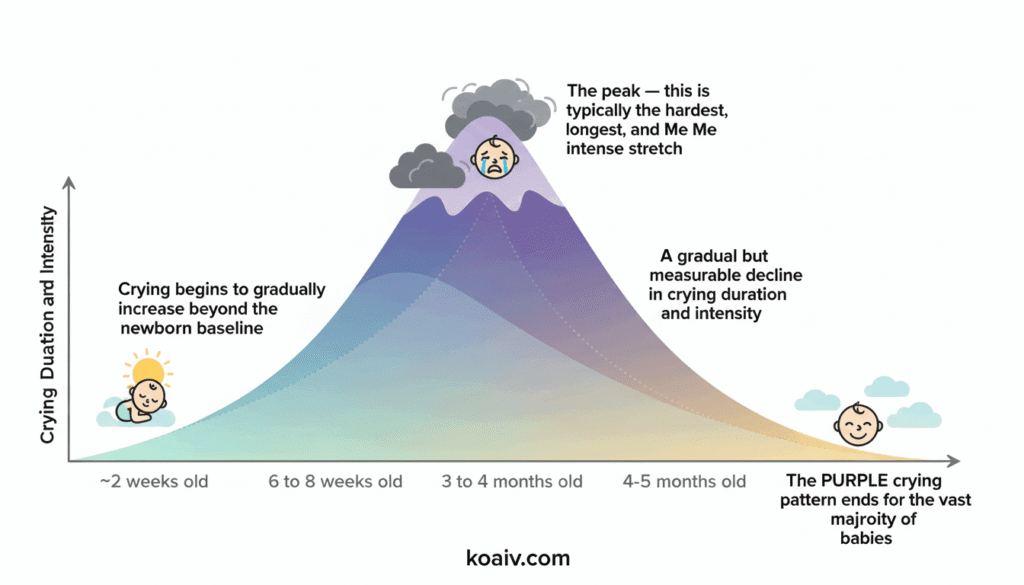
The critical takeaway: PURPLE crying has a biological expiration date. For most infants, the intense, unpredictable crying that defines this phase is functionally over by the fifth month of life. Not because anyone “fixed” it. Not because the right sleep training method was finally discovered. But because the baby’s brain matured past the developmental window that produced the crying in the first place. For practical soothing ideas, see the 5S Technique and guidance for overtired newborns.
But that raises a natural question: what, exactly, is happening inside a baby’s brain that causes all of this?
What Is the Period of PURPLE Crying?
To understand when PURPLE crying stops — and, perhaps more importantly, why it stops — it helps to understand what it actually is. And to understand that, a brief detour into how the concept was born is essential.
The Problem with the Word “Colic”
For generations, when a baby cried excessively and inexplicably, the medical world reached for a single word: colic. The standard clinical definition — coined in 1954 by Dr. Morris Wessel — was known as the “Rule of Threes”: crying for more than three hours a day, for more than three days a week, for more than three weeks. If a baby met those criteria, the baby “had colic.”
The problem, as Dr. Barr recognized, was not the definition itself but the implications it carried. The word “colic” derives from the Greek kolikos, meaning “of the colon” — it literally implies a stomach problem. And for decades, that etymological association sent parents and pediatricians alike chasing gastrointestinal ghosts: switching formulas, eliminating foods from breastfeeding diets, prescribing gas drops, investigating reflux. In most cases, none of it made a meaningful difference, because the stomach was never the issue.
Dr. Barr’s insight was revolutionary in its simplicity: what if the problem isn’t a problem at all? What if this crying pattern was not a symptom of something wrong, but a feature of something right — a normal, healthy, and temporary byproduct of the baby’s neurological development?
That insight led him to develop the concept of the Period of PURPLE Crying — deliberately replacing the medical-sounding “colic” with a framework that emphasizes normalcy and, crucially, finiteness. The word “Period” was chosen with surgical precision: it signals a defined beginning and a guaranteed end.
The PURPLE Acronym
Each letter in PURPLE describes a specific characteristic of this type of crying. Understanding all six helps parents recognize the pattern when they are living inside of it — and, just as importantly, helps them distinguish it from something that might genuinely require medical attention.
P — Peak of Crying
The crying does not arrive at full volume on day one. It builds gradually, like a wave gathering energy far from shore, and crests around the second month of life. This is why many parents report feeling blindsided: the first two or three weeks may have been relatively calm, creating a false sense of what “normal” looks like. The peak is the summit of the mountain described earlier — the point of maximum intensity before the inevitable decline.
U — Unexpected
This is perhaps the most disorienting characteristic for new parents. Unlike a hunger cry (which follows a predictable schedule) or a pain cry (which follows a clear cause), PURPLE crying episodes begin without any identifiable trigger and end just as mysteriously. The baby could be freshly fed, impeccably dry, and warmly held — and still erupt into full-volume crying. The absence of a discernible “why” is what makes this phase so psychologically exhausting for caregivers. The human brain is wired to identify cause and effect; when no cause can be found, the default assumption is often self-blame. That assumption, while understandable, is entirely wrong.
R — Resists Soothing
This is the letter that breaks hearts. During a PURPLE crying episode, the standard soothing techniques — rocking, feeding, pacifiers, singing, bouncing, driving around the neighborhood at midnight — may have little to no effect. The baby is not rejecting the parent. The baby’s neurological system is simply in a state that cannot yet be overridden by external input. Think of it like a computer running a critical system update: it cannot process new commands until the update is complete. The crying is the update. It will finish when it finishes.
P — Pain-like Face
During episodes, the baby’s face contorts into an expression that is virtually indistinguishable from genuine pain: red, scrunched, mouth wide open, fists clenched, back arched. This is, understandably, one of the most alarming aspects of the experience. It is also one of the most misleading. Multiple studies have confirmed that during PURPLE crying episodes, many babies show no physiological markers of actual pain — no elevated heart rate beyond what the crying itself would produce, no digestive distress, no identifiable source of discomfort. The face is a neurological artifact: the baby’s still-developing facial muscle control defaults to this expression during states of high arousal, regardless of the cause.
L — Long-lasting
PURPLE crying is not a twenty-minute fuss session. Episodes can last anywhere from one to five hours per day, and in extreme-but-still-normal cases, even longer. During the peak weeks, three to four hours of daily crying time is well within the range that pediatricians would consider typical for a healthy infant going through this phase.
E — Evening
The episodes cluster heavily in the late afternoon and evening hours — roughly between 4 PM and midnight — a phenomenon so consistent across cultures that parents have given it its own folk name: “the witching hour.” (A generous term, given that it often lasts three or four hours.) The current scientific hypothesis for this clustering is cumulative sensory overload: by the end of the day, the baby’s immature nervous system has absorbed more stimulation than it can process, and crying is the pressure valve that releases the excess.
Understanding all six characteristics together creates something that no single letter can provide alone: a checklist. When a baby is crying inconsolably at 9 PM, with a pain-like face, for the third hour straight, resisting every soothing attempt, with no discernible cause — and this pattern has been intensifying over the past several weeks — that is not a medical emergency. That is PURPLE crying, unfolding exactly as Dr. Barr’s research predicts.
But knowing the what still leaves the deeper question: why?
The Neuroscience of PURPLE Crying
Here is where the conversation shifts from survival to understanding — and where, for many parents, the emotional weight of the experience begins to lift.
The Great Transition: Womb to World
For approximately nine months, the developing baby existed in what sensory scientists would describe as a near-perfect low-stimulation environment. The womb is dark. It is warm — a constant 98.6°F. It is rhythmically noisy, filled with the steady whoosh of blood flow and the muffled bass of the mother’s heartbeat. It is physically contained: the baby is held, compressed, gently rocked with every step the mother takes. Hunger does not exist; nutrients arrive continuously through the umbilical cord. There is nothing to see, very little to hear, and almost nothing to decide.
Then, in the span of a few hours, all of that ends.
Birth is, from the baby’s sensory perspective, the most dramatic environmental transition a human being will ever experience. The temperature fluctuates. Light is blinding. Sound is chaotic and unpredictable. The body is suddenly unsupported, subject to gravity in a way it has never experienced. Hunger arrives in sharp, cyclical waves. And the brain — still profoundly immature, with billions of neural connections yet to be formed — is expected to process all of it simultaneously.
For the first week or two, many newborns are still partially buffered by what developmental scientists call the “newborn cocoon“ — a state of relative sleepiness and neurological insulation that eases the transition. But by the second or third week of life, that buffer begins to dissolve. The brain starts “waking up” to the world in earnest, and the sensory flood begins.
Crying as a Neurological Pressure Valve
The adult brain manages sensory overload with a sophisticated toolkit: it can focus attention, filter irrelevant input, self-soothe through conscious breathing, or simply close its eyes and think of something calming. A two-week-old baby has none of these tools. The neural pathways for self-regulation — located primarily in the prefrontal cortex, the brain region responsible for emotional control, attention, and decision-making — are among the last to develop and will not reach functional maturity for years.
So what does a brain do when it is overwhelmed and has no internal mechanism to regulate the overload?
It cries. Loudly, intensely, and for long stretches — because crying is the only output channel a newborn possesses when the input exceeds capacity. The PURPLE crying is not the baby communicating a specific need. It is the baby’s nervous system discharging accumulated sensory energy that it cannot yet process or contain.
Think of it this way: imagine being placed in a room with ten televisions, all tuned to different channels, all at maximum volume, with no way to turn any of them off, no earplugs, and no door. After a few hours, the urge to scream would be overwhelming — not because anything is wrong, but because the input has exceeded the system’s capacity.
That is, in simplified terms, what the first few months of life feel like to a developing brain.
The Cross-Cultural Evidence
Perhaps the most compelling evidence that PURPLE crying is biological rather than environmental comes from cross-cultural research. Studies have compared infant crying patterns across radically different parenting traditions — from high-contact, babywearing cultures in sub-Saharan Africa to low-contact, scheduled-feeding environments in Northern Europe — and found that the crying curve is virtually identical. The peak still occurs around six to eight weeks. The decline still begins around month three. The phase still resolves by month five.
Parenting style, feeding method (breast vs. bottle), household income, and cultural context change many things about infant development. They do not change the timeline of PURPLE crying. The brain builds its self-regulation architecture on its own schedule, regardless of the external environment.
This finding is liberating, because it means the crying is not something a parent is causing, and therefore not something a parent can — or should be expected to — prevent. It is a universal feature of human neurological development, as innate and inevitable as the baby’s first steps.
The crying stops when the brain catches up. And the brain always catches up.
4 Subtle Signs That PURPLE Crying Is Nearing Its End
Knowing that the phase ends by month five is reassuring in theory. But when a parent is at week seven, staring down what feels like an endless corridor of screaming evenings, a calendar date four months away offers cold comfort. What parents in the thick of it need are real-time indicators — small, observable signals that the brain is maturing and the crying is beginning its descent from the summit.
Most parenting resources omit these signs entirely, offering nothing beyond “it gets better around three to four months.” The following four markers, drawn from developmental research and clinical observation, provide a more granular — and more hopeful — roadmap.
Sign 1: The Return of Cause and Effect
During the PURPLE peak, the “U” (Unexpected) dominates: the crying has no discernible trigger and no reliable off switch. As the phase begins to resolve, parents start noticing that the crying once again makes sense. The baby cries — and a feeding stops it. The baby fusses — and it’s clearly because the diaper is wet. The reappearance of logical, cause-and-effect crying is one of the earliest indicators that the brain’s self-regulation circuitry is coming online. The crying is no longer a general system overload; it is returning to its intended function as specific communication.
Sign 2: The Witching Hour Compresses
The evening crying marathons do not vanish abruptly. They shrink. What was a five-hour block of inconsolable crying at the peak gradually compresses to four hours, then three, then ninety minutes, then a manageable forty-five-minute fuss session before bedtime. The compression is often so gradual that parents living inside of it don’t notice — much like watching the hour hand of a clock, the movement is invisible in real time but unmistakable in retrospect. Keeping a simple daily log of evening crying duration (even just a note on a phone with a start and end time) can make this trend visible and provide genuine, data-driven reassurance.
Sign 3: Soothing Starts Working Again
The “R” (Resists Soothing) is the characteristic that inflicts the deepest emotional wound on caregivers, because it mimics rejection. As the PURPLE phase wanes, this characteristic dissolves first gradually, then noticeably. A specific white noise track reliably calms the baby. A rhythmic bounce on a yoga ball consistently produces drowsiness. A pacifier is accepted and held. The tools that felt completely useless at the peak are, one by one, regaining their power — not because they’ve changed, but because the baby’s brain has developed enough self-regulation capacity to receiveexternal soothing input.
Sign 4: The Arrival of the Social Smile
This is, for many parents, the turning point — the moment where the relationship shifts from one-directional caregiving to genuine two-way interaction. The social smile(distinct from the reflexive sleep smiles newborns produce) typically emerges between six and twelve weeks of age. It is a deliberate, responsive expression: the baby sees a familiar face, processes the recognition, and consciously produces a smile in return.
This milestone is neurologically significant because it demonstrates that the brain has matured enough to not only process a complex social stimulus (a face) but also generate a voluntary motor response (a smile) — a feat of neural coordination that was impossible just weeks earlier. The emergence of the social smile almost always coincides with, or slightly precedes, the beginning of the PURPLE crying decline. The brain is not just stopping the crying; it is replacing it with an entirely new, richer, and far more rewarding form of communication.
When that first real smile arrives — not during sleep, not from gas, but in direct response to a parent’s face — the summit is officially in the rearview mirror.
Surviving the Summit: Evidence-Based Strategies for the Hardest Weeks
Understanding the neuroscience is intellectually satisfying. It does not, however, make Thursday night at 11 PM any less brutal. Knowing that the crying is “just a phase” does not silence it. What follows are strategies grounded in pediatric research and clinical practice — not for stopping the crying (because during a true PURPLE episode, nothing reliably will), but for protecting the caregiver’s capacity to endure it safely.
Strategy 1: The Sensory Reset — Recreating the Womb
Since PURPLE crying is fundamentally a response to sensory overload, one of the most effective approaches is to reduce sensory input to something approximating the womb environment. Pediatric occupational therapists often refer to this as a “sensory reset,”and it involves four simultaneous elements:
- Darkness: Dim the room as much as possible. The baby’s visual system is one of its most active sensory channels, and reducing light input lowers the overall neurological load.
- White noise: Continuous, steady sound at approximately 65–70 decibels (roughly the volume of a running shower) mimics the constant auditory backdrop of the womb. Apps and dedicated machines work equally well; the key is consistency and steady-state sound rather than music with varying patterns.
- Swaddling: A snug swaddle recreates the physical containment of the womb, reducing the startle reflex (the Moro reflex) that can restart a crying cycle just as it seems to be ending.
- Rhythmic motion: Gentle, repetitive bouncing or swaying — the kind of movement the baby experienced with every step the mother took during pregnancy — activates the vestibular system and has a measurable calming effect on the autonomic nervous system.
This combination will not work every time — the “R” in PURPLE means that some episodes simply have to run their course. But on nights when the crying is approaching its crescendo rather than already at full peak, the sensory reset can shorten episodes meaningfully and prevent escalation.
Strategy 2: The Tag-Team Imperative
This is not a suggestion. It is a necessity.
No single human being — regardless of patience, love, experience, or resolve — is designed to absorb hours of inconsolable infant crying alone, night after night, for weeks on end. The neurological toll is cumulative: each successive hour of unrelieved exposure to high-decibel crying elevates cortisol (the stress hormone), depletes serotonin (which regulates mood and patience), and progressively impairs the prefrontal cortex — the very brain region responsible for calm decision-making and impulse control.
The baton pass — physically handing the baby to another caregiver and leaving the room — is one of the most important tools in the PURPLE survival toolkit. It doesn’t matter if the other person is a partner, a grandparent, a sibling, a friend, or a postpartum doula. What matters is that no single caregiver reaches the point of depletion. The ideal rotation is every 30 to 60 minutes during peak episodes, with the off-duty caregiver in a completely separate room — ideally with a closed door and, yes, headphones.
For single parents or those without a local support network, this is where community resources become essential. Many communities offer crisis nurseries, parent helplines , and postpartum support groups. Using these resources is not an admission of inadequacy. It is the most competent possible response to a biologically demanding situation.
Strategy 3: The Permission to Walk Away
Every major pediatric institution in the Western world — the American Academy of Pediatrics, the Centers for Disease Control and Prevention, the Canadian Paediatric Society, Seattle Children’s Hospital — endorses the following guidance, and it deserves to be printed in bold, framed, and hung in every nursery:
It is completely safe to place a crying baby in a secure crib, on their back, and walk away for 10 to 15 minutes.
The baby will continue to cry. The baby will be physically safe. And — this is the part that matters — the caregiver will return calmer, more regulated, and more capable of providing gentle, patient care than they would have been at their breaking point.
This guidance is not incidental to the Period of PURPLE Crying program. It is, in fact, the central safety message of Dr. Barr’s entire body of work. The PURPLE crying framework was developed not only as a developmental education tool but also as a Shaken Baby Syndrome (now more formally called Abusive Head Trauma) prevention initiative. Dr. Barr’s research demonstrated that the peak of infant crying and the peak of abusive head trauma incidents occur in the same developmental window — around six to eight weeks — and that the most dangerous variable is not the crying itself but a caregiver who has reached the absolute end of their capacity without an exit strategy.
Walking away is the exit strategy. Placing the baby in the crib and stepping into another room for ten minutes is not abandonment. It is not neglect. It is the single most protective act a caregiver can perform at their breaking point — protective for the baby, and protective for themselves.
Strategy 4: Babywearing and the Power of Motion
A landmark study published in the journal Pediatrics found that babies who were carried for an additional two hours per day (beyond the carrying that occurred during feeding and fussing) experienced a 43% reduction in overall crying duration. The mechanism appears to be vestibular stimulation — the gentle, rhythmic, full-body movement that the baby experienced constantly in the womb and that, after birth, occurs only when someone carries or rocks them.
Structured baby carriers (wraps, ring slings, or soft-structured carriers with appropriate head support for newborns) allow caregivers to provide this vestibular input while keeping both hands free — a practical consideration that sounds trivial until hour three of an evening episode. The carrier also positions the baby upright against the caregiver’s chest, which provides warmth, the sound of a heartbeat, and gentle compression — three additional elements of the “womb recreation” strategy described above.
Not every baby responds to babywearing during a PURPLE episode (remember the “R”), but many respond to being worn before an episode begins, suggesting that proactive carrying during calm periods may help delay the onset or reduce the intensity of evening crying clusters.
Strategy 5: The Caregiver’s Headphones (The Counterintuitive Strategy That Works)
This is the recommendation that surprises the most parents — and the one that many report as the single most useful piece of practical advice they received during the PURPLE phase.
Prolonged exposure to infant crying triggers a cascade of stress responses in the adult nervous system: cortisol spikes, heart rate elevates, muscles tense, and the “fight or flight” system activates. This is not a weakness — it is an evolutionary feature designed to make the crying impossible to ignore, ensuring that caregivers respond to their infant’s needs. But during a PURPLE episode, where the crying cannot be resolved regardless of the response, this relentless physiological alarm becomes counterproductive. It exhausts the caregiver without benefiting the baby.
The solution: noise-cancelling headphones playing calm music, a podcast, or an audiobook — worn while continuing to hold, rock, or bounce the baby.
The baby cannot perceive the headphones. The baby is still being held, still receiving warmth, motion, and physical contact. But the caregiver’s auditory stress trigger is significantly dampened. Research on caregiver stress during infant crying consistently shows that reducing the perceived intensity of the sound lowers cortisol levels, slows heart rate, and — critically — helps the caregiver maintain a gentler, more rhythmic holding pattern. Tense, rigid holding (the kind that involuntarily occurs when a caregiver is overwhelmed) can actually escalate a baby’s distress. Relaxed, fluid holding can do the opposite.
In other words: by taking care of their own nervous system, the caregiver may inadvertently create the conditions that help the baby settle sooner. Both parties benefit from a single, counterintuitive intervention.
Red Flags: When the Crying Is Not PURPLE and a Doctor Should Be Called
While the Period of PURPLE Crying is an entirely normal and healthy developmental phase, one of the greatest responsibilities of any article discussing it is to clearly delineate where normal ends and concerning begins. Not every crying baby is a PURPLE crying baby, and the difference matters.
The Baseline Rule
A simple heuristic separates PURPLE crying from pathological crying: PURPLE babies are inconsolable but otherwise thriving. Between episodes, they feed well, gain weight on schedule, produce normal wet and dirty diapers, make eye contact, and show no signs of systemic illness. The crying is intense, but it is the only abnormality.
When other abnormalities are present alongside the crying, the cause may be different — and potentially urgent.
Seek Immediate Medical Attention If:
| Red Flag | Why It Matters |
|---|---|
| Fever ≥ 100.4°F (38°C), especially in babies under 2 months | In young infants, even a low-grade fever can indicate serious bacterial infection. This is always treated as a medical emergency in the neonatal period. |
| Projectile vomiting or vomiting unusual colors (green/bile-colored) | May indicate gastrointestinal obstruction (such as pyloric stenosis), which requires urgent surgical evaluation. |
| A cry that sounds distinctly different — higher-pitched, weaker, or more “shrieking” than usual | A sudden change in cry quality can indicate neurological distress, pain from a source like a hair tourniquet (a strand of hair wrapped tightly around a finger or toe), or infection. |
| Lethargy or unusual difficulty waking the baby | Excessive sleepiness or unresponsiveness can signal infection, dehydration, or metabolic problems. |
| Complete refusal to feedfor more than one consecutive feeding | May indicate oral pain (thrush, mouth injury), systemic illness, or other conditions requiring evaluation. |
| A visible bulge in the abdomen, groin, or around the belly button, especially during crying | Could indicate an incarcerated hernia — a condition where trapped tissue loses blood supply. This requires same-day medical evaluation. |
| Bloody stool or significant change in stool pattern | May indicate a milk protein allergy, intussusception (a type of intestinal blockage), or infection. |
The guiding principle: when in doubt, call a pediatrician. No doctor has ever faulted a parent for calling with a concern about a crying baby. And the peace of mind that comes from a professional confirming “this is normal PURPLE crying” is, in itself, therapeutic.
A Word About Guilt — Because Someone Needs to Say It
There is a silent epidemic embedded inside the Period of PURPLE Crying, and it has nothing to do with the baby. It is the crushing, pervasive guilt that settles over caregivers who cannot stop their baby from crying.
The internal monologue is almost universal: Why can I not fix this? Other parents seem to manage. What am I doing wrong? Am I not cut out for this?
The answer to every one of those questions is the same, and Dr. Barr’s research provides the evidence to back it: This is not a problem to be solved. It is a phase to be survived. The inability to stop the crying is not a deficit in the caregiver. It is a defining feature of the phase itself — it is literally the “R” in PURPLE.
Cross-cultural data confirms that parents in every society on earth — experienced parents, first-time parents, parents with extensive support systems, and parents navigating alone — encounter the same crying curve and the same limits of soothing. The crying is not a reflection of competence. It is a reflection of neurology.
Recognizing this — truly internalizing it, not just reading it — is often the single most important shift a parent can make during the PURPLE period. It does not stop the crying. But it removes the layer of self-blame that makes every episode twice as heavy as it needs to be.
Conclusion
The Period of PURPLE Crying occupies a paradoxical place in the landscape of parenthood. It is one of the most universal human experiences in existence — every baby in every culture goes through it — and yet, for the parents living inside of it, it feels like the loneliest, most isolating passage imaginable.
Dr. Barr’s greatest contribution was not merely giving the phenomenon a name. It was giving it a boundary. The word “Period” is the most important word in the entire phrase, because it means this experience has edges. It has a beginning that can be identified, a peak that can be anticipated, and an end that can be trusted.
Here is what the research, spanning decades and continents, confirms:
- The crying will peak around six to eight weeks.
- The crying will begin to decline after month two.
- The crying will resolve — for the overwhelming majority of babies — by month five.
And on the other side of that fifth month, something extraordinary is waiting. Not just the absence of crying, but the presence of something new: a baby who smiles at familiar faces, who laughs at silly sounds, who reaches for the caregiver who survived the summit and stayed. The relationship that felt so one-sided during those long, screaming nights becomes, at last, a dialogue.
Every night endured is not a failure to stop the crying. It is one night closer to the morning when it stops itself.
The summit is temporary. The view from the other side is permanent.
Sources and Further Reading:
- Period of PURPLE Crying — Official Program (BC Children’s Hospital Research Institute)
- Centers for Disease Control and Prevention (CDC) — Preventing Abusive Head Trauma
- Hunziker, U.A. & Barr, R.G. (1986). Increased carrying reduces infant crying: A randomized controlled trial. Pediatrics, 77(5), 641–648.
- Barr, R.G. (2012). Preventing abusive head trauma resulting from a failure of normal interaction between infants and their caregivers. PNAS, 109(Supplement 2), 17294–17301.
- World Health Organization — Nurturing Care for Early Childhood Development

October 25, 2026
October 25, 2026

October 25, 2026