
The Newborn Behavioral Observations (NBO) System
Understanding Newborn Cues: An NBO Approach
Every newborn arrives speaking a rich, ancient language of movement, gaze, and gesture. The Newborn Behavioral Observations system is the Rosetta Stone that finally makes it legible.
Every parent knows the moment. It is 2:47 in the morning. The baby has been fed, changed, swaddled, and rocked. And yet, the crying continues — escalating, urgent, entirely inscrutable. In that exhausted fog, a quiet but devastating thought surfaces: What is my baby trying to tell me?
This question, whispered in nurseries around the world, points to one of early parenthood’s most disorienting truths. Human beings arrive on earth as extraordinarily communicative creatures, but they communicate in a language most adults have never been taught to read. A turning head, a splayed hand, a particular quality of stillness — each is a deliberate signal, a sentence in a vocabulary that predates spoken words by millions of years. The tragedy is not that babies fail to communicate. It is that the adults who love them most have rarely been given a decoder.
That is precisely the gap that the Newborn Behavioral Observations (NBO) systemwas designed to fill. Rooted in four decades of neonatal behavioral science and refined at Harvard Medical School’s Brazelton Institute, the NBO is not a diagnostic test or a developmental scorecard. It is something far more human than that — a structured framework for helping parents truly see their baby, perhaps for the very first time.
First, Some Essential Context: Why Do Babies “Speak” This Way?
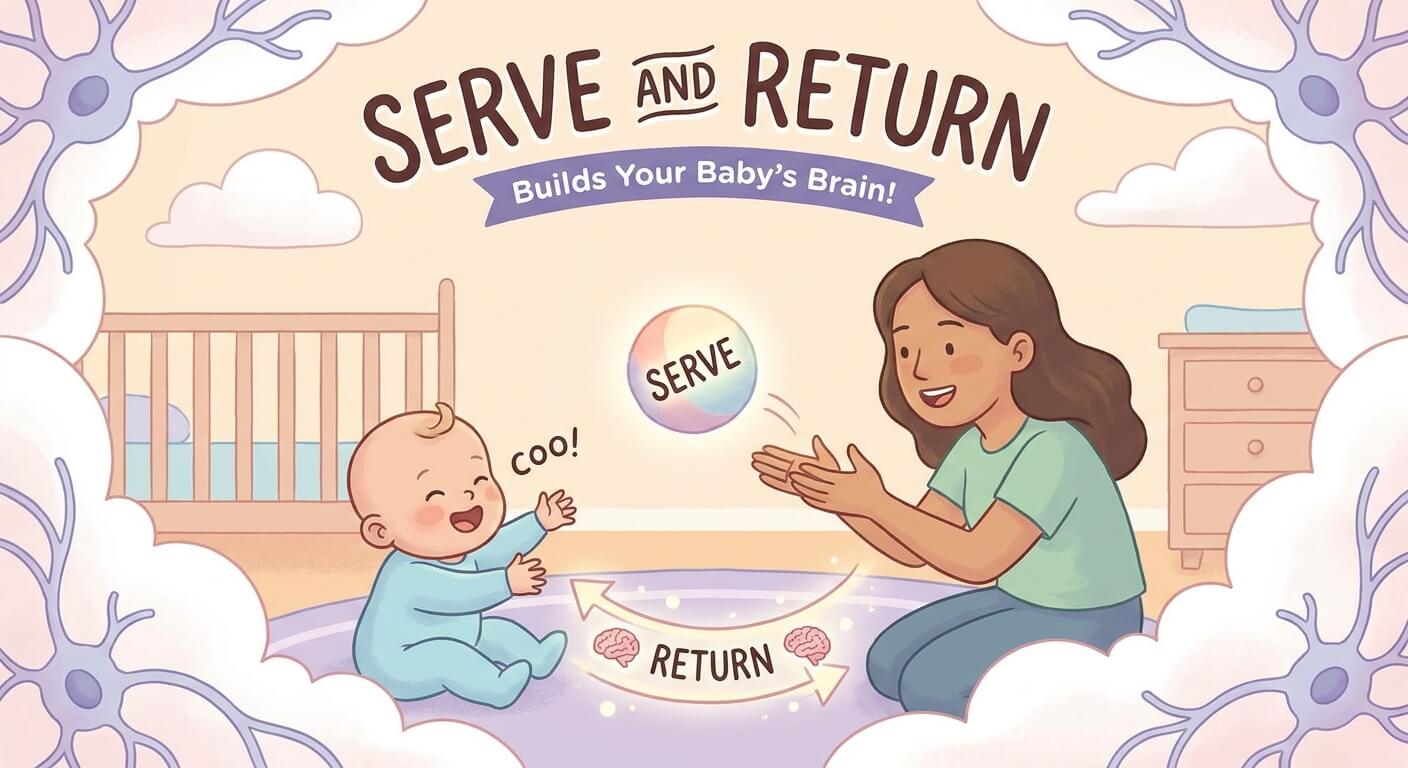
Before diving into the specifics of understanding newborn cues, it helps to step back and consider a fundamental question: why do newborns communicate through body language at all? The answer lies in a remarkable quirk of human evolution. Observing these signals can help parents recognize the quiet-alert state and respond through simple serve-and-return interactions.
Compared to virtually every other mammal on earth, human beings are born staggeringly early. A newborn horse stands and walks within hours. A newborn monkey clings to its mother independently. A human newborn, by contrast, cannot hold up its own head. The reason is architectural: the human brain is so large relative to the birth canal that if gestation lasted long enough for the baby to achieve the neurological maturity of, say, a newborn chimpanzee, the head simply would not fit. The evolutionary compromise was to deliver the baby earlier and let the brain finish its most intensive development outsidethe womb — a period that the anthropologist Ashley Montagu memorably called “exterogestation,” or the external pregnancy.
This means that for roughly the first three months of life, the newborn exists in a kind of neurological twilight — still wiring fundamental brain circuits, still calibrating sensory systems, still learning to regulate basic bodily processes that other mammals master before birth. The infant cannot speak, point, gesture, or sign. But it absolutely, urgently needs to communicate — about hunger, fatigue, overstimulation, pain, and readiness for connection.
The solution evolution landed on was behavioral cueing: a system of involuntary and semi-voluntary body signals — changes in muscle tone, gaze direction, skin color, breathing pattern, and limb position — that broadcast the infant’s internal state to any caregiver attuned enough to notice. Think of it as biological Morse code, tapped out not on a telegraph but through the baby’s entire body.
The problem, of course, is that most modern parents have never been handed the codebook. And this is where the NBO enters the story.
What Is the Newborn Behavioral Observations (NBO) System?
The Origins
To understand the NBO, it helps to know the name that precedes it. In 1973, the pioneering American pediatrician Dr. T. Berry Brazelton published the Neonatal Behavioral Assessment Scale (NBAS) — a groundbreaking 28-item clinical tool that, for the first time in medical history, treated the newborn not as a passive bundle of reflexes but as an active, organized, communicating individual. The NBAS assessed everything from how a baby responded to a rattle to how effectively it could shut out a repeated disturbance to protect its sleep. It was revolutionary, and it fundamentally reshaped neonatal medicine.
There was, however, a significant limitation. The NBAS required extensive training to administer — typically fifteen to twenty hours of supervised instruction — and was designed primarily as a research and clinical assessment tool. It was brilliant science, but it lived behind a professional wall that few parents would ever scale.
Dr. Kevin Nugent, a developmental psychologist and longtime collaborator of Brazelton’s at the Brazelton Institute at Boston Children’s Hospital, recognized this gap. In the early 2000s, he and his colleagues distilled the core insights of the NBAS into a more accessible instrument: the Newborn Behavioral Observations (NBO) system. The NBO encompasses 18 neurobehavioral observations — fewer than the NBAS, more tightly focused, and critically, designed not as a test administered to a baby, but as a shared experience conducted with a family.
What the NBO Is Not
This distinction — “shared experience” versus “clinical test” — deserves emphasis, because it cuts against deeply ingrained expectations about what happens when a professional observes a baby.
The NBO does not generate a score. It does not rank the baby against a normative curve. It does not produce a report card that says “advanced,” “normal,” or “delayed.” There is no passing and no failing. In this respect, the NBO departs radically from the anxiety-provoking assessment culture that pervades so much of modern parenthood, where developmental milestones function as a competitive leaderboard from birth.
Instead, the NBO asks a profoundly different kind of question. Not “How does this baby compare to other babies?” but rather “Who is this particular baby?” What are this baby’s unique sensory preferences? How does this baby handle stress? What specific strategies help this baby calm down? How does this baby signal readiness for social interaction, and how does this baby signal that it has had enough?
The Core Philosophy: The Baby as Guide
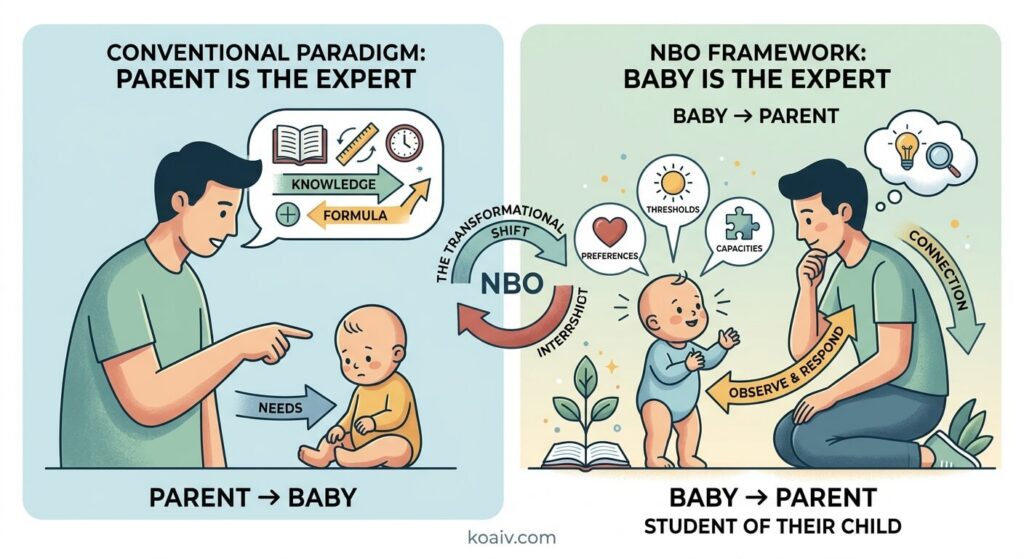
This leads to the NBO’s most transformative insight — a conceptual shift that changes not just what caregivers do, but how they think. In the conventional parenting paradigm, the relationship flows in one direction: the adult has the knowledge, the baby has the needs, and caregiving is the process of the knowledgeable adult figuring out and meeting those needs. The parent is the expert. The baby is the subject.
The NBO inverts this hierarchy entirely. In the NBO framework, the baby is the expert on the baby. The infant is not a passive recipient of care but an active participant in a relationship, constantly broadcasting information about its preferences, thresholds, and capacities. The parent’s role is not to impose a caregiving formula but to observe, listen, and respond — to become, in essence, a student of their own child.
This is not sentimentality. It is rigorous developmental science. And the evidence behind it is substantial.
What the Research Shows
A 2007 study published in the Journal of Neonatal Nursing found that mothers who participated in NBO sessions during the early postpartum period reported significantly greater confidence in their caregiving abilities and stronger feelings of connection to their infant compared to control groups who received standard care. A subsequent randomized controlled trial, published in the Infant Mental Health Journal in 2014, demonstrated that NBO-based interventions were associated with measurably reduced maternal anxiety and more sensitive parenting behaviors at three months postpartum — the period when the foundations of long-term attachment are being laid.
In Scotland, where the NBO has been integrated into national health visiting services, early implementation data suggests improvements in parent–infant interaction quality and parental mental health outcomes across diverse socioeconomic populations. The World Health Organization has increasingly recognized the importance of such relationship-focused early interventions as foundational to lifelong health and development.
The question, then, is practical: what exactly does the NBO teach parents to observe?
The 6 Infant Behavioral States: The Essential Foundation for Understanding Newborn Cues
Imagine trying to interpret a friend’s facial expression without knowing whether that friend is awake or asleep, relaxed or stressed, focused or daydreaming. The expression itself — a furrowed brow, say — means entirely different things depending on the underlying context. A furrowed brow during deep concentration is unremarkable. A furrowed brow during a casual conversation is a signal worth investigating.
The same principle applies to newborns, and this is where the concept of behavioral states becomes indispensable. A behavioral state is the infant’s current level of arousal — the neurological “setting” that determines how the baby experiences and responds to the world at any given moment. Every cue a baby produces must be interpreted withinthe context of the baby’s current state, or it will almost certainly be misread.
The NBO framework identifies six distinct behavioral states, arranged along a continuum from deepest sleep to full crying. Understanding these states is the single most important step in learning to read newborn cues, because state is always the context and cues are always the text.
State 1: Deep Sleep (Quiet Sleep)
What it looks like: The baby lies completely still. Breathing is slow, deep, and regular — a metronome-like rhythm that is almost hypnotically peaceful to observe. The eyes are firmly closed with no movement beneath the lids. The face is relaxed. The limbs are still.
What is happening inside: Deep sleep is the brain’s maintenance shift. During this phase, the body releases growth hormone, repairs tissue, and consolidates the neural connections formed during waking experience. For a newborn — whose brain is building roughly 700 new synaptic connections per second, according to Harvard’s Center on the Developing Child — this maintenance work is not optional. It is mission-critical.
What caregivers should know: A baby in deep sleep is genuinely difficult to rouse, and attempting to do so — for a feeding, for instance — often results in frustration for both parties. Unless medically necessary, the most supportive response is to wait for the baby to cycle naturally into a lighter sleep state, which typically occurs every 45 to 60 minutes.
State 2: Light Sleep (Active Sleep)
What it looks like: The eyelids flutter. The face twitches — grimaces, half-smiles, frowns cycle through like a silent film. The baby may vocalize softly: small grunts, sighs, or whimpers. The limbs may jerk or twitch. Breathing becomes irregular. To an untrained observer, it looks very much like the baby is waking up.
What is happening inside: This is REM (Rapid Eye Movement) sleep — the neurologically richest phase of the sleep cycle. In adults, REM occupies roughly 20–25% of total sleep time. In newborns, it accounts for an extraordinary 50% or more. During REM, the developing brain is not resting; it is rehearsing. Neural pathways are being activated, tested, and strengthened. Some researchers describe neonatal REM sleep as the brain’s internal simulation engine — running its circuitry through practice drills in the absence of external input.
The most common mistake: This is, without exaggeration, the single most frequent error new parents make — and the NBO explicitly addresses it. A baby in State 2 appears to be waking up. The twitching, the vocalizing, the irregular breathing all trigger the caregiver’s instinct to respond. The parent rushes in, picks up the baby, and — in the process — wakes a baby who was never actually awake.
The result is a disrupted sleep cycle, a genuinely awake and now potentially overtired baby, and a parent who is baffled about why the baby “won’t go back to sleep.” The NBO’s advice is elegantly simple: when in doubt, wait thirty to sixty seconds and observe. More often than not, the baby will cycle through the active phase and settle back into quiet sleep without any intervention at all.
Think of light sleep as a washing machine’s spin cycle. The machine rocks, vibrates, and makes noise — but it is doing exactly what it is supposed to do. Opening the door mid-cycle does not help. It just means the load needs to start again.
State 3: Drowsy (The Transitional State)
What it looks like: The baby’s eyes may be partially open, but the gaze is glassy, unfocused, and slightly distant — the look of someone who has just been woken from a deep nap and is not yet sure where they are. Movements are slow and languid. Responses to stimulation (a voice, a touch) are delayed and muted.
What is happening inside: Drowsiness is a threshold state — a neurological crossroads where the brain can tip in either direction, toward wakefulness or back toward sleep. The key characteristic of this state is its instability: it does not persist for long, and the direction it resolves depends heavily on what happens in the environment around the baby.
What caregivers should know: If the goal is sleep, this is the moment for gentle, sustained soothing — quiet voice, dim light, rhythmic motion. If the goal is interaction, patient and low-intensity engagement (soft eye contact, calm speech) can gradually coax the baby toward full alertness. What does not work is high-intensity stimulation: bright lights, animated voices, or sudden movement. These tend to overwhelm the drowsy system and push the baby not toward alertness but toward irritability.
State 4: Quiet Alert — The Golden Window for Learning and Connection
What it looks like: This state is unmistakable once recognized, and recognizing it changes everything. The baby’s eyes are wide open, bright, and focused with remarkable intensity. The body is still and relaxed — there is a quality of gathered attention, as if the baby has paused everything else in order to concentrate fully on the world. The gaze tracks faces and objects with deliberate effort. The expression is one of profound, almost luminous attentiveness.
What is happening inside: In the quiet alert state, the newborn’s brain is operating at peak receptivity. Sensory input is being processed, neural connections are being formed, and — most remarkably — the infant is actively seeking social engagement. Research published in Developmental Science (2013) found that the quality of an infant’s attention during quiet alert states was among the strongest early predictors of language acquisition at 18 months of age. In other words, what happens during these windows has measurable consequences for cognitive development.
Why this matters so much: Here is the difficult truth: in a newborn, the quiet alert state may last only five to ten minutes at a stretch before fatigue or overstimulation tips the baby into a more active or distressed state. These windows are brief, unpredictable, and extraordinarily valuable. Caregivers who learn to recognize State 4 and respond to it — with face-to-face interaction, gentle speech, responsive mirroring, or simply calm, attentive presence — are making the most of the most neurologically potent moments in their baby’s waking life.
Dr. Brazelton himself described the quiet alert state as “the baby at their best” — and decades of research have confirmed his intuition. This is the window for connection. This is where the relationship begins to be felt by both parties.
If the baby’s behavioral states were radio frequencies, State 4 would be the one clear channel — the signal without static. Everything transmitted during this window comes through with full fidelity.
State 5: Active Alert (The Yellow Light)
What it looks like: The stillness of the quiet alert state gives way to increasing movement. The baby squirms, kicks, and waves its arms with growing intensity. Vocalizations increase — not yet crying, but fussy, effortful sounds. The face may redden slightly. The gaze becomes less focused, more darting.
What is happening inside: The baby’s system is signaling that a threshold has been crossed. Something needs to change: the baby may be building toward hunger, approaching sensory overload, or simply reaching the limit of how long the immature nervous system can sustain active engagement with the environment. State 5 is the neurological equivalent of a yellow traffic light — not yet an emergency, but a clear warning that one is coming if the current trajectory continues.
What caregivers should know: State 5 is the ideal moment for gentle, preemptive intervention. A change of position, a reduction in stimulation, a quiet feeding, or a shift to a calmer environment can often prevent the escalation to full crying. The key insight is temporal: every minute spent in responsive action during State 5 can prevent ten minutes of distressed crying in State 6.
State 6: Crying (The Late-Stage Signal)
This state needs no description. It is the one baby behavior that every adult, parent or not, recognizes instantly.
What most people misunderstand: Here is the critical reframe that the NBO offers, and it is worth reading twice: Crying is not the beginning of the baby’s communication. It is the end. A baby who reaches full, sustained crying has already sent multiple earlier, quieter signals — disengagement cues, autonomic stress responses, increasing motor agitation — that went unrecognized or unaddressed. Crying is what happens when the subtler channels fail.
This is not a statement of blame. It is an invitation to shift attention earlier in the communication sequence. The goal the NBO proposes is not to become better at stopping crying once it starts (though that matters too), but to become fluent enough in the earlier states that the conversation never reaches its most desperate chapter.
The table below summarizes all six states in a quick-reference format:
| State | Name | Key Signs | Caregiver Response |
|---|---|---|---|
| 1 | Deep Sleep | Still body, regular breathing, eyes closed | Do not disturb; allow rest |
| 2 | Light Sleep | Twitching, fluttering eyelids, irregular breathing | Wait and observe; do not pick up immediately |
| 3 | Drowsy | Glassy eyes, slow movements, delayed reactions | Gentle soothing or soft engagement |
| 4 | Quiet Alert | Wide bright eyes, still body, focused gaze | Engage! Talk, sing, make eye contact |
| 5 | Active Alert | Squirming, fussing, increasing movement | Intervene gently — feed, reduce stimulation |
| 6 | Crying | Intense vocalization, full distress | Soothe; reflect on earlier missed cues |
With behavioral states as the foundation, the next layer of the NBO’s framework comes into focus: the specific cues that babies produce within these states.
Decoding the Three Categories of Newborn Cues
If behavioral states are the context — the weather conditions, so to speak — then newborn cues are the forecast: specific, readable signals that tell a caregiver what the baby is experiencing right now and what is likely to happen next. The NBO organizes these cues into three intuitive categories that, once learned, become second nature.
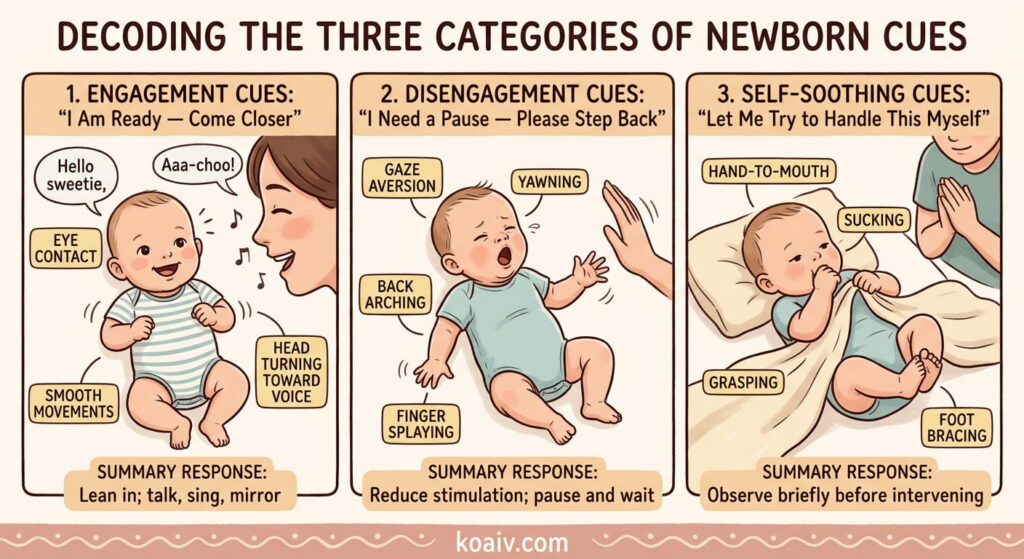
Engagement Cues: “I Am Ready — Come Closer”
Engagement cues — sometimes called approach cues in the clinical literature — are the baby’s invitation to interact. They are the behavioral equivalent of an open door, and they tend to cluster during the quiet alert state, though they can appear briefly in other states as well.
What to look for:
- Sustained eye contact — the baby locks onto a face or voice with focused, deliberate attention
- Brightening of the eyes — a visible widening and “lighting up” of the gaze, distinct from the glassy look of drowsiness
- A relaxed, open facial expression — smooth forehead, softly parted lips, an overall quality of receptivity
- Smooth, coordinated limb movements — arms and legs moving with a fluid, purposeful quality rather than jerky agitation
- Turning the head toward a voice or sound — an active search behavior, requiring genuine neurological effort from a newborn
- Reaching or extending the hands — often with fingers gently curled rather than tightly fisted
When a baby produces engagement cues, the social brain — specifically, the networks involving the prefrontal cortex, the superior temporal sulcus, and the mirror neuron system — is online and receptive. The baby is not merely tolerating interaction; the baby is seeking it. These are the moments that build what developmental psychologists call contingent responsiveness: the reciprocal, rhythmic, back-and-forth exchange between caregiver and infant that the neuroscientist Dr. Dan Siegel describes as the biological mechanism underlying secure attachment.
Think of it this way: when two adults have a good conversation, there is a rhythm — one speaks, the other listens, responds, and the first reacts in turn. This dance of mutual attunement does not begin with language. It begins here, in the wordless exchanges of the first weeks of life, when a baby gazes at a face and a parent gazes back.
How to respond: Meet the invitation. Lean in — both literally and figuratively. Speak softly, position the face 8 to 12 inches from the baby’s eyes (the focal distance of newborn vision), offer gentle facial expressions, and mirror the baby’s sounds and movements. The goal is not to perform. The goal is to respond — to let the baby feel that its signals have been received and answered.
Disengagement Cues: “I Need a Pause — Please Step Back”
If engagement cues are the open door, disengagement cues — also called avoidance cues — are the gently raised hand that says not right now. They are perhaps the most commonly misread signals in the entire newborn behavioral repertoire, and the consequences of misreading them are both immediate and cumulative.
What to look for:
- Turning the head away from a face, voice, or stimulus
- Breaking eye contact — gaze drifting away or eyes closing briefly
- Yawning — not always a sign of sleepiness; frequently a stress response
- Hiccuping — often a sign of autonomic nervous system activation, not a digestive event
- Sneezing — similarly, more often a regulatory response than an indication of illness
- Arching the back — a full-body withdrawal from stimulation
- Splaying the fingers wide — what clinicians informally call the “stop sign hand,”with fingers spread open and rigid
- Furrowing the brow or grimacing
- A sudden increase in body tension — the shift from fluid to rigid
Why these cues are so often misread: When a baby turns away from an animated, smiling, loving parent, the instinctive interpretation is personal: the baby doesn’t want me. The baby is bored. I’m doing something wrong. Many caregivers respond by escalating — getting more animated, more vocal, more insistent — in an effort to re-engage. This is precisely the opposite of what the baby needs, and it creates a feedback loop of increasing overstimulation that frequently ends in State 6 crying that appears to have come “out of nowhere.”
What is actually happening: The baby is not rejecting the parent. The baby is regulating. The developing nervous system has reached its processing capacity — its bandwidth is full — and the baby is deploying the only tools available to reduce incoming stimulation: gaze aversion, physical withdrawal, and autonomic discharge (the hiccups, yawns, and sneezes that function as pressure-release valves for a stressed system).
Imagine sitting in a movie theater where the volume has been slowly increasing. At first it is fine, even enjoyable. But at a certain point, the sound becomes physically uncomfortable. Covering one’s ears in that theater is not a rejection of the movie. It is a sensible response to being overwhelmed. The baby’s disengagement cues are the neurological equivalent of covering its ears.
The innovative reframe: One of the NBO’s most valuable contributions to modern parenting culture is the reframing of disengagement as competence rather than failure. A baby who turns away from overstimulation is not misbehaving. That baby is demonstrating a remarkably sophisticated neurological skill: the ability to self-regulate by modulating sensory input. Honoring these cues — by pausing interaction, lowering one’s voice, dimming lights, reducing movement, or simply holding the baby quietly — communicates something profound to the infant’s developing brain: your signals are heard, your boundaries are respected, and you are safe.
How to respond: Reduce. Simplify. Quiet. The baby has communicated clearly; the only task is to listen. Stop the current activity. Speak more softly or not at all. Decrease visual stimulation. Offer containment — firm, gentle pressure with a hand on the chest or a snug swaddle — without adding new sensory input. Then wait. Often, after a brief recovery period, the baby will produce engagement cues again, signaling readiness to reconnect. The conversation is not over. It is simply paused.
Self-Soothing Cues: “Let Me Try to Handle This Myself”
The third category of newborn cues is perhaps the most frequently overlooked and overridden — not out of negligence, but out of the well-meaning urgency that drives most early caregiving. These are the baby’s self-soothing cues: active, purposeful strategies that the infant deploys to manage its own arousal and bring itself back toward equilibrium.
What to look for:
- Bringing hands to mouth or face — the most common self-soothing behavior in newborns
- Sucking on fingers, fist, or wrist — non-nutritive sucking activates the parasympathetic nervous system, producing a genuine calming effect
- Grasping clothing, a blanket edge, or a caregiver’s finger — tactile anchoring
- Bracing feet against a firm surface — using proprioceptive (body-position) feedback to organize the sensory system
- Tucking limbs toward the body midline — returning to the flexed, contained posture of the womb
It is natural — and deeply loving — for a caregiver to want to solve every moment of infant distress immediately. When a baby fusses and brings its hand to its mouth, the instinct is often to pull the hand away and substitute a pacifier, or to pick the baby up and begin active soothing. But in doing so, the caregiver inadvertently interrupts the baby’s own attempt at self-regulation — a process that, if allowed to unfold, builds the neurological architecture for emotional regulation that will serve the child for decades.
Consider a toddler learning to walk. Every parent knows that the child must be allowed to wobble, stumble, and occasionally fall in order to develop balance and coordination. Constantly holding the toddler upright does not accelerate walking — it delays it. Self-soothing in infancy operates on the same principle. The baby needs space to practice calming itself, with the caregiver standing ready to assist if the baby’s own efforts prove insufficient.
How to respond: The NBO advocates for a brief “wait window” — a pause of ten to thirty seconds during which the caregiver observes the baby’s self-soothing attempt before intervening. This pause is not neglect. It is respect. It communicates: I see that you are working on this. I am right here if you need me, but I trust you to try. A baby who successfully self-soothes in response to mild stress is demonstrating impressive neurological organization. A baby who cannot — who escalates despite vigorous hand-to-mouth effort — is communicating equally clearly: I need more help right now. Both outcomes are informative, and neither is cause for concern.
The table below offers a side-by-side comparison of all three cue categories:
| Cue Category | What It Means | Key Signs | Best Response |
|---|---|---|---|
| Engagement | “I’m ready to connect” | Eye contact, smooth movements, head turning toward voice | Lean in; talk, sing, mirror |
| Disengagement | “I need a break” | Gaze aversion, yawning, back arching, finger splaying | Reduce stimulation; pause and wait |
| Self-Soothing | “Let me try first” | Hand-to-mouth, sucking, grasping, foot bracing | Observe briefly before intervening |
The A.M.O.R. Framework: How to Read the Whole Baby at Once
Individual cues are powerful, but the NBO’s deepest insights emerge when the baby is read holistically — when the caregiver learns to attend not just to a single signal but to the overall pattern of the baby’s behavior across multiple domains simultaneously. To make this comprehensive observation accessible and memorable, the NBO’s four domains of observation can be organized into the A.M.O.R. framework — an acronym that, fittingly, spells the word for “love” in several Romance languages.
A — Autonomic: The Body’s Baseline
The autonomic nervous system is the body’s autopilot — the network that controls breathing, heart rate, digestion, temperature regulation, and other involuntary functions. In adults, this system operates smoothly and invisibly. In newborns, it is still being calibrated, and its struggles are often visible on the surface.
What to observe: Smooth, regular breathing versus rapid, irregular, or labored breathing. Stable skin color versus sudden mottling, pallor, or flushing. The absence or presence of tremors, jitteriness, frequent hiccuping, or unexplained sneezing. Gastrointestinal signs such as spitting up during periods of stress.
What it tells caregivers: Autonomic instability is the first layer of the baby’s stress response. When the autonomic system is struggling — signaled by color changes, breathing irregularities, or jitteriness — it means the environment is demanding more than the baby’s baseline regulatory capacity can currently handle. This is the body saying, the conditions need to change before anything else can improve.
M — Motor: The Language of Movement
Motor behavior refers to the quality, organization, and tone of the baby’s movements — the vocabulary of the physical body.
What to observe: Smooth, fluid limb movements versus jerky, disorganized flailing. Relaxed muscle tone versus persistent rigidity or unusual floppiness. The baby’s ability to bring hands to midline (the center of the body). The quality of posture — how the baby holds itself in space when supported.
What it tells caregivers: A baby whose movements are smooth and well-organized is generally in a regulated, comfortable state. A baby whose movements become increasingly jerky, rigid, or frantic is broadcasting motor distress — often a precursor to state escalation. Importantly, motor behavior is also a window into neurological development. Nugent has noted that a baby’s postural tone — the background tension in the muscles — tells a remarkably rich story about the maturity and organization of the developing nervous system.
O — Organization of State: How the Baby Navigates Transitions
State organization refers not to any single behavioral state but to the quality of the baby’s movement between states — how smoothly or abruptly the baby transitions from sleeping to waking, from calm to distressed, and back again.
What to observe: How quickly does the baby move from quiet alertness to fussiness? Can the baby sustain the quiet alert state for several minutes, or does it become overwhelmed within seconds? After reaching a state of distress, how readily does the baby return to calm — independently or with support? Can the baby habituate to a repeated, non-threatening stimulus?
A word about habituation: Habituation is a concept that deserves its own moment, because it is one of the most elegant and often overlooked demonstrations of newborn intelligence. Habituation is the brain’s ability to recognize a repeated stimulus as non-threatening and choose to ignore it.
When a baby in light sleep is exposed to a repeated gentle sound and, after several repetitions, shows no response at all, that baby has not “failed to notice.” That baby has decided — at a neurological level — that the sound is irrelevant and not worth waking up for. This is learning in its most fundamental form: the ability to filter signal from noise, to sort the world into “things that matter” and “things that don’t.” Far from being a trivial observation, habituation capacity in the neonatal period has been correlated in longitudinal research with later measures of cognitive efficiency and attentional control.
R — Responsiveness: The Social Self
Social responsiveness encompasses the baby’s capacity to orient toward, engage with, and respond to the human world — faces, voices, touch, and emotional tone.
What to observe: Does the baby turn toward the sound of a human voice? Does the baby demonstrate a visual preference for faces over objects? Can the baby track a slowly moving face or brightly colored object across the visual field? How does the baby respond to being held — does it mold into the caregiver’s body (a sign of trust and comfort) or remain rigid and resistant?
What it tells caregivers: The newborn’s social responsiveness is often startlingly sophisticated. Within hours of birth, neonates demonstrate a measurable preference for their mother’s voice — a sound they have been processing and learning for the final trimester of pregnancy through the muffled acoustics of the amniotic environment. By two days of age, most newborns show a statistical preference for human faces over other visual stimuli of comparable complexity. Research by developmental psychologist Andrew Meltzoff has demonstrated that neonates as young as 42 minutes old can imitate facial expressions — sticking out the tongue in response to anadult doing the same — a finding that suggests the social brain is not merely present at birth but active and seeking connection.
The A.M.O.R. framework, taken as a whole, transforms the caregiver’s observational lens from narrow to panoramic. Rather than fixating on a single cue — why is the baby hiccuping? — the framework invites a broader reading: How is the baby’s breathing? Are movements smooth or tense? How long has the baby been in this state? Is the baby oriented toward me or withdrawing? The answers, taken together, paint a portrait of the whole infant in this moment — not a list of symptoms, but a story.
Three Practical NBO-Inspired Experiments to Try at Home
Understanding the theory behind newborn cues is essential. But there is a difference between knowing a language and speaking it. The following three structured observations — adapted from NBO clinical practice for home use — are designed to bridge that gap, turning abstract knowledge into embodied, lived experience.
Experiment 1: The Voice Tracking Game
When to try it: During a State 4 quiet alert window — when the baby’s eyes are wide, bright, and focused.
What to do: Position slightly to the side of the baby’s line of sight, about 10 to 12 inches away from the face. Begin speaking in a soft, rhythmic voice — a gentle narrative, a lullaby, a simple repetition of the baby’s name. Do not move into the baby’s direct visual field. Instead, watch what happens.
What to observe: Within a few seconds, most babies will begin a deliberate, effortful process of turning the head toward the voice. The eyes will search. The body will orient. The mouth may open slightly. What unfolds is not a reflex. It is intention — a two-week-old marshaling its limited motor resources to locate and connect with a human being. It is, in miniature, the same impulse that will one day drive that child to turn when a friend calls its name across a playground.
This simple observation demonstrates that the baby already possesses social orientation — the foundational capacity that will eventually underpin language, empathy, and every meaningful relationship the child will form across its lifetime.
Experiment 2: The Habituation Observation
When to try it: While the baby is in State 2 light sleep.
What to do: Gently introduce a mild, consistent stimulus — a quiet rattle shaken briefly at a distance of about a foot from the baby’s head, or a soft penlight shone briefly near (never directly on) the baby’s closed eyes. Present the stimulus once. Wait ten seconds. Present it again. Repeat four to six times.
What to observe: Most babies will show a visible startle or arousal response the first time — a twitch, a facial grimace, a change in breathing rhythm. With each subsequent repetition, watch that response diminish. By the fourth or fifth presentation, many babies will show almost no reaction whatsoever.
This is habituation in real time — the brain assessing a stimulus, categorizing it as non-threatening, and constructing a neural shortcut that says: this can be safely ignored. It is one of the most elegant demonstrations of learning in the entire developmental repertoire. The baby in the crib, seemingly doing nothing more than sleeping, is in fact running a sophisticated threat-assessment algorithm and making executive decisions about the allocation of attentional resources. It is, by any reasonable definition, thinking.
Habituation capacity has real-world implications. A baby with strong habituation skills can sleep through the ambient noises of a household — a closing door, a sibling’s laughter, a dog barking. A baby who struggles with habituation may startle awake at every minor sound, leading to fragmented sleep for the entire family. Observing habituation gives caregivers critical information about the baby’s sensory thresholds and can guide practical decisions about sleep environments.
Experiment 3: The Soothing Staircase
When to try it: When the baby enters State 5 active alerting or early State 6 crying.
What to do: Resist the natural impulse to immediately deploy the most intensive soothing strategy available — vigorous bouncing, loud shushing, rapid pacing. Instead, apply interventions in ascending order of intensity, pausing at each step for fifteen to twenty seconds to observe whether it is sufficient:
- Step 1 — Voice only: Speak the baby’s name in a calm, steady voice.
- Step 2 — Voice plus touch: Add a warm, still hand on the baby’s chest or belly.
- Step 3 — Containment: Gently bring the baby’s arms to midline, offering the flexed, bounded feeling of the womb.
- Step 4 — Picking up: Lift the baby and hold close to the body, offering the warmth and heartbeat rhythm of physical contact.
- Step 5 — Rhythmic movement: Add gentle rocking, swaying, or bouncing to the holding.
What to observe: Note which step on the staircase is sufficient to return the baby to a calm state. Some babies settle at Step 1. Others need Step 4 or 5. Both responses are entirely normal — they simply reflect different regulatory thresholds and temperamental profiles.
The Soothing Staircase accomplishes two things simultaneously. First, it builds a precise, personalized soothing map for that particular infant — knowledge that transforms midnight crying from a crisis into a protocol. Second, it preserves the baby’s opportunity to participate in its own calming process. By starting at the lowest level of intervention, the caregiver creates space for the baby’s own self-soothing mechanisms to engage before being overridden by external input. Over time, many parents find that their baby’s “settling step” gradually moves down the staircase — from Step 5 to Step 3, from Step 3 to Step 2 — as the baby’s self-regulatory capacity matures. This progression is one of the most gratifying markers of early development to witness.
Why Understanding Newborn Cues Through the NBO Matters
It would be reasonable, at this point, to ask whether all of this attention to behavioral states and cue categories is truly necessary. Babies have been born, and parents have cared for them, for hundreds of thousands of years without formal observation frameworks. Why does the NBO matter?
The answer lies in two converging bodies of evidence — one focused on the infant, the other on the caregiver — that together tell a story of profound and lasting consequence.
For the Baby: The Architecture of Secure Attachment
In the 1950s, the British psychiatrist John Bowlby proposed a theory that would eventually reshape the entire field of developmental psychology: attachment theory. Bowlby argued that the quality of the infant–caregiver relationship in the first year of life creates an internal working model — a template — that shapes how that individual approaches relationships, manages stress, and navigates the social world for the rest of their lives.
Decades of longitudinal research have confirmed this framework with remarkable consistency. The University of Minnesota’s landmark study, which followed participants from infancy into their thirties, found that attachment security assessed in the first year of life predicted adult outcomes across domains that most people would assume are unrelated to infant caregiving: mental health, romantic relationship quality, academic achievement, workplace effectiveness, and even physical health outcomes.
The mechanism underlying secure attachment is not mysterious. It is contingent responsiveness — the caregiver’s reliable, accurate reading of the infant’s cues and timely, appropriate response to them. Not perfect responsiveness (research suggests that even in the healthiest dyads, caregivers “miss” roughly 50% of infant signals), but good-enough responsiveness — a pattern in which the infant learns, over hundreds and thousands of exchanges, that its communications are heard and its needs will be met.
This is precisely what the NBO system trains caregivers to do. Not to be perfect. To be attuned.
For the Parent: The Antidote to Postpartum Anxiety
The benefits of NBO-informed caregiving flow in both directions. For the parent, the transformation is equally significant, though it is often overlooked in clinical conversations that focus primarily on infant outcomes.
Postpartum anxiety — a clinical condition distinct from postpartum depression, though the two frequently co-occur — affects approximately 18% of new mothers and 10% of new fathers, according to data from the American Psychological Association. Recent studies suggest that these figures have climbed in the post-pandemic period, as social isolation and information overload have intensified the pressures on new parents.
A primary driver of postpartum anxiety is the experience of helplessness — the terrifying sense of not understanding what the baby needs and being unable to provide it. This experience is self-reinforcing: anxiety degrades attentional capacity, which makes it harder to read the baby’s cues, which increases the frequency of crying episodes, which deepens the parent’s sense of failure, which amplifies the anxiety. It is a vicious cycle that can erode parental confidence, strain partner relationships, and, in severe cases, compromise the parent’s capacity to provide sensitive, responsive care.
The NBO addresses this cycle at its root. When a parent learns to recognize a disengagement cue — a head turn, a yawn, a splayed hand — and responds by reducing stimulation, and then watches the baby visibly settle, something profound occurs in the parent’s own nervous system. The helplessness narrative, I don’t know what my baby wants and I am failing, begins to dissolve. In its place grows something the developmental literature calls parental self-efficacy: the conviction, grounded in repeated lived experience rather than abstract reassurance, that one is capable of reading and meeting this particular baby’s needs.
This is not a minor psychological footnote. Research consistently demonstrates that parental self-efficacy is one of the strongest independent predictors of warm, sensitive, and responsive caregiving — the very caregiving behaviors that drive the infant attachment outcomes described above. The NBO, in this light, creates a virtuous cycle: improved cue-reading builds parental confidence, which improves the quality of caregiving, which strengthens infant attachment, which produces a calmer and more readable baby, which further builds parental confidence. It is a feedback loop that, once initiated, becomes self-sustaining.
Learning to read newborn cues through the NBO is like learning to read a topographical map before a hike. The terrain does not change — there will still be hills, streams, and rough patches. But the experience of navigating that terrain transforms entirely. What was disorienting becomes legible. What was frightening becomes manageable. And what was merely survived begins, at last, to be enjoyed.
Conclusion
Parenting, stripped to its essence, is an act of translation — a sustained, loving effort to understand a being whose experience of the world is radically different from one’s own. The Newborn Behavioral Observations system does not offer a shortcut around that challenge. What it offers is something more valuable: a shared vocabulary that closes the distance between caregiver and child, faster and more completely than intuition alone.
The six behavioral states are the context. The engagement, disengagement, and self-soothing cues are the sentences. The A.M.O.R. framework is the grammar. Together, they form a language — not invented by clinicians in a laboratory, but spoken by every human infant who has ever drawn breath, waiting patiently for someone with the knowledge to listen.
The science is clear, and it is hopeful. Every parent can learn this language. It does not require medical training, advanced degrees, or special equipment. It requires only what most new parents already possess in abundance: attention, love, and the willingness to watch closely.
Beginning to understand newborn cues does not make the 2:47 AM moments disappear. The baby will still cry. The exhaustion will still come. But something fundamental shifts when a parent can look at a fussing infant — at the turned head, the splayed fingers, the rhythmic hiccups — and think, not What is wrong?, but I hear you. I know what you need.
That shift, small as it sounds, changes everything. It changes the night. It changes the relationship. And, if the research is to be believed, it echoes forward through an entire life.
The baby has been speaking all along. The only question was whether anyone would learn to listen.
Sources and Further Reading:
- Brazelton Institute, Boston Children’s Hospital — The authoritative source on the NBO system, clinical training, and the foundational research of Dr. Kevin Nugent and Dr. T. Berry Brazelton
- World Health Organization — Early Child Development — Global frameworks for early infant-caregiver interaction and its lifelong developmental significance
- Nugent, J.K., Keefer, C.H., Minear, S., Johnson, L.C., & Blanchard, Y. (2007). Understanding Newborn Behavior and Early Relationships: The Newborn Behavioral Observations (NBO) System Handbook. Baltimore: Paul H. Brookes Publishing

October 25, 2026
October 25, 2026
October 25, 2026