The Science of Synaptic Pruning
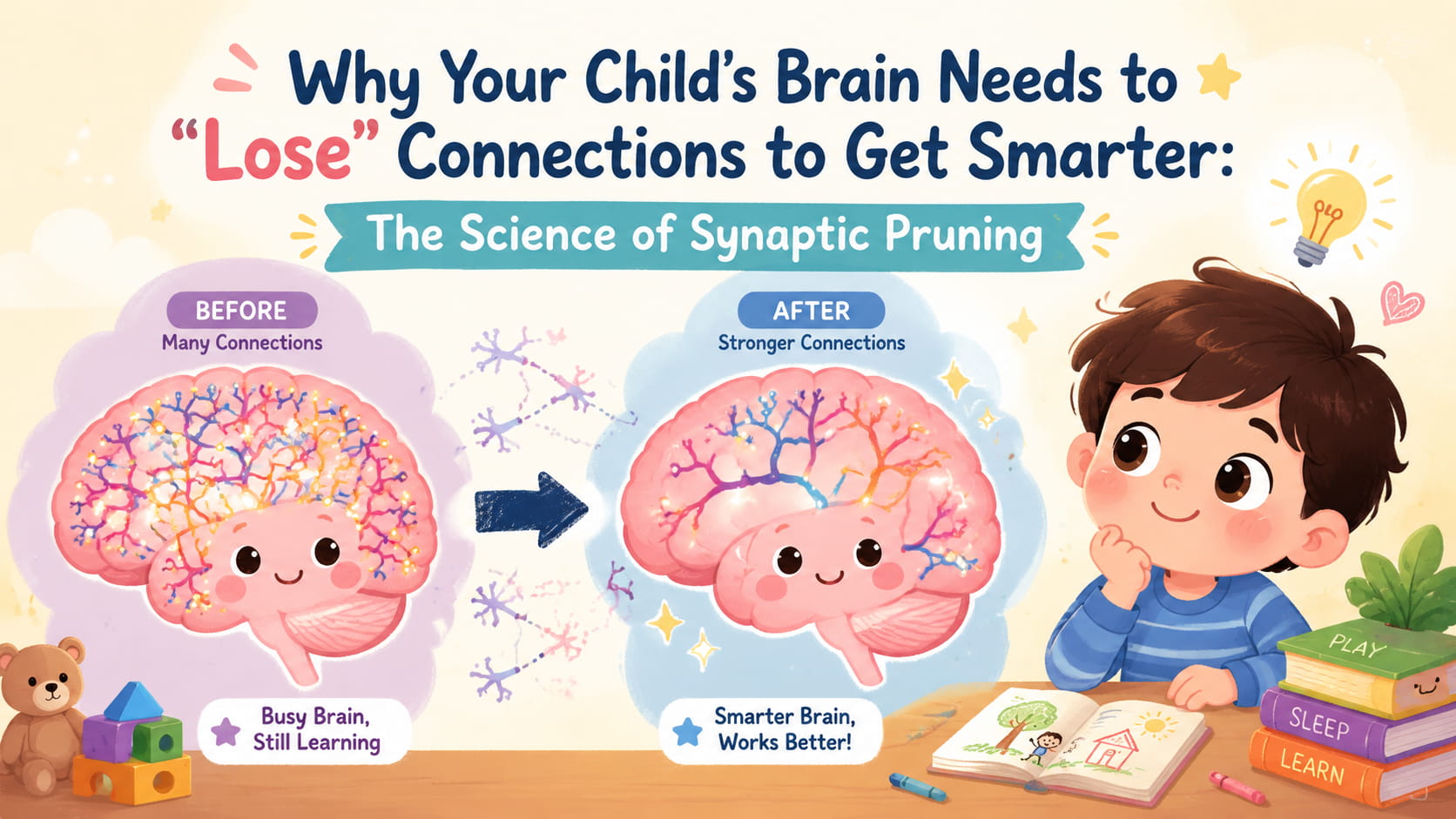
Why Your Child’s Brain Needs to “Lose” Connections to Get Smarter: The Science of Synaptic Pruning
Governed by the biological law of use it or lose it child brain development, synaptic pruning is the brain’s natural editing process that systematically eliminates weak, unused neural connections to sculpt a highly streamlined, efficient, and intelligent mind.
Here is a fact that should stop every parent mid-thought: a two-year-old’s brain contains roughly twice as many neural connections as a fully grown adult’s. Not slightly more. Not ten percent more. Double.
Let that settle for a moment. A toddler who cannot tie their shoes, who confuses “yesterday” with “last year,” who melts down over a broken cracker — that child is walking around with the most densely wired brain they will ever possess. And yet, by any functional measure — the ability to read, to plan, to reason, to manage emotions, to navigate complex social situations — the adult brain outperforms the toddler’s in every conceivable way.
How is this possible? How can less wiring produce more intelligence?
The answer lies in one of biology’s most elegant and underappreciated processes: synaptic pruning. It is the brain’s way of editing itself — a deliberate, experience-guided dismantling of neural connections that transforms a chaotic, over-wired organ into a streamlined engine of thought, feeling, and creativity.
For most of the twentieth century, scientists and parents alike operated under a simple assumption: brain development was a story of accumulation. More neurons. More connections. More stimulation. More flash cards. The bigger and busier the brain, the better the child. It was the intellectual equivalent of believing that a cluttered desk is a sign of genius.
Modern neuroscience has overturned this assumption completely. It turns out that the developing brain is less like a sponge absorbing everything it encounters and more like a sculptor working in marble — starting with a massive, rough block of raw material and then carefully, deliberately chipping away everything that is not the masterpiece. The brilliance is not in what the sculptor adds. It is in what the sculptor removes.
How a Brain Gets Wired in the First Place
Before diving into the concept of synaptic pruning, it helps to understand what, exactly, is being pruned. Think of the brain as an unfathomably complex communication network — like a city’s telephone system, but built from living cells instead of copper wire.
The brain is made up of approximately 86 billion neurons — specialized cells whose sole purpose is to communicate with one another. Each neuron is a tiny biological processor, receiving signals from some cells and sending signals to others. But neurons do not touch each other directly. Instead, they communicate across microscopic gaps called synapses. (The word comes from the Greek synapsis, meaning “conjunction” — a joining point.)
When a neuron “fires” — when it activates — it releases tiny packets of chemicals called neurotransmitters across the synapse. These chemicals float across the gap and land on the neighboring neuron, either encouraging it to fire in turn or telling it to stay quiet. This process — a chemical handshake between two cells — is the fundamental unit of every thought, every feeling, every memory, and every learned skill a human being will ever experience.
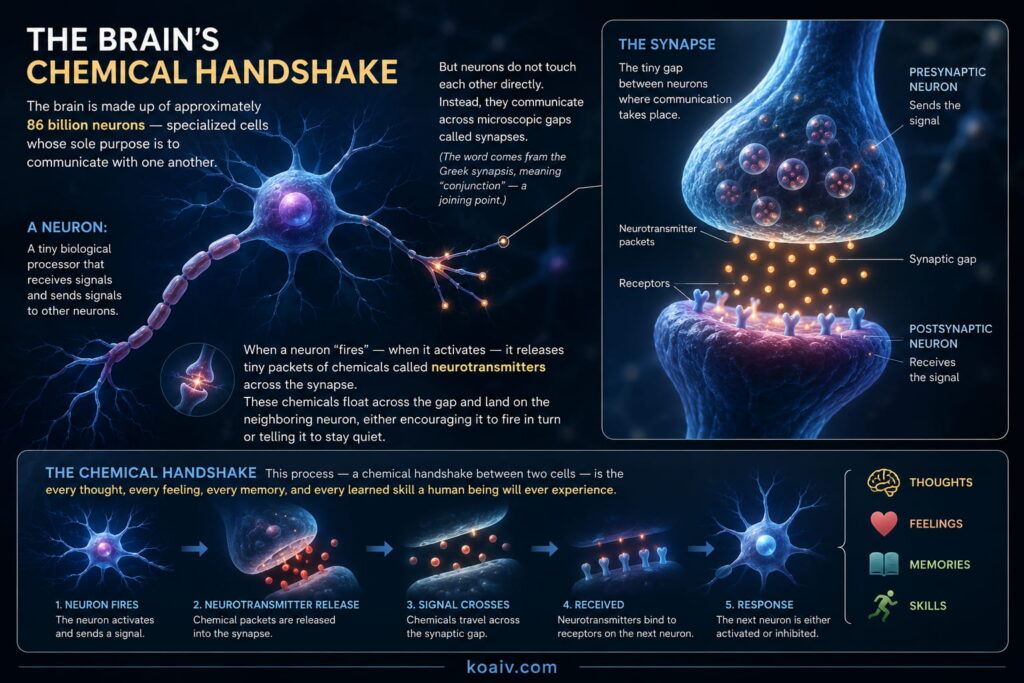
A single neuron can form synaptic connections with up to 10,000 other neurons.Multiply that by 86 billion neurons, and the result is a network of almost incomprehensible density — roughly 100 trillion synaptic connections at peak capacity in early childhood. For perspective, that number exceeds the estimated count of stars in the Milky Way galaxy.
Every time a child learns a new word, recognizes a parent’s face, reaches for a toy, or feels the warmth of being held — that experience is encoded in the pattern of synaptic connections firing together. The phrase neuroscientists use is deceptively simple: “Neurons that fire together, wire together.” Repeated experiences strengthen specific connections. Neglected ones fade. This is the biological basis of learning, and it sets the stage for everything that follows.
The Great Explosion: Synaptogenesis and the Over-Connected Infant Brain
In the months before and after birth, the brain enters a period of extraordinary construction. Neuroscientists call it synaptogenesis — literally, “the birth of synapses” — and the numbers involved are staggering.
During peak synaptogenesis, a baby’s brain generates up to 1 million new synaptic connections every single second (Harvard Center on the Developing Child, 2016). One million per second. By the time a child reaches age two or three, their brain has produced far more synapses than it will ever need or use — an intentional biological surplus that researchers estimate at roughly double the adult count.
But why would the brain build connections it doesn’t intend to keep? Isn’t that wasteful?
Not at all. In fact, it is one of evolution’s most brilliant strategies. Consider the problem the developing brain faces: at the moment of birth, it has no way of knowing what kind of world it has been born into. Will this child grow up in the Arctic tundra or the Amazon rainforest? Will they need to speak Mandarin, Swahili, or English? Will their survival depend on detecting the footsteps of predators or the honking of city traffic?
Rather than pre-programming the brain for a single environment (which would be catastrophically inflexible), evolution takes a different approach: overproduce connections first, then let experience decide which ones to keep. The brain casts an enormous net of potential pathways, and then — based on the actual experiences the child encounters — it selectively strengthens the pathways that prove useful and eliminates those that don’t.
This is where the real story begins. Because the process of elimination — synaptic pruning — is not a footnote in brain development. It is arguably the main event.
What Synaptic Pruning Actually Is
Synaptic pruning is the brain’s systematic process of eliminating weak, unused, or redundant neural connections to make the remaining network faster, more efficient, and more specialized. It is not a sign of decay. It is a signature of optimization.
The analogy that neuroscientists return to most frequently — and the one that parents tend to find most illuminating — involves gardening. Imagine planting a rose garden. In the early months, a healthy rose bush sends out dozens of shoots in every direction. Some reach toward the sunlight. Others grow sideways into dead space. Still others tangle into neighboring plants, creating a dense, unproductive thicket.
A skilled gardener does not celebrate this overgrowth. Instead, the gardener prunes — selectively cutting back the weak, misaligned, and redundant branches so that the bush’s limited energy flows into the strongest, most productive shoots. The result is not a smaller plant. It is a better one — more blooms, stronger stems, deeper roots.
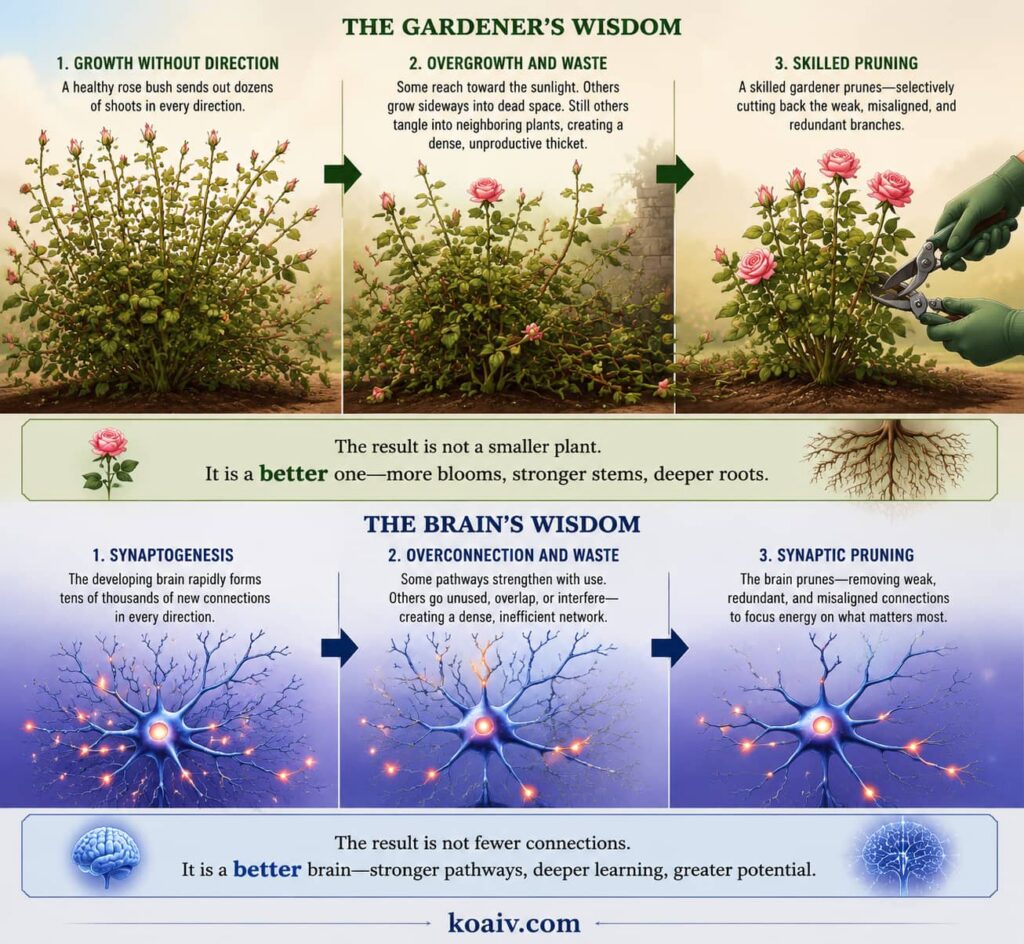
The developing brain operates on precisely the same principle. Synaptogenesis is the garden growing wild. Synaptic pruning is the skilled gardener shaping it into something magnificent.
Meet the Brain’s Gardeners: A Closer Look at Microglia
So who, exactly, does the pruning? The answer is a class of cells that most people have never heard of, despite the fact that they make up roughly 10 percent of all cells in the brain: microglia.
Microglia (pronounced my-CROG-lee-uh) are the brain’s resident immune cells — tiny, mobile, and remarkably versatile. For decades, scientists thought their only job was defending the brain against infection, much like white blood cells patrol the rest of the body. But breakthrough research over the past fifteen years has revealed a far more sophisticated role: microglia are the architects of synaptic pruning.
Here is how the process works at the cellular level. As a child goes about their daily life — playing, sleeping, talking, exploring — some neural pathways fire frequently and consistently. These active pathways develop a kind of molecular “keep me” signal, a set of protective proteins on their surface that essentially say to nearby microglia: “This connection is in use. Move along.”
Pathways that are rarely or never activated, by contrast, develop a different molecular tag — a set of proteins that researchers call “eat me” signals (Stephan et al., 2012, published in Science). When microglia detect these markers, they do exactly what the name implies: they physically engulf and digest the tagged synapse through a process called phagocytosis (from the Greek phagein, “to eat,” and kytos, “cell”). The microglia literally consume the unused connection, recycling its components and clearing the neural real estate for more productive use.
Imagine a city that sends inspectors to check every road on a regular schedule. Roads with heavy traffic get repaved and widened. Roads that nobody uses — no tire marks, no footprints, no sign of activity — get demolished, and the materials are used to strengthen the busy roads instead. That’s microglia at work.
What makes this system so remarkable is its precision. Pruning is not a blunt instrument. It is not the brain randomly deleting connections like a computer wiping a hard drive. It is a targeted, experience-guided, molecularly regulated editing process. And the editor — the microglia — is responding directly to the patterns of a child’s actual lived experience.
This means something profound: the experiences a child has are not just creating memories. They are physically reshaping the architecture of the brain itself.
Timing Is Everything — The Two Critical Windows of Pruning
Synaptic pruning does not occur at a steady, uniform pace throughout childhood. Instead, it arrives in two powerful waves, each targeting different regions of the brain and serving different developmental purposes. Understanding these windows is essential for anyone who cares about child development — because each one represents both an extraordinary opportunity and a point of particular vulnerability.
The First Wave: The Toddler and Preschool Years (Ages 2–5)
The first major pruning wave begins around age two and intensifies through the preschool years. During this period, pruning is concentrated primarily in the brain’s sensory cortices (the regions processing sight, sound, touch, taste, and smell) and the motor cortex (the region governing physical movement and coordination). Language circuits, which straddle both sensory and motor areas, are also heavily pruned during this window.
The effects of this pruning are visible in everyday behavior, even if parents don’t realize what they’re observing.
Consider hearing. A newborn’s auditory system is essentially wide open — it can detect and process virtually any sound frequency the human ear is capable of registering. This is why an infant startles at subtle background noises that adults barely notice. The baby’s brain has not yet learned which sounds matter and which are just noise.
By age four or five, something has shifted dramatically. The child can sit in a noisy classroom and follow a teacher’s voice. They can tune in to a bedtime story while ignoring the hum of the refrigerator and the distant sound of traffic. This is not because their hearing has become less acute; it is because their brain has pruned the redundant auditory pathways, streamlining the system to prioritize meaningful sound — particularly human speech.
The Language Window: A Case Study in Pruning’s Power
Perhaps the most vivid demonstration of early childhood pruning comes from the field of language acquisition. Groundbreaking research by Dr. Patricia Kuhl at the University of Washington’s Institute for Learning & Brain Sciences has shown that infants are born as what she calls “citizens of the world” when it comes to language. In the first six months of life, babies can distinguish the phonetic sounds of every human language — Mandarin tones, Hindi retroflex consonants, French nasalized vowels, English “th” sounds — all of them.
But here is the twist: by approximately 10 to 12 months of age, this universal ability begins to narrow. The brain, guided by the sounds it hears most frequently, starts pruning the pathways for phonemes that don’t appear in the child’s native language. A Japanese infant, for example, gradually loses the ability to distinguish between the English “L” and “R” sounds — not because of any deficiency, but because those sounds are not meaningfully distinct in Japanese, and the brain reallocates its resources to the sounds that are.
By the first birthday, most children have already become specialists in their native language, at the cost of their earlier universality. This is synaptic pruning in action — the brain trading breadth for depth, generality for mastery.
For Parents: This is why the period between birth and age five is often called a “critical period” for language development. It is not that learning a second language later in life is impossible — it is absolutely achievable at any age. But during this early window, the brain is neurologically primed to absorb language with an efficiency and a naturalness that will never be quite as effortless again. The window doesn’t close forever, but it does narrow.
The Second Wave: The Teenage Brain Under Construction (Ages 12–25)
If the first pruning wave is a renovation of the ground floor — sensory systems, motor skills, basic language — the second wave is a wholesale remodeling of the penthouse suite.
Beginning around puberty and continuing, remarkably, until roughly age 25, the brain undertakes a massive pruning of the prefrontal cortex — the most evolutionarily recent and sophisticated region of the human brain. The prefrontal cortex is sometimes called the brain’s “CEO” because it manages the highest-order cognitive functions: long-range planning, impulse control, consequence evaluation, emotional regulation, moral reasoning, and social cognition. It is, in a very real sense, the region that makes humans human.
Landmark research by neuroscientist Dr. Jay Giedd at the National Institute of Mental Health, using longitudinal MRI studies that tracked the same children from childhood through early adulthood, revealed something that surprised the scientific community: gray matter volume in the prefrontal cortex peaks just before puberty and then declines steadily through the teenage years as synaptic pruning accelerates.
This discovery fundamentally reframed the way scientists — and, increasingly, parents and educators — understand adolescent behavior.
Why Teenagers Do What They Do
The stereotype of the teenager is familiar to every parent: brilliant one moment, bafflingly irrational the next. Capable of sophisticated abstract thought, yet prone to breath-taking lapses in judgment. Emotionally intense, socially hyper-aware, and maddeningly impulsive — sometimes all in the span of a single conversation.
Through the lens of synaptic pruning, these contradictions make perfect neurological sense. The teenage brain is not broken. It is not deficient. It is under construction.
Here is an analogy that captures the situation. Imagine a major highway interchange — one of those complex, multi-level cloverleaf structures where several highways converge. Now imagine that interchange undergoing a total reconstruction. The old ramps are being torn out. New, better-designed ones are being built. Some lanes are closed, some are rerouted, and at several points, traffic is being funneled through temporary, narrow detours.
During the construction period, drivers navigating the interchange will experience delays, wrong turns, frustration, and the occasional fender-bender. None of this means the interchange is poorly designed. It means the improvement process is inherently messy.And when the construction is complete, the interchange will handle more traffic, more efficiently, than it ever could before.
This is precisely what is happening in the adolescent prefrontal cortex. Childhood-era neural pathways — adequate for the cognitive demands of elementary school but insufficient for adult-level reasoning — are being systematically pruned and replaced with faster, more efficient, more heavily myelinated circuits. But during the transition, the prefrontal cortex is temporarily less reliable than it will eventually become, which is why teenagers can solve calculus problems in one moment and make catastrophically poor decisions about risk in the next.
The teenage brain is not a finished product operating poorly. It is an unfinished product operating exactly as expected for its stage of construction. Patience, structure, and understanding from the adults in a teenager’s life are not indulgences — they are neurological necessities during this period.
A Side-by-Side Comparison of the Two Pruning Windows
| Window One: Early Childhood (Ages 2–5) | Window Two: Adolescence (Ages 12–25) | |
|---|---|---|
| Primary Brain Region | Sensory cortices, motor cortex, language areas | Prefrontal cortex (executive function center) |
| What’s Being Optimized | Perception, language, motor skills, sensory filtering | Judgment, planning, impulse control, emotional regulation, identity |
| Observable Behavioral Change | A child moves from sensory overwhelm to focused attention; language becomes fluent and specialized | A teenager moves from impulsivity and emotional volatility toward strategic, adult-level thinking |
| Analogy | Tuning a radio from static to a clear signal | Remodeling the command center of a large organization |
| Completion Marker | Basic sensory and motor mastery by school age | Mature executive function by the mid-twenties |
“Use It or Lose It” in Child Brain Development
Now comes the question that matters most for parents, educators, and anyone who shapes a child’s daily environment: What determines which connections are kept and which are pruned?
The answer is disarmingly simple in principle and infinitely complex in practice. It is a rule that neuroscientists have distilled into five words that every parent should know:
“Use it or lose it.”
How Experience Becomes Architecture
This phrase — the “use it or lose it” principle of child brain development — is not a motivational slogan. It is a description of a precise molecular process called experience-dependent plasticity.
Here is how it works, step by step:
- A child has an experience. It could be anything: hearing a bedtime story, playing catch in the backyard, arguing with a sibling, struggling with a puzzle, being comforted after a fall.
- That experience activates specific neural pathways. The neurons involved in processing that experience fire in a particular pattern, sending electrical signals along specific synaptic connections.
- Repeated activation triggers myelination. When the same pathway is activated again and again — through practice, repetition, and sustained engagement — the brain begins wrapping that pathway in a substance called myelin (MY-uh-lin). Myelin is a fatty, insulating sheath that coats the neural fiber much like the rubber insulation around an electrical wire. Its effect is dramatic: myelinated pathways transmit signals up to 100 times faster than unmyelinated ones and are far less prone to signal loss or interference.
- Myelinated pathways are protected from pruning. The myelin sheath serves a dual purpose. It doesn’t just make the connection faster — it also signals to the microglia that this pathway is essential, actively used, and should be preserved. In effect, myelin is a “do not demolish” sign posted on a neural highway.
- Unmyelinated, unused pathways are tagged for elimination. Connections that receive little or no activation remain bare, slow, and molecularly unprotected. Over time, they accumulate the “eat me” signals that attract microglia, and they are pruned away.
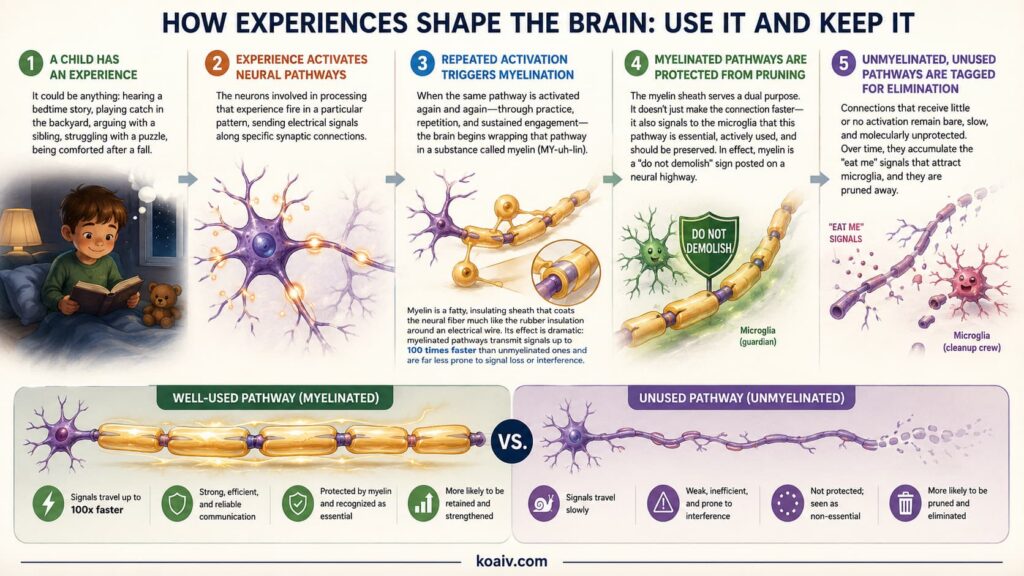
The experiences a child has on a regular basis literally determine which neural pathways survive and which are eliminated. This is not metaphorical. It is not philosophical. It is the physical mechanism by which a child’s environment shapes the structure of their brain.
The Deep Sleep Connection
There is one more critical variable in this equation, and it is one that many parents underestimate: sleep.
Groundbreaking research by neuroscientists Giulio Tononi and Chiara Cirelli at the University of Wisconsin-Madison led to the development of the Synaptic Homeostasis Hypothesis (2014), which proposes that the majority of synaptic pruning and memory consolidation occurs during slow-wave deep sleep — the deepest, most restorative stage of the sleep cycle.
Here is the logic: during waking hours, the brain is busy processing a flood of incoming experiences, strengthening some connections and creating new ones. By the end of the day, the synaptic network is energetically “saturated” — overloaded with the day’s accumulation of strengthened pathways. The brain needs a period of downtime to sort through this accumulation, identify what to keep, and clear away what is no longer needed.
That period of downtime is sleep. Specifically, deep sleep.
During slow-wave sleep, the brain also activates the glymphatic system — a waste-clearance mechanism (discovered in 2012 by Dr. Maiken Nedergaard at the University of Rochester) that flushes toxic metabolic byproducts out of the brain using cerebrospinal fluid. Think of it as the brain’s internal plumbing, running its cleaning cycle while the occupant sleeps.
When a child does not get enough sleep — or when sleep quality is poor due to irregular schedules, excessive screen time before bed, or environmental disruptions — the pruning and cleanup processes cannot complete their work. The brain enters the next day carrying yesterday’s metabolic waste and yesterday’s unresolved synaptic clutter. Over time, this accumulates, potentially affecting attention, emotional regulation, memory consolidation, and learning.
Sleep, in other words, is not the absence of productivity. It is one of the most productive things a child’s brain does all day.
The Nuanced Question of Screen Time
The “use it or lose it” principle inevitably raises a question that dominates contemporary parenting discourse: What about screens?
It is important to approach this question with nuance rather than alarm. The concern, from a neurological standpoint, is not that screens are inherently toxic. It is that certain types of screen engagement may preferentially activate some neural pathways while leaving others dormant — and over time, the dormant ones are pruned.
Consider the difference between two children, both spending an hour with a tablet:
- Child A is passively watching a rapid-fire, highly stimulating animated video — bright colors, fast cuts, loud sounds, and no narrative complexity. This activates the brain’s visual processing and reward circuits intensely but provides minimal engagement to the circuits governing sustained attention, narrative comprehension, creative problem-solving, or emotional regulation.
- Child B is using a drawing application to illustrate a story they invented, narrating the plot aloud while making decisions about color, composition, and character. This engages motor planning, spatial reasoning, language production, narrative structure, creative thinking, and decision-making — a rich, multi-circuit activation.
Both children were “on a screen.” But the neural consequences of their experiences are profoundly different. Over time, the circuits that are consistently engaged will be myelinated and preserved. The circuits that are consistently bypassed will be tagged for pruning.
The implication is not “ban all screens.” It is something more sophisticated: the quality and type of experience matters far more than the medium through which it is delivered. A thoughtful, interactive, co-viewed experience on a screen can be neurologically richer than a passive, low-engagement experience in the physical world. The pruning shears follow the pattern of activation, not the delivery platform.
Understanding Variations in Pruning
The healthy brain prunes with remarkable precision — not too much, not too little, guided by a calibration system refined over millions of years of evolution. But like any complex biological process, pruning can sometimes deviate from its optimal range. Understanding these variations is important not for generating anxiety, but for fostering empathy, early identification, and appropriate support.
Under-Pruning: When the Brain Keeps Too Many Connections
In some individuals, the pruning process is less efficient than typical, resulting in a brain that retains a higher-than-usual density of synaptic connections. Research by Dr. Cynthia Schumann and colleagues at the UC Davis MIND Institute has found evidence that this pattern of under-pruning — particularly an excess of hyper-local connectivity(dense connections within specific brain regions, at the potential expense of efficient communication between regions) — is frequently observed in the brains of individuals on the autism spectrum.
This neurological profile helps explain several hallmark features of the autistic experience: extraordinary sensitivity to sensory input (too many sensory connections remain active, making it difficult to filter out background stimulation), intense focus on specific interests (heavily reinforced local circuits), remarkable pattern recognition, and challenges with the kind of flexible, integrative processing that requires smooth long-range coordination between distant brain regions.
The framing here is essential. Under-pruning does not mean the brain has failed. It means the brain has optimized differently — retaining more raw connectivity at the cost of some streamlining. This is a neurological difference, not a neurological deficit. It produces a brain that experiences the world in ways that are genuinely different from the statistical norm — sometimes challenging, sometimes extraordinary, and often both.
Over-Pruning: When the Editor Becomes Too Aggressive
At the other end of the spectrum, research has increasingly linked excessive synaptic pruning — particularly in the prefrontal cortex during late adolescence — to the development of schizophrenia. A landmark 2016 study by Sekar et al., published in Nature, identified specific genetic variants affecting a group of proteins called complement component 4 (C4) — the same molecular system that tags synapses for microglial pruning.
Individuals carrying certain C4 variants showed dramatically elevated pruning activity in the prefrontal cortex during adolescence. The result, researchers propose, is a prefrontal cortex that has been pruned too aggressively — stripped of connections that were genuinely necessary for coherent thought, accurate perception, and the ability to distinguish internal mental events from external reality.
This finding is remarkable for two reasons. First, it represents one of the strongest genetic links ever identified for schizophrenia. Second, it reframes the condition: what was once understood primarily as a chemical imbalance is now being recognized, at least in part, as a disorder of the brain’s editing process — a case of the pruning shears cutting too deep.
Optimal brain development is not about maximizing pruning, just as it is not about preventing it. The goal — for the brain, and for the adults who support its development — is equilibrium. A balanced, well-regulated pruning process, guided by rich experience, emotional safety, and adequate sleep, is the foundation of healthy cognitive development. When something seems atypical in a child’s development, early consultation with a developmental pediatrician or pediatric neurologist can provide clarity and, when needed, timely support.
Designing a Pruning-Friendly Environment
Understanding the biology of synaptic pruning is intellectually fascinating. But its real value lies in what it reveals about the conditions that support healthy brain development — conditions that parents, caregivers, and educators have meaningful power to create.
The brain’s pruning process is not something that requires micromanagement. It is not something that can be hacked, accelerated, or optimized through special products or programs. What it requires is something both simpler and more profound: an environment that provides the right inputs and removes unnecessary obstacles.
Three principles emerge from the research with particular clarity.
Principle One: Choose Depth Over Breadth
Modern parenting culture — particularly in competitive, resource-rich communities — has developed a deep faith in the power of enrichment at scale. The logic seems sound: if experience drives pruning, then more experiences should mean better pruning. Sign the three-year-old up for Mandarin on Monday, violin on Tuesday, gymnastics on Wednesday, coding on Thursday, and swimming on Friday. Cast the widest possible net, and the best pathways will surely emerge.
Through the lens of synaptic pruning, however, this logic inverts. Superficial exposure to many activities creates many weakly activated pathways — precisely the kind of thin, unmyelinated connections that are most likely to be pruned. A child who spends thirty minutes per week on six different activities may be investing just enough time in each one to form new connections, but not nearly enough to strengthen any of them to the point of myelination and preservation.
By contrast, deep, sustained, repetitive engagement with a smaller number of rich experiences — reading together every evening, extended free play, practicing a musical instrument with consistency over years, engaging in long family conversations — generates the kind of intense, repeated neural activation that produces thick, durable myelin sheaths and robust, pruning-resistant pathways.
This aligns with psychologist Angela Duckworth’s widely cited research on grit and deliberate practice. Duckworth’s work, published in the Journal of Personality and Social Psychology, demonstrates that sustained, effortful engagement in a domain — not scattered, diluted exposure to many domains — is the strongest predictor of exceptional skill development. The neuroscience of pruning provides the biological mechanism for why this is true: depth of practice is what builds the high-speed neural highways that survive the editing process.
This does not mean that children should never explore new activities. Exploration is healthy and important, especially during the toddler and preschool years when the brain is sampling its environment broadly. But exploration should coexist with — and gradually give way to — deeper, sustained engagement in the activities that capture a child’s genuine interest and sustained attention. The goal is not maximum breadth of exposure. It is meaningful depth of experience.
Principle Two: Emotional Safety Is a Biological Necessity, Not a Luxury
If there is a single finding from developmental neuroscience that deserves wider public awareness, it is this: chronic stress fundamentally disrupts the pruning process.
When a child is exposed to persistent, unmanaged stress — ongoing family conflict, emotional neglect, instability, fear, or chaos in the home environment — the body’s stress-response system releases sustained high levels of the hormone cortisol. In short bursts, cortisol is a useful and adaptive chemical; it sharpens attention and mobilizes energy for dealing with immediate threats. But when cortisol levels remain chronically elevated — a state that the Harvard Center on the Developing Child has termed “toxic stress” — the effects on the developing brain are measurably harmful.
Chronic cortisol exposure has been shown to:
- Disrupt microglial function, causing the brain’s pruning gardeners to work erratically — sometimes pruning too aggressively in some areas, sometimes failing to prune adequately in others.
- Preferentially strengthen threat-detection circuits (the amygdala and related structures) at the expense of the prefrontal cortex circuits responsible for learning, reasoning, and emotional regulation.
- Impair the formation of myelin, weakening the insulation on precisely the neural pathways that need it most.
The result is a brain that has been architecturally optimized for survival — hypervigilant, reactive, and primed to detect danger — rather than for growth — curious, flexible, and capable of sustained, creative thought. This is not a character flaw or a failure of will. It is a structural adaptation in the brain’s wiring, driven by the environment.
The implication for parents is both sobering and empowering: psychological safety is not a soft variable in child development. It is not a nice-to-have. It is a hard biological prerequisite for the pruning process to function as designed. A child who feels emotionally secure — whose primary relationships are consistent, responsive, and warm — is a child whose stress-response system is calibrated for curiosity and learning rather than for defense and survival.
Creating emotional safety does not require perfection. It does not require the absence of all conflict or difficulty. Research on “serve and return” interactions — the developmental term for responsive, back-and-forth communication between a child and caregiver — shows that what matters most is not the absence of stress, but the presence of a buffering relationship that helps the child regulate their stress response. A parent who is present, attuned, and reliably responsive is providing something that no enrichment program, no educational toy, and no curriculum can replace: the neurochemical environment in which healthy pruning thrives.
Principle Three: Protect Sleep as the Brain’s Nightly Renovation Window
Given what is now understood about the relationship between deep sleep, synaptic pruning, glymphatic waste clearance, and memory consolidation, a child’s sleep is not a minor logistical concern. It is one of the most consequential inputs into the entire arc of cognitive development.
The American Academy of Sleep Medicine provides evidence-based sleep recommendations by age group:
| Age Group | Recommended Sleep Duration |
|---|---|
| Infants (4–12 months) | 12–16 hours (including naps) |
| Toddlers (1–2 years) | 11–14 hours (including naps) |
| Preschoolers (3–5 years) | 10–13 hours (including naps) |
| School-age children (6–12 years) | 9–12 hours |
| Teenagers (13–18 years) | 8–10 hours |
These figures are not aspirational targets. They represent the minimum duration the developing brain requires to complete its nightly cycle of consolidation, pruning, and cleanup. Every hour of lost sleep is an hour of incomplete neural maintenance — an accumulating debt that affects attention, emotional regulation, memory, and learning.
For parents struggling with bedtime resistance, screen-time negotiations, or the temptation to allow late-night schedules, the neuroscience offers a useful cognitive reframe. Sleep is not the end of the day’s productivity. It is the beginning of the brain’s most important work shift. Protecting a child’s sleep is not about discipline or routine for its own sake. It is about providing the biological conditions under which the brain can complete its most essential cognitive task.
Conclusion
There is a particular kind of wisdom that takes most people a lifetime to fully internalize — the understanding that excellence is not a product of relentless accumulation, but of intelligent, deliberate subtraction. The best writers do not add more words to a sentence; they remove every word that does not serve the meaning. The best architects do not add more rooms; they eliminate every space that does not serve the occupant. The best strategists do not pursue every opportunity; they ruthlessly focus on the few that matter most.
The developing brain operates by the same principle, executed with a precision and elegance that no human institution has ever matched. It does not become extraordinary by hoarding every connection it creates. It becomes extraordinary by developing the biological intelligence to identify what to keep and what to release — and then executing that judgment across trillions of connections with molecular accuracy.
For parents, educators, and caregivers, the implications are both humbling and liberating. The brain does not need to be engineered. It does not need to be hacked or optimized through elaborate interventions. It needs what it has always needed: rich, deep experience. Emotional safety. Adequate sleep. And the patience to let a magnificently designed biological process unfold.
The job is not to build every connection. The job is to help nurture the ones that matter — and trust the brain to do the rest.
After all, the sculptor does not create the masterpiece by adding more marble. The sculptor creates it by removing everything that is not the masterpiece.
And that, it turns out, is exactly what the developing brain has been doing all along.
Sources & Further Reading
- Harvard Center on the Developing Child — Brain Architecture — Harvard University
- Harvard Center on the Developing Child — Toxic Stress — Harvard University
- National Institute of Mental Health — The Teen Brain: 7 Things to Know — NIMH
- Sekar, A. et al. (2016). “Schizophrenia risk from complex variation of complement component 4.” Nature, 530, 177–183. — Nature
- Kuhl, P.K. (2010). “Brain Mechanisms in Early Language Acquisition.” Neuron, 67(5), 713–727.
- Tononi, G. & Cirelli, C. (2014). “Sleep and the Price of Plasticity: From Synaptic and Cellular Homeostasis to Memory Consolidation and Integration.” Neuron, 81(1), 12–34.
- American Academy of Pediatrics — Healthy Sleep Habits — AAP HealthyChildren.org
- Centers for Disease Control and Prevention — Child Development — CDC
- Society for Neuroscience — BrainFacts.org — Society for Neuroscience
- Dana Foundation — The Brain and Neuroscience — Dana Foundation
Key Takeaways
- Synaptic pruning is the brain’s strategic process of eliminating unused neural connections — a core mechanism of cognitive optimization, not intellectual loss.
- A toddler’s brain has approximately twice as many synapses as an adult’s. The journey from childhood to mature cognition is a story of refinement, not expansion.
- Two critical pruning windows — early childhood (ages 2–5) and adolescence (ages 12–25) — represent the most intensive periods of neural editing.
- The “use it or lose it” principle of child brain development means that a child’s daily experiences directly determine which neural pathways survive and which are eliminated.
- Microglia — the brain’s immune cells — physically consume unused synapses in a precision-guided process regulated by molecular signaling.
- Deep sleep is when the brain performs the majority of its pruning, memory consolidation, and metabolic cleanup. Protecting sleep is protecting cognitive development.
- Chronic stress disrupts microglial function and can redirect pruning toward survival-oriented circuits at the expense of learning and regulation — making emotional safety a biological necessity.
- Variations in pruning are linked to neurodivergence (both under-pruning and over-pruning), underscoring that different pruning patterns represent differences in neural optimization, not simply deficits.
- The most effective parenting strategy is not maximum enrichment but depth of experience, emotional consistency, and respect for the brain’s own extraordinary capacity for self-organization.