
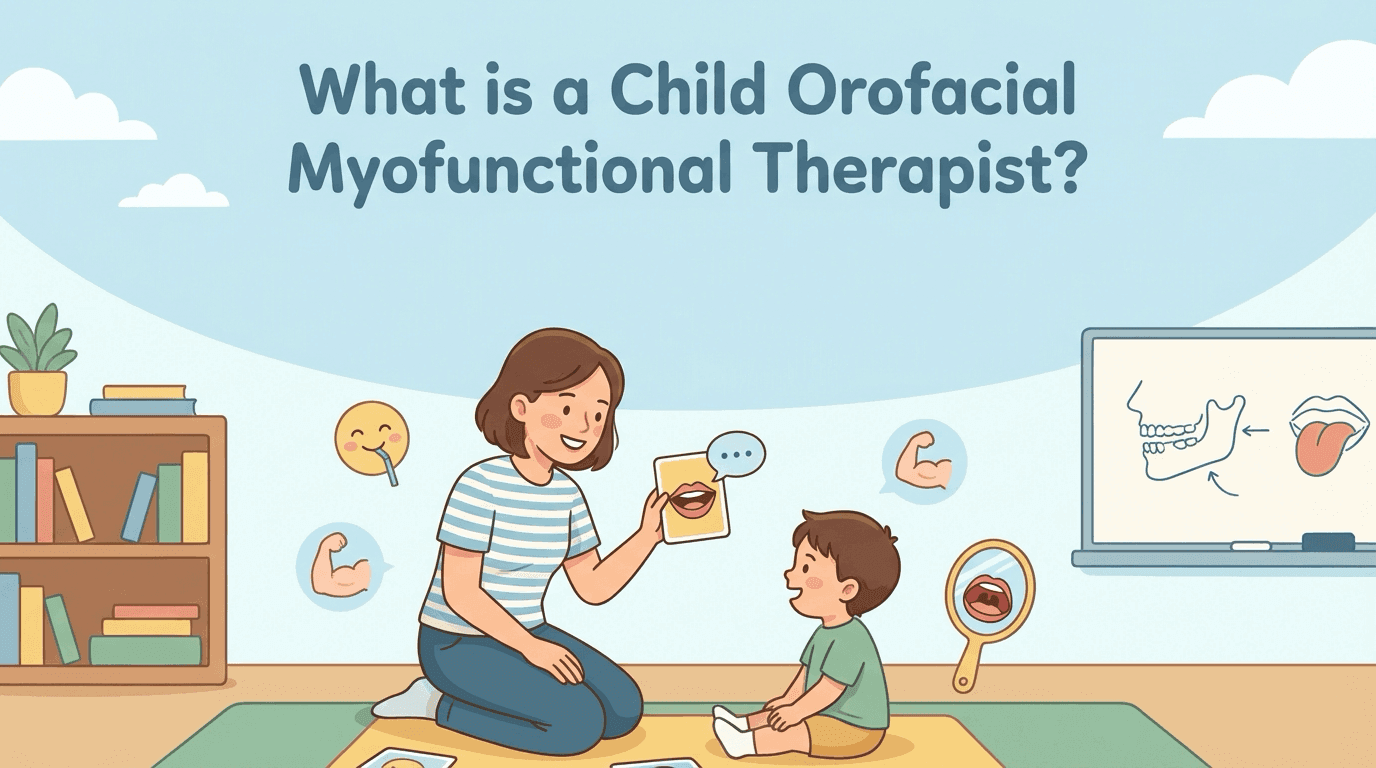
What-is-a-Child-Orofacial-Myofunctional-Therapist
What is a Child Orofacial Myofunctional Therapist? (And Why Your Mouth-Breathing Child Might Need One)
A Child Orofacial Myofunctional Therapist is a specialized healthcare professional who rehabilitates the muscles of the mouth and face to address the hidden root causes of common sleep, breathing, eating, and speech issues, ultimately guiding proper facial development and systemic health.
Every night, in bedrooms across the world, a scene plays out so common that most parents barely register it. A child falls asleep with lips parted, jaw slack, breathing audibly through the mouth. The sound is so familiar it has become background noise—part of bedtime, not a cause for concern. Down the hall, at the dinner table earlier that evening, the same child chewed laboriously, avoided anything crunchy, and left a ring of crumbs and sauce that seemed unusually messy for a five-year-old. At school, a teacher has started mentioning trouble focusing. The pediatrician, consulted at the last wellness visit, offered a reassuring shrug: “Some kids are just like that. Give it time.”
And so the family waits—because separately, none of these things feels alarming. Mouth breathing is just how some children sleep. Messy eating is just a phase. Trouble concentrating is just a personality trait, or perhaps the early whisper of an attention deficit. Taken one at a time, each observation dissolves into the comfortable fog of normalcy.
But what if they are not separate things at all? What if the open mouth, the labored chewing, the restless sleep, and the wandering attention are all branches of the same tree—all traceable to a single, hidden root that no one has thought to examine?
A Term That Sounds Harder Than It Is
Before going further, it is worth pausing on the name itself, because few professional titles do a worse job of explaining what they actually mean. “Orofacial Myofunctional Therapist” reads like a password to a medical conference, not a description of someone who could change a child’s life. But the term, once decoded, is surprisingly intuitive.
- Oro — from the Latin os/oris, meaning mouth
- Facial — pertaining to the face
- Myo — from the Greek mys, meaning muscle
- Functional — relating to how something works, not just its structure
String those pieces together, and the job description emerges with clarity: this is a specialist who focuses on how the muscles of the mouth and face function together, and what happens when they do not.
The simplest analogy is one borrowed from the world of physical rehabilitation. When a person tears a ligament in the knee, a surgeon repairs the structural damage—but recovery does not end in the operating room. A physical therapist must then retrain the muscles around that joint: teaching them to fire correctly, bear weight properly, and move in patterns that protect the repaired structure. Without that muscular retraining, even the best surgical repair is vulnerable to re-injury, because the muscles have not learned to support what the surgeon has built.
An Orofacial Myofunctional Therapist does precisely this kind of work—not for knees, but for the extraordinarily complex system of muscles that control the tongue, lips, cheeks, and jaw. These are the muscles responsible for breathing, chewing, swallowing, and even the shape of the face itself. When they work correctly, no one notices. When they do not, the consequences ripple through a child’s health in ways that are as far-reaching as they are frequently misunderstood.
Understanding Oral Resting Posture
To grasp why this specialty matters, there is one concept that sits at the centre of the entire field. It is called oral resting posture, and it refers to something deceptively simple: what the mouth does when a person is not eating, drinking, or talking—which is to say, most of the time.
The ideal oral resting posture looks like this: the lips are gently together without effort, the teeth are slightly apart (not clenched), and—most critically—the tongue rests wide and flat against the roof of the mouth, known as the palate. Breathing, in this position, flows quietly in and out through the nose.
To understand why this matters, imagine the roof of a child’s mouth as a piece of soft clay. During the years of rapid facial growth—roughly from birth through early adolescence—the palate is remarkably malleable. The tongue, when resting in its proper position, acts as a natural mould. It presses gently upward and outward against the palate, slowly widening it, creating space for adult teeth, and supporting the development of a broad, well-proportioned airway behind it. Think of the tongue as a living retainer—one that works around the clock, for free, requiring no orthodontic appointments.
Now consider what happens when the tongue does not rest on the palate. Perhaps the child is a chronic mouth breather, so the tongue drops to the floor of the mouth to make way for airflow. Perhaps a tight band of tissue beneath the tongue—a condition commonly known as a tongue tie—physically prevents it from reaching the palate at all. Whatever the cause, the result is the same: the palate loses its natural shaping force.
Without that gentle, persistent pressure from below, it begins to narrow and vault upward, creating a high, cathedral-like arch inside the mouth. The dental arch narrows with it, crowding the teeth. And the airway behind the palate—the very passage through which a child needs to breathe during sleep—shrinks proportionally.
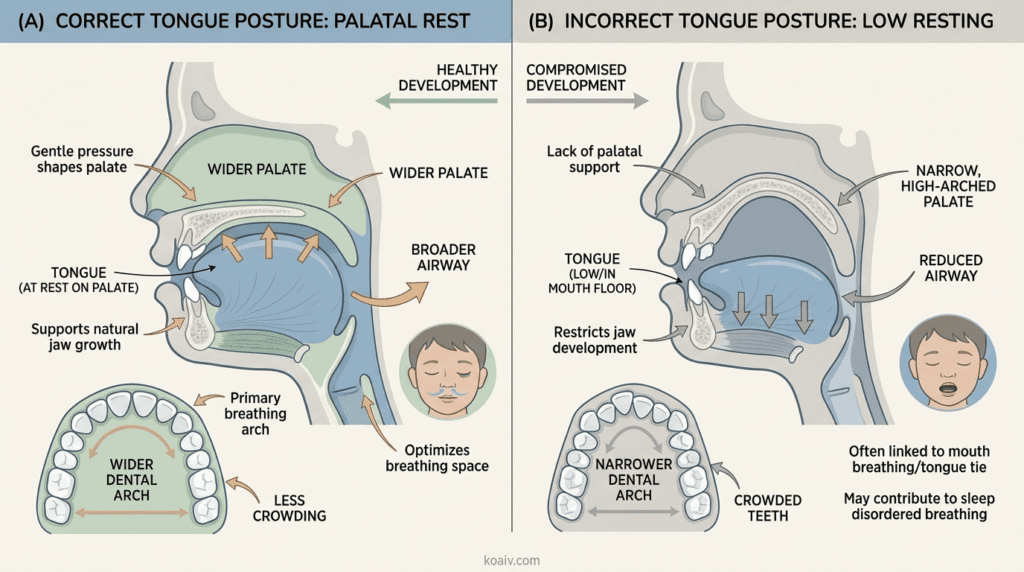
This single chain of cause and effect—tongue position, palate shape, dental alignment, airway size—is the thread that runs through nearly everything an Orofacial Myofunctional Therapist does.
What Parents See Before Anyone Diagnoses
One of the most valuable aspects of understanding myofunctional disorders is that their indicators are not hidden. They are visible every day—at the dinner table, in a school portrait, at the bedside of a sleeping child. Parents often sense that something is off long before a professional confirms it. The challenge is that the signs tend to show up in different rooms, at different times, to different specialists, and no single observer connects them.
When the Airway Speaks Through Sleep
The relationship between mouth breathing and disrupted sleep is one of the most thoroughly studied areas in this field, and the findings are striking. A comprehensive meta-analysis published in SLEEP (Camacho et al., 2015) found that myofunctional therapy reduced the severity of obstructive sleep apnoea in children by approximately 62 percent—a figure that competes favourably with many pharmaceutical interventions and, notably, addresses a root cause rather than merely managing a symptom.
The signs that a child’s airway may be compromised during sleep are more varied than most parents realise. Snoring is the most obvious, but it is far from the only indicator. Teeth grinding—clinically termed bruxism—is often the jaw’s unconscious attempt to push itself forward and reopen a partially collapsed airway. Restless sleep, unusual sleeping positions (particularly with the neck hyperextended), night sweats, and bedwetting in older children can all be downstream effects of disordered breathing during sleep.
Perhaps the most consequential daytime symptom is one that leads families in an entirely different direction: hyperactivity and difficulty concentrating. A growing body of research, including a pivotal study published in Pediatrics (Chervin et al., 2002), has demonstrated that children with sleep-disordered breathing are significantly more likely to exhibit behaviours consistent with attention deficit hyperactivity disorder (ADHD). In some cases, what appears to be a behavioural or neurological condition is, in fact, a child’s brain running on insufficient oxygen night after night—a problem that originates not in the brain, but in the airway, and ultimately in the muscles that support it.
When Mealtimes Tell a Story
The dinner table is another diagnostic stage, though its signals tend to be dismissed as quirks of personality rather than symptoms of dysfunction. A child who refuses crunchier foods—raw carrots, apples, crackers—may not be “picky” in the behavioural sense. That child may lack the muscular coordination in the tongue and cheeks to manage a bolus of food that requires genuine lateral chewing—the side-to-side motion of the jaw that breaks down hard textures.
The tongue, in a well-functioning system, acts as a remarkably precise conveyor belt, sweeping food from the centre of the mouth to the molars, holding it in place during chewing, and then gathering it into a compact ball for swallowing. When tongue mobility or strength is compromised, this process breaks down, and what the family sees is food falling out of the mouth, pocketing in the cheeks, gagging on textures, or simply refusal to eat anything that demands real chewing effort.
Equally telling is the tongue-thrust swallow—a pattern in which the tongue pushes forward against or between the front teeth during swallowing, rather than pressing upward and backward against the palate as it should. To appreciate the significance of this pattern, consider the math: the average person swallows between 500 and 1,000 times per day. Each tongue-thrust swallow delivers a small but measurable force against the front teeth. Over the course of months and years, that repetitive pressure produces the same effect as a thumb pressing on wet clay—gradually pushing the teeth forward, opening a gap between the upper and lower front teeth (called an open bite), and undermining any orthodontic correction that may have already been attempted.
When Habits Refuse to Leave
Thumb sucking, finger sucking, and prolonged pacifier use are developmentally normal in infancy. They become clinically significant when they persist beyond approximately age two to three, because by that point the forces they exert on the developing palate are substantial enough to alter its shape. A 2016 study in the Journal of Orthodonticsconfirmed a direct association between prolonged non-nutritive sucking habits and measurable structural changes, including posterior crossbites, open bites, and narrowed palatal arches.
What makes these habits so difficult for families to break is that they are rarely about willpower. A child who sucks a thumb is typically seeking a form of oral sensory regulation—a deep, calming pressure that the mouth craves. In many cases, that craving exists precisely because the tongue is not resting comfortably on the palate, where it would ordinarily provide a similar sensation of oral completeness. Addressing the habit without addressing the underlying oral posture is like pulling a weed from the top of its stem and expecting it not to grow back. The root system remains entirely intact.
When the Face and Teeth Tell the Full Story
A trained eye can read a great deal from a child’s facial structure and dental patterns. A high, narrow palate—visible when a child opens the mouth wide—indicates that the tongue has not been exerting its natural widening force. Crowded or overlapping teeth suggest a jaw that has not developed enough width to accommodate the full complement of adult teeth. A receding chin or a noticeably long, narrow face may reflect years of chronic mouth breathing, which, by keeping the jaw in a dropped position, subtly directs facial growth downward and backward rather than forward and outward—a pattern clinicians sometimes describe as “long face syndrome.”
And there is the child who has been in speech therapy for a lisp that stubbornly refuses to resolve. In many of these cases, the lisp is not a learned articulation error—it is a structural one. The tongue, restricted by a tie or weakened by years of low resting posture, physically cannot reach the spot behind the upper front teeth where the sounds /s/ and /z/ are produced. No amount of repetition drills can overcome a muscular or structural barrier that has not been identified.
Why Mouth Muscles Matter for the Whole Body
At this point, a parent might reasonably ask: How can the position of a child’s tongue have consequences that stretch from sleep quality to facial shape to school performance? The answer lies in an underappreciated fact about human physiology—the nose is not merely an alternative breathing route. It is a fundamentally different biological system.
When air passes through the nasal passages, three things happen that cannot occur during mouth breathing. First, the air is warmed and humidified, protecting the delicate tissues of the throat and lungs. Second, it is filtered through a dense web of mucous membranes and tiny hairs, trapping particulates, allergens, and pathogens before they reach the lower respiratory tract. Third—and most significantly—nasal breathing triggers the production of a molecule called nitric oxide in the paranasal sinuses.
Nitric oxide is not a minor biochemical footnote. It is a potent vasodilator, meaning it widens blood vessels and improves blood flow. Research published in Acta Physiologica Scandinavica (Lundberg, 1996) demonstrated that nasal breathing enhances oxygen absorption in the lungs by approximately 10 to 25 percent compared to mouth breathing. For a growing child—whose brain is consuming more metabolic energy per kilogram of body weight than at any other point in life—that differential in oxygen delivery is not trivial. It is the difference between a brain that runs on a full tank and one that runs perpetually on reserve.
This brings the conversation to perhaps the most important insight the field of orofacial myofunctional therapy offers: structure follows function. The bones of a child’s face do not grow according to a rigid genetic blueprint and then stop. They grow in response to the forces acting upon them, moment by moment, day after day, year after year.
The tongue pressing on the palate widens the jaw. The lips held together maintain forward facial development. Nasal breathing keeps the jaw in a closed, well-positioned posture. Remove any one of these forces—through mouth breathing, a tongue tie, or a low tongue posture—and the face develops differently. Not diseased, exactly, but differently, and in ways that progressively narrow the airway, crowd the teeth, and set the stage for a lifetime of compensatory problems.
This is why applying braces to a child with an unaddressed tongue thrust is an exercise in structural optimism. The orthodontist can move the teeth into alignment—beautifully, precisely, expensively—but if the tongue continues to push forward with every swallow, the teeth will eventually drift back to where the muscles dictate they belong. The muscles always win. They are, quite literally, on the clock twenty-four hours a day. No retainer works that many hours.
Where the OMT Fits Among Other Specialists
One of the most common sources of confusion for families is understanding how an OMT relates to the other professionals who may already be involved in a child’s care. The answer is not instead of—it is alongside. Orofacial myofunctional therapy is, by design, a collaborative discipline. It does not replace the orthodontist, the speech therapist, or the ENT surgeon. It works in the space between them, addressing the muscular dimension that none of those specialists, individually, is trained to fully manage.
A speech-language pathologist (SLP) focuses primarily on the acoustic and communicative output—helping a child produce sounds correctly, develop language, and communicate effectively. An OMT, by contrast, works upstream, asking why the sound is being produced incorrectly in the first place. Is the tongue too weak to reach its target? Is a structural restriction preventing the movement? The SLP and the OMT, when they collaborate, address both the cause and the symptom—and indeed, a growing number of speech-language pathologists are pursuing additional certification in orofacial myofunctional therapy, recognising how deeply the two disciplines intertwine.
A pediatric dentist or orthodontist manages the structural alignment of teeth and jaws. The OMT ensures that the muscular environment into which those teeth are being moved will support and maintain the correction. Many progressive orthodontic practices now require myofunctional therapy before, during, or after treatment, having observed that their outcomes are significantly more stable when the underlying muscular habits are addressed concurrently.
An ENT specialist addresses the structural barriers to breathing—removing enlarged tonsils or adenoids that physically block the airway, or releasing a tongue tie (a procedure called a frenectomy) that tethers the tongue to the floor of the mouth. The OMT’s role begins where the ENT’s ends: once the physical restriction has been removed, the muscles that have spent years compensating for it must be retrained to function in their newly freed range of motion.
Releasing a tongue tie without subsequent myofunctional therapy is analogous to removing a cast from a broken arm and expecting the patient to throw a baseball the next day. The structure has healed, but the muscles have not yet learned what to do with their restored freedom.
What OMT Actually Looks Like
For a family weighing a referral, the most practical question is inevitably: what would this actually involve?
Assessment
A comprehensive myofunctional evaluation is detailed by necessity. The therapist examines the structures of the mouth with the methodical attention of an architect surveying a building—assessing the shape of the palate, the size of the tonsils, the mobility and resting posture of the tongue, and the presence or absence of a tongue tie. The child is asked to swallow a sip of water while the therapist observes whether the tongue moves upward (correct) or forward (a tongue thrust). Lip competence is evaluated: can the child close the lips comfortably at rest, or does it require visible muscular strain?
Photographs are taken from multiple angles, establishing a baseline from which progress will later be measured. Many therapists also screen for sleep and breathing symptoms using validated questionnaires, building a holistic picture that extends well beyond the mouth itself.
Therapy
The most important thing any family can understand about myofunctional therapy is that it is not a passive treatment. Nothing happens to the child. The child must actively participate—and so must the family. This distinguishes OMT from many other paediatric interventions, and it is both its greatest strength and its primary challenge.
Therapy typically involves a series of targeted exercises—performed daily, usually for five to ten minutes—that progressively build strength, coordination, and new resting habits in the muscles of the tongue, lips, and cheeks. For younger children, these exercises are designed to feel more like play than work. A child might hold a small orthodontic button between pursed lips to build lip seal strength, practice “popping” the tongue to the roof of the mouth to develop the correct resting posture, or use an elastic band over the tongue tip while practicing swallows to retrain the upward movement pattern.
The key word in this process is muscle memory—the same principle that allows a pianist to play scales without looking at the keys, or a basketball player to sink free throws without consciously calculating the arc. The goal is not for the child to rememberto keep the tongue on the palate. The goal is for the tongue to go there automatically, unconsciously, because the muscles have been trained to a point where the correct position feels more natural than the incorrect one. Achieving this typically requires six to twelve months of consistent daily practice, with monthly clinical sessions to introduce new exercises, monitor progress, and troubleshoot.
Parental involvement is not a helpful bonus—it is a structural requirement. The therapist sees the child for a fraction of the time that the parent does. It is the parent who provides the gentle daily reminders, supervises the exercises, and reinforces the new habits at mealtimes and at bedtime. In this sense, the parent functions as the at-home coach in a rehabilitation programme that is, by its nature, a long game.
The Question of Timing
Myofunctional therapy can begin as early as age four or five for habit elimination and basic oral posture correction. The most impactful window, however, spans roughly from ages four to twelve—the period during which the bones of the face are still growing rapidly and remain highly responsive to muscular forces. During these years, correcting a tongue posture or eliminating a mouth-breathing habit does not merely change a behaviour; it has the potential to physically redirect the growth of the jaw and palate, widening the dental arch and expanding the airway in ways that become structurally permanent.
This does not mean that older children or even adults cannot benefit. They can, and they do—particularly in the management of sleep apnoea, post-orthodontic relapse, and TMJ (temporomandibular joint) dysfunction. The distinction is one of leverage: in a young child, functional correction and structural development work in concert, each amplifying the other. In an adult, functional correction can still resolve symptoms and stabilise outcomes, but it operates on a skeleton that has already reached its final shape.
The Thread That Runs Through It All
There is a satisfying coherence to the way orofacial myofunctional therapy works, once its logic becomes visible. It is not a treatment for snoring, or for crowded teeth, or for picky eating, or for thumb sucking, or for lisps. It is a treatment for the underlying muscular patterns that give rise to all of these things simultaneously. The child who snores, eats with difficulty, speaks with a lisp, and has crowded teeth is not a child with four problems. That child may very well be a child with one problem—one that has expressed itself in four different rooms of daily life, to four different concerned adults, none of whom were looking at the muscles.
The intervention itself is neither dramatic nor instantaneous. There is no surgery. There is no medication. There is a daily practice, five to ten minutes long, that looks a great deal like play—and that, over the course of months, rewires the foundational muscular habits that shape how a child breathes, eats, speaks, sleeps, and grows. The cumulative result of that rewiring is not a single improvement, but an interconnected cascade: the tongue rises to the palate, the palate widens, the airway opens, the breathing quiets, the sleep deepens, the attention sharpens, the teeth find more room, and the face develops along the trajectory that its genetics always intended.
For parents, the invitation is straightforward. It does not require a diagnosis or a referral—only an observation. Tonight, or at any quiet moment, simply watch a child at rest. Notice whether the lips are gently together or hanging apart. Listen for the sound of breathing: is it quiet, through the nose, or audible, through the mouth? Observe the jaw: is it relaxed, or visibly clenched? These are not clinical instruments. They are a parent’s eyes and ears, applied to a question that is both profoundly simple and remarkably consequential.
The families who discover this field tend to share one sentiment above all others: I wish I had known sooner. This article exists so that, perhaps, a few more families will.
The International Association of Orofacial Myology (IAOM) maintains a directory of certified practitioners at iaom.com. The Academy of Orofacial Myofunctional Therapy (AOMT) provides additional resources for families seeking to understand their child’s myofunctional health.
Sources and further reading:
- Myofunctional Therapy to Treat Obstructive Sleep Apnea: A Systematic Review and Meta-analysis
- Inattention, hyperactivity, and symptoms of sleep-disordered breathing
- Nitric oxide, produced in the upper airways, may act in an ‘aerocrine’ fashion to enhance pulmonary oxygen uptake in humans
- The effect of mode of breathing on craniofacial growth–revisited
- Pediatric obstructive sleep apnea and the critical role of oral-facial growth: evidences

October 25, 2026