
What-Is-a-Speech-Language-Pathologist-(SLP)-for-Babies-and-Children?
What Is a Speech-Language Pathologist (SLP) for Babies and Children?
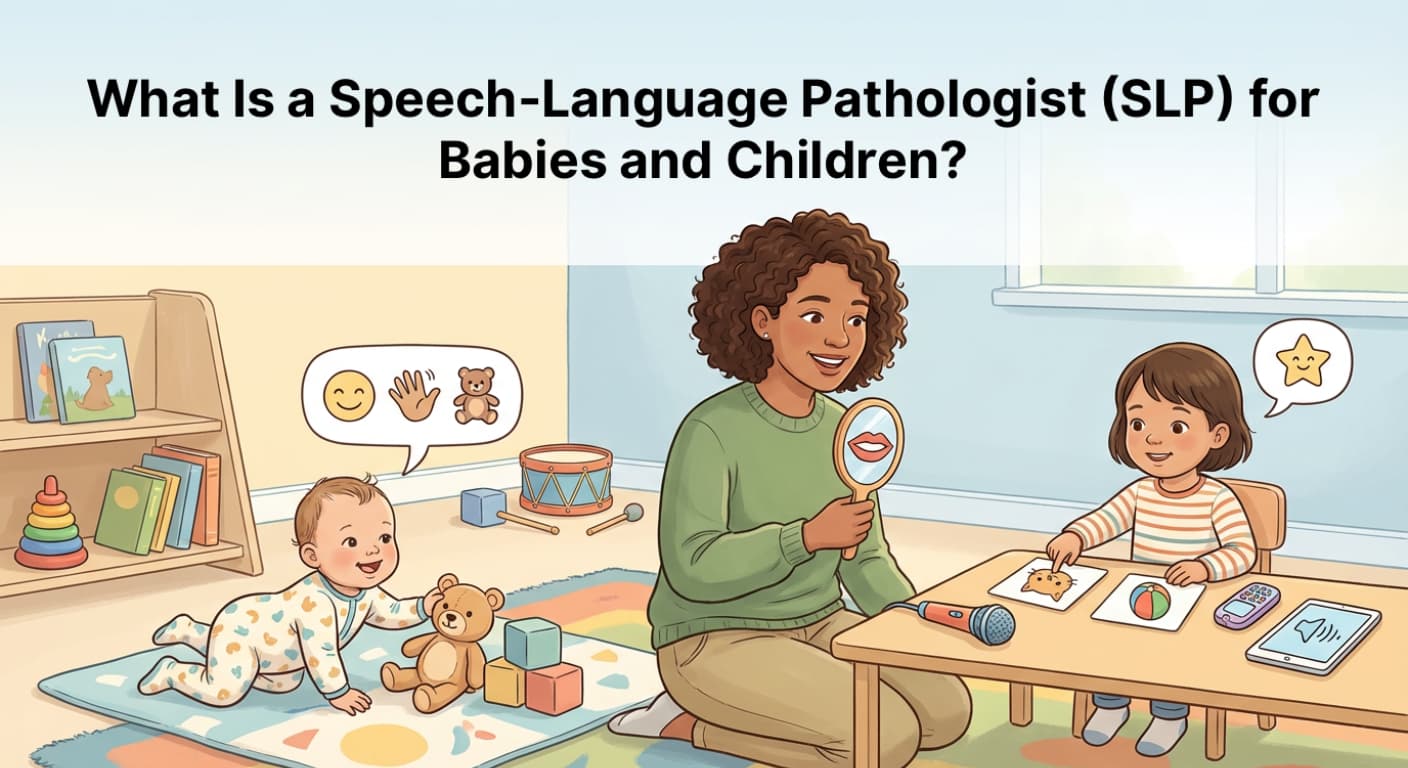
A speech-language pathologist (SLP) for babies and children is a specialized professional (often called a pediatric SLP or speech therapist) who evaluates and supports young children—from newborns and infants to toddlers and older kids—with challenges in communication, speech sounds, language development, feeding/swallowing, and related oral-motor skills to help them reach key developmental milestones.
There is a moment many parents know intimately — a quiet, private flash of worry that arrives somewhere between a well-child checkup and a sleepless night. A child turns eighteen months old and still no consistent “mama.” A newborn arches away from the breast, losing weight, crying through every feed. A three-year-old’s speech is so tangled that even grandparents exchange concerned glances across the dinner table.
Reassurance floods in from every direction. “Boys talk later.” “Einstein didn’t speak until he was four.” “They’ll grow out of it.” And sometimes that reassurance is accurate. But sometimes it isn’t. And here is the part most families discover much later than they should: the window during which early support makes the most profound, lasting difference is far narrower than most people expect.
This is where Speech-Language Pathologists enter the picture — not as a last resort, not as a symbol of something gone wrong, but as one of the most powerful developmental allies a young child and their family can have. Yet SLPs remain among the most misunderstood professionals in child healthcare. Most people think of them as specialists for kids who stutter or who can’t quite manage their R’s. The reality is far broader, and far more remarkable.
Who Is a Speech-Language Pathologist?
A Speech-Language Pathologist — commonly abbreviated as SLP, or known by the everyday term “speech therapist” — is a trained, licensed healthcare professional who specializes in helping people communicate. But that one sentence dramatically undersells the breadth of the work. SLPs evaluate and treat challenges across communication (the back-and-forth exchange of ideas and feelings), speech (the physical production of sounds), language (the cognitive system of words, grammar, and meaning), voice (the quality and function of the vocal cords), fluency (the smoothness and rhythm of speech), and — perhaps most surprisingly to parents — feeding and swallowing (how the mouth, tongue, and throat coordinate to eat and drink safely).
If the human communication system were a house, the speech-language pathologist would be the expert who can assess and repair the foundation, the plumbing, every room, and the front door. They see the whole structure, not just the front porch. Calling an SLP a “speech therapist” is a bit like calling a cardiologist a “heart doctor” — technically not wrong, but it obscures the complexity and depth underneath.
The Training Behind the Title
Understanding the rigor behind an SLP’s credential explains why their assessments carry real clinical weight. In the United States, SLPs hold at minimum a master’s degreein speech-language pathology, complete at least 400 hours of supervised clinical work, pass a national examination, secure state licensure, and earn the CCC-SLP(Certificate of Clinical Competence) from the American Speech-Language-Hearing Association. Their graduate training draws from anatomy, neuroscience, developmental psychology, linguistics, and phonetics — a foundation that is genuinely interdisciplinary. Equivalent credentialing bodies exist internationally: the RCSLT in the United Kingdom, Speech Pathology Australia, and CASLPA in Canada, among others. These are healthcare professionals supported by decades of peer-reviewed science, not tutors, not aides, not coaches.
| You might hear… | It means… |
|---|---|
| Speech therapist | The most common informal name — used interchangeably with SLP |
| Speech-language therapist | Common in the UK and Australia |
| Feeding therapist | An SLP specializing in feeding and swallowing |
| Communication specialist | Used in some school and clinical settings |
Where Do Pediatric SLPs Work?
Pediatric SLPs practice in a surprisingly wide variety of settings — hospitals and NICUs, where they support premature or medically complex newborns learning to coordinate feeding; early intervention programs, which deliver home-based services for children under three; private clinics offering outpatient therapy across a range of goals; public schools, where communication challenges affect learning; and increasingly, telehealth platforms that bring expert care into a family’s kitchen through a screen. Everywhere they practice, they collaborate — with pediatricians, occupational therapists, physical therapists, audiologists, psychologists, and educators — because no dimension of a young child’s development exists in isolation.
The Surprising Breadth of What SLPs Treat
This is the section that stops parents in their tracks. The common assumption — that SLPs work primarily with children who stutter or mispronounce sounds — captures perhaps ten percent of the full picture. “Communication” is not a single, isolated skill. It is a complex web of neurological, muscular, sensory, cognitive, and social processes. When any strand in that web is disrupted, an SLP can help. Here is what that looks like in practice.
Feeding and Swallowing: Before Language, There Is Nourishment
For the youngest patients — infants in their first weeks and months — the most pressing concern is often not speech at all. It is food.
Feeding is one of the most neurologically complex things the human body does. For a newborn to successfully breastfeed or bottle-feed, they must coordinate sucking, swallowing, and breathing in a precise rhythmic sequence — all while managing sensory input from textures, temperatures, and volumes. When any part of this system is disrupted — by prematurity, low muscle tone, structural differences like cleft palate, neurological conditions, or unresolved tongue tie — feeding becomes a struggle that can cascade into poor weight gain, caregiver distress, and a failure of bonding that reverberates far beyond the dinner table.
SLPs who work in feeding assess oral motor skills, sensory responses, and swallowing safety. They work with babies who take forty-five minutes to finish two ounces and fall asleep exhausted before finishing, who cough and splutter on thin liquids in patterns that suggest aspiration — food or liquid entering the airway. As children grow, SLPs guide families through texture progressions, resolve severe gagging and food refusal, and address the oral hypersensitivity that can make something as ordinary as a spoonful of yogurt feel genuinely unbearable.
The scale of the problem is striking: research published in the Journal of Pediatric Gastroenterology and Nutrition estimates that 25–45% of typically developing children experience some degree of feeding difficulty, with rates rising to 80% or higher among children with developmental disabilities. Yet feeding therapy remains one of the most underutilized SLP services, largely because parents don’t know it exists.
The Building Blocks of Communication (Before the First Word)
Language does not begin with words. It begins with eye contact at two weeks, social smiling at six weeks, cooing and turn-taking at two months. Long before a baby ever says “dada,” they are building the foundational architecture of communication — back-and-forth exchanges, shared attention, the dawning understanding that vocalization produces a response.
Think of language development like building a house. Words and sentences are the walls — the visible, impressive parts everyone admires. But babbling, eye contact, joint attention, and gesture are the foundation. If the foundation is incomplete, the walls will eventually show the cracks. SLPs are the foundation specialists.
By nine months, a typically developing baby babbles in varied strings, responds to their own name, makes eye contact to share interest, and uses gesture — reaching, pointing, waving. These milestones are not simply charming. They are neurological scaffolding, and they are predictive of language development in ways well-documented in the scientific literature. If they are missing or significantly delayed, an SLP can identify the gaps and begin targeted intervention during the most plastic period of brain development.
The American Academy of Pediatrics recommends developmental surveillance at every well-child visit, but a 2019 study in Pediatrics found that pediatricians correctly identified developmental concerns only about 30% of the timewithout formal screening tools. SLPs fill this gap — not because pediatricians are failing, but because communication development is a specialty requiring specialized eyes.
Speech Delays and Language Disorders in Toddlers
This is the territory most parents associate with SLPs — the toddler who isn’t talking yet, or whose speech is hard to understand. It is one of the most common reasons families seek evaluation, and one of the most frequently misunderstood.
A crucial distinction lurks beneath daily conversation: speech and language are not the same thing. Speech is the physical act of producing sounds — the mechanical coordination of lips, tongue, and breath. Language is the cognitive system of meaning, vocabulary, and grammar that underlies all communication. A child can have perfectly intact language with a speech difficulty, producing ideas fluently but mispronouncing sounds. Conversely, a child with clear, easy-to-understand speech may harbor a significant language disorder — struggling to comprehend what is said to them or to construct even simple sentences. These are related but distinct challenges, and the treatment approaches differ entirely.
Late talkers — children with fewer than fifty words or no two-word combinations by age two — represent about 10–15% of toddlers. Research by Dr. Leslie Rescorla at Bryn Mawr College followed late talkers into adulthood and found that while many do catch up by school age, a significant subset continues to show subtle language vulnerabilities that affect reading, academic achievement, and social processing well into adolescence. The reassuring narrative that all late talkers simply outgrow it is one that research has repeatedly, gently debunked.
Developmental Language Disorder (DLD) — a persistent difficulty with language not explained by hearing loss, autism, intellectual disability, or any other known condition — affects approximately 7.5% of children worldwide, making it more common than autism and roughly as common as dyslexia. It is also one of the least recognized developmental conditions in existence. Many children with DLD are labeled “inattentive,” “slow,” or “unmotivated” — when what they actually need is targeted language intervention from an SLP.
Articulation, Phonological Disorders, and Childhood Apraxia of Speech
How sounds are produced, organized, and sequenced is another large domain of pediatric SLP practice, and the distinctions within it matter for getting the right kind of help.
Articulation disorders involve difficulty producing specific sounds correctly — the child who consistently says “wabbit” for rabbit or “th” for “s.” These are common, often highly responsive to treatment, and typically resolve well with early intervention.
Key context: Not all sound errors are disorders. Certain sounds are developmentally expected to be mastered later than others. The /r/ sound, for example, is not expected to be fully accurate until age six or seven. A four-year-old saying “wed” for “red” is perfectly typical. An eight-year-old doing the same warrants an evaluation.
Phonological disorders run deeper. Rather than isolated sounds, they involve systematic patterns of error across multiple sounds — as if the child’s internal sound system has organized the rules of the language differently. A child might delete all consonants at the ends of words or substitute entire categories of sounds, not from physical difficulty but because the brain’s phonological map is drawn with different contours.
Childhood Apraxia of Speech (CAS) is something else entirely — a motor speech disorder in which the brain has difficulty planning and sequencing the precise, rapid movements needed for speech.
Think of it as a GPS that has the destination stored correctly but keeps giving the wrong turn-by-turn directions. Children with CAS typically present with highly inconsistent errors (the same word may emerge differently each time), find longer sequences dramatically harder than single syllables, and show limited improvement with approaches designed for simple articulation issues. CAS requires specialized, intensive treatment — approaches like PROMPT and ReST carry the strongest evidence base — and families of children with suspected CAS deserve to know this. Receiving the wrong type of therapy can mean years of limited progress. Diagnosis and treatment selection matter enormously.
Autism, Social Communication, and the Revolution of AAC
Pediatric SLPs play a central role in the assessment and treatment of Autism Spectrum Disorder (ASD) — not because autism is a language disorder, but because communication differences are among its most defining features. From identifying early social communication red flags (absence of pointing, reduced joint attention, limited facial expression) to implementing comprehensive communication intervention, SLPs are core members of every autism support team.
Most people think of communication as the words we use. But words are only part of the architecture. Social communication — what SLPs call pragmatic language — encompasses joint attention, conversational turn-taking, reading nonverbal cues, and understanding that the same words can mean entirely different things in different contexts. These “unwritten rules” don’t come intuitively to all children. SLPs work specifically on these skills through role-play, social scripts, and structured peer interaction, building bridges that connect a child’s inner world to the people around them.
Perhaps the most transformative development in pediatric SLP in recent decades has been the evolution of Augmentative and Alternative Communication (AAC) — systems that support or replace spoken communication for non-speaking or minimally verbal children. These range from picture exchange systems (physical cards traded to express wants and needs) to sophisticated speech-generating devices and tablet-based applications like Proloquo2Go, TouchChat, and LAMP Words for Life.
For years, families were warned that introducing AAC would cause their child to stop trying to talk — that the device would become a crutch. Research has conclusively dismantled this belief. A landmark 2020 meta-analysis in Augmentative and Alternative Communicationconfirmed that AAC does not suppress speech development; in the vast majority of studies, it enhances it. The analogy that resonates with many families: learning to read doesn’t stop children from speaking, and having a bicycle doesn’t stop someone from learning to walk. AAC gives a voice — and that voice creates experiences, builds confidence, and opens the neural pathways that support all further communication.
Other Conditions SLPs Address
Stuttering involves interruptions in the flow of speech — repetitions, prolongations, or blocks where speech seems to get “stuck.” Nearly all toddlers pass through a phase of normal developmental disfluency between ages two and five as language growth outpaces motor speech control. True stuttering is distinguished by its persistence, severity, and the presence of physical tension or avoidance.
The good news: early intervention for stuttering, when delivered promptly, achieves excellent resolution rates. Voice disorders — persistent hoarseness, chronic raspiness, a child who frequently loses their voice — may signal vocal nodules or other vocal cord concerns, and SLPs provide targeted voice therapy to build healthier habits. Beyond these, conditions including Down syndrome, cerebral palsy, cleft palate, hearing loss, prematurity, and various genetic syndromes all frequently require SLP support that is foundational to the child’s overall development and quality of life.
Developmental Milestones — A Parent’s Reference
Understanding whether a child’s development falls within the typical range is the crucial first step in knowing when to seek support. The framework below synthesizes broadly accepted benchmarks from ASHA and the CDC:
| Age | Communication Milestones | Feeding Milestones | Watch For |
|---|---|---|---|
| 2 months | Coos, social smile, reacts to sounds | Feeds without significant distress | No social smile; feeding takes >45 min |
| 6 months | Babbles (ba, ma, da), responds to name | Accepts smooth purees | No babbling; persistent gagging |
| 9 months | Gestures (reaches, waves, points); back-and-forth play | Manages soft mashed textures | Not responding to name; no gestures |
| 12 months | 1–3 meaningful words; points; waves bye-bye | Beginning finger foods; sippy cup | No words; no pointing |
| 18 months | 10–20 words; follows 1-step directions | Eats most soft family foods | Fewer than 10 words |
| 24 months | 50+ words; 2-word phrases | Uses spoon/fork with help | No word combinations |
| 36 months | Short sentences; 75% understood by strangers | Eats wide variety of textures | Hard to understand; no sentences |
| 48 months | Complex sentences; storytelling; asks “why?” | Independent with spoon; trying new foods | Persistent sound errors; poor narratives |
On regression: The loss of previously acquired skills at any age is always a red flag that warrants immediate evaluation. A child who was babbling and has gone silent, or a toddler who had words and suddenly stopped — this kind of regression should never be dismissed as a “phase.”
Recognizing When a Child Needs an SLP
One of the most important revelations for families is that they do not need to wait for a pediatrician’s diagnosis or referral to be concerned — or to act. Parental instinct has been validated by science. A 2011 meta-analysis of developmental screening research found that parental concern demonstrates high sensitivity for identifying developmental delay. In plain language: when a parent feels that something is off, the data says they are frequently correct. The pediatrician’s reassurance, however well-intentioned, does not override a persistent sense that something needs attention.
In babies (0–12 months), the flags include significant feeding difficulties (poor weight gain, prolonged feeds, visible distress or color changes during meals), absence of babbling by six to nine months, not responding consistently to their own name by nine months, no gestures (reaching, waving, pointing) by twelve months, and no social smile by three months.
In toddlers (1–2 years), concern is warranted when there are no words by fifteen months, fewer than ten words by eighteen months, no two-word combinations by twenty-four months, or difficulty following simple directions like “bring me the ball.”
In preschoolers (3–5 years), red flags include speech so garbled that even familiar listeners struggle at age three, no use of three-word sentences, persistent stuttering lasting more than six months, difficulty with social interaction, and marked frustration or avoidance around communication.
And then there is the “wait and see” question — perhaps the most fraught phrase in all of pediatric development. Waiting is sometimes appropriate, particularly for late talkers who are developing well in every other area. But waiting has a biological cost. The brain’s capacity for change — its neuroplasticity — is greatest in the first three years of life and declines steadily afterward. Think of the young brain as wet clay: easy to shape, responsive to the lightest touch, capable of profound transformation. As years pass, that clay gradually hardens.
Intervention can help at any age, but it generally requires more time, more intensity, and more effort to achieve what comes more easily in the early years. The same amount of effort, applied earlier, produces greater outcomes. This is not an argument for panic. It is an argument for prompt, calm, informed action.
What Happens During an SLP Evaluation
For families navigating this territory for the first time, the evaluation process can feel opaque. Demystifying it transforms anxiety into confidence.
Before the appointment, it helps to gather pregnancy and birth history, a timeline of developmental milestones, current feeding observations, and family history of speech, language, or literacy difficulties. Perhaps the single most valuable thing a parent can bring is a short video of the child communicating at home — playing, feeding, or “talking” — in a natural environment. Children often behave differently in the clinic than in their living room, and a candid two-minute clip gives the SLP an irreplaceable window into typical functioning.
The evaluation itself unfolds in layers. The SLP begins with a detailed parent interview, listening to the family’s story and gathering clinical data that no standardized test can capture. Next comes formal assessment — norm-referenced tools administered to thousands of same-age children that allow comparison of this child’s performance against their peers. Think of these scores the way you think of a height chart at the pediatrician’s office: if a child lands at the 10th percentile for vocabulary, it means ninety percent of same-age children scored higher — not that the child has failed, but that the gap is worth addressing.
For young children, the most informative phase is often the observational assessment — the SLP plays with the child using bubbles, toy animals, picture books, and blocks, engineering meaningful diagnostic observations while the child experiences nothing but play. A skilled pediatric SLP can evaluate a toddler’s language comprehension, expressive vocabulary, pragmatic skills, and articulation before the child ever realizes they are being assessed at all. For children with feeding concerns, the SLP may observe a full feeding session or recommend instrumental assessment such as a videofluoroscopic swallow study — a real-time X-ray video that reveals exactly what happens when the child swallows.
After the evaluation, the SLP synthesizes findings into a comprehensive written report: formal scores, clinical impressions, diagnostic conclusions, and specific recommendations. This document becomes a cornerstone — used for therapy planning, school services, insurance authorization, and referrals to other specialists. And the SLP doesn’t work alone. Especially for complex children, they coordinate with developmental pediatricians, occupational therapists, audiologists, psychologists, and behavioral analysts to ensure every dimension of the child’s development is addressed.
What Therapy Actually Looks Like
If one image deserves to be retired from the collective imagination, it is the picture of speech therapy as a child sitting rigidly across a desk from a clinician, drilling sounds in rote, mechanical repetition. For children under five — the most common age group in early intervention — this picture is almost entirely inaccurate.
Play Is the Work
Young children learn through play. This is not philosophy; it is neuroscience. During play, the brain’s dopamine reward systems activate, creating the neurochemical conditions that optimize memory formation and learning. Pediatric SLPs exploit this brilliantly, engineering therapeutic goals into play contexts that feel, to the child, like pure fun.
A session with a twenty-month-old might look, from the outside, like an adult blowing bubbles while a toddler reaches and squeals. From the inside, the SLP is modeling target vocabulary (“pop!” “more!” “up!”), creating communication temptations (the child wants the bubble wand — they need to communicate to get it), reinforcing every vocalization attempt immediately, and following the child’s gaze and interest to ride the wave of natural motivation. The “work” is invisible to the untrained eye. That is exactly the point.
Parent Coaching: The Multiplier That Changes Everything
For children in the birth-to-three window, the single most evidence-supported approach in pediatric SLP is parent coaching — a model in which the SLP’s primary goal is not to treat the child directly, but to teach the caregiver strategies that can be implemented across hundreds of daily interactions.
A child who receives SLP therapy once per week for one hour receives 52 hours of intervention per year. A child whose parents have been coached in responsive interaction strategies and implement them across daily routines — mealtimes, bath time, car rides, bedtime stories — receives those strategies embedded in potentially 1,000+ hours of interaction per year. The cumulative dose is not even comparable.
The strategies themselves are deceptively simple: follow the child’s lead by letting them direct play while providing rich language around what they choose; self-talk and parallel talk, narrating your own actions and theirs (“I’m pouring the water — you’re splashing!”); expand utterances by adding one element to whatever the child says (child says “ball,” parent responds “big ball” or “throw the ball”); reduce questions by replacing the tempting “What’s this?” with descriptive comments, which lowers pressure and models language more effectively; and create communication temptations by engineering moments where the child is motivated to communicate (a favorite toy placed inside a sealed container they cannot open alone).
These techniques are individually small. Deployed across a thousand daily interactions by a coached, attuned caregiver, they become the most powerful force in a child’s communication development.
Frequency, Duration, and the Shape of Progress
| Situation | Typical Frequency | Expected Duration |
|---|---|---|
| Mild articulation delay | Once weekly, 30–45 min | 6–18 months |
| Moderate language delay | 1–2x weekly, 45–60 min | 1–2 years |
| Autism / complex communication needs | 2–3x weekly, 45–60 min | Ongoing, with evolving goals |
| Childhood Apraxia of Speech | 3–5x weekly (intensive) | Variable; often longer-term |
| Feeding therapy | 1–2x weekly, 45–60 min | Highly variable |
Progress is real, but it is rarely linear. Families should expect periods of rapid gain followed by plateaus — and know that plateaus are a normal part of neurological consolidation, not evidence of failure. Regular re-evaluation, typically every six months, allows the SLP to recalibrate goals, measure growth, and adjust course as the child develops.
The Emotional Terrain — Naming What Families Actually Feel
There is a dimension to this journey that clinical literature frequently glosses over: the inner life of the parents.
When a child is identified as needing SLP services, caregivers navigate a genuinely complex emotional landscape — grief, guilt, fear, fierce protectiveness, and eventually, for most, a hard-won resilience. The guilt is particularly universal and particularly unfounded. Parents interrogate themselves relentlessly: Did I not talk to them enough? Was it the screen time? Did daycare hurt their language development? Is it because we speak two languages at home?
The research provides clear, compassionate answers. Moderate screen time in an otherwise language-rich environment does not cause language disorders — communication differences arise from neurobiological variation, genetics, and neurology, not from a parent who occasionally used the television as a babysitter. Bilingualism does not cause language delay. This is one of the most persistent and damaging myths in the field, and research is unequivocal in refuting it. Children learning two languages simultaneously may have smaller vocabularies in each individual language, but their total vocabulary across both languages is typically equal to or greater than that of monolingual peers. Two languages are a gift, never the cause of a disorder. Daycare’s social richness is, if anything, beneficial for language development.
The truth, supported by decades of research, is that parents are not the cause of their child’s communication challenges. They are, however, among the most powerful forces in their child’s recovery and growth.
Equal acknowledgment is owed to the logistical weight of the journey itself — the scheduling, the insurance authorizations and denials, the home practice routines layered atop an already demanding life. Therapy fatigue is real. Parental burnout is real. The families navigating this path deserve communities who see them — peer networks of parents walking the same road, clinicians who ask not just about the child’s progress but about how the family is actually doing.
And this much is worth remembering: first word, first two-word phrase, first bite of a new food. Every milestone belongs to the child and to the people who showed up, day after day, to make it possible. The children who make the most progress tend to have caregivers who have found a sustainable relationship with the process — present, engaged, and kind to themselves in equal measure.
Finding an SLP — and Knowing What to Look For
Locating a qualified SLP is more straightforward than most families expect. In the United States, ASHA’s “Find a Professional” directory at asha.org/public allows searches by specialty, age group, and location; look for the CCC-SLP credential. In the United Kingdom, the RCSLT directory at rcslt.org serves the same function. In Australia, search through Speech Pathology Australia at speechpathologyaustralia.org.au. Pediatricians, local parent groups, and community early childhood centers are also rich sources of personal recommendations. For children under three, the first call should almost always be to the state’s Early Intervention program — free, legally protected, home-based, and accessible without a referral.
When selecting a private SLP, a handful of questions can make an enormous difference in fit and outcomes:
- How much experience do you have with children this age and with this specific concern?
- What is your therapeutic philosophy and primary approach?
- How do you involve and coach parents as part of the therapy process?
- How do you collect data and measure progress?
- How frequently do you re-evaluate goals?
- Are you connected to other specialists if additional support is needed?
A few red flags deserve attention. An SLP who discourages parent presence in sessions is working against the evidence base; one who maintains no measurable goals or data collection is estimating progress rather than tracking it; and one who recommends against AAC without strong, individualized rationale may be operating from outdated beliefs. Ethical SLPs provide realistic expectations, not guarantees.
Frequently Asked Questions
“My bilingual child hears two languages. Could that be causing the delay?”
No. Bilingualism does not cause language delay. If a delay exists, it will be present in both languages. An SLP experienced with bilingual development should assess the child in both languages for the complete picture.
“Our eldest did all the talking — our younger child never needed to. Is that the issue?”
Sibling dynamics can reduce communicative pressure on a younger child, and it is a factor worth discussing with an SLP. However, it does not cause a language disorder. If there is a genuine delay, evaluation remains worthwhile.
“We’ve been in therapy for six months with no real progress. What now?”
Several questions deserve honest exploration: Is the frequency of sessions sufficient? Is the therapeutic approach well-matched to this child’s specific profile? Are home strategies being implemented consistently? Are there underlying factors — hearing, medical, neurodevelopmental — that haven’t yet been fully evaluated? Requesting a re-evaluation and discussing these questions openly with the SLP is entirely appropriate and expected.
“Does my child need a diagnosis to see an SLP?”
No. SLPs evaluate and treat concerns without any prior diagnosis. In fact, the SLP evaluation itself frequently contributes to — or directly produces — the diagnostic picture.
“Can an SLP help with extreme picky eating?”
Yes, when the picky eating has a sensory, oral motor, or behavioral feeding component. A feeding-specialized SLP is the appropriate professional.
“Will my child need therapy forever?”
Most children are discharged when they have met their goals. Timelines vary widely, but many children with mild to moderate delays complete a defined course of therapy and do not require services again.
Conclusion: The Most Powerful Thing a Parent Can Do Is Act
A speech-language pathologist for babies and children is not a specialist parents consult because they have failed. Seeking an SLP is not an admission of inadequacy. It is one of the most informed, proactive, and loving things a caregiver can do.
The evidence supporting early identification and early intervention is among the most consistent and robust in all of developmental science. Every month that passes during the first three years of life is a month of extraordinary neurological opportunity — a window during which the brain is forming connections, building systems, and laying down the architecture that will support communication, learning, and human connection for a lifetime.
The children who receive timely support — who have caregivers who trusted their instincts, asked questions, and made the call — are the children whose trajectories change in ways that ripple forward: into reading, into friendships, into confidence, into the fullness of who they are becoming.
For any caregiver holding that quiet, private worry — the invitation is not to panic. It is simply to act. To trust the instinct. To pick up the phone. To type “early intervention” and the name of your state into a search engine. To ask one question, start one conversation, make one call.
Every child deserves to be heard. Every child deserves a voice. And the professionals who have committed their careers to making that possible are closer, and more accessible, than most families realize.
Resources for Families
| Resource | What It Offers | Link |
|---|---|---|
| ASHA Public Portal | Find an SLP, access milestone guides, learn about conditions | asha.org/public |
| CDC “Learn the Signs. Act Early.” | Free milestone checklists and developmental resources | cdc.gov/actearly |
| Hanen Centre | Parent coaching resources, including It Takes Two to Talk | hanen.org |
| Apraxia Kids | Resources for families of children with CAS | apraxia-kids.org |

October 25, 2026

October 25, 2026
October 25, 2026