
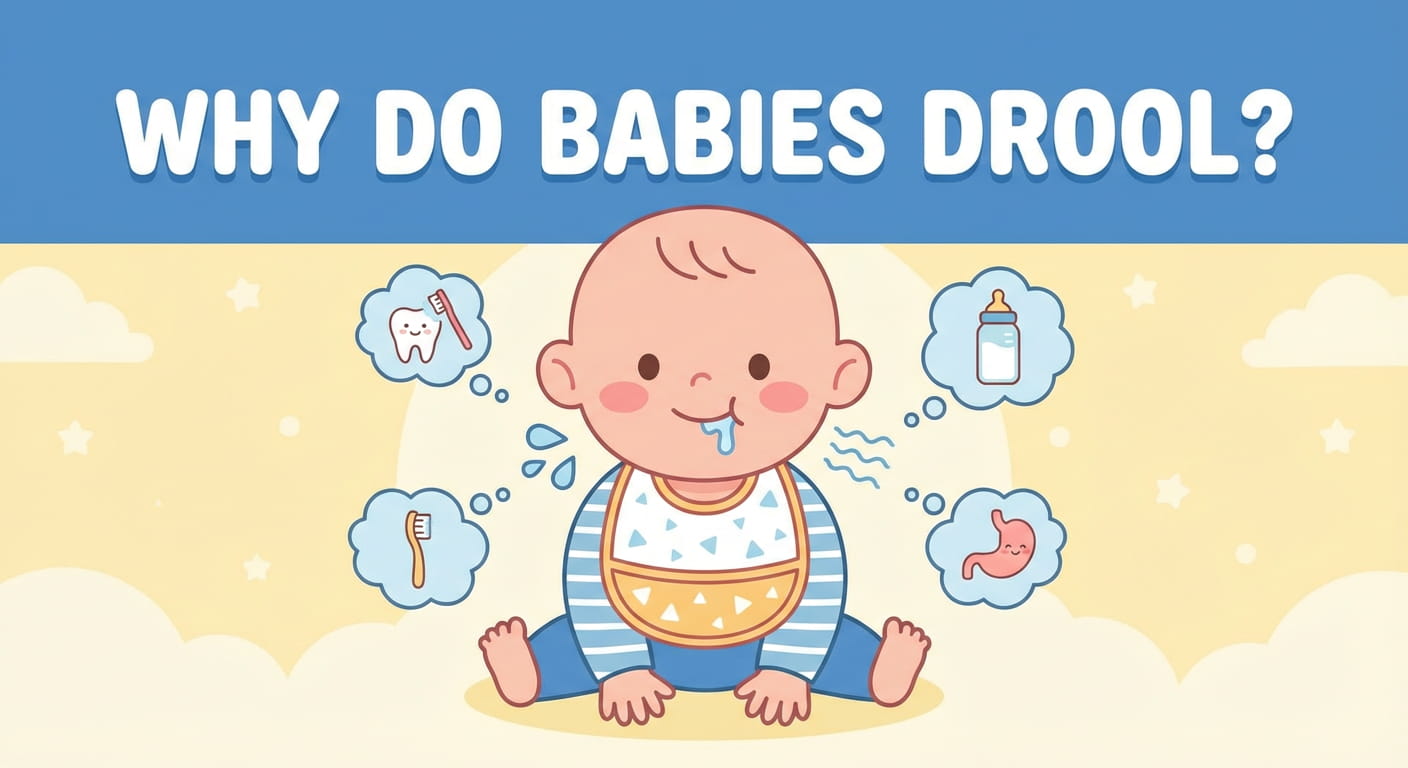
Why Do Babies Drool? It’s a completely normal part of infant development, driven by teething, the maturation of salivary glands, and the fact that babies haven’t yet developed the muscle control needed to swallow excess saliva.
Picture this: a chubby-cheeked baby is nestled in someone’s arms, radiating that irresistible, toothless grin that could melt stone. Then it happens. A shining rivulet of drool escapes the corner of that tiny mouth, silently soaking through a bib, a onesie, and, inevitably, a grandparent’s freshly ironed shirt. Laughter erupts. Someone scrambles for a cloth. And in the back of every parent’s mind, the same question surfaces:
Why on earth do babies drool so much?
It seems like such a small, silly thing — barely worth investigating. But pull back the curtain on this soggy little mystery and something surprising emerges. Drooling is not a flaw in babies’ design. It is not a malfunction. It is, in fact, a vivid signal that an almost miraculous set of biological processes is running exactly as it should. Understanding those processes does not just satisfy curiosity — it equips parents with the knowledge to care for their babies with greater confidence, calm, and wonder.
First, What Exactly Is Saliva? (And Why It Matters More Than You Think)
Before exploring why babies produce such extraordinary quantities of it, it is worth taking a moment to understand what saliva actually is. Most people think of it simply as “spit” — the wet stuff in the mouth. In reality, it is one of the body’s most sophisticated and hardworking fluids.
Think of saliva as a Swiss Army knife that lives in the mouth. On its surface it looks like plain water, but fold it open and it is packed with specialized tools, each serving a distinct and important purpose.
Here is what saliva is actually made of:
| Component | What It Is | What It Does |
|---|---|---|
| Water | ~99% of saliva | Keeps the mouth moist; carries all other components |
| Amylase | A digestive enzyme | Begins breaking down starchy foods the moment they enter the mouth |
| Mucin | A thick, slippery protein | Coats food so it slides safely down the throat |
| IgA Antibodies | Immune proteins | Attack and neutralize bacteria and viruses before they reach the body |
| Lysozyme | An antimicrobial enzyme | Punches holes in the walls of bacteria, destroying them |
| Lactoferrin | An iron-binding protein | Starves bacteria by stealing the iron they need to survive |
| Epidermal Growth Factor (EGF) | A healing protein | Speeds up the repair of cuts and sores inside the mouth |
| Calcium & Phosphate | Minerals | Constantly repair and strengthen tooth enamel |
That 1% of non-water ingredients is doing an enormous amount of work. To use another analogy: saliva is less like plain tap water and more like a busy emergency services team — immune defenders on one side, digestive workers on the other, and repair crews everywhere in between.
Where does saliva come from?
Three pairs of glands — positioned near the ears (parotid glands), beneath the jaw (submandibular glands), and under the tongue (sublingual glands) — act like tiny factories, producing saliva continuously and delivering it through small ducts into the mouth. Hundreds of additional microscopic glands line the inside of the cheeks and lips, quietly contributing to the flow.
In a healthy adult, these glands produce between 0.5 and 1.5 litres of saliva every single day — mostly swallowed automatically without any conscious awareness. In a baby at peak drool age, production surges significantly. The difference is that the adult swallows it all without thinking; the baby has not yet learned how.
That distinction is the whole story, in a single sentence.
The Central Mystery Explained: Why Swallowing Isn’t Automatic
Here is the insight that changes everything: swallowing saliva on autopilot is not something humans are born knowing how to do. It is a skill the brain has to learn.
This surprises most people. Swallowing seems so basic, so instinctive, that it is hard to imagine it requiring development. But there is an important distinction to understand.
Newborns are born with a primitive swallowing reflex — a hardwired, automatic response that kicks in when milk or formula hits the back of the throat during nursing or bottle feeding. This reflex is what allows newborns to feed safely from their very first hours of life. It is reflexive in the same way that blinking is reflexive: it happens without thought.
But managing saliva continuously — swallowing it dozens of times per hour, all day long, even while focused on something else entirely — is a different and far more sophisticated neurological task. It requires the brain to coordinate the lips, tongue, jaw, and throat muscles in a smooth, rhythmic sequence, constantly, without conscious direction. This is called automatic saliva control, and it develops gradually over the first two years of life.
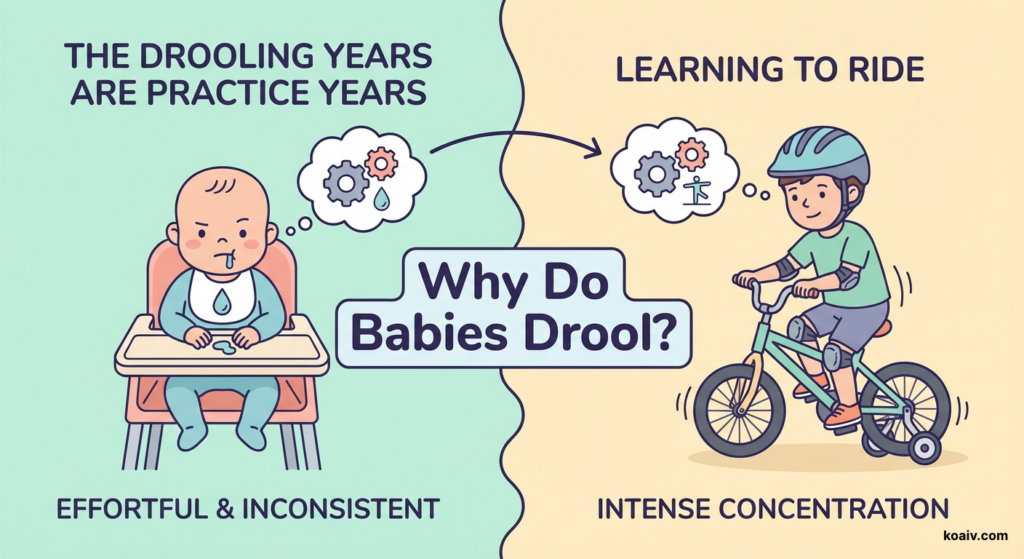
🧠 A helpful analogy: Think of it like learning to ride a bike. At first, every movement requires intense concentration — balancing, pedalling, steering all at once. Over time, the brain automates those movements so thoroughly that a cyclist can ride while holding a conversation, barely thinking about what their hands and feet are doing. The brain of a baby is doing something similar with swallowing: what begins as effortful and inconsistent gradually becomes automatic and invisible. The drooling years are, quite simply, the practice years.
Now add to this that the salivary glands “switch on” significantly around two to three months of age — suddenly producing far more saliva than a newborn’s quiet little glands did — and the situation becomes clear. A surge in saliva production meets a brain that has not yet automated its management. The result is a lot of drool, and a lot of wet bibs. It is not a problem. It is development, in action.
Six Reasons Babies Drool
Neurological immaturity is the foundation — but several overlapping factors shape when and how much a baby drools at any given moment. Understanding each one separately gives parents a much richer map of what is happening.
Reason 1: The Brain Is Still Building Its Wiring
At birth, the human brain is remarkably unfinished — by design. Unlike most animals, human babies arrive in the world with only about 25% of their adult brain volume. The remaining development happens outside the womb, shaped by experience, interaction, and time.
The neural pathways (think of these as the brain’s electrical wiring) that govern fine muscle control in the mouth, lips, and jaw form gradually over the first two years. Until those pathways are established and reinforced, the automatic management of saliva simply cannot happen with adult efficiency. The drool is, in essence, benign evidence of a construction project that is very much underway.
Reason 2: Teething — The Famous (and Slightly Misunderstood) Culprit
Teething is probably the first explanation most parents reach for — and it is valid, though the full picture is more nuanced than most realise.
Teething begins when the first teeth start pushing upward through the gum tissue. This process typically begins around four to seven months, though perfectly healthy babies may begin as early as three months or as late as twelve. The timing varies enormously between individuals, and no timeline is more “correct” than another.
When a tooth begins to move through the gum, the surrounding tissue becomes inflamed and tender — similar to how a blister forms on skin under friction. The body responds by producing extra saliva. Why? Because saliva has genuine therapeutic properties: it cools and soothes inflamed tissue, delivers antimicrobial protection against bacteria that might exploit the disrupted gum surface, and may help physically soften the tissue to ease the tooth’s passage.
A common myth worth correcting: Many parents and even some older medical texts attribute fever to teething. The American Academy of Pediatrics (AAP) is unambiguous on this point: teething does not cause fever. A low-grade rise in temperature (below 38°C / 100.4°F) may coincide with teething, likely due to general inflammation, but a true fever during this period should be investigated as an independent illness — not attributed to the teeth.
Reason 3: The Digestive System Is Preparing for a Whole New Job
This is one of the most elegant aspects of infant biology, and one that rarely gets the attention it deserves.
Around four to six months — precisely the window when most paediatric guidelines recommend introducing solid foods — something remarkable happens in a baby’s saliva. The concentration of amylase, the carbohydrate-digesting enzyme, increases substantially. The body, in other words, begins producing higher quantities of a key digestive tool right before it will be needed for the first time.
This is nature’s version of prep work. Before a restaurant opens for dinner service, the kitchen staff spends the afternoon chopping vegetables, marinating proteins, and heating the ovens. The surge in amylase-rich saliva is the body doing exactly this kind of preparation — getting the digestive system ready for its first encounter with rice cereal, pureed sweet potato, and mashed banana.
The drool, then, is not merely incidental to this stage. It is the overflow of a system ramping up its output in anticipation of a dietary transition.
Reason 4: Oral Exploration — The Mouth as the Primary Research Tool
Between roughly four and twelve months, babies enter a developmental phase that child psychologists call the oral sensorimotor stage. During this period, the mouth is the most sophisticated instrument the baby has for exploring the world.
Why the mouth? Because at four months, the mouth is far more neurologically advanced than the hands. The lips and tongue are packed with sensory receptors, capable of distinguishing textures, temperatures, and shapes with remarkable precision — far better than infant fingers, which are still developing their fine motor control. Mouthing everything is not random or unhygienic behaviour. It is systematic, information-rich sensory research.
🔬 Think of it this way: The mouth is the baby’s first and most powerful laboratory instrument. Where an adult picks up an object and examines it visually, a six-month-old turns it over, mouths it, feels its texture against the tongue, and thereby learns its properties far more thoroughly than any visual inspection would allow.
Every mouthing session, however, also stimulates the salivary glands to produce more output. The more intensely a baby explores orally, the more drool accompanies the investigation. This is entirely appropriate and should never be discouraged — it is how sensory and cognitive development progresses.
Reason 5: Congestion and Illness Disrupt Normal Saliva Management
When nasal passages are blocked — by a common cold, respiratory infection, or seasonal allergies — babies instinctively switch to breathing through their mouths. This shift in breathing posture fundamentally alters the oral environment.
Mouth breathing dries out the mucous membranes (triggering more fluid production), disrupts the normal swallowing rhythm (since swallowing and breathing through the mouth cannot happen simultaneously as smoothly as through the nose), and reduces the frequency of automatic saliva swallows. The combined result is noticeably more drool.
Additionally, both ear infections and sore throats can independently stimulate increased saliva production, as the body deploys saliva’s antimicrobial and anti-inflammatory properties toward the affected areas.
Reason 6: Allergies — The Often-Overlooked Trigger
Food and environmental allergies can cause the immune system to trigger excess saliva production as part of its broader inflammatory response. This is particularly relevant in older babies and toddlers and is frequently overlooked as an explanation for drooling that does not seem explained by teething or developmental factors alone.
If a baby consistently drools more after exposure to specific foods or environments (pollen season, dusty conditions), an allergic contribution is worth raising with a paediatrician.
The Drooling Timeline: What to Expect and When
One of the most reassuring things any parent can know is that drooling follows a remarkably predictable arc across the first two years. The variation between individual babies is wide — some drool heavily, some barely at all — but the general pattern holds.
| Age | Key Developmental Event | Drool Level |
|---|---|---|
| 0–2 months | Glands mostly quiet; newborn reflex feeding only | 🟢 Minimal |
| 2–4 months | Salivary glands “switch on”; oral play begins | 🟡 Noticeable |
| 4–7 months | Teething initiates; enzyme production surges | 🔴 Peak |
| 7–12 months | First teeth erupt; solids introduced; more exploration | 🔴 Sustained |
| 12–18 months | Chewing skill develops; swallowing automation improves | 🟠 Easing |
| 18–24 months | Brain wiring matures; automatic control strengthens | 🟢 Much reduced |
The most important takeaway from this timeline: the arc bends naturally toward improvement, without any intervention. Parents do not need to “treat” drooling — they need to manage it comfortably while the process runs its course.
Drool as a Superpower: Rethinking the Soggy Bib
Here is where the story takes a genuinely surprising turn. Far from being merely an unavoidable nuisance, infant drool is actively working in the baby’s favour in multiple important ways.
Immune Protection: The Mouth’s Security System
Consider the mouth from a security perspective: it is the primary entry point for both food and pathogens. Every mouthed toy, every finger, every spoonful of food carries with it a complex cargo of bacteria, viruses, and other microorganisms. The mouth is, in security terms, a major border crossing.
Saliva is the border control. IgA antibodies — the same class of antibodies found in breast milk — identify and neutralize pathogens before they can cross the mucosal lining and enter the bloodstream. Lysozyme physically destroys bacterial cell walls, like a molecular sledgehammer. Lactoferrin binds iron with extraordinary affinity, robbing bacteria of the mineral they need to multiply. For a baby whose broader immune system is still maturing, this salivary security system is a genuinely important line of defence.
Wound Healing: Nature’s Own First Aid
Epidermal growth factor (EGF) in saliva is a protein that binds to cells lining the mouth and signals them to multiply and repair damaged tissue. This is why small mouth sores, gum irritations from emerging teeth, and minor nicks heal faster inside the mouth than equivalent wounds on the skin. The baby’s own saliva is continuously applying a healing agent to the tissue most stressed by teething.
Oral Hygiene Before Teeth Even Appear
Saliva maintains the pH (acidity level) of the mouth within a narrow, protective range. Without this buffering action, acids produced by bacteria — and later by fermented food residues — would attack the enamel of emerging teeth and the mucosal lining of the gums. Even before the first tooth breaks through, saliva is already preserving the oral environment in which those teeth will eventually live.
The Secret Connection to Speech Development
This is perhaps the least widely known benefit, and it is genuinely fascinating. The specific muscle movements involved in managing saliva — lifting the tongue tip to the palate, pressing the lips together, stabilizing the jaw — are the same movements that will later produce the sounds of speech.
The consonant “t” requires precise tongue-tip elevation. The vowel “oo” requires lip rounding and jaw control. The “b” sound requires bilabial closure. A baby practising saliva management is, at the neurological level, practising the exact same oral motor coordination that will allow it to eventually say “mama,” “dada,” and everything that follows. Every swallow is a micro-rehearsal for language.
Managing the Drool: A Practical Parent’s Guide
Understanding drool is one thing; dealing with it in daily life is another. The following strategies make the peak drool months genuinely more manageable.
Protecting Baby’s Skin: Preventing and Treating Drool Rash
The most immediate skin concern is drool rash — a form of irritant contact dermatitis. The enzymes in saliva, so beneficial inside the mouth, become mildly irritating when left in prolonged contact with the delicate skin of the chin, cheeks, and neck. The rash typically appears as redness, roughness, or small dry bumps in these areas, worsening during teething flares when drool volume increases.
Prevention and management:
- Pat, never rub — Rubbing with a cloth removes the top layer of already-compromised skin cells and worsens irritation. A gentle patting motion lifts moisture without abrasion.
- Barrier cream is the primary tool — A thin layer of fragrance-free petroleum jelly, aquaphor, or dedicated baby skin barrier cream applied to clean, dry skin creates a physical shield between saliva and skin. Applying it to wet or dirty skin traps moisture underneath and can worsen the problem.
- Change bibs frequently — A wet bib pressed against skin for hours is a significant contributor to rash. Dry bibs matter more than bib quantity.
- Avoid fragranced wipes on irritated skin — Fragrance is one of the most common contact allergens in infant skincare products and can transform a mild rash into a more significant reaction.
Choosing the Right Bibs
Not all bibs perform equally, and selecting the right ones can noticeably reduce laundry burden and skin irritation.
| Bib Type | Best For | Consideration |
|---|---|---|
| Traditional snap bib | Feeding; moderate droolers | Can bunch up and miss drool at the neck |
| Bandana bib | Everyday wear; style-conscious; persistent drool | Lies flat; wide coverage; easy to change |
| Waterproof-backed bib | Heavy droolers; avoiding outfit changes | Excellent protection; ensure back layer breathes |
| Teething bib (silicone panel) | Active chewers and mouthers | Provides a safe surface to chew directly |
At peak drool, having eight to twelve bibs in rotation is a realistic and practical baseline. Anticipating the need rather than being caught short mid-day reduces stress considerably.
Safe Teething Strategies
Appropriate teething tools serve a dual purpose: providing gum relief and channelling oral exploration safely.
What works:
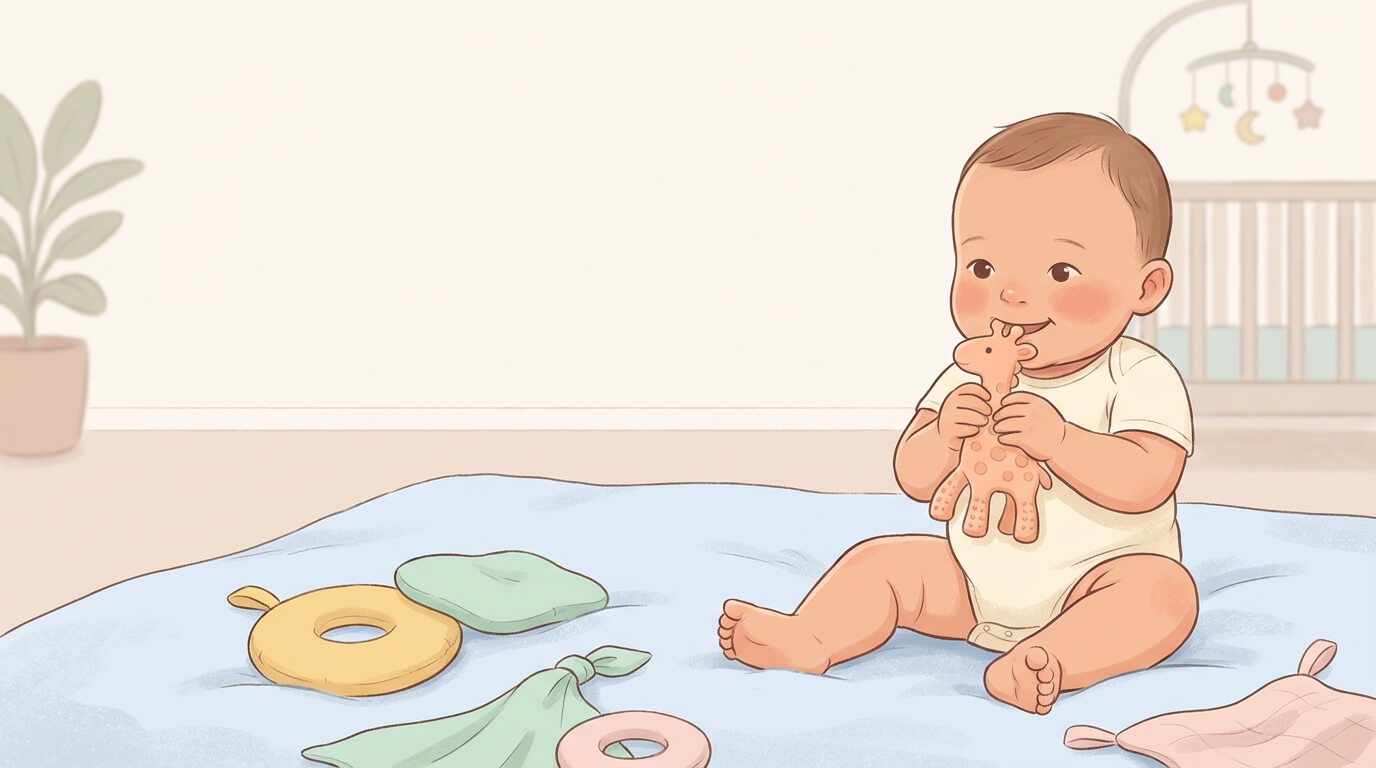
- Chilled (not frozen) silicone teething rings — The gentle coolness temporarily reduces inflammation; the firm texture provides satisfying pressure against sore gums. Frozen rings can become hard enough to damage delicate gum tissue.
- Solid rubber or wooden teethers from reputable manufacturers with clean ingredient certifications
- A clean, chilled (not frozen) damp washcloth — inexpensive, effective, and available everywhere
What to avoid:
- Amber teething necklaces — Despite their visibility in parenting communities, both the AAP and the U.S. Food and Drug Administration (FDA) have issued warnings against these products. The claimed mechanism — that amber releases succinic acid through skin contact to reduce inflammation — has no credible scientific support. The documented risks (strangulation, choking) are real and have caused verified harm. The risks are concrete; the benefits are not.
- Teething gels containing benzocaine — The FDA advises against the use of benzocaine products in children under two, as they can cause a rare but dangerous blood condition called methemoglobinemia.
Practical Laundry Tips
Drool stains are predominantly protein-based — the same category as blood and sweat stains. Standard detergents are poorly suited to protein stains; enzyme-based pre-treatment sprays (ingredients like protease or subtilisin) are highly effective. Apply to damp fabric, allow five to ten minutes of contact time, then launder as normal. Treating stains while still fresh — before they set into fibres — dramatically improves outcomes.
When Should a Caregiver Be Concerned?
The answer, in the great majority of cases, is: not yet. Drooling is developmentally normal, self-resolving, and does not require medical treatment.
That said, certain patterns warrant a conversation with a healthcare provider:
Signs Worth Discussing with a Paediatrician
- Drooling that persists significantly and frequently beyond age 2–3, with no apparent improvement trend
- Difficulty swallowing (dysphagia) — observable as frequent gagging, choking during meals, or distress around feeding
- Drooling accompanied by high fever, refusal to eat, or unusual sores in or around the mouth (which may indicate a viral infection such as hand, foot, and mouth disease or herpetic stomatitis)
- Drooling appearing suddenly and excessively in a previously dry older toddler, which may signal a new illness or dental problem
When Speech and Developmental Concerns Intersect
For toddlers aged two and above who still drool heavily during waking hours, a referral to a speech-language pathologist (SLP) is appropriate. SLPs are specialists in oral motor function — the precise coordination of mouth muscles for swallowing, chewing, and speech production. When drooling persists beyond typical developmental windows, it occasionally signals reduced oral muscle tone or coordination that responds well to targeted therapy.
Oral motor exercises recommended by SLPs — such as blowing bubbles, sucking through progressively thinner straws, and specific tongue movement drills — strengthen the muscles and pathways involved in saliva management. The interventions are gentle, playful, and effective when indicated.
It is also worth mentioning carefully and without alarm that persistent, unexplained drooling beyond typical developmental windows can occasionally be one of several signs associated with conditions such as hypotonia (reduced muscle tone) or developmental delays. This does not mean every late drooler has such a condition — individual variation is wide — but it is one reason that a paediatric check-in, if there is any parental concern, is always worthwhile. Early evaluation, when needed, is one of the most valuable things a parent can offer a child.
A Note for Parents of Older Toddlers Who Still Drool
For parents of children aged two to four who continue to drool regularly — particularly during focused activity, emotional moments, or sleep — a measured response is most helpful.
Some drooling in two-year-olds is entirely within typical range, especially during sleep or intense concentration. It becomes worth addressing when it occurs frequently during ordinary waking activity, when it troubles the child socially, or when it co-occurs with concerns about speech intelligibility.
In these cases, a referral to a speech-language pathologist or an occupational therapist (who addresses sensory processing dimensions of oral motor function) is the appropriate and effective next step. There is no stigma in pursuing evaluation — on the contrary, early identification of any area where a child needs support is one of the highest-value things a caregiver can do.
Conclusion
There is a quiet magnificence hidden inside one of babyhood’s most unglamorous signatures. What reads on the surface as a minor inconvenience — another bib to change, another onesie to pre-treat, another puddle on someone’s shoulder — is, in full context, the visible face of something remarkable.
The salivary glands awakening to their full function. The immune system deploying its defences. The digestive system preparing for decades of work. The brain building the neural roads it will one day use to produce language. The oral muscles practising, day by day, the coordination that will eventually speak the baby’s first word.
The essential takeaways:
- ✅ Drooling is overwhelmingly normal — driven by neurological maturation, teething, oral exploration, and digestive preparation
- ✅ The peak window is roughly four to twelve months, with most children showing meaningful improvement by eighteen to twenty-four months
- ✅ Saliva is biologically valuable — rich with immune agents, healing factors, and digestive enzymes
- ✅ Practical management centres on skin protection, appropriate bibs, and safe teething strategies
- ✅ Medical attention is rarely needed, but should be sought if drooling is heavy beyond typical age ranges, accompanies swallowing difficulties, or co-occurs with speech development concerns
- ✅ Science is finding new value in infant saliva — from diagnostic biomarkers to the origins of language itself
The next time a baby grins that irresistible, gummy grin and sends a stream of drool down someone’s collar, the most accurate response — beyond reaching for a cloth — might just be a quiet recognition that something extraordinary is underway. The rivulet of saliva is not the point. What it signals is.
📚 Sources and Further Reading:
- American Academy of Pediatrics (AAP): Teething: 4 to 7 Months
- U.S. Food and Drug Administration (FDA): Warning on Amber Teething Necklaces
- American Speech-Language-Hearing Association (ASHA): Pediatric Dysphagia
- Salivary flow patterns and the health of hard and soft oral tissues.
- Antimicrobial agents in saliva — protection for the whole body.
- The secretion, components, and properties of saliva.
Was this article helpful? If it answered a question that had been quietly worrying a household, share it with another parent who might find it useful. The best parenting knowledge is the kind that gets passed along.

October 27, 2026
October 27, 2026
October 27, 2026
October 27, 2026