
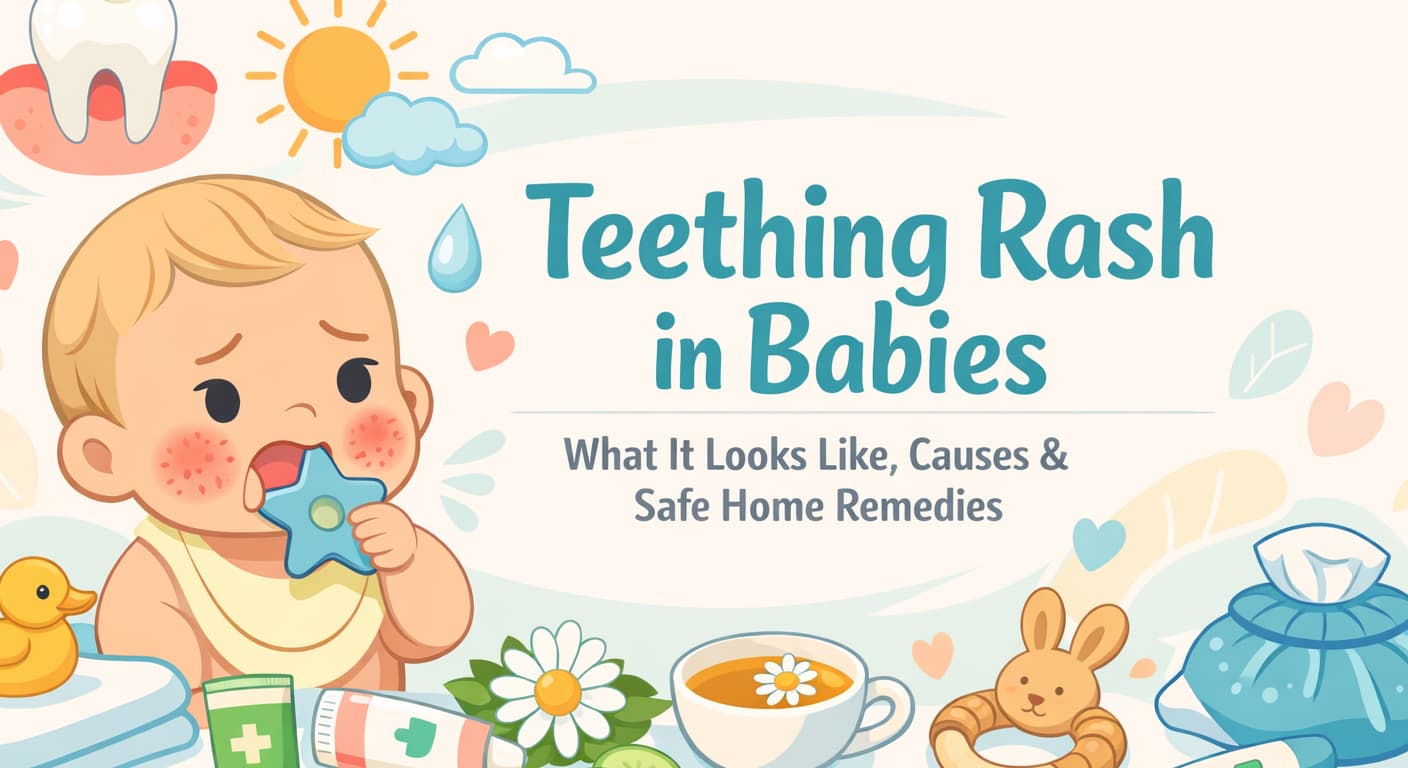
Teething-Rash-in-Babies-What-It-Looks-Like-Causes-Safe-Home-Remedies
Teething Rash in Babies: What It Looks Like, Causes & Safe Home Remedies
There is a particular milestone in early parenthood that no one adequately warns about. The baby books describe the “teething phase” with clinical detachment — a chart of emerging molars, a timeline of developmental benchmarks. What those books rarely capture is the visceral reality of watching a once-smooth, porcelain-soft baby face transform almost overnight into a landscape of angry, chapped, red skin — all thanks to an extraordinary, seemingly industrial quantity of drool.
Every seasoned parent knows the moment. The onesie is perpetually damp. The crib sheet needs changing twice before noon. And somewhere beneath all that glistening saliva, a raw, irritated rash has taken up residence around the chin, mouth, and neck folds, stubborn as a houseguest who refuses to leave.
For caregivers, witnessing this transformation can be a source of significant anxiety. The skin looks raw and painful, raising immediate concerns about infection or allergies. However, this condition — commonly known as teething rash or drool rash — is a nearly universal rite of passage. Medically identified as a specific form of irritant contact dermatitis, it is distinct from chronic conditions like eczema, though no less distressing to witness. The term simply means the skin is irritated by prolonged contact with an irritant — in this case, saliva.
Teething rash is extraordinarily common, entirely manageable, and almost always temporary.
What Is Teething, and What Is Teething Rash?
What Is Teething?
Teeth do not simply appear from nowhere. Long before a baby’s first tooth breaks through the gum, that tooth has been forming beneath the surface — slowly pushing upward through the gum tissue in a process called eruption. This process can take weeks or even months, during which the gum is under constant internal pressure.
Most babies begin teething somewhere between three and twelve months of age, though some start earlier and some later — both are normal. The lower front teeth (the lower central incisors) typically arrive first, followed by the upper front teeth, then the lateral teeth beside them, and eventually the molars at the back. By age three, most children have their full set of twenty primary teeth.
Baby Teeth Eruption Timeline (Approximate)
| Teeth | Common Name | Typical Age of Eruption |
|---|---|---|
| Lower central incisors | Bottom front two | 6–10 months |
| Upper central incisors | Top front two | 8–12 months |
| Upper lateral incisors | Top sides of front | 9–13 months |
| Lower lateral incisors | Bottom sides of front | 10–16 months |
| First molars (upper & lower) | Back chewing teeth | 13–19 months |
| Canines (upper & lower) | “Pointy” teeth | 16–23 months |
| Second molars (upper & lower) | Rear chewing teeth | 23–33 months |
Note: These ranges are guidelines, not strict rules. Significant variation is entirely normal.
The teething process is uncomfortable — pressure, soreness, and sensitivity in the gums are all common — which is why babies chew on everything within reach and why saliva production spikes so dramatically during this period.
What Is Teething Rash?
Teething rash (also called drool rash or drool dermatitis) is a skin irritation that develops in areas where saliva pools and sits against the skin — primarily the chin, cheeks, neck folds, and upper chest. It is not caused by the teeth themselves, nor by any product, formula, or food sensitivity in its basic form. It is, at its core, a chemical and physical reaction between excess saliva and delicate skin.
Pediatric dermatologists generally classify teething rash under the same broad category as other irritant rashes, such as diaper rash: the skin barrier is disrupted by repeated exposure to an irritant (saliva) plus friction and maceration (staying damp). In most healthy infants, teething rash is localized, superficial, and primarily a comfort and cosmetic issue — not a serious medical problem.
The goal is not perfection — no parent can stop all drool — but rather control: keeping the skin as healthy, comfortable, and protected as possible while this developmental phase runs its course.
The Real Science Behind Drool Rash
Most parents intuitively assume that teething causes teething rash. The logic is understandable but slightly off. The teeth themselves are not the villain here. Saliva is.
When a baby begins teething, the body dramatically increases saliva production. This is partly a biological reflex response to oral discomfort and partly the body preparing the digestive system for the solid foods arriving on the horizon. The result is a small human who produces saliva at a rate that seems almost comically disproportionate to their size. Babies don’t yet have perfect control over swallowing, so saliva spills out and pools on the skin.
Understanding the Skin’s Natural Defense System
To understand why teething rash happens, it helps to first understand what the skin is normally doing to protect itself — because teething rash is essentially the story of that protection being overwhelmed.
Healthy skin has an outermost layer called the stratum corneum. Think of it as a brick wall: bricks (flattened skin cells called corneocytes) held together by mortar (natural fats and oils called lipids), forming a waterproof, protective seal over the living tissue underneath.
This barrier does two critical jobs simultaneously:
- It keeps harmful substances out — bacteria, irritants, allergens
- It keeps moisture in — preventing the skin from drying out
When the stratum corneum is intact, skin looks smooth, feels soft, and heals quickly from minor insults. When it is damaged or broken down, the living layers beneath become exposed and vulnerable. Redness, rawness, and sensitivity follow.
Teething rash is the story of this protective barrier being repeatedly damaged by two distinct forces — one chemical, one physical.
The Enzyme Factor: When Saliva Becomes a Skin Irritant
Here is the piece of the puzzle that most parenting resources skip entirely, and it is arguably the most illuminating.
Saliva is not simply water. It is a sophisticated biological fluid containing digestive enzymes — most notably amylase — whose primary job is to begin breaking down carbohydrates the moment food enters the mouth. Saliva is produced by three pairs of glands (the parotid, submandibular, and sublingual glands) and also contains proteins, mucins, electrolytes, and antibacterial compounds. These enzymes are remarkably efficient — a single amylase molecule can break apart thousands of starch molecules per second.
The problem arises when, instead of encountering food, these enzymes encounter skin. When enzyme-rich saliva pools on a baby’s chin, neck, or chest for extended periods, amylase begins to break down the lipids and proteins that form the skin’s protective barrier. The skin’s natural pH balance can be altered, making the barrier more permeable, more inflamed, and more reactive.
This is why plain water, sitting on skin for an equivalent amount of time, would cause no comparable damage — water does not contain amylase. Drool, however, is essentially a mild digestive solution working continuously against some of the thinnest, most sensitive skin on the human body.
The skin of infants is particularly vulnerable for two reasons:
- Infant skin is significantly thinner than adult skin — research in pediatric dermatology has documented that infant skin can be up to 30% thinner than adult skin, meaning the protective barrier has less material to begin with before damage penetrates to sensitive living layers.¹
- The natural moisturizing factors and lipid composition of infant skin are still maturing, with higher transepidermal water loss, indicating greater susceptibility to irritants.
This enzymatic mechanism explains the particular stubbornness of teething rash. It is not simply surface dryness. The skin barrier is being actively degraded by a chemical process — which is why the single most important treatment is creating a physical barrier that prevents saliva from reaching the skin in the first place.
The Friction Factor: Well-Intentioned but Damaging
Compounding the enzymatic irritation is a second, equally important factor: mechanical damage from repeated wiping.
The instinct to clean a drool-covered face is natural and hygienic, but the manner of cleaning matters enormously. A rough wipe across an already compromised skin barrier creates microscopic tears in the skin — invisible to the naked eye but deeply consequential for healing. On infant skin — already thin, already being chemically degraded by amylase — repeated wiping operates like fine-grit sandpaper on a surface that is already under attack.
Other sources of friction compound the problem:
- A damp bib resting against the neck for hours
- A wet crib sheet pressing against the cheek all night
- Rough fabric — wool sweater collars or stiff onesie necklines — chafing against sensitive skin
The rash is often the result of a triple hit:
Moisture (saliva) + Enzymes (amylase and others) + Friction (wiping, fabric, rubbing) = Irritated, inflamed skin
Understanding these two mechanisms — enzymatic breakdown and frictional damage — is the foundation of every effective treatment and prevention strategy that follows: reduce moisture, reduce friction, and build a strong barrier.
Is It Teething Rash, or Something Else?
Before reaching for the barrier cream, it is worth confirming that what is presenting on the baby’s skin is, in fact, teething rash. Several common skin conditions can masquerade as drool rash or exist simultaneously alongside it. This matters because the treatment for each condition is different — and applying barrier cream to impetigo, for example, is not only ineffective but potentially delays needed treatment.
The Location Map
One of the most reliable ways to distinguish teething rash from other skin conditions is to look at where on the body the rash appears.
Teething rash follows the drool trail with predictable logic. It concentrates around the mouth and lips, spreads across the chin and cheeks, settles into neck folds where moisture accumulates, and sometimes tracks down to the upper chest. If drool is reaching it, the rash can follow.
Eczema (atopic dermatitis) tends to appear in different territories — the inner elbows, behind the knees, on the scalp — and presents as dry, scaly, sometimes thickened patches rather than the moist, bumpy redness characteristic of drool rash. In infants, eczema often presents on the cheeks, which can cause confusion. The key distinguishing features are texture (eczema is drier and scalier) and the presence of other typical eczema locations on the body. Eczema may be associated with a family history of allergies or asthma. Eczema can certainly coexist with teething rash, but a rash confined to drool-adjacent areas is unlikely to be eczema alone.
Hand, Foot, and Mouth Disease (HFMD) is the condition most critical to distinguish from teething rash. The distinguishing feature is unmistakable: blisters on the palms of the hands and soles of the feet. HFMD can produce mouth sores and facial irritation, but the presence of palm and sole blisters, combined with fever and general malaise, signals a viral infection caused by Coxsackievirus — requiring medical attention, not barrier cream. HFMD is highly contagious among young children in daycare and group settings.
Rash Location Guide
| Condition | Primary Location | Secondary Location | What It Looks Like |
|---|---|---|---|
| Teething/Drool Rash | Chin, around mouth, cheeks, neck folds | Upper chest | Flat or raised redness, chapped/raw texture, mild bumps without fluid |
| Eczema | Inner elbows, behind knees, scalp | Cheeks in infants | Dry, scaly, sometimes thickened patches; often itchy |
| Hand, Foot & Mouth Disease | Palms of hands, soles of feet | Inside mouth, face | Fluid-filled blisters on palms/soles; mouth sores; often with fever |
| Impetigo (bacterial) | Around nose and mouth | Can spread widely | Honey-colored or golden crusting, weeping fluid |
| Oral Thrush (candidal spread) | Corners of mouth, around lips | Inside mouth (white patches) | White patches inside mouth; reddish irritation at lip corners |
What Teething Rash Actually Looks Like
For parents encountering this for the first time, teething rash typically presents as:
- Flat or slightly raised redness on the chin, cheeks, or neck — similar in texture to windburn
- Chapped, raw-looking skin — the surface may look slightly roughened or scuffed
- Mild puffiness in the affected areas, particularly around the chin
- Occasionally, small bumps — tiny, red, without fluid inside and without crusting
- Skin that looks noticeably worse after naps or nighttime — a hallmark clue reflecting hours of uninterrupted enzymatic contact with damp bedding
It is rarely blistered, rarely weeping, and not accompanied by fever in its straightforward presentation. The baby may seem mildly uncomfortable if the skin is touched, but the rash itself is typically more distressing to the parent observing it than to the infant experiencing it.
Timing and Context
A classic teething rash appears around the time of increased drooling, gum swelling, or chewing behavior — generally between 3 and 12 months, though teething can start earlier or later. It may fluctuate — worse on days with more drool, more rubbing, or more pacifier use. If a rash appears in tandem with new foods, new detergents or skincare products, or high fever with lethargy and poor feeding, a broader differential diagnosis is warranted and pediatric guidance is advisable.
Treatment Plan for Teething Rash in Babies: The “Clean, Dry, Protect” Protocol
Effective management can be structured as a simple three-part routine: Clean, Dry, Protect. This sequence addresses the real drivers of the rash — irritant exposure, moisture, and barrier breakdown. Think of it as a protocol rather than a casual response — because the skin needs a reliable routine to heal.
Step 1: The Art of Cleaning
Pat. Do not rub.
This bears repetition because it runs counter to instinct. When wiping a drool-covered face, the natural motion is a swipe — efficient, fast, thorough-feeling. But this motion, repeated dozens of times a day across already inflamed skin, perpetuates the rash cycle by creating fresh mechanical damage.
The correct technique is a gentle blotting motion — press a soft cloth against the skin briefly, lift it away, move to the next area, and repeat. No lateral movement. No scrubbing. Think of the skin as a sunburn: you would dab and treat it gently.
The tool matters as much as the technique. The ideal cloth is ultra-soft (muslin cloths or soft cotton flannels are excellent), slightly damp but not dripping, and freshly laundered.
Use water only on affected skin. Scented baby wipes, even those marketed as “sensitive,” frequently contain preservatives and fragrances that sting broken skin and interfere with healing. A soft damp cloth or unscented cotton pad dampened with plain water is all that is needed for routine cleaning. If additional cleansing is necessary after food, use a fragrance-free, gentle cleanser formulated for sensitive baby skin and rinse thoroughly. Baby wipes are better reserved for diaper changes rather than frequent face cleaning.
How often? The goal is to remove saliva before it has extended contact with the skin, but not to clean so frequently that the wiping itself becomes the primary source of damage. Blotting after visible drool pooling — rather than wiping on a fixed schedule — is a reasonable approach.
Step 2: Creating the Barrier (The Most Critical Step)
If the enzymatic irritation of saliva is the enemy, the barrier cream is the armor. This is, without question, the single most impactful element of both treatment and prevention.
The goal is simple: create a physical layer between the skin and the saliva before the drool arrives. The cream must be occlusive — meaning it physically seals the surface rather than simply moisturizing it. Many standard moisturizers are absorbed into the skin and do little to create a physical barrier on the surface. What teething rash requires is a cream thick and stable enough to sit on the skin as a film, not disappear into it.
Effective options include:
- Petroleum jelly (Vaseline): Inexpensive, fragrance-free, preservative-free, and highly effective. When applied to skin, it does not absorb — it sits on the surface and forms a semiocclusive seal that dramatically reduces moisture and enzyme penetration. Many pediatric dermatologists regard petrolatum as the “gold standard” occlusive ingredient, with data supporting its effectiveness in reducing water loss and improving barrier recovery.² The main practical limitation is its texture: somewhat thin and slippery, meaning it can be rubbed off relatively easily.
- Aquaphor Healing Ointment: A step up in thickness from plain petroleum jelly. Its primary ingredient is still petrolatum, but it also contains panthenol (Vitamin B5 for skin repair), bisabolol (a natural soothing compound), and glycerin (a humectant). This means Aquaphor functions as both a barrier and an active skin repair agent — particularly useful when skin is already raw.
- Lanolin (such as Lansinoh): Perhaps the most underused solution in the drool rash toolkit. Lanolin is a waxy substance naturally secreted by sheep to protect their wool. When refined and purified to medical grade, it becomes one of the most effective occlusive and restorative substances available for damaged human skin. Because it shares chemical similarities with human skin lipids, it does not just sit on the skin as a foreign coating — it actually integrates with and helps rebuild the damaged lipid layer. It is ultra-thick and long-lasting, non-toxic, safe for ingestion, and has no fragrance or preservatives — specifically designed to remain on skin that goes directly into a baby’s mouth. For raw, irritated skin struggling to heal, lanolin’s combination of occlusive protection and active barrier restoration makes it exceptionally effective. However, it is essential to be aware of potential wool or lanolin sensitivities; although uncommon, contact allergy is possible. If redness worsens after lanolin is introduced, switching back to petrolatum may be helpful.
Barrier Product Comparison
| Product | Primary Mechanism | Best For | Texture | Cost |
|---|---|---|---|---|
| Petroleum Jelly (Vaseline) | Occlusive seal | Prevention; mild rash | Slippery, moderate thickness | Very low |
| Aquaphor Healing Ointment | Occlusive seal + active repair | Moderate rash; healing skin | Slightly thicker, smooth | Low–moderate |
| Lanolin (Lansinoh) | Occlusive seal + barrier restoration | Severe or persistent rash; very raw skin | Very thick, waxy | Moderate |
The “Before and After” Approach
The timing of application matters as much as the product itself. Applying barrier cream reactively — only after the skin is already wet and irritated — provides significantly less protection than a proactive strategy. Apply with intention at these strategic moments:
- Before feeding: The face will be in close contact with a bottle, breast, or food and immediately exposed to more saliva. A layer applied just before feeding catches that wave.
- Before naps and bedtime: The face will rest against potentially damp fabric for an extended period with no one available to blot. This is the highest-risk window — the application before sleep is arguably the most important of the day.
- Before car rides or stroller walks: Motion and drool can combine with friction.
- After each gentle cleaning: Reapply immediately so protection is restored before the next drool event.
The practical goal is to ensure that clean, protected skin is rarely meeting raw saliva directly. A simple rule of thumb: if the skin looks shiny from ointment, the protective layer is in place.
Step 3: Environmental Management
The third pillar of the treatment protocol addresses the context in which the rash exists — because even perfectly applied barrier cream will fight an uphill battle if the baby spends hours in a damp onesie collar or resting against a saliva-soaked sheet.
Bib Rotation Is Non-Negotiable. A damp bib left against the neck creates a constant source of moisture-induced irritation — essentially a compress of enzyme-rich moisture held continuously against already irritated skin. Changing bibs the moment they become damp — not waiting until saturation — is a practical and underappreciated element of management. Many parents find a minimum of eight to ten bibs useful during peak drool periods.
When choosing bibs, consider:
- Absorbency: Bibs with a soft cotton or bamboo inner layer draw moisture away from skin faster than smooth synthetic materials
- Backing: A waterproof or water-resistant backing prevents moisture from soaking through to clothing
- Fit: Bibs that sit comfortably at the neck without gaping or pressing tightly against irritated skin
Clothing choices matter during a flare. Rough fabrics like wool, or tight collar fits that press against inflamed neck skin, significantly worsen the rash. During active flare-ups, soft cotton or bamboo garments with loose necklines are preferable. This is a small change that often produces a noticeable difference within a day or two.
Preventing Teething Rash in Babies: Staying One Step Ahead
For parents whose babies are entering the heavy-drool phase but have not yet developed a rash, prevention is entirely achievable. The strategies are identical in principle to treatment but applied before irritation appears — and they are considerably easier to implement on healthy skin than on already raw, sensitive skin.
The Pre-Emptive Application
Healthy skin is much better at resisting enzymatic damage than compromised skin. When a baby is drooling significantly but the skin appears intact, applying a thin layer of petroleum jelly or Aquaphor around the mouth and chin daily — even on good skin days — creates a standing barrier that enzymatic saliva cannot easily penetrate. This is analogous to applying sunscreen on a cloudy day: the threat is still present even when the immediate signs are not. Making this part of morning routines creates an invisible shield against the day’s activities.
For parents who prefer to minimize products, petroleum jelly is sufficient for prevention. Lanolin and Aquaphor are more valuable once the skin is already compromised and needs active repair in addition to protection.
Nighttime Defense
Nighttime is where teething rash wins its most significant battles. During waking hours, saliva is swallowed regularly, the face frequently changes position, and caregivers are present to blot away accumulations. During sleep, all of that changes. Saliva pools in the cheek and neck without being swallowed as often. The face rests in one position against fabric for hours. No one is present to clean or reapply cream. The result is hours of uninterrupted enzymatic contact with the skin.
This is why so many parents notice that the rash looks dramatically worse in the morning than it did at bedtime.
Two strategies address this effectively:
- Apply the thickest layer of barrier cream before bedtime — thicker than at any other point during the day. The goal is a visible, protective film that can sustain several hours of continuous drool exposure. Lanolin is particularly valuable here because its waxy, thick consistency persists through extended moisture exposure better than thinner products. This is sometimes called “slugging” — applying a very generous layer of ointment before bed.
- Place an absorbent towel or extra burp cloth beneath the fitted crib sheet in the area where the baby’s head rests. This creates an additional layer of moisture absorption, reducing the pool of saliva that the face rests against. Safety note: Any additional layer beneath the fitted sheet must be completely flat, securely positioned so it cannot shift or bunch, and thin enough that it does not meaningfully alter the sleeping surface. This must be implemented in full accordance with safe sleep guidelines — when in doubt, consult your pediatrician before adding any materials to the sleep environment.
The Pacifier Problem Few Parents Anticipate
Pacifiers are both a valuable comfort tool and, potentially, a rash-aggravating one. The plastic or silicone shield of a standard pacifier can trap moisture and saliva directly against the lip and cheek skin, creating a persistently damp microenvironment that prevents healing and continues the enzymatic exposure cycle.
Strategies to mitigate this:
- Switch to a pacifier with open ventilation holes in the shield, allowing air to circulate and reducing moisture trapping. Look for the term “ventilated shield” or “air holes” in the product description.
- Periodically remove the pacifier, pat the skin dry underneath and around it, and reapply barrier ointment if the area looks damp.
- Keep pacifiers clean by washing regularly with mild soap and water.
- If rash appears predominantly in the exact shape of the pacifier shield, reconsidering brand, shape, or usage time may be beneficial.
The Food Connection: A Frequently Overlooked Variable
For babies who have begun eating solids, the teething rash equation gains an additional variable that deserves specific attention. The introduction of solid foods typically coincides with teething age, and many parents notice dramatic worsening of the rash around mealtimes without understanding why.
The Acid Factor
Certain foods are notably acidic. When these foods contact already compromised skin around the mouth during feeding, they cause a contact reaction driven by pH irritationrather than enzymatic breakdown. Healthy infant skin naturally maintains a slightly acidic pH of approximately 4.5 to 5.5 — the “acid mantle.” When highly acidic foods disrupt this balance on damaged, inflamed skin, the result looks very similar to drool rash but tends to appear more immediately after meals.
High-Acidity Foods to Watch During Teething
| Food Category | Common Examples | Approximate pH |
|---|---|---|
| Citrus fruits | Oranges, lemons, limes, grapefruit | 2.0–4.0 |
| Tomato products | Tomato purée, tomato-based sauces | 4.0–4.5 |
| Berries | Strawberries, blueberries, raspberries | 3.0–3.5 |
| Tropical fruits | Pineapple, kiwi | 3.5–4.0 |
| Fruit pouches | Many commercial baby purées | Variable (often acidic) |
This does not mean these foods must be avoided entirely — they are nutritious and appropriate for babies who have started solids. The management strategy is straightforward:
- Apply a layer of barrier cream before meals involving acidic foods. The cream intercepts the acid before it can reach compromised skin.
- After the meal, clean the face promptly and gently with a soft, damp cloth — avoiding prolonged contact that allows acid residue to continue irritating the skin.
- Reapply barrier ointment if redness is visible.
Parents who notice that the rash seems dramatically worse after certain meals may find that reliably pre-protecting with barrier cream produces a noticeable improvement. Temporarily reducing the most acidic offerings during a severe flare, then gradually reintroducing them with consistent barrier protection once the skin has healed, is a practical short-term approach.
If a clear pattern emerges — each time a specific food touches the skin, the area becomes very red, bumpy, or hives appear — or if there are signs like vomiting, swelling of lips or eyelids, or difficulty breathing, stop that food and contact your pediatrician promptly. That may suggest a true food allergy rather than simple irritation.
When to Call the Pediatrician
The vast majority of teething rashes are uncomplicated and resolve with consistent home care within three to five days. However, there are specific presentations that warrant prompt medical evaluation — because the conditions that can develop from or alongside teething rash require medical treatment, not home management.
Signs of Bacterial Infection (Impetigo)
Impetigo is a bacterial skin infection that can develop when the compromised barrier of a drool rash provides an entry point for bacteria that normally live harmlessly on the skin’s surface — particularly Staphylococcus aureus and Streptococcus pyogenes. These bacteria are common in the environment and on everyone’s skin; they only become problematic when they gain access to deeper layers through a break in the barrier.
The hallmark signs are distinctive and should prompt a same-day or next-day call to the pediatrician:
- Honey-colored or golden-yellow crusting on or around the rash — genuinely distinctive in color, a rich amber or brownish-golden crust
- Weeping fluid or pus from the affected area
- Skin that appears significantly more inflamed, swollen, or painful than a standard drool rash
- Rapidly spreading redness or warmth
- Accompanying fever
Impetigo requires antibiotic treatment — topical antibiotic cream for mild, localized cases or oral antibiotics for more widespread infection — and should not be managed at home with barrier cream alone. It is also moderately contagious, so good handwashing after touching the affected area is important.
Oral Thrush and Candidal Spread
Oral thrush is a yeast (Candida) infection presenting as white, creamy patches inside the baby’s mouth — on the tongue, inner cheeks, or gum line — that cannot be easily wiped away (this is the key distinguishing feature from harmless milk residue, which wipes away cleanly). Thrush is relatively common in infants, particularly after antibiotic use.
When oral thrush is present, Candida can spread from the mouth to the surrounding skin — to the corners of the lips (angular cheilitis) and the perioral area — where it may present as reddish, sometimes slightly scaly irritation that resembles or coexists with drool rash. In neck folds or under the chin, yeast may produce a red, shiny rash with tiny satellite spots beyond the main rash that does not respond to regular barrier creams. Candidal skin infection does not respond to barrier cream alone; it requires antifungal treatment prescribed by a physician.
Eczema Requiring Medical Management
While mild eczema can be managed at home with emollient creams, moderate to severe eczema — particularly when it is not responding to over-the-counter moisturizers, causing significant itching and sleep disruption, or becoming infected — warrants medical evaluation. A pediatrician may prescribe a short course of mild topical corticosteroid cream to bring inflammation under control.
Eczema and teething rash can coexist and fuel each other: the drool damages the skin barrier, and the underlying eczema prevents it from healing properly. Treating both simultaneously under medical guidance produces faster resolution.
Persistence Without Improvement
If a rash does not show meaningful improvement after three to five days of consistent barrier cream application and environmental management, or if it continues to worsen or spreads beyond typical drool-exposed areas, it is appropriate to seek a pediatric evaluation. The skin may require a short course of mild topical medication, or an underlying condition — eczema, contact allergy, periorificial dermatitis — may be contributing. Healthcare professionals may also investigate for allergies or underlying skin disorders.
Quick Reference: When to Call the Pediatrician
| Sign | Possible Cause | Urgency |
|---|---|---|
| Honey-colored or golden crusting | Impetigo (bacterial infection) | Same day or next day |
| Weeping fluid or pus from rash | Impetigo or secondary infection | Same day |
| Rash accompanied by fever | Infection | Same day |
| White patches inside mouth + skin rash | Oral thrush + candidal spread | Within a few days |
| No improvement after 3–5 days of barrier cream | Eczema, contact allergy, or other cause | Within a week |
| Rash spreading beyond drool-contact areas | Consider other diagnoses | Within a few days |
| Blisters on palms or soles of feet | Hand, Foot & Mouth Disease | Same day |
A Simple Day-to-Day Plan
Here is how all of this might look in practice.
Morning: During the diaper and clothes change, check the face and neck. If damp, pat with water, pat dry, and apply a thin layer of barrier ointment to the mouth, chin, and neck folds. Put on a clean, dry bib.
During the day: Swap bibs as soon as they become damp. When drool is visible, pat gently with a soft cloth, let air dry briefly, and reapply a light layer of barrier ointment. Before feeds, apply or refresh the barrier layer.
Mealtimes (solids): Apply barrier cream around the mouth before messy or acidic foods. After the meal, gently clean with water and a soft cloth, pat dry, and reapply if redness is visible.
Bedtime: Gently clean and pat dry the face and neck. Apply a thicker “night shield” layer of barrier ointment. Dress baby in dry, soft sleepwear. Ensure there is an absorbent layer under the fitted sheet where the head rests (the sheet must stay tight and flat).
This is not about perfection every time. It is about establishing a gentle, repeatable pattern that gives the skin more “good hours” than “bad hours” each day.
A Temporary Phase, Not a Permanent Condition
Parenting contains an abundance of challenges that are simultaneously alarming in appearance and thoroughly benign in medical reality. Teething rash belongs emphatically in that category.
That red, chapped chin is not a sign of neglect, sensitivity to products, or an underlying condition. It is the natural consequence of an impressive biological process — the emergence of teeth, the ramping up of the digestive system, the extraordinary developmental leap of an infant becoming a toddler. The drool is evidence that the body is working exactly as designed.
The framework for managing it is elegant in its simplicity:
The Teething Rash Management Summary
| Step | Action | Why It Works |
|---|---|---|
| Clean | Blot gently with a soft, damp cloth. No rubbing. Water only on irritated skin. | Removes saliva without adding frictional damage. Avoids preservatives that sting broken skin. |
| Protect | Apply petroleum jelly, Aquaphor, or lanolin proactively — before feeding, before sleep, after cleaning. | Creates a physical barrier between saliva enzymes and the skin surface. |
| Manage environment | Rotate bibs when damp. Choose soft, loose clothing. Use an absorbent layer under the crib sheet. | Reduces total hours of enzymatic and moisture contact. |
| Anticipate food exposure | Apply barrier cream before acidic foods. Clean promptly after meals. | Prevents pH irritation from compounding enzymatic damage. |
| Monitor for warning signs | Watch for golden crusting, weeping, fever, white mouth patches, or lack of improvement. | Catches bacterial or fungal infection requiring medical treatment before it worsens. |
Conclusion
The teething phase will end. The drool will subside. The smooth baby skin will return. In the meantime, a tube of lanolin or petroleum jelly, applied with intention and consistency, is one of the most powerful tools available — and now you understand exactly why.
You are not failing if your baby gets drool rash. It is common and very fixable. Your job is not to stop all drool — you cannot — but to support the skin through this stage. And it is wise, not overprotective, to call your pediatrician if something seems off, lasts too long, or looks infected.
References & Further Reading:

October 25, 2026
October 25, 2026

October 25, 2026

October 25, 2026