
Blue-Bump-on-Baby-Gums-It's-Likely-a-Harmless-Eruption-Cyst—Parents'-Guide
Blue Bump on Baby Gums? It’s Likely a Harmless Eruption Cyst
Blue Bump on Baby Gums? Perhaps you noticed it during a bath, when the light caught the inside of your baby’s mouth at just the right angle. Perhaps it happened while wiping down the gums after a feeding. You were checking for that first pearly white tooth, and instead you spotted a dark, angry-looking blue or purple lump sitting on the gum. For any parent, the immediate reaction is panic. Is it a bruise? An infection? Did something get lodged in there? Did they fall and hit their mouth?
Take a breath.
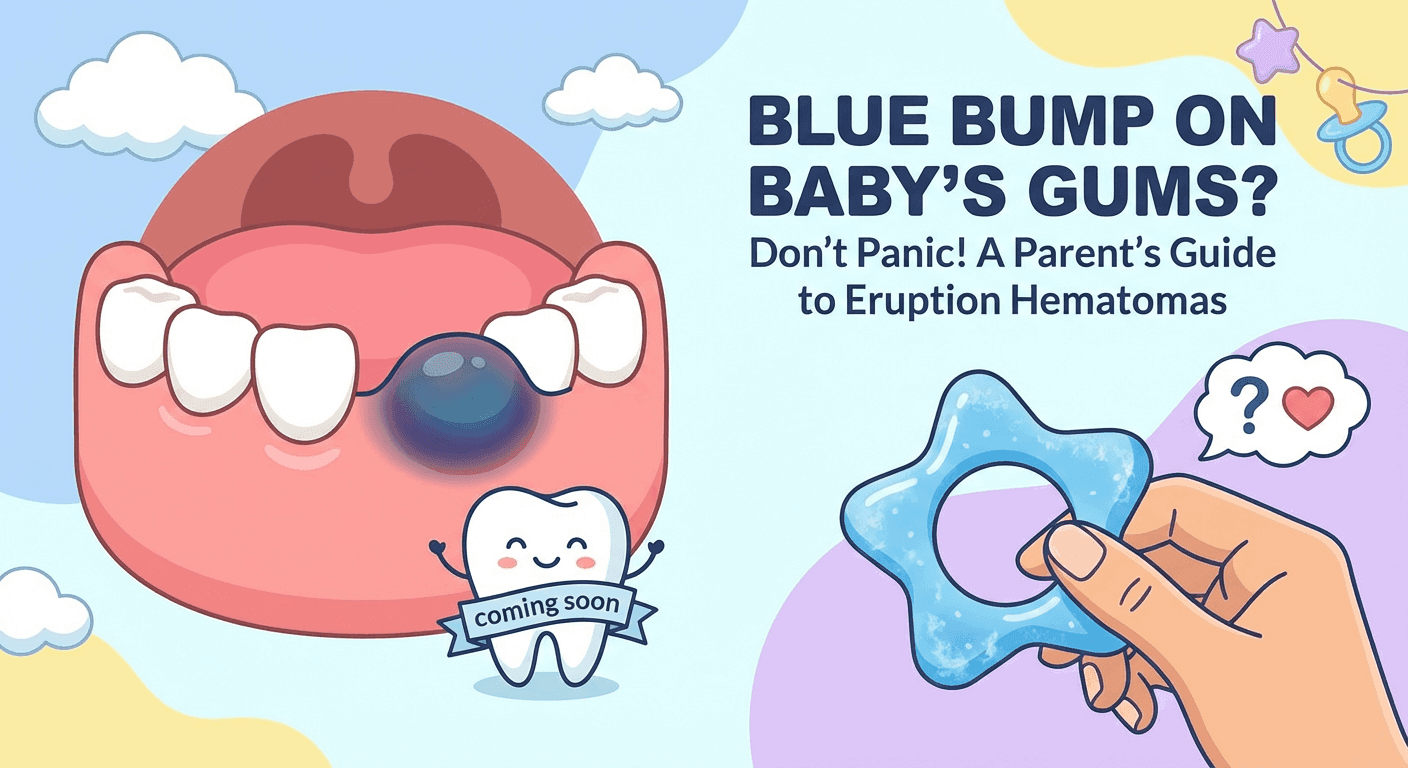
Seeing a dark, blue bump on your baby’s gums can be alarming. In most cases, this purple bump on baby gums — or even a dark spot that looks nearly black — is a common and harmless condition known as an eruption hematoma, sometimes called a teething blood blister. Pediatric dentists encounter it almost daily. It is not an injury. It is not a disease. It is not caused by poor hygiene. It is, in the most accurate and reassuring terms possible, a tooth knocking on the door from the inside.
Most eruption hematomas resolve completely on their own within one to three weeks, typically when the tooth breaks through the gum. No treatment is needed in the vast majority of cases.
How Baby Teeth Actually Work
Before diving into eruption hematomas specifically, it helps enormously to have a simple mental picture of what is happening inside your baby’s mouth long before any tooth becomes visible.
Teeth Begin Forming Before Birth
Here is something that often catches parents off guard: your baby’s teeth started developing while they were still in the womb — specifically, around the sixth week of pregnancy. By the time a baby is born, all 20 primary teeth (the official term for “baby teeth”) are already fully formed beneath the gum line, sitting in the jawbone like seeds waiting for the right season. They are just not visible yet.
Think of the gums as a thick, protective blanket drawn over a set of buried keys. The teeth are all there — they simply have not yet pushed through the blanket to the surface.
The Baby Teething Timeline
Starting around 6 to 12 months of age, these teeth begin a slow, upward journey. Understanding the general schedule of baby tooth eruption helps parents contextualize the teething experience — including why eruption hematomas occur most often in specific age windows.
| Tooth Type | Upper Jaw (Approx. Age) | Lower Jaw (Approx. Age) |
|---|---|---|
| Central Incisors (front teeth) | 8–12 months | 6–10 months |
| Lateral Incisors (beside front teeth) | 9–13 months | 10–16 months |
| First Molars (back chewing teeth) | 13–19 months | 14–18 months |
| Canines / Cuspids (pointed teeth) | 16–22 months | 17–23 months |
| Second Molars (furthest back) | 25–33 months | 23–31 months |
Note: These ranges are averages. Every baby develops on their own timetable, and variations of several months in either direction are entirely normal. A tooth erupting at 4 months or at 15 months does not indicate a developmental problem without other clinical evidence.
What “Eruption” Actually Means — And Why It Takes So Long
The word “eruption” conjures images of something dramatic and sudden. In dental terms, the process is far more gradual. Over a period of weeks to months, each tooth slowly migrates upward through the jawbone, which remodels around each tooth as it moves. The gum tissue is gradually thinned and stretched from below until the tooth finally breaks through the thick tissue of the gums (gingiva) to appear in the mouth.
This slow upward journey is significant because it means there is a prolonged period during which the tooth is close to — but not yet through — the surface. It is during this final stage, when the tooth crown is pressing against the underside of the gum, that conditions become ripe for an eruption hematoma to form. Understanding this timeline makes the appearance of the blue bump on baby gums far less mysterious: it is not a random event. It is a predictable consequence of a specific moment in an ongoing, months-long process.
What Exactly Is an Eruption Hematoma?
The term sounds clinical and alarming — but like many medical phrases, it is simply a precise description of something fairly straightforward.
Let’s break it into its two parts:
- “Eruption” — the process of a tooth pushing through the gum tissue.
- “Hematoma” — a medical word for a localized, contained collection of blood that has escaped from blood vessels and pooled in surrounding tissue. A bruise is one. A blood blister is another.
Put them together: an eruption hematoma is a pocket of trapped blood that forms in the gum tissue as a tooth pushes its way to the surface. You might also hear it called a teething hematoma or baby gum hematoma — these all describe the same thing.
The Mechanism: A Seed Pushing Through Soil
Imagine a seed planted just beneath the surface of damp garden soil. As it grows and swells, it pushes upward, displacing the earth around it. Now imagine that the “soil” is not inert dirt but living tissue — soft, flexible, and threaded throughout with tiny, delicate blood vessels called capillaries. These capillaries are so small they are invisible to the naked eye, yet they carry blood continuously through the gum tissue.
As the emerging tooth migrates upward, it exerts steady pressure on these capillaries. In most cases, this pressure is diffuse enough that the tiny vessels simply move aside, and any micro-damage is repaired seamlessly by the body. But occasionally — particularly when a tooth is large relative to the overlying tissue, or when the gum tissue is slightly thicker than average — the pressure ruptures some of those tiny blood vessels.
Normally, blood that escapes a ruptured capillary in loose tissue gets absorbed quickly. But in this specific situation, there is a very small, enclosed space between the crown of the tooth and the thin layer of gum tissue covering it. Blood that escapes into this tight space has nowhere to go. It pools. It accumulates. And because the gum tissue overlying it is thin and slightly translucent, that pool of blood becomes visible from outside — which is precisely the dark spot on baby gums that you see when you look into your baby’s mouth.
Essentially, an eruption hematoma is a bruise contained inside a balloon. If the fluid inside is mostly clear, it looks pale and is called an eruption cyst. If blood mixes in, it turns blue or purple and is called an eruption hematoma.
What Does a Blue Bump on Baby Gums Look Like?
Part of what makes eruption hematomas so frightening is how dramatic they appear. For identification purposes, this teething bump typically presents as:
- Color: Deep blue, purple, or dark maroon — occasionally appearing almost black. The dark hue comes from the pooled blood visible through the thin, translucent gum tissue above it. This baby teething gum discoloration is often described as a “dark spot before tooth comes in.” Think of how a blood blister on your finger looks dark through the overlying skin — the same principle applies here.
- Size: Usually small, ranging from a few millimeters (about the size of a match head) to roughly the size of a pea. In some cases, particularly with the larger molars at the back of the mouth, they can be bigger.
- Texture: Often soft and slightly squishy when touched gently, because the blood inside is still liquid. They can feel firmer if the blood has begun to clot internally — similar to how a bruise feels harder after a day or two.
- Location: This is the biggest clue. The bump sits directly on the gum ridge — the raised arch of tissue where the teeth are prepared to emerge. This location detail is critically important and will become relevant later when we discuss which symptoms should prompt a call to the dentist.
- Borders: Unlike an infection, which typically has poorly defined, spreading redness, an eruption hematoma usually has relatively defined edges. It looks more like a contained bubble than a spreading stain.
According to pediatric dental literature, eruption hematomas are most commonly observed in children between 6 and 24 months, corresponding with the primary tooth eruption schedule — though they can also appear later, particularly when permanent molars emerge in older children. In toddlers aged 2–3, eruption hematomas often appear over the second molars, which are the last baby teeth to come in and among the largest.
The same identification and management principles apply at this age. While precise prevalence data is difficult to pin down (many cases go unreported simply because the tooth breaks through before a dentist appointment is made), eruption hematomas are considered a routine variant of normal tooth development rather than a pathological condition. In plain terms: they are an expected quirk of a normal process, not a sign that anything has gone wrong.
Does an Eruption Hematoma Hurt Your Baby?
Here is one of the most counterintuitive aspects of eruption hematomas — and the hardest part for parents to reconcile: they almost always look far worse than they feel.
Why It Looks Worse Than It Feels
The surface layer of the gums contains fewer nerve endings than deeper oral structures like the tooth pulp or deeper jaw tissue. This means that while the gum surface is not entirely without sensation, it is less sensitive than you might assume given how dramatic the visual presentation can be. Additionally, the pressure inside the blister is often balanced by the pressure of the tooth pushing up, and unlike a cut or scrape, the nerves are not exposed to the air.
Many infants with visible eruption hematomas appear no more distressed than they would be during ordinary teething. They gnaw on toys, drool with impressive enthusiasm, and fuss intermittently — but these are teething symptoms broadly, not necessarily symptoms of the hematoma specifically.
That said, every baby is different. Some infants display heightened irritability when a hematoma is present, particularly if it is larger. The pressure from a fluid-filled sac pressing on already-tender gum tissue can add an additional layer of discomfort to what is already a frustrating developmental process. Think of it this way: ordinary teething is uncomfortable because a hard tooth is pressing outward from beneath. An eruption hematoma adds a swollen, pressurized pocket to that picture — a bit like the difference between a bruise and a bruise with a blister on top.
Normal behavior: Drooling, chewing on fingers and toys, mild fussiness, slightly disrupted sleep.
Abnormal behavior: Refusing to eat due to pain, high fever, touching the face and screaming, or consistently refusing to eat or drink across multiple feeding sessions.
The Sensory Dimension: Why Babies Get Mouthy About It
There is an often-overlooked behavioral component worth noting. A fluid-filled baby mouth bump on the gum ridge is a genuinely novel sensation for an infant. The tongue — one of the most richly innervated organs in the human body, capable of detecting textures measured in fractions of a millimeter — immediately investigates any unfamiliar presence in the mouth. This is not a learned behavior; it is a hardwired sensory reflex.
Parents may notice increased tongue-thrusting toward the affected area, more lip-smacking than usual, or a baby who seems strangely fascinated with the inside of their own mouth. You might see them push their tongue repeatedly against the bump, or notice their jaw moving in an exploratory, non-feeding way. This is not distress — it is sensory exploration. The nervous system is simply cataloging an unfamiliar texture, the same way your tongue automatically seeks out the spot where a tooth has been filled.
How Long Does an Eruption Hematoma Last?
At some point — days to a few weeks after the hematoma first appears — the tooth will win. Most eruption hematomas resolve within one to three weeks as the hard enamel cuts through the top of the bubble, perforating the overlying tissue and allowing both the tooth to emerge and the accumulated blood to escape.
Warning for parents: This baby tooth breakthrough can produce a “crime scene” moment. You might put your baby down for a nap and wake them up to find a smear of blood on the crib sheet, on a pacifier, or on their lips. The amount of blood is typically minimal — usually a pinkish tinge in the saliva rather than active or persistent bleeding. It resolves quickly on its own, generally within minutes.
Do not panic. This is normal, and it is a good sign. What you are seeing is not fresh bleeding from an injury but rather the controlled release of blood that had been sitting pooled in that pocket, sometimes for days. It means the tooth has emerged, the pressure is gone, and the hematoma is history. Think of it as the final punctuation mark on the teething story that the hematoma was telling.
How to Treat an Eruption Hematoma at Home
The most important thing to understand about eruption hematomas is that the overwhelming majority of them — upward of 90% — require no medical intervention whatsoever. The human body, specifically the process of tooth eruption itself, handles them naturally and efficiently.
The gold standard of management is a strategy pediatricians and dentists often call “watchful waiting.” This phrase is worth unpacking because it is deceptively simple and, for many parents, genuinely difficult to execute. Watchful waiting does not mean ignoring the situation — it means actively monitoring without intervening. It means choosing not to poke, prod, squeeze, or “help” the bump along, while staying alert for specific red flags that would indicate a need for professional evaluation.
Here is what you can do at home to support your baby’s comfort during this period:
Cold Therapy: The First Line of Comfort
Cold is your best friend here. It serves two purposes simultaneously: it numbs the areaby reducing nerve signal transmission in the gum tissue, and it causes blood vessels to constrict slightly (vasoconstriction), which can reduce pressure and swelling — and help stop the bruise from getting bigger.
Practical options:
- A chilled (not frozen) teething ring — place it in the refrigerator, not the freezer. Frozen teethers can adhere to moist gum tissue and cause thermal injury.
- A clean, damp washcloth placed in the refrigerator for 15–20 minutes, then offered for the baby to chew on.
- For older infants who have started solids, a silicone feeder mesh bag filled with cold pureed fruit.
Key point: Always supervise cold therapy, and limit application to a few minutes at a time. The goal is gentle, modulated cooling — not sustained cold exposure. The temperature of ice is extreme enough to damage the delicate mucosal tissue in an infant’s mouth. Gum tissue is not skin — it has much less insulating capacity and is more vulnerable to thermal injury. Stick to refrigerator-cold, not freezer-cold.
The “Chew to Cure” Principle
Here is an insight that often surprises parents: chewing on safe surfaces actively helps resolve the situation. Instinct tells you to protect the bruised area, but the opposite is actually helpful.
The mechanism operates on multiple levels. First, the mechanical friction of chewing stimulates gum tissue and promotes local circulation — essentially giving the area a gentle massage from outside. Second, chewing applies consistent, gentle counter-pressure against the gum from above. Because the tooth is already pressing upward from below, this downward chewing pressure acts like a two-sided force helping compress the hematoma sac and encouraging the tooth to complete its breakthrough. The friction thins out the gum tissue on top of the tooth, helping it puncture the cyst faster. In a very real sense, every supervised chewing session is a small act of physiological progress.
Think of it like a door that is stuck in its frame. Applying gentle, consistent pressure toward the obstacle eventually moves it.
Recommended chewing aids:
- Firm silicone teethers with varied surface textures — different textures stimulate different areas of the gum and keep the baby engaged
- Chilled silicone mesh feeders filled with soft, cold fruit for babies who have started solids
- Textured rubber teething rings in a variety of shapes
- A clean, cold, dampened washcloth tied loosely into a knot for texture
What to avoid:
- Amber teething necklaces — these present documented strangulation and choking hazards and have no credible evidence supporting their effectiveness. Both the AAPD and the American Academy of Pediatrics advise against them.
- Any teether with small detachable parts — choking risk
- Hard plastic or wooden teethers that cannot flex — these can apply excessive force to developing gum tissue
- Any teether that cannot be cleaned easily — bacteria accumulate rapidly on textured surfaces
Over-the-Counter Teething Pain Relief
If your child seems genuinely miserable, pediatrician-approved analgesics can provide systemic relief on particularly difficult days.
- Acetaminophen (e.g., infant Tylenol) — appropriate for infants from 2 months of age onward, dosed by weight
- Ibuprofen (e.g., infant Advil or Motrin) — appropriate for infants over 6 months of age, dosed by weight
Always follow the dosing instructions on the packaging precisely, use the dosing syringe that comes with the product rather than a household spoon, and consult your pediatrician before administering any medication to a young infant, particularly one under 6 months.
A note on topical teething gels: The American Academy of Pediatric Dentistry (AAPD) and the FDA advise against using topical teething gels containing benzocaine for children under 2 years. Benzocaine, a local anesthetic found in products like Orajel, can in rare cases cause a serious condition called methemoglobinemia — a disorder that reduces the blood’s ability to carry oxygen. Natural “teething gels” vary widely in their ingredients and lack robust safety testing in infants; consult a healthcare provider before using any topical oral product on a baby.
Gum Health and Nutrition: The Supporting Cast
While no dietary intervention will prevent or accelerate the resolution of a specific eruption hematoma, general gum health plays a supporting role in how smoothly the broader teething process unfolds. Gum tissue that is well-nourished tends to be more resilient to the micro-trauma of eruption and better equipped to heal efficiently afterward.
For babies beginning their introduction to solid foods, the following nutrients are beneficial components of a balanced early diet:
- Vitamin C — supports collagen production, a key structural protein in gum tissue. Good sources for infants starting solids include appropriately mashed or pureed soft fruits and vegetables such as sweet potato, mango, and avocado.
- Vitamin K — plays a role in the blood clotting cascade, the biological mechanism the body uses to stop bleeding and begin healing after tissue is disrupted. Soft-cooked leafy vegetables, when age-appropriate, are good sources.
- Vitamin D and Calcium — while more directly relevant to tooth and bone formation earlier in development, adequate intake supports overall oral structural health.
It bears emphasizing: no single food item is a remedy for any aspect of teething, and hematomas are not caused by nutritional deficiency in otherwise healthy infants. These are supporting factors in overall gum health — not treatments.
Eruption Hematoma vs. Normal Teething: How to Tell the Difference
Many parents wonder whether the baby gum swelling they’re seeing is just normal teething or something more specific like an eruption hematoma. The two are closely related — an eruption hematoma is essentially a variation of normal teething — but there are clear differences in appearance.
| Feature | Normal Teething Swelling | Eruption Hematoma |
|---|---|---|
| Color | Pink or slightly reddened, matching surrounding gum tissue | Dark blue, purple, or nearly black |
| Shape | General puffiness along the gum ridge | A distinct, defined bump or dome |
| Fluid | No visible fluid collection | Visible fluid-filled sac beneath thin gum tissue |
| Pain level | Mild to moderate fussiness | Usually similar to normal teething; occasionally slightly more |
| What’s happening | Tooth pressing upward, stretching the gum | Tooth has ruptured small blood vessels; blood has pooled beneath the gum surface |
| Action needed | Comfort measures (chilled teethers, gum massage) | Same comfort measures; watchful waiting |
The key tooth eruption sign that distinguishes an eruption hematoma from ordinary baby gum swelling is the color. Normal teething produces pink, puffy gums. An eruption hematoma produces a distinctly dark, blue-purple bump. Both are normal. Both resolve when the tooth comes through.
When to Call the Doctor: Recognizing True Red Flags
Watchful waiting is the appropriate approach in the vast majority of cases — but there are specific circumstances under which a hematoma warrants professional evaluation. The red flags below are not meant to create new anxiety but to give you a precise, actionable framework for knowing when to worry about baby gum swelling.
Red Flag #1: Duration Without Resolution
What to watch for: A hematoma that persists for more than 2 to 3 weeks without the tooth visibly breaking through, and without any sign that the bump is getting smaller or changing.
Why this matters: In some cases, the overlying gum tissue is unusually thick, dense, or fibrous — creating a physical barrier that the tooth cannot penetrate through normal eruption force alone. This is not dangerous, but it does benefit from professional assessment.
What to do: Call your pediatric dentist to schedule a consultation. This is not an emergency — a regular appointment is appropriate.
Red Flag #2: Signs of Infection
An infected hematoma looks and behaves very differently from a normal one, and because oral infections in infants can escalate to involve deeper tissues, this red flag warrants prompt action.
Signs of possible infection:
- Bright red, inflamed tissue spreading outward from the bump into the surrounding gum (distinct from the dark blue/purple of the bump itself)
- Heat — the tissue around the bump feels noticeably warm to the touch compared to the rest of the gum
- Pus or yellowish/greenish discharge — as opposed to clear fluid or blood-tinged fluid, which can be normal
- Fever (above 100.4°F / 38°C) in conjunction with oral swelling
- Facial swelling that extends beyond the gum line — swelling that makes one cheek appear visibly larger than the other, or swelling around the jaw or neck
What to do: Call your pediatric dentist or pediatrician for a same-day or next-day appointment. Do not wait for a scheduled visit. Oral infections in infants, while uncommon, can spread to adjacent tissues and should not be managed with watchful waiting.
Red Flag #3: Feeding Refusal
What to watch for: The baby is refusing to nurse, take a bottle, or accept solids — not just fussing during feeds, but consistently refusing to eat or drink across multiple feeding sessions.
Why this matters: Adequate nutrition and hydration are non-negotiable in an infant. Sustained feeding refusal that risks dehydration or caloric deficit crosses a threshold where evaluation becomes necessary.
What to do: Call your pediatrician if the baby refuses feeding for more than 6–8 hours or if you observe signs of dehydration (fewer than usual wet diapers, very dry mouth, sunken soft spot on the head in younger infants).
Red Flag #4: Wrong Location
Perhaps the most diagnostically important red flag is one of geography. Eruption hematomas, by definition, occur on the gum ridge — the raised arch of tissue where teeth are expected to emerge. This location constraint is the single most important factor in identifying an eruption hematoma versus something else.
A bluish, dark, or swollen bump anywhere else in the mouth — on the soft palate, the floor of the mouth, the inner cheek, or the tongue — is an entirely different entity. Such bumps require professional evaluation to rule out conditions including:
- Mucocele — a blocked or ruptured salivary gland duct that has formed a mucus-filled cyst
- Ranula — a larger variant of a mucocele, typically on the floor of the mouth
- Hemangioma — a benign collection of blood vessels that can form a bluish or reddish raised lesion anywhere in the oral soft tissues
- Other soft tissue pathologies — while rare in infants, this category includes entities that genuinely require evaluation
The one-sentence rule: If the bump is on the gum ridge where a tooth is expected to be, it is almost certainly an eruption hematoma. If it is anywhere else in the mouth, see a professional.
Quick-Reference Checklist
| What You See | Normal or Cause for Concern? |
|---|---|
| Dark blue or purple bump on gum ridge | ✅ Normal eruption hematoma |
| Small amount of pink-tinged saliva | ✅ Normal — tooth breaking through |
| Baby mouthing and exploring the area | ✅ Normal sensory behavior |
| Bump persists beyond 2–3 weeks | ⚠️ Call the dentist |
| Bright red, spreading redness in gums | 🚨 Call the dentist promptly |
| Warmth, pus, or discharge from the area | 🚨 Call the dentist promptly |
| Fever plus oral swelling | 🚨 Call the dentist promptly |
| Facial swelling beyond the gum line | 🚨 Seek same-day evaluation |
| Baby refusing all feeds or fluids | 🚨 Call pediatrician same day |
| Dark bump on palate, floor of mouth, cheek, or tongue | 🚨 Requires professional evaluation |
Medical Treatment for Eruption Hematomas That Need Intervention
For the small minority of eruption hematomas that do not resolve on their own — typically those associated with unusually thick gum tissue or particularly large molars — pediatric dentists have a straightforward, well-established solution.
Surgical Exposure: A Minor Procedure With Immediate Results
The procedure — formally referred to as surgical exposure of the tooth — involves a pediatric dentist making a small, precise incision in the overlying gum tissue to release the trapped fluid and allow the tooth to complete its eruption unimpeded. The word “surgical” understandably triggers concern, so here is what this treatment for baby gum hematoma actually involves in practice:
- Preparation: The gum tissue is first numbed with a topical anesthetic gel, followed by a small injection of local anesthetic. Because infant gum tissue is thin and the procedure is very brief, the amount of anesthetic needed is minimal.
- The incision: The dentist makes a very small cut in the tissue overlying the trapped blood pocket — essentially creating the opening the tooth was working toward.
- Release: The trapped fluid drains instantly, the pressure is relieved, and the tooth, now free of the overlying barrier, is given a clear path to erupt.
- Recovery: Typically rapid — most infants are noticeably more comfortable within hours. The tooth usually becomes visible within days of the procedure.
Parents who have accompanied their infants through the procedure consistently report that the preparation and anxiety beforehand far outweighed the procedure itself. It is shorter than many diaper changes.
It is worth noting that surgical intervention is considerably more common for permanent molars in older children than it is for primary (baby) teeth. The vast majority of infant eruption hematomas resolve without so much as a dental appointment.
Eruption Hematomas vs. Eruption Cysts: What’s the Difference?
You may encounter another term in your research: eruption cyst. These two conditions are closely related — so closely that they are sometimes used interchangeably — but there is a subtle distinction worth understanding.
| Feature | Eruption Hematoma | Eruption Cyst |
|---|---|---|
| Contents | Blood (sometimes mixed with tissue fluid) | Clear or yellow tissue fluid — without significant blood |
| Appearance | Dark blue, purple, or nearly black | Translucent, yellowish, or light blue |
| Cause | Rupture of small blood vessels during eruption | Fluid accumulation in the follicular space around the tooth crown, without significant bleeding |
| Treatment | Almost always resolves without intervention | Almost always resolves without intervention |
| Concern threshold | Same red flags apply | Same red flags apply |
In clinical practice, the distinction matters less than their shared characteristic: both are benign fluid accumulations associated with tooth eruption, and both resolve when the tooth breaks through. If a bump appears light yellow or translucent rather than dark blue, it may technically be an eruption cyst rather than a hematoma — but the management and reassurance are identical.
Frequently Asked Questions
Is a blue bump on baby gums normal?
Yes — in the vast majority of cases, a blue or purple bump on your baby’s gum is completely normal. If the bump sits directly on the gum ridge in a location where a tooth is expected to emerge, and your baby is within the typical teething age range, it is almost certainly an eruption hematoma. These are a routine part of normal tooth development and resolve on their own when the tooth breaks through.
Can I pop it myself with a needle?
Absolutely not — and this point deserves unambiguous emphasis. Attempting to puncture, squeeze, or drain a hematoma at home introduces bacteria from the oral environment — and from hands — into a blood-filled, enclosed space. Blood is an excellent growth medium for bacteria, and a blood-filled pocket that becomes infected can escalate rapidly into a dental abscess, which is a more serious and painful condition requiring antibiotic treatment and possibly more extensive dental intervention. Beyond infection risk, attempting to pop the bump can cause tissue damage, unnecessary bleeding, and significant distress to the baby. There is genuinely no benefit — the body is entirely capable of managing this process on its own.
How long does a baby gum hematoma last?
Most eruption hematomas last between a few days and three weeks. The timeline depends on how close the tooth was to the surface when the hematoma formed and how quickly the tooth completes its eruption. Front teeth (incisors) tend to break through faster, while larger molars may take longer. If the hematoma persists beyond three weeks without any visible change, it is worth contacting your pediatric dentist for guidance.
Will it leave a scar or permanently affect the gum?
No. Once the tooth has erupted and the gum tissue has healed — a process that usually takes only days to a couple of weeks — there is no residual scarring, discoloration, or change in gum appearance. The gum returns completely to its normal, healthy pink color and texture. The tooth itself is unaffected by the hematoma that preceded its emergence. The mouth heals faster than almost any other part of the body.
Can a fall or bump to the face cause this kind of bruise on the gum?
Traumatic injury can cause a baby gum bruise, and this is a distinct phenomenon from an eruption hematoma. The key difference is context: an eruption hematoma appears over a period of days, in a location directly above an erupting tooth, in a baby who is in the normal teething age range. A traumatic hematoma appears suddenly, immediately following an impact, and may not be located over an erupting tooth. If a baby has recently experienced a fall or facial impact and a bruise-like swelling appears on or near the gum tissue, that should be evaluated by a healthcare provider regardless of whether a tooth is actively erupting. Dental trauma in infants can occasionally affect the developing permanent teeth beneath.
Blue bump on gum — eruption cyst or eruption hematoma?
The difference comes down to color. An eruption hematoma appears dark blue, purple, or nearly black because it contains blood. An eruption cyst appears translucent, yellowish, or light blue because it contains clear fluid without significant blood. Both form over erupting teeth, both are harmless, and both resolve on their own when the tooth breaks through. The management is identical regardless of which one your baby has.
Can older children get eruption hematomas too?
Yes, and this surprises many parents who assume teething is a strictly infant experience. While primary tooth eruption in infants is the most common context, eruption hematomas can and do occur when permanent teeth emerge — particularly the second molars (emerging around age 11–13) and occasionally the third molars (wisdom teeth, emerging in late adolescence and early adulthood). The same principles of identification and management apply.
Should I take my baby to the dentist when I first notice a hematoma?
Not necessarily on an emergency basis — but the discovery of a hematoma is a reasonable opportunity to call your pediatric dentist to describe what you are seeing and get personalized guidance. Most pediatric dentists are happy to advise over the phone whether an in-person visit is needed based on your description. If your baby does not yet have a pediatric dentist (the AAPD recommends a first dental visit by age 1 or within 6 months of the first tooth appearing), this is an excellent reason to establish that baby dental care relationship now.
Is there anything I can do to prevent eruption hematomas in future teething episodes?
Not directly — eruption hematomas are a natural consequence of normal tooth development, and no dietary or behavioral intervention has been shown to reliably prevent them. That said, regular gum massage with a clean finger during the teething period, which many pediatric dentists already recommend for gum health and comfort, may promote healthy tissue and circulation in the area — though this has not been formally studied as a hematoma-prevention strategy.
Conclusion
The eruption hematoma is visually startling, but it is ultimately a progress marker. Its presence means the tooth has already migrated close enough to the surface to rupture superficial capillaries. If you think back to the seed analogy — the tooth has already pushed up through most of the soil. It is not at the beginning of its journey. It is near the end. That dramatic blue bump on baby gums is, in practical terms, the tooth announcing its imminent arrival. The process is working exactly as it should.
When the bump appears, the tooth is typically just days — occasionally a week or two — away from breaking through. The timeline varies by individual and by tooth type (front teeth tend to be faster; molars, being larger, often take longer), but the visual landmark of a hematoma reliably signals that eruption is in its final stage.
One practical action to take right now: When the hematoma is first noticed, take a photo. Not just as a keepsake, but as a clinical baseline. Monitoring whether the bump is growing, shrinking, or staying stable over the following days is genuinely valuable information for any dental professional who might later be consulted. A photograph taken today gives you a point of comparison for tomorrow.
Babies are, by nature, works in progress — perpetually under construction, perpetually surprising the people who love them most. Teething, in all its inconvenient, sleep-disrupting, gum-bruising complexity, is simply one chapter in that ongoing story. The blue bump is not a setback. It is a plot point. And like most plot points in the story of infant development, it resolves beautifully — usually with a small, gleaming, brand-new tooth as the payoff.
That tooth, when it finally appears, will have earned its place. And so will you.

October 25, 2026
October 25, 2026

October 25, 2026

October 25, 2026