
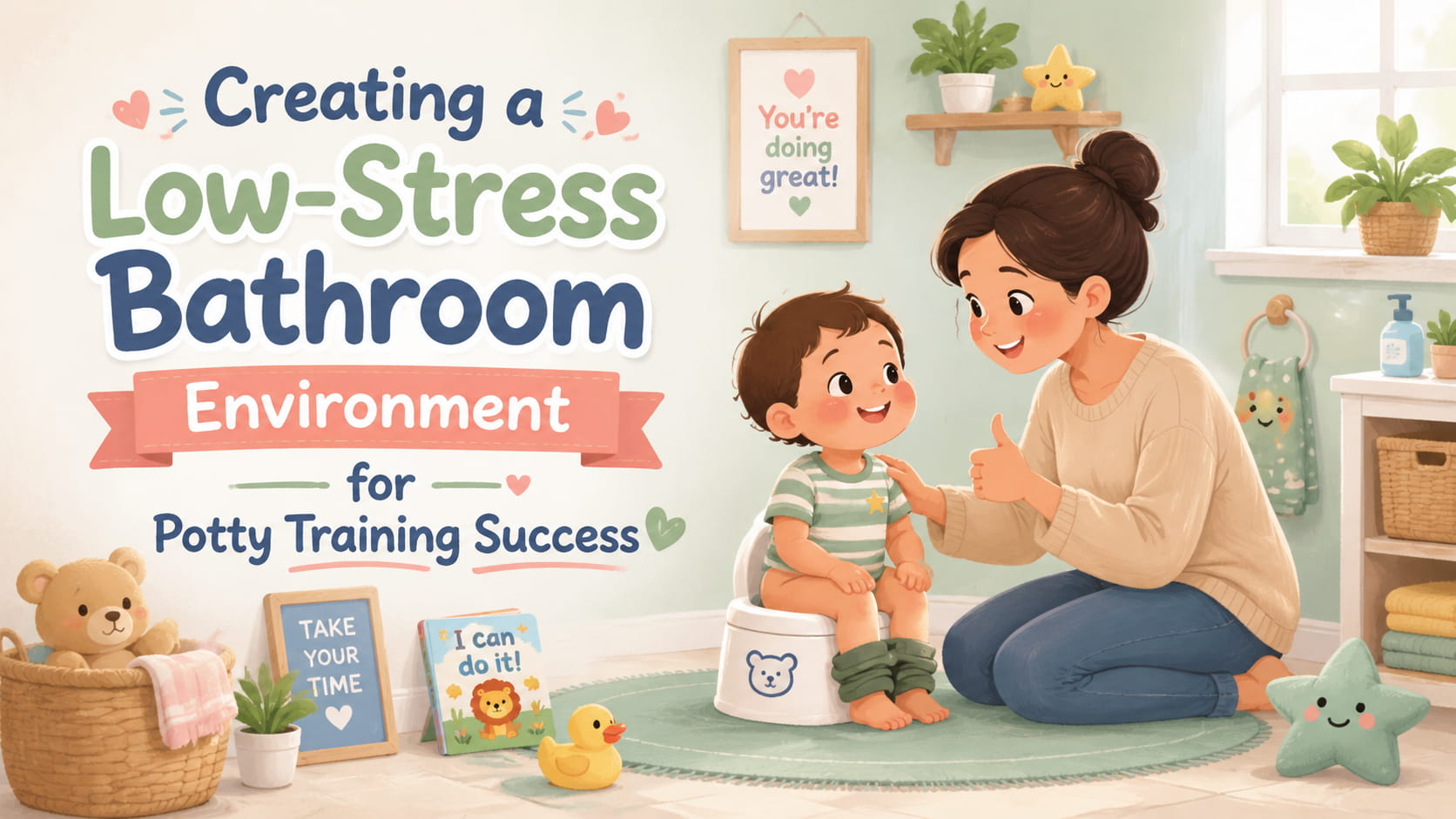
Creating a Low-Stress Bathroom Environment for Potty Training Success
Creating a Low-Stress Bathroom Environment for Potty Training Success
By creating a Low-Stress Bathroom Environment that prioritizes physical stability, autonomy, and sensory-friendly calm, parents can neutralize a toddler’s biological fight-or-flight response, making successful elimination physiologically possible.
Put this setup into a wider routine with our gentle potty training guide, including first steps, calm scripts, and caregiver handoffs.
Key Takeaways
| Insight | Why It Matters | Action Step |
|---|---|---|
| Environment precedes behavior | The physical space activates either the “rest and digest” or “fight or flight” nervous system response—determining whether elimination is biologically possible | Audit the bathroom from 30 inches off the ground before beginning any training |
| A dangling foot blocks elimination | Without foot support, the pelvic floor clenches to stabilize the body, making urination and defecation biomechanically difficult | Use a step stool that allows feet to rest flat, with knees at or above hip height |
| Toilet flushes reach 80 decibels | For auditory-sensitive children, the flush is a genuine sensory threat that triggers conditioned avoidance | Never force flushing; use sticky notes to block auto-flush sensors in public restrooms |
| Cold and harsh light trigger tension | A shivering, squinting child’s muscles are engaged in thermal defense, not relaxation | Add a warm rug, switch to 2700K soft-white lighting, keep the bathroom comfortably heated |
| Familiarity extinguishes fear | Systematic desensitization—gradual, safe exposure—rewires the brain’s threat associations | Introduce the potty as living room furniture 4–6 weeks before expecting its use |
| Autonomy is a developmental imperative | Children aged 18 months–3 years are psychologically driven to prove self-sufficiency | Make every step of the bathroom routine independently navigable for small bodies |
| The parasympathetic state enables elimination | The body can only “go” when the nervous system has determined that the environment is safe | Every environmental modification is, ultimately, a nervous system intervention |
The Bathroom Through a Toddler’s Eyes
There is a thought experiment worth conducting before purchasing a single piece of potty training equipment.
Get down on your knees. Crawl into the bathroom. Now look around.
From this vantage point—roughly 30 inches off the ground, the eye level of the average two-year-old—the room transforms. The toilet looms like a massive, cold throne with no railing, no seatbelt, and no discernible bottom. The overhead fluorescent light hammers downward with a blue-white intensity that flattens shadows and makes everything feel clinical. The walls are hard, the floor is harder, and every sound—the drip of a faucet, the hum of a vent fan, the distant murmur of a television—ricochets off ceramic surfaces and multiplies into an echoey, disorienting soundtrack. The room smells of cleaning products that sting the nostrils.
And then, without warning: the flush. A sudden, thunderous roar of swirling water that swallows everything in its path and disappears into an unknowable darkness below.
For a two-foot-tall human still learning to trust their own body, this is not a room that says “relax.” This is a room that says “danger.”
That distinction—between a room that whispers safety and a room that screams threat—is the quiet, often invisible hinge on which successful potty training swings. Pediatric occupational therapists, child psychologists, and developmental researchers have been converging on this point for decades, though the message has been slow to reach mainstream parenting culture: environmental design precedes behavioral success.
The logic is disarmingly simple once stated plainly. If the physical environment triggers a child’s sensory alarm system—if the room feels cold, loud, unstable, or unfamiliar—the child’s body will reflexively tense up. Not because they are being “difficult.” Not because they lack motivation. But because their nervous system, operating on ancient, deeply wired survival programming, has decided that this is not a safe place to be vulnerable.
And vulnerability, it turns out, is precisely what elimination requires.
(Before rearranging a single piece of bathroom furniture, it is worth understanding the biological reasons why stress derails potty training at the most fundamental level. Why Potty Training Is a Misnomer)
What follows is not a collection of quick tips or aesthetic upgrades. It is a systematic, evidence-informed framework for transforming a standard bathroom into a sensory-calm, autonomy-enabling environment—one that communicates to a toddler’s nervous system, in the only language that nervous system truly understands, that it is safe to let go.
A Brief Primer on the Toddler Nervous System
Before diving into step stools and nightlights, it helps to understand why the bathroom environment matters so profoundly. The answer lies in a basic feature of human biology that most adults have forgotten they possess—because it operates silently, automatically, and below the level of conscious awareness.
The Two Modes: “Rest and Digest” vs. “Fight or Flight”
The human nervous system has two fundamental operating modes, governed by two branches of the autonomic nervous system. Think of them as two gears in a car:
First gear: The sympathetic nervous system, often called the “fight or flight” response. This is the body’s emergency broadcast system. When the brain perceives a threat—a sudden loud noise, a sensation of falling, an unfamiliar environment—the sympathetic nervous system floods the body with stress hormones like adrenaline and cortisol. Heart rate increases. Muscles tense. Breathing quickens. And critically, the body shuts down all “non-essential” functions to redirect energy toward survival. Digestion slows. Appetite vanishes. And the muscles controlling urination and defecation—the sphincters—clamp shut.
This makes intuitive evolutionary sense. An organism fleeing from a predator cannot afford to pause for a bathroom break.
Second gear: The parasympathetic nervous system, often called the “rest and digest” response. This is the body’s all-clear signal. When the brain decides that the environment is safe, warm, familiar, and non-threatening, the parasympathetic nervous system takes over. Heart rate slows. Muscles relax. Digestion resumes. And—crucially for the purposes of this article—the sphincter muscles soften, and the body is able to eliminate.
Here is the insight that reframes everything: urination and defecation are parasympathetic functions. The body can only release when it feels fundamentally safe. This is not a metaphor. It is not a mindset exercise. It is a hard-wired neurological fact, operating entirely below the level of conscious choice.
A toddler cannot decide to override a fight-or-flight response any more than an adult can decide to stop sweating in a sauna. The nervous system does not negotiate.
What This Means for the Bathroom
The practical implication is profound and immediate: every element of the bathroom environment is, in effect, a signal to the child’s nervous system. Cold tiles signal threat. Harsh light signals exposure. Echoing sounds signal an unpredictable space. An unstable seat signals a risk of falling.
Each of these signals, individually small, can compound into a cumulative sensory load that tips the nervous system from parasympathetic mode into sympathetic mode. Once that switch flips, the child’s body is physiologically incapable of eliminating—no matter how willing, motivated, or well-coached the child might be.
Conversely, a warm rug signals comfort. Soft light signals intimacy. Quiet signals predictability. A stable, foot-supported seat signals physical security. These signals, too, compound—but in the opposite direction, building a cumulative environment of safety that allows the parasympathetic system to do its work.
This is why environmental modification is not a “nice to have” or a decorating exercise. It is the foundational intervention. Fixing the environment often fixes the behavior—without ever addressing the behavior directly.
The Physical Setup: Engineering Complete Autonomy
With the neurological framework in place, the first practical domain to address is physical setup—specifically, the equipment and spatial configuration that determine whether a toddler can navigate the bathroom independently.
The emphasis on independence is not incidental. It is rooted in developmental psychology.
Why Autonomy Matters
Between approximately 18 months and 3 years of age, children are navigating what the pioneering psychologist Erik Erikson identified as the second stage of psychosocial development: Autonomy vs. Shame and Doubt. During this window, a child’s most urgent developmental task is to prove—primarily to themselves—that they are a capable, competent individual who can do things on their own.
Think of it as the psychological equivalent of learning to walk. Just as the body is driven to master bipedal locomotion, the psyche is driven to master self-sufficiency. When a child successfully performs a task independently—pulling on their own shoes, pouring water from a small pitcher, climbing into a chair—a deep sense of confidence and self-trust is reinforced. When they are consistently helped, interrupted, or overridden, the opposite message takes root: “I cannot do this. I need someone else.”
Now apply this to the bathroom. Every single step in a potty visit—walking to the bathroom, pulling down clothing, climbing onto the seat, reaching for toilet paper, washing hands—is an opportunity to either reinforce autonomy or undermine it. If the toilet paper is mounted too high for small arms to reach, if the soap dispenser requires adult-strength hands to operate, if the sink is unreachable without being lifted—each of these design failures sends the same quiet message: “You are not capable here.”
Repeated across dozens or hundreds of bathroom visits, these micro-messages accumulate into a macro-narrative that can significantly erode a child’s willingness to engage with potty training at all.
The solution is to audit and redesign the bathroom for complete toddler autonomy.
Why Stability Is Non-Negotiable
The most consequential equipment decision in potty training is not which brand to choose—it is ensuring absolute physical stability for the child while seated. Stability is not merely a safety feature. It is a direct nervous system intervention. A child who feels physically unstable—who senses, even subconsciously, that they might slip, wobble, or fall—cannot relax. Their muscles engage protectively. Their attention shifts from the task of elimination to the task of not falling. The parasympathetic system cannot engage.
There are two primary equipment paths, each with specific stability considerations:
The standalone potty chair is the simplest solution for younger toddlers (typically 18–28 months). Because it sits directly on the floor, the child’s feet rest flat on the ground. There is no height to manage, no climbing to negotiate, no fear of falling. The biomechanical alignment—hips and knees bent at roughly 90 degrees—naturally facilitates elimination. When selecting a standalone potty, look for three features: a wide, stable base that will not tip; a splash guard for practical hygiene; and a removable inner bowl for easy cleaning.
A toilet seat insert on the full-sized toilet is appropriate for older or larger toddlers who express interest in using the “big toilet.” The insert narrows the toilet opening so a small body cannot slip through—addressing one of the most common toddler fears. But the seat insert alone solves only half the problem.
The other half—and this is where the most common and most damaging parental mistake occurs—is the step stool.
The Biomechanics of a Step Stool: More Than Just a Climbing Aid
Most parents purchase a step stool to help their child climb up to the toilet seat. Once the child is seated, the stool’s job, in the parent’s mind, is done.
It is not.
The step stool is the single most important piece of potty training equipment in the bathroom, and its function has almost nothing to do with climbing. Its primary purpose is to ensure that the child’s feet rest flat on a solid surface while seated on the toilet, allowing the knees to sit at or slightly above hip level.
To understand why this matters, consider a brief lesson in pelvic floor anatomy—explained in the simplest possible terms.
The Pelvic Floor, Explained Simply
Imagine the base of the torso as a hammock made of muscles. This “hammock” stretches from the pubic bone at the front to the tailbone at the back. It supports the bladder, the intestines, and (in biological females) the uterus. This muscular hammock is called the pelvic floor.
Running through this hammock are the openings for the urethra (for urination) and the anus (for defecation). To keep things contained during normal activity, the pelvic floor muscles stay gently contracted—like a drawstring pulled snug.
For elimination to occur, the pelvic floor must relax—the drawstring must loosen. This happens naturally and automatically when the body is in the parasympathetic (“rest and digest”) state and when the body is in a biomechanically favorable position.
The most favorable position is a squat, or something close to it. When the knees are elevated above the hips, the angle between the rectum and the anal canal opens (a concept known as the anorectal angle), and a specific muscle called the puborectalisrelaxes its grip around the lower colon. This is why humans—like virtually all other mammals—evolved to eliminate in a squatting position. The modern seated toilet, with its chair-height seat and straight-legged posture, actually works against natural biomechanics, which is why products like the Squatty Potty have become popular among adults.
Now imagine a small child perched on an adult-sized toilet. Their legs dangle in empty air, six or eight inches above the floor. Their body, registering the absence of ground beneath their feet, interprets this as instability—a potential fall. The core muscles engage to maintain balance. The pelvic floor tenses to stabilize the pelvis. The puborectalis grips tighter. The anorectal angle narrows.
In other words: the child is now sitting in a position that makes elimination biomechanically difficult or impossible—not because they aren’t trying, but because the physics of their body will not permit it.
The solution is almost absurdly simple: a step stool, positioned so that the child’s feet rest completely flat, with knees at or slightly above hip height. This single adjustment restores the natural squat-approximation posture, relaxes the pelvic floor, and opens the anorectal angle.
When selecting a step stool, look for:
- Non-slip surfaces on both the top platform and the bottom feet
- Appropriate height for the specific child and toilet (adjustable models offer the most flexibility)
- No wobble whatsoever—any instability will be detected by the nervous system and trigger protective muscle tension
This is not a convenience item. It is a physiological requirement.
The Full Autonomy Checklist: Every Step, Every Reach
With the primary seating equipment addressed, the next task is to audit the entire bathroom visit sequence—from the moment the child enters the bathroom to the moment they leave—and eliminate every point where an adult must intervene.
Here is a practical reference checklist, designed to be used as a physical walkthrough:
| Step | What to Check | Modification if Needed |
|---|---|---|
| Entering the bathroom | Can the child open/reach the door independently? | Install a lower door handle or leave the door ajar during training |
| Pulling down clothing | Can the child manage their own waistband? | Use elastic-waist pants; avoid buttons, zippers, and overalls |
| Climbing onto the toilet | Is the step stool stable and positioned correctly? | Anchor the stool or use a model with suction-cup feet |
| Sitting securely | Are feet flat? Knees at or above hip height? | Adjust stool height; consider a different stool model |
| Reaching toilet paper | Can they reach it without twisting or leaning dangerously? | Install a freestanding holder beside the potty, or lower the wall-mounted holder |
| Climbing down | Can they step down safely onto the stool? | Ensure stool surface is non-slip; practice the movement |
| Reaching the sink | Can they reach the faucet and turn it on? | Place a separate step stool at the sink |
| Accessing soap | Can small hands actually operate the dispenser? | Switch to a lightweight foaming soap dispenser |
| Drying hands | Is a towel within reach? | Lower the towel hook or ring to child height |
A bathroom designed for complete toddler autonomy will look slightly different from a standard adult bathroom. Towel hooks will be lower. Soap dispensers will be smaller. Step stools will occupy floor space. This is not a flaw in the design—it is the design working exactly as intended.
The Sensory Experience: Dialing Down the Overwhelm
With the physical infrastructure in place—stable seating, proper foot support, and full accessibility—the next frontier is less visible but arguably more impactful: the sensory environment.
The transition from physical setup to sensory calibration is natural and important. Having the right equipment is necessary, but it is not sufficient. A child can have perfect foot placement and optimal pelvic alignment and still be unable to eliminate—if the room’s sensory environment has triggered their fight-or-flight response. Physical readiness creates the conditions for elimination; sensory safety gives the nervous system permission to actually engage those conditions.
This is where the bathroom presents a unique challenge. Unlike the living room, the playroom, or the bedroom—spaces that families naturally soften with rugs, textiles, warm lighting, and familiar objects—the bathroom is typically designed for efficiency and hygiene, not comfort. Hard surfaces, cold materials, bright lights, and loud water noises are features, not bugs, from an architectural perspective. But from a toddler’s neurological perspective, the standard bathroom is a sensory obstacle course.
Research supports this concern. A frequently cited estimate from the work of Dr. Lucy Jane Miller and colleagues at the STAR Institute for Sensory Processing suggests that sensory processing differences affect approximately 1 in 6 children to a clinically significant degree (The American Journal of Occupational Therapy, 2007). But even children without a diagnosable sensory processing disorder can be overwhelmed by a bathroom environment—because the sensory intensity of the average bathroom is objectively higher than nearly any other room in the home.
The Terrifying Flush: Managing the Bathroom’s Loudest Threat
If there is one single sensory element that derails more potty training journeys than any other, it is the flush.
The numbers tell a striking story. A standard residential toilet flush registers between 70 and 80 decibels. For reference, normal conversation occurs at about 60 decibels, and the Occupational Safety and Health Administration (OSHA) recommends hearing protection for sustained exposure above 85 decibels. A powerful flush in a small, hard-surfaced bathroom—where sound has nowhere to be absorbed and instead bounces off every wall, floor, and countertop—can subjectively feel louder than its measured decibel level suggests.
For a toddler, particularly one with auditory sensitivity, the flush is not merely unpleasant. It is a jump scare—a sudden, unpredictable explosion of noise that the child cannot control, cannot anticipate, and cannot escape while seated on the toilet. The nervous system responds accordingly: adrenaline surges, muscles clench, and the parasympathetic system shuts down. If this experience is repeated enough times, the child may develop a conditioned aversion to the toilet itself—the brain learning, through simple Pavlovian association, that toilet = loud scary thing, and mounting resistance before the child even enters the bathroom.
Practical Strategies for Flush Anxiety
1. Never force a child to flush if they are afraid. This rule deserves emphasis because it runs counter to the instinct many parents have to “complete the routine.” The reasoning is clear: forcing a frightened child to flush creates exactly the kind of negative association that makes future bathroom visits harder, not easier. Instead, let the child leave the room entirely before flushing. Some children will gradually become comfortable flushing from the doorway, or with ears covered, or with a parent’s hand on their back. Some will not be ready to flush independently for months. All of these timelines are normal and healthy.
2. Validate the experience rather than dismissing it. There is an important difference between saying “It’s okay, it’s just water” and saying “That IS really loud, isn’t it? I don’t love that sound either.” The first response, though well-intentioned, effectively tells the child that their sensory experience is wrong—that they should not be feeling what they are clearly feeling. The second response acknowledges the child’s reality, names the shared experience, and communicates: “Your perception is valid. You are not broken for reacting to this.” This validation alone can significantly reduce the intensity of the fear response over time.
3. The public restroom sticky-note hack. Public restrooms present a particular challenge: automatic flush sensors. These motion-activated sensors are designed to flush the toilet the moment a person stands up—or, in the case of a fidgeting toddler, the moment the child shifts their weight, leans forward, or reaches for toilet paper. The result is an unexpected, uncontrolled blast of water and noise while the child is still seated and at their most vulnerable. For many families, a single auto-flush incident in a public restroom is enough to set training back by weeks.
The solution is elegantly low-tech: keep a small pad of sticky notes in the diaper bag. Before the child sits down, place a sticky note over the auto-flush sensor. This blocks the infrared beam and prevents the toilet from flushing until the note is removed—giving the child time to finish, stand up, move to a safe distance, and prepare before the flush occurs. Peel the sticky note off when everyone is clear of the stall. This simple intervention has been shared widely among pediatric occupational therapists and has become something of a “parent hack” legend for good reason: it works.
Temperature, Lighting, and the Atmosphere of Calm
The flush may be the bathroom’s loudest sensory challenge, but it is not the only one. Two other environmental factors—temperature and lighting—operate more subtly but can be equally disruptive to the parasympathetic state needed for elimination.
Temperature: Why Cold Defeats Relaxation
The connection between cold and muscle tension is something every adult intuitively understands. Think of stepping barefoot onto a cold bathroom floor on a winter morning: the shoulders hunch, the jaw tightens, the whole body contracts involuntarily. This is the body’s thermoregulatory response—muscles generate heat through contraction, and the nervous system prioritizes warming the body over almost every other function.
For a toddler—whose smaller body mass means they lose heat faster than adults—this effect is amplified. A child sitting on a cold toilet seat, with bare skin against cold ceramic, and bare feet on cold tiles, is a child whose muscles are engaged in thermal defense. The sphincter muscles, which are part of the pelvic floor’s muscular network, participate in this generalized tension. Relaxation—and therefore elimination—becomes physiologically more difficult.
The fix is straightforward:
- A warm, washable bathroom rug placed in front of the potty or toilet provides both thermal insulation and a comforting tactile surface for bare feet. Choose a machine-washable option with a non-slip backing.
- Keep the bathroom warm before visits. If the bathroom tends to run cold, close the door and run warm water in the sink for a minute before the child enters, or ensure that the home’s heating keeps the bathroom at a comfortable temperature.
- Consider a warm toilet seat cover or simply acknowledge that the initial cold of the seat is unpleasant and let the child know it will warm up in a moment.
Lighting: The Case for Softness
Standard bathroom lighting is designed for tasks that require precision: shaving, applying makeup, inspecting skin. Accordingly, most bathrooms feature bright, cool-spectrum overhead fixtures—often fluorescent or cool-white LED—that flood the room with light in the 4000–5000 Kelvin color temperature range.
This kind of light is excellent for visibility. It is terrible for relaxation. Cool-spectrum, high-intensity light suppresses the production of melatonin (the body’s relaxation and sleep hormone) and activates cortisol production—the same stress hormone involved in the fight-or-flight response. This effect, extensively documented in circadian rhythm research, means that a brightly lit bathroom is, in a subtle but measurable way, chemically activating the very stress pathways that inhibit elimination.
The alternative is to shift the bathroom’s lighting toward the warm end of the spectrum(2700–3000 Kelvin), which mimics the golden tones of late afternoon sunlight and supports parasympathetic activation rather than undermining it.
Practical options include:
- Replacing cool-white bulbs with warm-white LED bulbs (look for “2700K” or “Soft White” on the packaging)
- Installing a dimmer switch to allow the light level to be reduced during potty visits
- Adding a small, warm-glow nightlight plugged into a low outlet, which can serve as the sole light source during evening bathroom trips—maintaining enough visibility for safety while keeping the overall brightness low and calming
Creating an Atmosphere of Familiarity
Beyond temperature and lighting, the bathroom can be made more inviting through the inclusion of familiar, comforting objects that signal to the child: “This is your space too.”
- A small basket of favorite board books near the potty provides both entertainment and a signal that this is a relaxed, unhurried environment
- A favorite small toy or figurine placed on a low shelf can serve as a “bathroom buddy”
- A framed piece of the child’s own artwork on the wall transforms the room from a sterile adult space into a shared family space
These additions are not frivolous decorations. They are familiarity cues—objects that the child’s nervous system has already categorized as “safe” and “mine”—that counterbalance the inherent sensory intensity of the bathroom.
Normalizing the Space: Bringing the Potty Into the Living Room
There is one more strategy in the environmental toolkit—and it is, paradoxically, the most powerful and the most counterintuitive. It does not involve the bathroom at all.
The transition from addressing the bathroom’s sensory environment to rethinking where the potty lives in the home follows a logical thread: if the goal is to create the deepest possible association between the potty and the feeling of safety, why limit that association-building to the one room in the house most likely to trigger stress? Why not begin the relationship between child and potty in the environment where the child already feels most completely at ease?
This is the principle behind what child development professionals call systematic desensitization—a concept from behavioral psychology that, despite its clinical-sounding name, describes something beautifully simple.
Systematic Desensitization
The concept was formalized by South African psychiatrist Joseph Wolpe in the late 1950s, originally as a treatment for phobias in adults. The core insight is this: fear is a learned association, and it can be un-learned through gradual, safe exposure.
An analogy makes the principle intuitive. Imagine an adult who is afraid of dogs. If that person is locked in a room with a large, barking German Shepherd, their fear will intensify—the exposure is too sudden, too intense, and too uncontrollable. But if the same person begins by looking at photographs of calm dogs, then watching videos, then sitting across a large room from a sleeping puppy, then gradually moving closer over days or weeks—eventually, the brain rewires its associations. Dog stops triggering danger and begins triggering neutral or even pleasant.
The same principle applies to a toddler and a potty. If the child’s first meaningful encounter with the potty occurs in the bathroom—a room already loaded with sensory stressors—the brain is likely to bundle the potty into the category of “bathroom = stressful.” But if the first encounter occurs in the living room, surrounded by toys, soft lighting, familiar sounds, and the comforting presence of daily life, the brain forms an entirely different association: potty = safe, familiar, mine.
The “Living Room Potty” Phase: A Step-by-Step Guide
The practical application of this principle is remarkably simple:
Step 1: Introduce the potty as furniture, not as a toilet. Four to six weeks before active potty training is expected to begin, place a clean, standalone potty chair in the child’s most comfortable space—the playroom, the living room, or the family room. Do not make a ceremony of it. Do not explain its function with urgency or expectation. Simply place it in the room as if it were a new stool or a small chair.
Step 2: Do nothing. This is the hardest step for most parents, because it requires restraint in a culture that rewards action. The temptation to say “Do you want to try sitting on it?” or “That’s where big kids go potty!” is powerful. Resist it. The point of this phase is not instruction—it is normalization. The potty should become as unremarkable as the coffee table.
Step 3: Allow the child’s natural curiosity to lead. Toddlers are, by nature, relentlessly curious about new objects in their environment. Within days, most children will approach the potty, examine it, touch it, and—critically—sit on it while fully clothed. They may sit on it while reading a book. They may place stuffed animals on it. They may incorporate it into imaginative play. All of this is not only acceptable; it is exactly the point. Every casual, playful interaction with the potty is a data point being recorded by the child’s nervous system: this object is safe, familiar, and fun.
Step 4: Gradually migrate the potty to the bathroom. After the child has developed a comfortable, positive relationship with the potty in the living space, the potty can be moved—gradually, if needed—to the bathroom. Because the child already has a neural history of safety associations with this specific object, the potty arrives in the bathroom as a known friend in an unfamiliar room, rather than an unfamiliar object in an unfamiliar room. The difference in the child’s nervous system response is often dramatic.
A 2019 review published in Child: Care, Health and Development provides academic support for this approach, finding that child-led, graduated exposure methods consistently outperform adult-directed, schedule-based training methods across a range of developmental outcomes, including time to continence, incidence of regression, and long-term emotional associations with toileting.
Putting It All Together: The Low-Stress Bathroom Checklist
For parents ready to implement these strategies, the following visual checklist provides a comprehensive, at-a-glance reference:
The Sensory-Calm Bathroom: Environment Audit
| Category | Element | Goal | Quick Fix |
|---|---|---|---|
| Stability | Toilet seat / potty chair | No wobble, no slip, no fear of falling | Standalone potty for younger toddlers; seat insert + stool for older |
| Foot Support | Step stool | Feet flat, knees at or above hips | Adjustable, non-slip, no-wobble stool |
| Acoustics | Toilet flush | Reduce or eliminate flush-related fear | Allow child to leave before flushing; sticky notes for auto-flush |
| Temperature | Floor and seat surfaces | Warm enough to prevent muscle tension | Washable rug, warm room temperature |
| Lighting | Overhead and ambient light | Warm, soft, non-clinical | 2700K bulbs, dimmer switch, warm nightlight |
| Accessibility | Toilet paper, soap, towel, sink | All reachable without adult assistance | Lower hooks, foaming soap, second stool at sink |
| Familiarity | Personal objects | Signal “this is your space” | Books, a favorite toy, child’s artwork |
| Desensitization | Potty placement | Positive associations before bathroom use | Living room potty phase, 4–6 weeks before training |
Conclusion
There is a deeply ingrained cultural instinct, when a child struggles with potty training, to look for the answer in the child’s behavior—or, more painfully, in the parent’s technique. The internal monologue is familiar: “Am I not being consistent enough? Am I pushing too hard? Not hard enough? Is there something wrong?”
But behavior does not emerge from a vacuum. It emerges from an environment.
A bathroom that is cold, loud, harshly lit, and scaled for adult bodies sends a clear signal to a toddler’s nervous system—a signal that bypasses conscious thought entirely and speaks directly to the ancient, survival-oriented brain: “This is not a safe place for vulnerability.” And a nervous system that has received this signal will do exactly what millions of years of evolution have programmed it to do: it will protect itself by shutting down non-essential functions.
Elimination is a non-essential function in a perceived emergency.
Conversely, a bathroom that is warm, quiet, softly lit, stable underfoot, independently navigable, and populated with familiar, comforting objects sends the opposite signal: “This is a safe place. The body can relax. It is okay to let go.”
The remarkable thing about this reframe is not its complexity—it is its simplicity. The work of transforming a bathroom is not expensive, not technically demanding, and not time-consuming. It is a series of small, deliberate, empathetic choices: a warm rug on cold tiles. A dimmer switch replacing a harsh fluorescent. A step stool positioned just so. A sticky note in the diaper bag. A potty chair, placed quietly in the living room one Tuesday afternoon, and then left alone to become familiar.
Each of these modifications is, in its own way, an act of translation—a parent learning to speak the language of the child’s nervous system and using that language to say: “I see how you experience this room. I understand it is overwhelming. I have made it safe for you.”
That message, received by the body before a single spoken word is exchanged, is the most powerful potty training intervention in existence.
And the best part? By the time the child is ready to sit down—feet flat, knees high, in a warm and quiet room, on a potty they have known for weeks—the hardest work is already done. The environment has done the teaching. The body knows what to do.
All that remains is to trust it.
Sources & Further Reading
- Harvard Health Publishing – Understanding the Stress Response
- STAR Institute for Sensory Processing – Understanding Sensory Processing
- Child: Care, Health and Development
- Centers for Disease Control and Prevention – Developmental Milestones
- Miller, L. J., Anzalone, M. E., Lane, S. J., Cermak, S. A., & Osten, E. T. (2007). Concept Evolution in Sensory Integration: A Proposed Nosology for Diagnosis.The American Journal of Occupational Therapy, 61(2), 135–140.
- Enders, G. (2015). Gut: The Inside Story of Our Body’s Most Underrated Organ.Greystone Books. (Foundational reference for pelvic floor biomechanics and elimination posture.)
- Erikson, E. H. (1950). Childhood and Society. W. W. Norton & Company. (Classic text on psychosocial developmental stages, including Autonomy vs. Shame and Doubt.)
October 27, 2026

October 27, 2026

October 27, 2026

October 27, 2026