

Nighttime Potty Training Why Biology Matters More Than Discipline
Nighttime Potty Training: Why Biology Matters More Than Discipline
Unlike daytime learning, nighttime potty training is an involuntary biological process governed by hormonal and neurological development, meaning parents should abandon stressful behavioral tactics and instead use gentle strategies to protect their child’s sleep until the body naturally matures.
For daytime learning and other toileting questions, explore our gentle potty training guide for practical next steps and caregiver scripts.
Key Takeaways
- Daytime and nighttime potty training are governed by entirely different biological systems. Daytime control is neurological and cognitive — a learned skill. Nighttime dryness is endocrine and involuntary — a hormonal milestone. Mastering one does not produce the other, any more than learning to ride a bicycle produces the ability to swim.
- Anti-Diuretic Hormone (ADH) is the central mechanism of nighttime dryness.This hormone instructs the kidneys to reduce urine production during sleep. Many children’s brains do not yet produce a sufficient ADH surge — a normal developmental variation, not a failure.
- The brain’s arousal mechanism must also mature. Young children spend significantly more time in deep sleep than adults, making their brains less responsive to the bladder’s “full” signal. This is a neurological developmental timeline, not a behavioral issue.
- Bedwetting has a significant hereditary component. If one parent experienced late bedwetting, the child has a ~40% probability of the same; if both parents did, that rises to ~70%.
- Behavioral reward systems are not just ineffective — they are actively harmful.Sticker charts and incentive programs presuppose conscious agency over an unconscious, involuntary biological process. When the child inevitably “fails,” they internalize shame.
- “Lifting” manages laundry, not development. It does not teach the sleeping brain anything and disrupts the deep sleep critical for the very neurological maturation being awaited.
- Nighttime pull-ups are sleep aids, not developmental setbacks. They protect sleep quality and emotional wellbeing while the biology matures, with no evidence of delaying the process.
- The “lasagna bed” method transforms nighttime accident recovery. Layering two sets of sheets with alternating waterproof protectors reduces sheet-change time to under sixty seconds.
- Shame is the primary mechanism of psychological harm from bedwetting. The accident itself is neutral; the emotional environment around it determines whether the child emerges unscathed or carries lasting self-esteem damage.
- Nighttime dryness is a milestone like puberty — it unfolds on a biological timeline. The only true intervention is time, patience, and the systematic elimination of pressure.
The Frustration of the Midnight Sheet Change
The clock reads 2:07 AM. The house, which was wrapped in the deep silence that only the small hours can produce, is suddenly pierced by a small, quavering voice from down the hallway. Before the conscious mind has fully engaged, the body already knows what has happened — it has happened before, many times — and the legs are swinging out of bed with the weary automaticity of someone who has performed this ritual dozens of times.
The scene is always the same. A small figure stands in the doorway, pajama bottoms darkened with wetness, face crumpled into that particular expression children wear when they know something has gone wrong but cannot quite explain what it was. The sheets are soaked. The mattress protector, if one was remembered, has done its job, but the sheets and the pajamas and sometimes the blanket need to come off, need to be replaced, need to be carried downstairs in a damp bundle while a shivering child stands in the bathroom waiting for a fresh set of clothes.
And here is the thought that makes this moment so uniquely frustrating, so different from the ordinary exhaustions of parenting: this child is potty trained. During daylight hours, this very same child uses the toilet independently, confidently, without reminders. They go to preschool. They visit friends’ houses. They handle their daytime bathroom needs with the kind of casual self-sufficiency that, just months ago, seemed like a distant dream. The daytime problem has been solved — completely and definitively.
So why is the bed wet? Again. Still.
The questions that spiral through a sleep-deprived mind at 2 AM carry a particular emotional weight: Did I do something wrong during the daytime training? Am I not being firm enough? Should I be waking them up before I go to bed? Are they being lazy? Is something wrong with them? These are not idle questions. They are questions laced with guilt, with self-doubt, and — perhaps most damagingly — with the creeping suspicion that this is somehow a failure. The parent’s failure. The child’s failure. Someone’s failure.
This article exists to dismantle that suspicion entirely. And the tool for dismantling it is not opinion, not philosophy, not parenting ideology — it is biology. Specifically, the biology of what happens inside a child’s body during sleep, and why that biology operates on a completely different timeline than anything that happens during the day.
The central thesis is both simple and profoundly liberating: daytime potty control is a learned neurological skill, but nighttime dryness is an involuntary hormonal process. One can be taught. The other cannot. One responds to practice and encouragement. The other responds only to the passage of time.
Understanding this distinction does not just change how families approach bedtime. It changes how they feel about it. And that emotional shift — from frustration and shame to patience and understanding — may be the most important thing a parent can do for a child who is still wetting the bed.
(For a complete picture of how the daytime foundation fits into this larger developmental journey, our core guide provides the full framework: Why Potty Training Is a Misnomer.)
But first, to truly understand why nighttime is a fundamentally different challenge, it helps to understand what is actually happening — and not happening — inside a sleeping child’s body.
A Quick Primer: How the Body Manages Urine
Before diving into the specific biology of nighttime dryness, it is worth taking a step back to understand the basics. Many parents have never had reason to think about how urine is actually produced and managed by the body, and a brief overview makes everything that follows far more intuitive.
The process begins with the kidneys — two fist-sized organs located in the lower back. The kidneys function as the body’s filtration system, continuously processing blood and extracting waste products, excess water, and unneeded substances. The result of this filtration is urine, which flows from each kidney through a thin tube called a ureter and down into the bladder.
The bladder is essentially a muscular storage bag. It is remarkably elastic — in an adult, it can comfortably hold around 400 to 500 milliliters of fluid (roughly two cups), though in a young child, the capacity is considerably smaller. As the bladder fills, its muscular walls stretch, and stretch-sensitive nerve endings embedded in those walls begin to send signals up through the spinal cord and into the brain. These signals grow progressively more insistent: first a mild awareness, then a noticeable urge, then an urgent need.
During the day, when a person is awake and alert, the brain receives these signals, interprets them consciously, and initiates the decision to find a bathroom. This is the process that daytime potty training teaches a child to recognize and respond to. It is a conscious, voluntary process — which is precisely why it can be learned, practiced, and mastered.
But what happens at night? The body does not simply stop producing urine when the lights go out. The kidneys continue working around the clock. Without some biological mechanism to manage this process during sleep, every human being — adult and child alike — would wake up in a wet bed every single night.
That mechanism exists. In fact, there are two of them. And understanding how they work — and why they take years to fully develop in children — is the key to understanding everything about nighttime potty training.
The Two Biological Roadblocks to Nighttime Dryness
The human body has evolved two elegant systems to keep the bed dry during sleep. Think of them as two layers of protection, working together like a security system with both a lock on the door and an alarm on the window. If one fails, the other serves as a backup. But in young children, both systems are frequently still under construction — and when neither is fully operational, nighttime accidents are not just likely; they are inevitable.
Roadblock #1: The Magic Hormone — Anti-Diuretic Hormone (ADH)
Deep inside the brain, nestled in a structure called the hypothalamus — a small but extraordinarily important region that acts as the body’s master control center for hormones, body temperature, hunger, and sleep — there is a system that produces a hormone called Anti-Diuretic Hormone, or ADH. In medical literature, this hormone also goes by the name vasopressin, but its function is the same regardless of the label.
To understand what ADH does, it helps to break down the name itself. “Anti” means against. “Diuretic” refers to something that increases urine production (this is why medications that make people urinate more frequently are called “diuretics”). So “anti-diuretic hormone” is, quite literally, the hormone that works against urine production.Its job is to tell the kidneys: slow down. Produce less urine. We are sleeping now, and we do not need to fill the bladder at full speed.
Here is how it works in a fully developed system: as part of the body’s natural circadian rhythm — the internal 24-hour clock that regulates sleep, wakefulness, hunger, and dozens of other processes — the brain releases a significant surge of ADH shortly after a person falls asleep. This surge acts like a dimmer switch on the kidneys. It does not shut them off entirely (they still perform essential filtration), but it reduces their urine output to roughly 50% of daytime levels. This is why a healthy adult can drink a glass of water at 9 PM and still sleep seven or eight hours without a bathroom trip. The body is simply not producing urine at its usual pace.
Now, here is the developmental reality that changes everything about how nighttime accidents should be understood: many young children’s brains do not yet produce a sufficient or well-timed surge of ADH at night.
This is not a disease. It is not a disorder. It is not a deficiency that requires treatment. It is a completely normal feature of a still-developing endocrine system — the network of glands and hormones that regulates countless bodily functions and continues maturing well into adolescence. The ADH system, like the system that eventually triggers puberty or the one that determines when adult teeth emerge, operates on a genetically pre-programmed timeline that varies significantly from child to child.
Without that ADH surge, the kidneys have no reason to slow down at night. They continue producing urine at the same rate they would at 2 PM on a Tuesday afternoon. The bladder — which in a three-year-old holds perhaps 120 to 150 milliliters, roughly half a cup — fills up in a matter of hours. And since the child is sound asleep, what happens next is exactly what physics would predict: the bladder overflows.
The analogy that perhaps captures this most clearly is that of a bathtub. Imagine a bathtub with the faucet running and the drain open. During the day, ADH functions like a hand that turns the faucet down to a trickle at bedtime — the drain (urination) is closed during sleep, but the inflow is so slow that the tub does not overflow before morning. In a child without mature ADH production, the faucet stays on full blast all night long. No amount of willpower, training, or reward systems can change the water pressure. Only the maturation of the hormonal system — the hand on the faucet — can do that.
The timeline for ADH maturation is highly variable and strongly influenced by genetics. Research published in the Journal of Urology has consistently demonstrated a hereditary component to bedwetting: if one parent was a late bedwetter, a child has a roughly 40% chance of experiencing the same pattern; if both parents experienced late bedwetting, that probability rises to approximately 70% (von Gontard et al., 2011). The body follows its genetic blueprint, not the parenting plan.
For many children, the ADH system reaches functional maturity between ages three and five. For a significant minority — roughly 15% of five-year-olds and 5% of ten-year-olds, according to data from the National Institute of Diabetes and Digestive and Kidney Diseases (NIDDK) — the process takes considerably longer. These are not outliers or anomalies. They are simply on the later end of a perfectly normal developmental bell curve.
Roadblock #2: Deep Sleepers and the Brain’s Arousal Mechanism
The ADH system is the first line of defense — the lock on the door. But even in a world where the bladder fills to capacity, there is a second system designed to prevent an accident: the brain’s arousal mechanism — the neural alarm that is supposed to wake a person up when the bladder sends its urgent “I’m full” signal.
To understand why this system so frequently fails in young children, it helps to understand a little about sleep architecture — the term scientists use to describe the structural pattern of sleep stages that the brain cycles through each night.
Sleep is not a uniform state. It is not like flipping a light switch from “on” to “off.” Instead, sleep unfolds in repeating cycles of distinct stages, each with its own characteristics and purpose:

The critical stage for understanding bedwetting is Stage 3 — deep sleep, also known as slow-wave sleep. During this stage, the brain produces large, slow electrical waves (which is where the name comes from), and the sleeper is profoundly disengaged from both external stimuli (noises, light) and internal stimuli (a full bladder, a dry throat). Deep sleep is, in a sense, the brain’s scheduled maintenance window. It is when growth hormone is released in children, when the immune system does intensive repair work, when the neural connections formed during the day are strengthened and consolidated. It is essential, restorative, and biologically non-negotiable.
Here is the crucial developmental difference: young children spend a dramatically higher proportion of their total sleep time in deep, slow-wave sleep than adults do.A typical adult might spend 15-20% of the night in deep sleep. A young child can spend 40% or more in this profoundly unconscious state. This is not a flaw or an abnormality — it is a feature of developing brains, which have far more restorative work to do each night than adult brains.
But that extraordinary depth of sleep is precisely what makes the bladder’s “wake up!” signal inaudible. The full bladder sends its signal upward through the nervous system, just as it does during the day. But the signal arrives at a brain that is, for all practical purposes, in the neurological equivalent of a soundproof room. The child is not ignoring the signal. The child is not being lazy. The child’s brain is simply too deeply asleep to detect it.
Think of it like a cell phone receiving a call while buried inside a thick winter coat at the bottom of a gym bag in a noisy car. The call is coming through — the signal is being transmitted — but the conditions make it impossible for the sound to reach anyone who could answer it. The phone is not broken. The caller is not at fault. The environment simply prevents the connection.
Research from the University of Amsterdam’s Sleep Center has provided compelling evidence for this mechanism: children with nocturnal enuresis (the medical term for bedwetting) consistently show higher arousal thresholds on polysomnography studies — meaning it takes a significantly stronger stimulus to wake them from deep sleep compared to their age-matched peers who are already dry at night (Nevéus, 2017). This is measurable, objective, neurological data confirming that bedwetting in these children is a function of brain maturation, not behavior or motivation.
Two Systems, One Conclusion
The picture that emerges from understanding these two biological mechanisms is unambiguous:
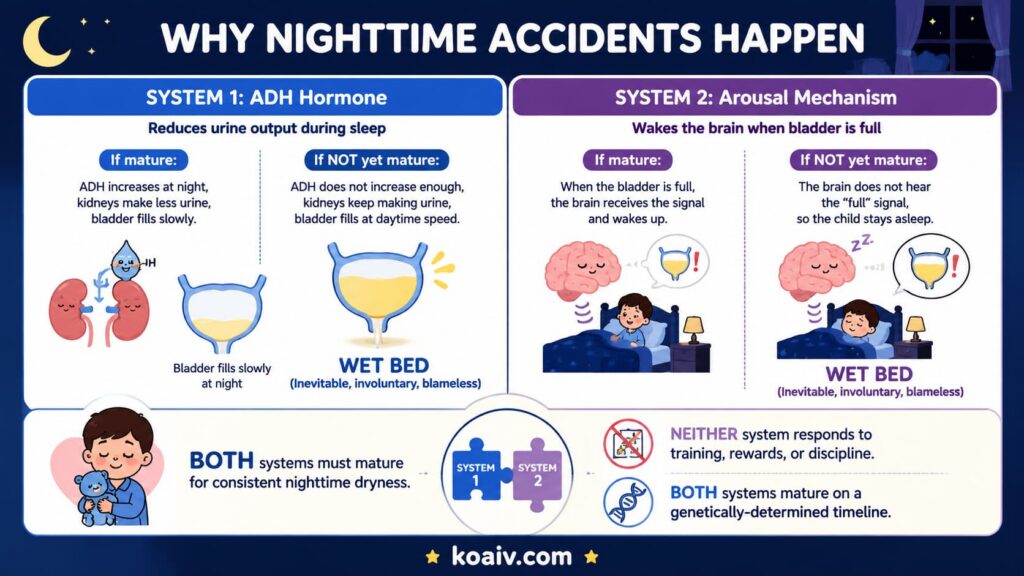
For a child to stay dry at night, both systems must be functioning. The ADH must be produced in sufficient quantity to slow urine production, and the arousal mechanism must be mature enough to wake the child if the bladder does fill despite the hormonal help. When one or both systems are still developing — as they are in millions of perfectly healthy children — nighttime accidents are not a failure. They are a biological certainty.
And this leads directly to the question that every parent asks next: If this is biology, then why did I spend three months doing sticker charts?
Why Traditional “Training” Tactics Fail at Night
The distinction between daytime and nighttime potty training is one of the most consequential — and most commonly missed — insights in early childhood development. Society and culture treat them as two parts of the same process: Part One (daytime) and Part Two (nighttime), as if nighttime dryness were simply the advanced level of the same skill. Master the basics during the day, and the nighttime version should follow naturally, like moving from addition to subtraction in the same math class.
But this framing is fundamentally incorrect, and it is the root cause of an enormous amount of unnecessary parental guilt and childhood shame.
Daytime and nighttime potty training are two completely different bodily systems.Daytime control is cognitive and motor-driven — the child learns to recognize the sensation of a full bladder, decides to go to the bathroom, walks there, and uses the toilet. It involves conscious awareness, voluntary muscle control, and learned behavior. It is a skill, and like all skills, it can be taught, practiced, and mastered.
Nighttime dryness is strictly endocrine — hormonal. It depends on the maturation of the ADH system and the neurological arousal mechanism, neither of which is under conscious control, and neither of which responds to any form of behavioral intervention.
The most clarifying analogy is this: expecting daytime potty success to automatically translate to nighttime dryness is like expecting a child who has learned to ride a bicycle to suddenly know how to swim. Both involve the child’s body. Both are physical milestones. But they involve completely different systems, completely different skills, and completely different timelines. No amount of bicycle practice will produce swimming ability, and no amount of daytime potty practice will produce nighttime ADH surges.
With this framework in mind, the failure of traditional nighttime tactics becomes not just understandable but utterly predictable.
The Futility of Sticker Charts for Unconscious Acts
The sticker chart may be the single most ubiquitous tool in the modern parenting toolkit. For daytime behaviors — remembering to brush teeth, saying please and thank you, tidying up toys — it can be remarkably effective. The underlying mechanism is straightforward behavioral psychology: positive reinforcement increases the frequency of a chosen behavior. The child performs the desired action, receives a reward (the sticker), associates the action with a positive outcome, and becomes more likely to repeat it.
But there is a foundational requirement baked into this mechanism that is easy to overlook: the individual must have conscious control over the behavior being rewarded. Sticker charts work because the child is making a decision — a conscious, voluntary, in-the-moment decision — to perform the action. The chart tracks choices. It incentivizes agency.
A sleeping child has no agency. They are not making decisions. They are not choosing to wet or not wet the bed any more than they are choosing to grow two centimeters taller overnight or to have a particular dream. When a child goes to sleep and wakes up wet, no decision was made. No behavior occurred. An involuntary, unconscious biological event took place, governed entirely by the maturation level of hormonal and neurological systems that the child cannot access, influence, or even perceive.
When a sticker chart is placed on the wall for “dry nights,” the damage it causes is subtle but significant. On the nights the child happens to wake up dry — which will occur occasionally, as bladder capacity, fluid intake, and sleep depth naturally fluctuate — the sticker goes on the chart, and the child feels proud. But this creates a dangerous illusion: it implies that the child did something to earn that sticker. It implies that dryness is an achievement, a result of effort or good behavior.
Which means that on the inevitable nights when the child wakes up wet, the inescapable conclusion — from the child’s perspective — is that they failed. They did not try hard enough. They were not good enough. They could have earned the sticker, but they chose not to, or they were too lazy, or they did not care enough. The child who fails to earn the sticker does not conclude that the sticker system is flawed. They conclude that they are flawed.
Pediatric psychologist Dr. Howard Bennett, author of Waking Up Dry: A Guide to Help Children Overcome Bedwetting, has written extensively about the shame cycle that well-intentioned reward systems create when applied to bedwetting. The pattern is consistent: initial enthusiasm, followed by sporadic success, followed by inevitable failure, followed by escalating shame and withdrawal (Bennett, 2015). The child begins to dread bedtime — not because of the wetness itself, but because of what the wetness means within the reward framework.
The research on the psychological impact of bedwetting reinforces this concern with striking clarity. Studies examining self-esteem in school-age children who wet the bed consistently rank bedwetting among the most distressing conditions for child self-worth, comparable in its reported emotional impact to parental separation and bullying (Moffatt, 1994). And critically, the research suggests that it is not the bedwetting itself that causes this distress — it is the shame architecture built around it by well-meaning adults who have mistaken a biological event for a behavioral one.
The Exhaustion of “Dream Pees” (Lifting)
Another strategy that enjoys widespread popularity — particularly among parents who are themselves desperate for uninterrupted sleep — is the practice known as “lifting” or “dream pees.” The approach is straightforward: at some point before the parent goes to bed, typically around 10 or 11 PM, they wake the child (or semi-wake them — many children remain essentially asleep throughout), carry them to the toilet, help them urinate, and return them to bed. The reasoning is intuitive: if the bladder is emptied at 11 PM, perhaps it will not fill to capacity again before the 6 AM alarm.
It is worth acknowledging that this tactic does, in certain cases, reduce the frequency of wet sheets. And for families in the trenches of nightly accidents, fewer wet sheets is not a trivial benefit. But the reduction in laundry should not be confused with developmental progress, because the two have almost nothing to do with each other.
Lifting does not teach the child’s brain anything. The child’s ADH system does not observe the 11 PM bathroom trip and conclude that it should start producing more hormone. The arousal mechanism does not register the interruption and decide to become more sensitive. The parent is essentially performing the function of the child’s missing biological systems manually — emptying the bladder that the immature ADH system failed to keep from filling, and providing the wake-up signal that the immature arousal mechanism failed to send. The moment the parent stops lifting, the accidents return to their previous frequency, because nothing internal has changed. It is the biological equivalent of carrying a child to school every day and calling it walking practice.
But there is a second, more concerning dimension to this practice. Lifting actively disrupts the child’s deep sleep — the very sleep stage that is most critical for their physical growth, cognitive development, and neurological maturation. Even when the child appears to remain asleep during the process (eyes closed, no apparent awareness), polysomnography studies show that the brain transitions out of its current sleep stage during any physical disturbance, and the architecture of the remaining night’s sleep is altered (Mindell et al., 2006).
This creates a quietly counterproductive dynamic: the parent is interrupting the child’s deep sleep — the sleep that is essential for the very brain maturation (including maturation of the arousal mechanism) that would eventually resolve the bedwetting naturally. It is a strategy that may marginally address the symptom while potentially, subtly, working against the underlying biological timeline.
And of course, the parent’s own sleep is disrupted as well, compounding the exhaustion that makes the entire nighttime experience so emotionally charged.
A Note on Fluid Restriction
One additional tactic deserves brief mention, as it is among the most commonly recommended pieces of folk wisdom around bedwetting: restricting fluid intake in the evening. The logic is deceptively simple — less water in means less urine out — and there is a kernel of practical truth to the idea that a child who drinks a large glass of juice immediately before bed may have a fuller bladder than one who does not.
However, as a strategy for preventing bedwetting, fluid restriction is both largely ineffective and potentially counterproductive. The kidneys will process whatever fluid is in the body; reducing evening intake shifts the timing of urine production slightly but does not meaningfully change the total output over the course of a night. More importantly, adequate hydration is essential for children’s health, and creating anxiety around drinking water — “no more water after 6 PM!” — adds yet another layer of stress and restriction to an already fraught experience.
The American Academy of Pediatrics recommends that children be encouraged to drink plenty of fluids throughout the day and to avoid excessive fluid intake just before bed, but explicitly advises against strict fluid restriction as a bedwetting intervention (AAP, 2023).
Gentle Strategies for the Nighttime Wait
If the conclusion of the preceding section feels disorienting — so everything we have been doing is pointless? — that is a perfectly natural response. When the tools in the toolbox are revealed to be designed for the wrong job, the immediate reaction is often: then what tools should we be using?
The honest, science-backed answer is that the primary “strategy” for nighttime dryness is time. The biology will mature when it matures, on its own genetically-influenced schedule, and no intervention can meaningfully accelerate that timeline. This can feel like an unsatisfying answer in a culture that values action, optimization, and control.
But here is what transforms waiting from passive resignation into an active, empowering stance: the goal is not to fix the child — it is to optimize the conditions around the child while their biology does its work. Protect sleep quality. Eliminate shame. Minimize the practical disruption of nighttime accidents. Create an environment in which the child feels safe, supported, and completely unburdened by something that is not their fault and not within their control.
These strategies are not about training. They are about caring — wisely, practically, and without guilt.
1. Embracing Nighttime Pull-Ups Without Guilt
Few parenting decisions inspire more anxiety than the choice to put a four- or five-year-old who is fully daytime trained back into nighttime pull-ups or diapers. The cultural weight attached to this decision is immense. It feels like regression — like taking a step backward, undoing progress, admitting defeat. The internal monologue often sounds something like: They should be past this by now. Other kids their age are dry at night. Putting them back in pull-ups is giving up.
This framing deserves to be dismantled — thoroughly and permanently.
A nighttime pull-up is not a crutch. There is a persistent myth that wearing a pull-up at night somehow “teaches” the body that it is acceptable to urinate during sleep, thereby delaying the maturation of the ADH system or the arousal mechanism. There is no scientific evidence for this. The hormonal and neurological systems that control nighttime dryness are developing according to a genetic program that is entirely indifferent to what the child is wearing. A pull-up no more delays nighttime dryness than a cast on a broken arm delays bone healing — both are protective measures used while the body does its own internal work.
What a nighttime pull-up is, most accurately, is a sleep aid. It is a tool whose purpose is to protect the quality of sleep for both the child and the family. Consider what happens on a night with an accident and no pull-up: the child wakes cold, wet, and distressed. The parent wakes, turns on lights, strips sheets, changes pajamas, comforts the crying child, and remakes the bed. Everyone’s sleep is shattered. The child may absorb the message that their body did something wrong, something disruptive, something that made everyone upset.
Now consider the same night with a pull-up: the child sleeps through. The parent sleeps through. In the morning, the pull-up is removed and disposed of matter-of-factly, without drama or commentary. The child’s sleep was uninterrupted. Their self-esteem was unscathed. Their body continued its slow, invisible work of hormonal maturation without the disruption of a middle-of-the-night cortisol spike from distress.
The American Academy of Pediatrics explicitly states that nighttime dryness is a developmental milestone with high individual variability, and recommends protective undergarments as an appropriate management strategy without any associated concern about delaying development (AAP, 2023).
Parents who describe the decision to use nighttime pull-ups as “transformative” are almost universally reporting the same change: the elimination of nightly anxiety. When no one in the family is lying in bed dreading the 2 AM alarm, everyone sleeps better. And better sleep — for both the parent and the child — accelerates every developmental process, including the very neurological maturation that everyone is waiting for.
2. Layering the Bed: The “Lasagna” Method
For families in the transitional phase — the weeks or months when dry nights are becoming more frequent but accidents still happen unpredictably — there is a beautifully practical technique that has earned an almost legendary status among experienced parents. It is known, affectionately and accurately, as the “lasagna bed.”
The concept is simple. Instead of making the bed in the standard way — one mattress protector, one fitted sheet — the bed is assembled in alternating layers, like the Italian dish from which the method borrows its name:

When a nighttime accident occurs, the recovery process is reduced to approximately sixty seconds: peel off the top fitted sheet (Layer 4) and the waterproof protector beneath it (Layer 3), toss them into the hallway or a hamper, pull the blanket back over the already-clean second sheet (Layer 2), and everyone is back in bed. No fumbling in the dark for clean sheets. No hunting through the linen closet. No fifteen-minute mattress-spraying-and-remaking ordeal while a shivering child stands in the bathroom doorway.
The child does not have the experience of standing cold and exposed while the entire bed is reconstructed. The parent does not endure the extended wakefulness that makes falling back asleep so difficult. What was a significant disruption — often thirty minutes or more from start to finish — becomes a brief, almost mechanical process that barely interrupts the night.
This technique is a practical embodiment of the larger philosophy at work in this entire approach: manage what can be managed, and release what cannot. The accident cannot be prevented — not by any amount of willpower, training, strategy, or nighttime intervention. But the aftermath, the disruption, the emotional weight of the experience — all of that can be reduced to almost nothing with a little preparation and the right materials.
3. Creating a Shame-Free Environment
Beyond the practical strategies, the single most important thing a family can do during the period of nighttime development is to systematically eliminate shame from the experience of bedwetting. This is not a soft, feel-good suggestion. It is a recommendation grounded in decades of pediatric psychology research showing that shame is the primary mechanism through which bedwetting causes lasting psychological harm.
What does a shame-free environment look like in practice?
- Language matters. Accidents are called “accidents,” not “messes” or “problems.” They are discussed with the same neutral tone used for any other minor inconvenience — a spilled glass of water, a scraped knee. They are not whispered about, and they are not announced to siblings or extended family.
- Reactions matter. The middle-of-the-night response is calm, quiet, and mechanical. Sheets are changed without sighing, eye-rolling, or expressions of frustration. The child hears: “It’s okay, let’s get you into dry pajamas” — not “Again? Come on.”
- Framing matters. When the topic comes up in conversation — and it will — the child hears a consistent, simple message: Your body is still growing. Some parts of your body are not ready yet, and they will be when they’re ready. This is not your fault, and there is nothing wrong with you.
This last point deserves particular emphasis. Children are extraordinarily sensitive to the emotional subtext of adult behavior. A parent who says “It’s fine, sweetie” while visibly frustrated, sighing, and aggressively stripping sheets is sending a message that contradicts the words. The child reads the body language, not the script. Genuine calm — the kind that comes from actually understanding the biology and truly believing that the accident is no one’s fault — is qualitatively different from performed calm, and children can tell the difference.
Nighttime Dryness as a Milestone, Not an Achievement
There is a second innovative perspective that deserves space in this conversation, because it reframes not just bedwetting but the entire cultural relationship with childhood milestones.
Nighttime dryness is a developmental milestone in the same category as puberty — it happens when the body is biologically programmed to make it happen.
Consider: no parent places a sticker chart on the wall to encourage a child to grow taller. No family restricts evening snacks to accelerate the arrival of adult teeth. No one withholds dessert until a child’s voice drops an octave. These are all biological processes governed by genetic timelines and hormonal systems, and the very idea of trying to incentivize or discipline them into happening faster strikes everyone as absurd.
And yet, the production of Anti-Diuretic Hormone — a hormonal event governed by the same endocrine system that will eventually orchestrate puberty — is routinely treated as though it were a behavior that can be coached. The framing is so deeply embedded in the culture that it requires active effort to see past it.
When a pediatrician tells a concerned parent, “Most children outgrow bedwetting by age seven,” the word outgrow is doing crucial work in that sentence. Not “overcome.” Not “conquer.” Not “learn to stop.” Outgrow. The body grows into the capability, at the pace determined by its own internal clock.
The role of the parent in this process is not director, strategist, or optimizer. It is patient custodian — protecting the child’s sleep, protecting the child’s self-esteem, minimizing the practical inconveniences of the transitional period, and offering the calm, confident reassurance that comes from genuinely understanding what is happening.
Conclusion
There is a parable, perhaps apocryphal, about a farmer who became frustrated with the slow growth of his seedlings and decided to help them along by pulling gently on each one. By the next morning, every seedling was dead. The farmer’s intentions were good. His understanding of what was actually needed was not.
The parallel to nighttime potty training is almost too precise to be coincidence. The pulling — the sticker charts, the midnight wake-ups, the fluid restrictions, the exasperated sighs at 2 AM — does not accelerate the growth. It damages the seedling. The ADH will surge when the endocrine system is mature. The arousal mechanism will sharpen when the neural circuitry is complete. And in virtually every child, it will happen — on the precise schedule that genetics and biology have determined.
What families can do in the meantime is both simpler and more profound than any training program:
Remove the pressure. No sticker charts. No rewards. No punishment. No comments at breakfast about whether the bed was wet or dry. No comparisons to siblings, cousins, or classmates.
Protect the sleep. Use pull-ups without guilt. Layer the bed for quick changes. Avoid waking the child unnecessarily. Prioritize uninterrupted, deep, restorative sleep — because that sleep is not just a luxury; it is the biological environment in which the very systems being waited for are doing their developing.
Provide the conditions. A shame-free household. A child who knows, genuinely and completely, that the wet bed is not their fault. A family that treats the transitional period with the same patience they would extend to any other biological process over which no one has control.
Trust the process. The bloom is coming. It has its own calendar. And the only thing that can be done — the only thing that needs to be done — is to provide the right conditions and wait.
Sources & Further Reading
- American Academy of Sleep Medicine (AASM) — Pediatric Sleep Duration Recommendations
- Mayo Clinic — Bed-wetting: Symptoms, Causes, Diagnosis, and Treatment
- International Children’s Continence Society (ICCS) — Clinical Standards and Guidelines for Nocturnal Enuresis
- Nevéus, T. (2017). “Pathogenesis of Enuresis: Towards a New Understanding.” International Journal of Urology. National Institutes of Health / PubMed
- von Gontard, A., et al. (2011). “The Genetics of Enuresis: A Review.” Journal of Urology, 185(6). American Urological Association
- Mindell, J. A., et al. (2006). “Sleep and Sleep Disorders in Children and Adolescents.” Psychiatric Clinics of North America
- Centers for Disease Control and Prevention (CDC) — Child Development Milestones
- National Institute of Diabetes and Digestive and Kidney Diseases (NIDDK) — Bladder Control Problems and Bedwetting in Children