

Why Your Self-Worth Is Not Tied to Their Potty Progress
Why Your Self-Worth Is Not Tied to Their Potty Progress
By reframing toilet readiness as a natural biological process rather than a reflection of parental competence, caregivers can successfully release the crushing potty training pressure and completely untangle their self-worth from their toddler’s timeline.
When you want a practical next step, our gentle potty training guide brings together readiness, calm scripts, and support for common challenges.
Key Takeaways
- Parental self-worth has become accidentally entangled with toilet training timelines, driven by a convergence of social media culture, generational mythology, and institutional enrollment policies — none of which reflect the actual science of child development.
- “Early training” in past generations was a fundamentally different practice — parents were conditioned to catch a child’s eliminations, not children exhibiting advanced neurological control. The economic necessity of hand-washing cloth diapers, not superior parenting, drove the earlier timeline.
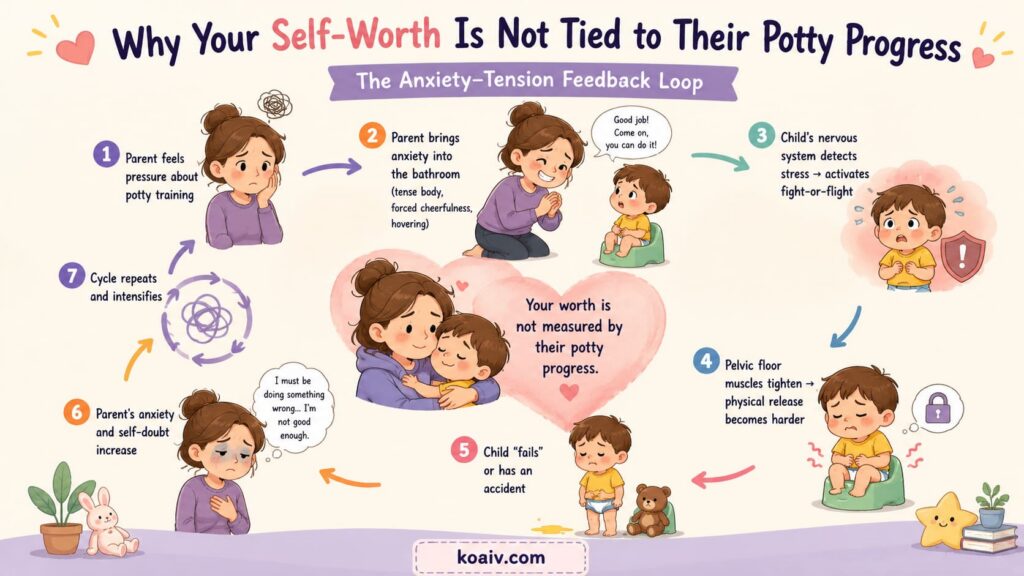
- Parental anxiety is physiologically contagious through co-regulation. Stress transmitted in the bathroom activates the child’s fight-or-flight response, causing pelvic floor muscles to tighten and making the physical act of releasing the bladder or bowels literally harder.
- The pressure creates a self-reinforcing feedback loop: parental anxiety → child detects stress → muscles tighten → “failure” → increased parental anxiety → deeper entrenchment of the cycle.
- Bodily autonomy is non-negotiable. Sleep, eating, and elimination cannot be coerced. Pressure does not produce compliance — it produces resistance, withholding, or regression.
- Redefine success. A child who feels safe, respected, and attuned to their body’s signals is a far more meaningful parenting achievement than a dry diaper at an arbitrary age.
- 3-day bootcamp success stories are substantially explained by survivorship bias. They represent children who were already biologically ready; the method coincided with existing readiness rather than creating it.
- Potty training is biological facilitation, not a parenting skill. Just as no parent takes credit for a child’s growth in height or the eruption of adult teeth, no parent should bear blame for the pace of neurological maturation.
- Practical boundary scripts provide an effective, warm strategy for redirecting well-meaning relatives without engaging in unproductive debates.
The Unspoken Competition of the Toddler Years
It begins, as most parenting anxieties do, with a perfectly ordinary question delivered in a perfectly ordinary setting.
A Tuesday morning. A playground. Two parents — exhausted, coffee-dependent, doing their best — watch their toddlers negotiate the politics of a shared sandbox. And then, between sips, the question: “So… are they potty trained yet?”
Four words. Casual. Conversational. And for one of those two parents, absolutely devastating.
In the fraction of a second before the answer forms, an entire internal tribunal convenes. The mind races through evidence it has been unconsciously cataloguing for months: the failed attempt in February that ended with tears on both sides. The pediatrician’s patient, slightly too-patient, reassurance. The Instagram reel — viewed at 2 a.m. while feeding a newborn — of some impossibly put-together mother celebrating her eighteen-month-old’s toilet triumph, filmed in a bathroom that looked like a Pottery Barn catalog. The silent verdict arrives before the spoken words do: Not yet. And somehow, that means something about me.
This is the quiet epidemic no one is naming clearly enough.
Somewhere along the way — through a combination of social media pressure, generational mythology, and institutional gatekeeping — modern parenting culture has performed an extraordinary sleight of hand. It has taken a biological milestone, one governed by the maturation of nerves and muscles that no human being can consciously accelerate, and recast it as a parenting performance metric. A child’s diaper status has become, in the cultural imagination, a proxy for parental competence.
The result is a generation of mothers and fathers carrying a psychological weight that was never theirs to hold. And the cost — to their confidence, to their wellbeing, and most importantly, to their relationship with the very child they are trying to help — is far greater than most realize.
This piece is not another potty training guide. There will be no schedules, no reward charts, no debates about pull-ups versus underwear. Instead, it is an examination of something more foundational and, arguably, more urgent: the need to untangle parental self-worth from a child’s bodily functions. Because the pressure is real, the sources are identifiable, the damage is measurable, and the path forward is clearer than most parents dare to believe.
This mindset shift — from performance to patience — is the very foundation of a biology-first approach to childhood development. Before exploring the emotional terrain of letting go, it helps to ground oneself in the actual science of readiness: Why Potty Training Is a Misnomer. Understanding the physiology first transforms the pressure into perspective.
Where Does the Crushing Pressure Come From?
Before any problem can be solved, it must first be understood. And the pressure that parents feel around potty training is not a single monolithic force — it is a convergence of at least three distinct currents, each reinforcing the others, each deserving its own examination.
Understanding where the pressure originates is, itself, the first act of liberation. Naming a force reduces its power. What follows is a clear-eyed look at the three primary sources.
The “Bootcamp” Culture and the Social Media Illusion
To understand why so many parents feel inadequate about toilet training, it helps to understand the information ecosystem in which they are making decisions.
The dominant narrative of potty training on social media in the 2020s is the “3-day bootcamp” — a structured, intensive approach that promises full toilet independence within a single long weekend. It is marketed with the confidence of a business productivity hack: follow the steps, commit to the process, and results are guaranteed.
For readers unfamiliar with this approach, the basic premise is straightforward: over three consecutive days, the child wears no diaper, the parent watches continuously for signs of imminent urination or bowel movement, and the child is repeatedly guided to a small toilet or potty chair. The theory is that total immersion accelerates learning, much like a language immersion program.
And for some children, it works beautifully. These are the stories that populate the feeds.
But here is what the algorithm does not show — and what the method’s loudest advocates rarely discuss: the social media feed is, by its very architecture, a highlight reel. It is a curated exhibition of peak moments, not a documentary of ordinary life. When a parent scrolls past a video of a beaming twenty-month-old announcing a successful trip to the potty, the platform does not attach a disclaimer: “This child’s nervous system happened to reach maturity at the exact moment this training push began.”
What goes unseen is the far larger population of families who attempted the same method, with equal diligence and commitment, and encountered something very different: accidents on hour forty-seven, a child who began fearfully withholding bowel movements (refusing to go at all, sometimes for days), tears from both parties, and a bathroom that had been transformed from a neutral space into a place of stress and failure. These families are not posting triumphant content. They are quiet. Many are ashamed. And they have absorbed, without anyone explicitly stating it, a deeply damaging message: the method worked for everyone else, so the failure must be mine.
A helpful analogy: Imagine a swimming class that claims every child will swim independently after three lessons. The children who happen to be developmentally ready for swimming — whose motor coordination, body awareness, and comfort in water have reached the necessary threshold — will indeed appear to “succeed” because of the class. But the class did not create the readiness. It merely coincided with it. The children who were not yet ready will splash, struggle, and swallow water, and their parents will wonder what they did wrong. The answer, of course, is nothing. The timing was simply not right for that particular child.
This distinction — between a method that creates readiness and a method that capitalizes on pre-existing readiness — is one of the most important ideas in this entire discussion. We will return to it in greater depth later.
Generational Pressure: “You Were Trained by 18 Months!”
If social media is the loudest source of pressure, generational comparison is perhaps the most intimate — and therefore the most difficult to deflect.
The scene is familiar to nearly every parent of a toddler: a family dinner, a holiday gathering, a casual phone call. A grandparent, uncle, or family friend offers what they believe is helpful encouragement: “In my day, children were out of diapers by eighteen months. I had you trained before you could walk properly. I don’t understand why it takes so long now.”
The remark is usually delivered without malice. It is often accompanied by genuine bewilderment. And for the parent on the receiving end, it lands with the force of a quiet indictment.
But the historical context that is never supplied alongside this comparison is both illuminating and profoundly liberating. To understand why, a brief detour into domestic history is necessary — because what “potty training” meant in 1965 and what it means in 2026 are, in practice, almost entirely different activities.
The washing machine changed everything. Prior to the widespread adoption of the automatic washing machine — which only became a common household appliance in the Western world during the 1950s and 1960s — laundering cloth diapers was a physically grueling, time-consuming, daily ordeal.
There were no disposable diapers (Pampers was not introduced until 1961, and affordable, widely available disposables did not become the norm until the late 1970s). Every soiled diaper meant another round of soaking, scrubbing, wringing, and hanging to dry. For mothers managing multiple children, this was not a minor inconvenience — it was hours of additional physical labor every week.
In this context, “training” a child out of diapers as early as possible was not a parenting philosophy. It was maternal survival. The motivation was not developmental insight but economic and physical necessity.
Furthermore — and this is the detail that most dramatically reframes the generational comparison — what was called “training” before the modern era was more accurately described as parent conditioning.
Researchers in developmental history and pediatric literature have consistently noted that early “toilet training” in the pre-disposable era typically involved the caregiver learning to read an infant’s rhythmic biological cues — the specific grunts, facial expressions, squirming, or timing patterns that preceded elimination — and rushing the child to a pot at precisely the right moment. The parent was trained to catch the output. The child’s own neurological control over their sphincter muscles was no more advanced than it is today.
What does “sphincter control” mean? In simple terms, a sphincter is a ring-shaped muscle that acts like a valve — it opens and closes to let things through. Humans have sphincter muscles at the base of the bladder and at the end of the bowel. For a child to be truly “toilet trained,” their brain must be able to send a signal to these muscles that says “hold” or “release” on command.
This requires a specific level of nervous system development — particularly the development of a fatty coating around nerve fibers called myelin, which speeds up signal transmission. This myelination process is entirely biological. It cannot be hurried by practice, incentives, or parental enthusiasm, any more than a child can be made to grow taller by stretching.
The human nervous system has not changed meaningfully in two or three generations. What has changed is the economic necessity of early training and the availability of modern diapers. Grandparental comparisons, however lovingly intended, are comparing fundamentally different practices under fundamentally different material conditions.
Institutional Deadlines: The Impossible Bind of Preschool Requirements
Of all the sources of potty training pressure, the institutional deadline commands the most sympathy — because it is the most structurally real. Unlike social media pressure, which can theoretically be scrolled past, or generational comments, which can be gently deflected, a preschool enrollment policy that requires full toilet independence is a concrete, administrative gate. It has deadlines. It has consequences.
For readers unfamiliar with this landscape: many preschool and daycare programs, particularly competitive or highly sought-after ones, require that children be fully toilet trained — meaning they can independently recognize the urge, get to the bathroom, manage their clothing, and use the toilet without adult assistance — before they are admitted. Some programs offer flexibility; many do not. The practical stakes can be enormous: a coveted school place, a critical step in a child’s socialization, or a parent’s ability to return to full-time work may all hinge on whether a three-year-old’s bladder has reached a specific developmental threshold by a specific calendar date.
According to research published in the Journal of Developmental & Behavioral Pediatrics, approximately 60% of parents reported that external deadlines — most commonly daycare or preschool enrollment requirements — were their primary motivator for beginning toilet training, regardless of whether their child was showing signs of readiness. In other words, the single most common reason parents begin the process is not a biological signal from the child, but an administrative requirement from an institution.
This deserves to be named with precision: institutional deadlines impose an arbitrary, calendar-based timeline onto a process that is fundamentally biological and individual. It is the equivalent of a school requiring all children to reach a height of 100 centimeters by September 1st — a demand that ignores the enormous natural variation in the pace of physical growth.
The anxiety this generates in parents is entirely legitimate. It deserves validation, not dismissal. What it does not deserve, however, is for the parent to internalize the institutional pressure as evidence of personal inadequacy. The preschool’s policy reflects its staffing constraints and operational needs. It does not reflect the competence of any individual parent.
The Three Sources of Potty Training Pressure
Source What It Sounds Like What’s Really Happening Social Media “This 3-day method worked for everyone!” Survivorship bias — only successes are visible Generational Comparison “You were trained by 18 months!” Different era, different practice, different conditions Institutional Deadlines “Must be trained for enrollment” Administrative policy, not developmental science
The Psychological Toll on the Parent-Child Relationship
Understanding where the pressure comes from is clarifying. But understanding what the pressure does — once it has taken up residence inside a parent’s nervous system — is where the stakes become truly urgent.
Because parental anxiety about potty training does not stay contained within the parent. It does not remain a private, internal experience that can be managed through willpower or hidden behind a cheerful expression. Anxiety leaks. And the place it leaks most profoundly is directly into the very relationship it most desperately wants to protect.
When Anxiety Becomes Contagious: The Science of Co-Regulation
To understand how a parent’s emotional state physically affects a child’s ability to use the toilet, it helps to understand a concept from developmental neuroscience called co-regulation.
In simple terms, co-regulation is the process by which a young child’s nervous system takes its cues from the nervous system of their primary caregiver. Think of it as emotional Wi-Fi: a toddler is constantly, unconsciously scanning their parent’s face, voice, body posture, and breathing patterns for information about whether the current environment is safe or dangerous. This is not a conscious process for either party — it happens automatically, below the level of awareness, and it is one of the most well-documented phenomena in child development research.
An analogy that makes this concrete: Imagine walking into a room where everyone is visibly tense — jaws clenched, voices hushed, eyes darting. Even if no one explains the situation, the body responds: heart rate increases, muscles tighten, breathing becomes shallow. Now imagine a toddler, whose ability to independently assess safety is still developing, entering a bathroom where the most important person in their world — the parent — is radiating anxiety, forced cheerfulness, and desperate hope. The child does not think, “My parent seems stressed about my toileting.” The child’s nervous system simply registers: this place is not safe.
The implications for potty training are direct and physiological. When a parent approaches the bathroom with tense shoulders, a strained voice pitched a half-octave too high into artificial cheerfulness, searching eyes, and an undercurrent of desperate expectation, the child’s nervous system activates what neuroscientists call the sympathetic nervous system — commonly known as the fight-or-flight response.
Here is the critical detail that most potty training advice overlooks entirely: when the fight-or-flight response is activated, the muscles of the pelvic floor contract. The sphincter muscles tighten. The bladder holds. The bowel resists release. This is not a choice the child is making. It is an automatic, protective, biological response to perceived threat. The very act that the parent is hoping will occur becomes, under conditions of transmitted anxiety, physically harder for the child’s body to execute.
In other words, the parent’s urgency has — through perfectly understandable, well-documented neurological pathways — made the problem measurably worse. Not through bad intentions. Not through poor technique. Through the involuntary transmission of stress from one nervous system to another.
This is not a moral failing. It is a physiological feedback loop. And naming it clearly removes the blame from both parties while pointing toward a genuinely constructive response: the single most effective thing an anxious parent can do to help their child succeed on the toilet is to regulate their own nervous system first.
The Power Struggle and the Sacred Domain of Bodily Autonomy
The anxiety feedback loop is one pathway through which pressure damages the process. But there is a second, equally important dynamic at play — one rooted not in neuroscience but in the psychology of human autonomy.
There is a remarkably short list of domains over which one human being cannot exercise genuine coercive control over another — regardless of age, size, or authority. That list includes three items: sleep, eating, and elimination. All three are governed by the autonomic nervous system — the part of the nervous system that operates below conscious control — and, ultimately, by the individual’s own body.
A parent can create conditions conducive to sleep, but cannot make a child fall asleep. A parent can prepare nourishing food, but cannot make a child swallow. And a parent can lead a child to the toilet, sit beside them, read stories, offer encouragement, and wait — but cannot make a child release their bladder or bowels.
This is not a discipline problem. This is biology.
For readers who find this counterintuitive, consider: adults themselves cannot urinate on command in certain situations. The “shy bladder” phenomenon — the inability to urinate in a public restroom when others are nearby — is not a failure of willpower. It is the body’s autonomic nervous system overriding conscious intention because the environment does not feel sufficiently safe. If grown adults with fully mature nervous systems experience this, it should come as no surprise that a two-year-old, in the early stages of neurological development, experiences something similar — and far more intensely — when the emotional atmosphere feels pressured.
When parental anxiety escalates into overt pressure — through increasingly urgent prompts, frustration that leaks through facial expressions, reward systems that gradually shift from celebration to bribery to veiled threats, or the subtle but devastating withdrawal of warmth and affection in moments of failure — the child does not experience a motivational adjustment. The child experiences a threat to bodily autonomy, which developmental psychologists identify as one of the most primal forms of threat a developing person can perceive.
The response is not compliance. The response is one of three things: resistance (“No! I don’t want to!”), withholding (the child begins refusing to use the bathroom at all, sometimes holding bowel movements for days, which can lead to constipation, impaction, and medical complications), or regression (a child who had been making progress suddenly reverts to earlier behavior). All three responses intensify the parent’s anxiety, which intensifies the pressure, which intensifies the child’s resistance — a spiral that can persist for months.
Dr. William Sears, the pediatrician whose decades of research on attachment parenting have influenced contemporary child-development practice, captured this dynamic with characteristic precision: the more a parent “needs” a child to perform a developmental task, the less likely the child is to perform it comfortably. The psychological transaction has become contaminated. The child is no longer learning a new bodily skill. The child is navigating a parent’s emotional need — and these are fundamentally different activities requiring fundamentally different internal states.
Gentle Strategies for Untangling Your Worth from Their Progress
The preceding sections paint a clear — and, for many parents, painfully recognizable — picture of how pressure originates, how it transmits, and how it backfires. The natural question that follows is: What does the alternative look like in practice?
The good news is that untangling parental self-worth from a child’s toileting progress does not require perfection. It does not demand that a parent eliminate all anxiety overnight or achieve some unrealistic state of Zen detachment. It requires, instead, a series of deliberate, specific, and repeatable reframings — cognitive tools that, practiced with consistency, genuinely shift the emotional architecture of the experience.
What follows are three concrete strategies, each addressing a different dimension of the pressure.
1. Redefining What “Success” Actually Means
The dominant cultural metric for potty training success is a binary: dry underwear by a specific age, or failure. This metric is simple, measurable, and deeply embedded in the way most parents think about the process. It is also a remarkably poor measure of anything meaningful about either a child’s development or a parent’s competence.
Consider what this metric actually captures. A child who achieves dry underwear at twenty-two months has demonstrated one thing: that their particular neurological and muscular system happened to reach a specific developmental threshold at an early point on the normal distribution curve. It says nothing about the quality of their relationship with their parent, the sophistication of their emotional regulation, or their sense of safety within their own body. It is, at most, a measure of biological timing — as arbitrary and uninformative as measuring the age at which a child’s first molar erupts.
A more honest and generative definition of success looks fundamentally different:
True success is raising a child who feels safe in their body, respected in their autonomy, and confidently attuned to their own physical signals — regardless of the age at which those signals become reliably actionable.
A child who achieves this — whether it happens at twenty-four months or forty-two months — has learned something far more valuable than bladder control. They have learned that their body is trustworthy, that its rhythms deserve respect, and that the adults in their life can be counted on to honor its timeline. These lessons echo forward through childhood, adolescence, and adulthood in ways that no early dry diaper can match.
This is not a consolation prize. This is the actual prize.
The American Academy of Pediatrics (AAP) has consistently maintained, across multiple revised guidance documents, that most children are not developmentally ready for toilet training before 18 months, with the average window of readiness falling between 24 and 36 months. Crucially, the AAP’s research also indicates that children who begin training later — when they are genuinely ready — often achieve full reliability more quickly and with fewer episodes of regression, withholding, or behavioral resistance than children who are pushed to begin before readiness is established.
In other words, the urgency does not purchase the outcome it promises. In many cases, it actively delays it.
The most powerful tool a parent can have is not a rigid schedule — it is the ability to read a child’s own biological signals of readiness. (Potty Training Readiness: 7 Physiological and Behavioral Cues to Look For)
2. Boundary Setting with Well-Meaning Relatives
Understanding the historical context of generational pressure (as discussed earlier) is intellectually liberating. But intellectual understanding, by itself, does not resolve the acute discomfort of the moment — the Thanksgiving dinner, the Sunday phone call, the playground encounter — when the comment actually arrives.
What parents need in those moments is not a lecture on the history of the washing machine. What they need are prepared scripts: brief, warm, unambiguous responses that close the conversational door without escalating into debate or defense.
The goal of a boundary script is subtle but specific. It is not to educate the relative (though the impulse is understandable). It is not to defend oneself (though the feelings absolutely warrant it). It is to acknowledge the comment, assert ownership of the decision, and redirect the conversation — all in a single breath.
Several scripts have proven consistently effective in practice:
| Situation | Suggested Response |
|---|---|
| Grandparent comparing eras | “We’re letting their biology lead the way, and we’re not worried about the calendar. Thanks for your interest, though!” |
| Relative questioning the timeline | “Our pediatrician is keeping a close eye on things, and we’re following their guidance.” |
| Persistent or repeated comments | “We’re handling it in the way that feels right for our family. We feel good about where we are.” |
| Well-meaning advice offered unsolicited | “I appreciate the suggestion! We’ve found an approach that’s working for us, so we’re going to stick with it.” |
What these scripts share is a refusal to enter the implied debate. They do not argue with the relative’s premise. They do not present counterevidence. They do not apologize. They simply decline to participate in the conversational frame that the comment assumes — a frame in which the parent’s approach is up for evaluation.
Practiced with warmth, a genuine smile, and the quiet confidence of someone who has examined the evidence, these scripts are remarkably effective. They may need to be repeated — some relatives require multiple encounters before the message registers — but consistency renders them increasingly automatic and decreasingly stressful.
The deeper truth these scripts protect is worth stating explicitly: no relative, however well-intentioned or experienced, is raising this particular child. The parent in the room is the only person with full information — the child’s temperament, sensory sensitivities, sleep patterns, medical history, daily rhythms, fears, and joys. That comprehensive, intimate knowledge confers a legitimate authority over decisions about that child’s development. It does not require external validation, and it does not owe external justification.
3. Radical Acceptance: Embracing What Cannot Be Controlled
The first strategy (redefining success) addresses what is measured. The second strategy (boundary scripts) addresses who gets a voice. The third — and perhaps most profound — addresses something deeper: the parent’s relationship with uncertainty itself.
Radical acceptance, a concept drawn from dialectical behavior therapy (DBT) and Buddhist philosophy, does not mean passive resignation or indifference. It means the deliberate, conscious acknowledgment that certain outcomes are genuinely beyond one’s control, and that this is appropriate — not a failure. It is the difference between “I can’t control this and that means I’m powerless” and “I can’t control this because it was never mine to control in the first place.”
Applied to potty training, radical acceptance begins with a clear-eyed look at what actually determines the timeline:
- Myelination. As discussed earlier, this is the biological process by which nerve fibers develop a fatty protective coating (myelin) that dramatically increases the speed and reliability of signal transmission. Until the nerve pathways between the brain and the bladder/bowel sphincters are sufficiently myelinated, the child literally cannot send the “hold” or “release” signal fast enough to act on it reliably. This process unfolds on its own biological clock. It cannot be accelerated by practice, enthusiasm, sticker charts, or parental devotion.
- Temperament. Some children are cautious, risk-averse, and deeply uncomfortable with new physical sensations. For these children, the unfamiliar feeling of sitting on a cold toilet seat, the alarming splash of water, or the strange sensation of releasing without the familiar containment of a diaper can be genuinely distressing — not because of poor parenting, but because of inborn temperamental wiring.
- Neurodiversity. Children with autism spectrum conditions, ADHD, sensory processing differences, and a range of other neurodevelopmental profiles may experience the sensory environment of the bathroom — the echoing acoustics, the bright lights, the cold surfaces, the sounds of flushing — as significantly more intense and potentially overwhelming than neurotypical peers. These children may need additional time, environmental modifications, and patience. Their timeline is not delayed; it is different. And this difference reflects neurology, not parenting quality.
- Pelvic floor maturity. The muscles of the pelvic floor, which provide the structural support for bladder and bowel control, develop at varying rates. In some children, these muscles achieve the necessary strength and coordination earlier; in others, later. A pediatric physical therapist can assess this if concerns arise, but in the vast majority of cases, it is simply a matter of waiting for the muscles to catch up with the child’s cognitive understanding.
Listing these factors plainly serves a specific purpose: it makes visible the truth that the parent’s role in this process is genuinely that of a guide, not an engine. A guide creates favorable conditions, offers consistent and gentle support, pays attention to the terrain, and trusts the landscape to reveal the path forward. An engine forces movement regardless of conditions and depletes itself in the attempt.
One more analogy: Consider a gardener planting seeds. The gardener controls the soil quality, the watering schedule, and the sunlight exposure. The gardener does not control when the seed germinates. Two identical seeds, planted in identical conditions, may sprout days or even weeks apart — because germination is governed by internal biological processes that the gardener cannot see, measure, or accelerate. A good gardener does not blame themselves when one seed takes longer. A good gardener trusts the process and keeps providing favorable conditions.
Dr. T. Berry Brazelton, the pioneering pediatrician whose child-led approach to toilet training became the basis of the American Academy of Pediatrics’ official guidance, offered an observation that contains more practical wisdom than most entire books on the subject: “The timing is the child’s. The parent’s job is to be ready when the child is.” A single sentence. And arguably the only potty training advice any parent truly needs.
Reframing the Paradigm: Potty Training as Biological Facilitation
The strategies above — redefining success, setting boundaries, practicing radical acceptance — are powerful and practical. But beneath all of them lies a deeper paradigm shift, a fundamental reframing that, once fully absorbed, changes the emotional texture of the entire experience.
Here is the reframe, stated as simply as possible:
Potty training is not a parenting skill. It is the facilitation of a biological process.
Consider the evidence. When a child grows three centimeters over the course of a winter, no parent attributes that growth to their nutritional creativity or their superior parenting instincts. Growth is understood as biology. The parent’s role is supportive — good nutrition, adequate sleep — but no one takes personal credit for the centimeters themselves.
When a child’s adult teeth begin pushing through the gum line, displacing baby teeth, no one posts a tutorial titled “How I Helped My Child’s Permanent Teeth Erupt: A 5-Step Method.” Dental development is understood as physiology. The parent provides fluoride toothpaste and regular dental visits. The teeth arrive on their own schedule.
When a child’s voice deepens during puberty, when growth plates fuse, when hormonal changes reshape the body — all of these are understood, without controversy, as biological processes that unfold according to an internal, individual timetable. The parent creates supportive conditions. The body does the work.
Toilet readiness is no different. The sphincter muscles will mature. The nerve pathways will myelinate. The brain-bladder connection will solidify. The child will, barring genuine medical conditions that warrant professional evaluation, eventually acquire full and reliable bladder and bowel control. Every single healthy adult walking the planet is proof of this. The parent’s role is not to produce this outcome — it was always going to happen — but to create a calm, supportive, low-pressure environment in which the child’s own biology can unfold without interference, anxiety, or shame.
The moment this reframing truly takes hold — the moment a parent genuinely internalizes that they are facilitating biology, not performing a skill — the ego is safely removed from the equation. And with the ego removed, the anxiety loses its fuel. The bathroom stops being a testing ground and becomes, again, what it should be: a neutral, ordinary room where an ordinary, inevitable biological process eventually occurs.
The Survivorship Bias of the “3-Day Bootcamp”
Earlier in this discussion, the 3-day bootcamp method was introduced alongside the observation that its social media success stories paint an incomplete picture. This idea deserves fuller treatment, because the statistical principle at its core — survivorship bias — is one of the most useful mental models a parent can possess, not just for potty training, but for evaluating parenting advice of all kinds.
What Is Survivorship Bias?
Survivorship bias is a logical error that occurs when conclusions are drawn by looking only at the cases that “survived” a selection process — that is, the visible successes — while ignoring the much larger, invisible population of cases that did not succeed.
The classic example: During World War II, the U.S. military examined bombers that returned from missions and noted where they had sustained the most bullet damage — the wings, the fuselage, the tail. Engineers proposed reinforcing those areas with additional armor. The statistician Abraham Wald pointed out the critical flaw in this reasoning: the engineers were studying the survivors. The bullet holes on returning planes showed where a bomber could be hit and still fly home. The areas with no damage on returning planes — the engines, the cockpit — were precisely the places where a hit was fatal. Those planes never came back to be studied.
The parallel to potty training is direct. The parents loudly broadcasting their bootcamp success stories are the “returning bombers.” They are the families whose children happened to be, at the moment of the intensive training push, already at or near full neurological readiness. The concentrated effort of three days served as a launching pad for a process that was already biologically primed to succeed. The bootcamp did not create the readiness. It capitalized on readiness that was already present.
The parents whose children were not yet at that threshold — who attempted the identical method with identical diligence and encountered withholding, tears, escalating resistance, and weeks of cleanup — are the bombers that did not return. They are not posting. They are not visible. And their absence from the data creates a profoundly misleading impression of the method’s effectiveness.
What the Social Media Feed Shows vs. What’s Actually Happening
| Visible (Posted) | Invisible (Silent) |
|---|---|
| “Day 3: She did it! Zero accidents!” | Child not yet ready; attempts led to withholding and fear |
| “This method changed our lives!” | Method attempted and abandoned; parents feel they “failed” |
| “Why didn’t we do this sooner?” | Early attempt created bathroom anxiety lasting months |
| Confidence, celebration, advice-giving | Shame, self-doubt, silence |
Importantly, naming this bias is not an argument against the bootcamp method itself. For families whose children are showing clear, robust signs of readiness, a concentrated training effort can be a useful and efficient approach. The argument is against treating the method’s outcome as a measure of parental competence. If it works, it worked because the child was ready. If it does not work, it did not work because the child was not yet ready. The parent’s quality is not the variable being measured.
Conclusion
This has been, by design, a long and thorough examination — not of techniques, but of the emotional and psychological landscape that surrounds one of early parenthood’s most anxiety-producing milestones. The argument can be distilled into a few core truths that bear restating plainly, without qualification or caveat.
A child’s diaper status is not a parent’s report card.
It is not a measure of attentiveness, dedication, intelligence, patience, or love. It is not a reliable indicator of the quality of attachment, the sophistication of the parenting approach, the harmony of the household, or the depth of the parent-child bond. It is, at its most accurate, a rough and imprecise proxy for where one particular child sits on a biological developmental timeline that varies enormously — and normally — across individuals.
Every healthy adult on this planet has learned to use a toilet. Every one. The timeline differed. The method differed. The age of mastery differed. And not a single one of those adults, in the course of their adult lives, has ever been asked, or has ever cared, whether they achieved this milestone at twenty months or forty months. It is a distinction that matters intensely for a brief window and then becomes, permanently and completely, irrelevant.
The parent who has stayed present through every accident, every regression, every frustrating plateau week, every small triumph greeted with disproportionate celebration, every load of laundry, and every moment of quiet doubt — that parent has been doing something profoundly real and significant and good. Not contingently good. Not “good if it works out.” Good in itself. Good because presence, patience, and respect for a child’s autonomy are goods, full stop, independent of any outcome on any given day.
There is a particular quality of courage required to step back from the cultural noise — to stop measuring a child’s biology against a neighbor’s timeline, to decline the implied competition of the playground question, to look a well-meaning grandparent in the eye and say, with warmth and certainty, “We’re not worried.” It is not passive courage. It is the active, daily, deliberate choice to exchange anxiety for trust — trust in the child’s body, in the developmental process, and in one’s own quiet, steady, sufficient presence.
The toilet will happen. The readiness will come. It always does.
In the meantime, give yourself permission to exhale.
Sources & Further Reading
- National Institute of Child Health and Human Development (NICHD) — Child Development and Behavior Branch (CDBB)
- Journal of Developmental & Behavioral Pediatrics (Toilet learning: Anticipatory guidance with a child-oriented approach)
- Centers for Disease Control and Prevention (CDC) — Developmental Milestones
- Harvard Graduate School of Education — Usable Knowledge: Child Development
- Brazelton, T.B. — “A Child-Oriented Approach to Toilet Training” (Foundational paper establishing the readiness-based paradigm)
- The American Psychological Association (APA) — Parenting Stress and Child Development