
Why Potty Training Is a Misnomer
Why Potty Training Is a Misnomer
Successful potty training is a natural, biological milestone that should be guided by a child’s neurological and emotional readiness rather than arbitrary age deadlines or high-pressure “bootcamps” to ensure a healthy, stress-free transition.
Turn these ideas into everyday next steps with our gentle potty training guide, including readiness, first steps, and practical scripts.
Key Takeaways
- Age is not a readiness indicator. True potty training readiness is a convergence of physical, cognitive, and emotional development — not a birthday on the calendar.
- The brain-bladder connection is neurological. Myelination of the sphincter nerve pathway — the “insulation” on the body’s internal wiring — cannot be accelerated by behavioral methods, rewards, or pressure.
- Premature pressure carries measurable medical risk. Forced training before physiological readiness is a documented contributor to chronic constipation, dysfunctional voiding, encopresis, and UTIs in school-age children.
- Nighttime dryness is hormonal, not behavioral. It depends on vasopressin (ADH) production — a developmental process that matures independently of daytime training and can take until age 5, 7, or later.
- Regressions are stress responses, not defiance. They reflect cognitive overload from life changes or developmental leaps. Compassion — not punishment — is the evidence-based response.
- Neutral language protects body autonomy. The words families use around elimination shape a child’s long-term relationship with their own body and their capacity for self-trust.
- Later and readiness-based often means faster and healthier. Children who begin potty learning when genuinely ready typically complete the transition more quickly and with fewer complications than those who begin early under pressure.
- The parent’s emotional state is part of the method. A regulated, patient, self-compassionate parent is the single most effective potty training “tool” that exists.
The Pressure-Cooker of Potty Training
Somewhere between the eighteen-month checkup and the preschool enrollment form, potty training transformed from a quiet developmental milestone into a competitive sport.
It happens in the most ordinary of moments. A parent is standing at a playground, watching their two-and-a-half-year-old climb a slide, when another parent mentions — casually, almost too casually — that their child “trained in a weekend.” The statement lands softly, but its aftershock is seismic. Suddenly, the playground feels different. A mental clock starts ticking, one that was not there before.
Friends casually drop their child’s age into conversation the way other parents might mention an early reader or a prodigious soccer player. Preschool waiting lists quietly enforce enrollment deadlines — must be fully trained by age three — as if a bladder operates on an academic calendar. Grandparents, with the best of intentions, offer cautionary tales of “how it was done back then,” often involving strict schedules, cold floors, and a stopwatch. Social media floods parenting feeds with triumph posts: Day 3. She got it. We’re done! — followed by 847 heart reactions and a comment section that reads like a victory parade.
Nobody posts about Day 14, when it all fell apart again. Nobody posts about the tears — the child’s and the parent’s.
The net effect is a kind of collective anxiety that descends on families right around the time their toddler begins pulling at their diaper. Parents feel the clock ticking before the child has even taken a single step toward readiness. And that anxiety — well-intentioned, deeply human, and entirely understandable — becomes the invisible force that drives many families toward approaches that are faster, more intensive, and more pressurized than the child’s developing body can sustainably accommodate.
This article is an invitation to step off that treadmill entirely.
Because here is what the research actually shows: potty training is not a performance. It is not a test of parental competence. It is a biological unfolding — as natural and as individually timed as learning to walk, cutting a first tooth, or developing the coordination to catch a ball. And when it is treated as such — when it is guided by the architecture of a child’s developing nervous system rather than by societal timelines or parental pride — the process becomes not only smoother, but profoundly more protective of the child’s long-term physical health and the family’s emotional well-being.
The evidence-based, compassionate path forward is not about doing more. It is about understanding what the body already knows, and trusting it.
Why This Conversation Matters Now More Than Ever
Before diving into the science, it helps to understand why potty training has become such a fraught topic in the first place — and why so many parents feel more confused, not less, despite having access to more information than any generation in history.
For most of human history, potty training was not a “thing.” It happened gradually, communally, and without much fanfare. Children observed older children and adults, imitated when they were ready, and arrived at independence on their own developmental schedule. There was no three-day method because there was no preschool deadline.
The modern anxiety around potty training is, in many ways, a product of specific cultural forces:
- The rise of rigid preschool enrollment criteria, which created artificial deadlines tied to the calendar rather than the child.
- The disposable diaper revolution of the 1970s and 1980s, which paradoxically made diapers so convenient that many families delayed training longer — leading to a cultural backlash and the emergence of “speed training” methods designed to compress the process.
- The explosion of parenting content on social media, which created an unprecedented platform for comparison and amplified extreme success stories while burying the messy, nonlinear reality of how most potty training actually unfolds.
Understanding this cultural backdrop is important because it helps parents separate legitimate developmental science from manufactured urgency. Much of the pressure surrounding potty training is not coming from pediatricians, developmental psychologists, or neurobiologists. It is coming from a culture that has conflated speed with success and early achievement with good parenting.
With that context in place, the natural question becomes: If the timeline is not about age, then what is it about? The answer lies in the nervous system — and it is far more elegant than any sticker chart.
The Biology of Potty Training Readiness
Perhaps the most liberating reframe in modern pediatric research is also the simplest: chronological age is a remarkably poor predictor of potty training readiness. The American Academy of Pediatrics (AAP) stopped recommending a specific age for potty training decades ago, shifting instead to a readiness-based approach — a change that carries profound implications for how families navigate this milestone.
To understand why age does not matter nearly as much as development does, it helps to look at what is actually happening inside a child’s body when the transition from diapers to toilets becomes biologically possible.
The Neurological Bridge: Understanding the Brain-Bladder Connection
At the core of every successful potty training experience is a physiological process that no sticker chart, reward system, or weekend bootcamp can accelerate: the myelination of the nerve pathway between the brain and the external urinary sphincter.
That sentence is full of technical language, so here is what it actually means in plain terms.
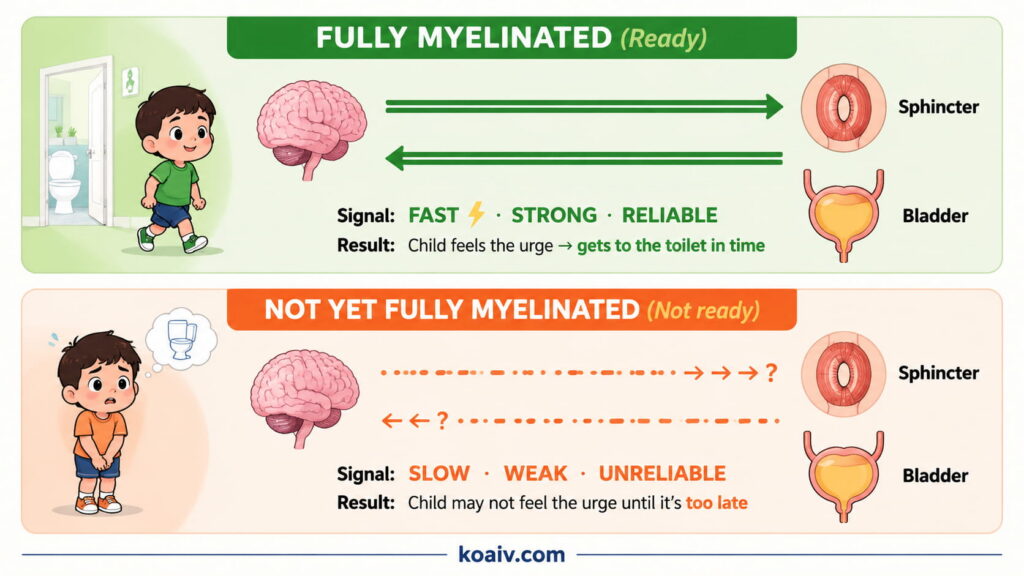
Myelin is a fatty, white substance that coats nerve fibers throughout the body. Its function is remarkably similar to the rubber insulation around an electrical wire. Without insulation, an electrical signal traveling through a wire is slow, weak, and prone to short-circuiting — it might arrive at its destination, or it might fizzle out along the way. With proper insulation, that same signal travels fast, strong, and reliably every time.
The same principle applies to the nervous system. When nerve fibers are coated with a thick, healthy layer of myelin, the electrical signals they carry — the messages the brain sends to the muscles, and the messages the muscles send back to the brain — travel rapidly and consistently. When nerve fibers are not yet fully myelinated, those signals are slower, weaker, and less dependable.
Now, here is where this connects directly to potty training:
For a child to successfully use a toilet, an extraordinarily complex chain of neurological events must occur — a chain that most adults take completely for granted because it has been automated for decades:
Step 1: The bladder fills with urine, stretching the bladder wall.
Step 2: Stretch receptors in the bladder wall detect the fullness and send a signal up through the spinal cord to the brain.
Step 3: The brain receives the signal and interprets it as the conscious sensation of “needing to go.”
Step 4: The brain evaluates the situation: Is this the right time and place?
Step 5: If the answer is yes, the brain sends a signal back down to the external urinary sphincter — the ring of muscle that acts as the “gate” — instructing it to relax and allow urine to pass.
Every single step in this chain depends on well-myelinated nerve pathways. If the myelin coating is still developing — if the “insulation” on these wires is thin or patchy — the signal may not arrive in time, may not be strong enough to register consciously, or may not produce a reliable muscular response. The result is what looks like an “accident,” but is, in reality, a nerve pathway that has simply not finished building itself yet.
This is a critical distinction. A child who has an accident is not being disobedient, lazy, or inattentive. That child’s wiring is still under construction. Myelination is a biological process governed by genetics, nutrition, and the overall pace of neurological development. It cannot be willed into existence by the parent or the child.
Dr. T. Berry Brazelton, the pioneering pediatrician whose child-oriented research fundamentally shifted American potty training practices in the late 20th century, championed this exact understanding. His landmark studies, published in Pediatrics, helped establish that rushing the process before this neurological readiness is in place does not accelerate success — it simply increases the likelihood of conflict, distress, and potentially harmful physical consequences that can persist for years.
The Three Pillars of True Potty Training Readiness
If age is not the indicator, then what is? Research consistently shows that readiness is not a single switch that flips on a particular birthday. It is a convergence of three distinct developmental streams — physical, cognitive, and emotional — that must come into relative alignment before sustainable progress becomes possible.
Think of it like a three-legged stool. If all three legs are sturdy, the stool holds weight reliably. If even one leg is too short, the stool wobbles — and no amount of external pressure will make it stable.
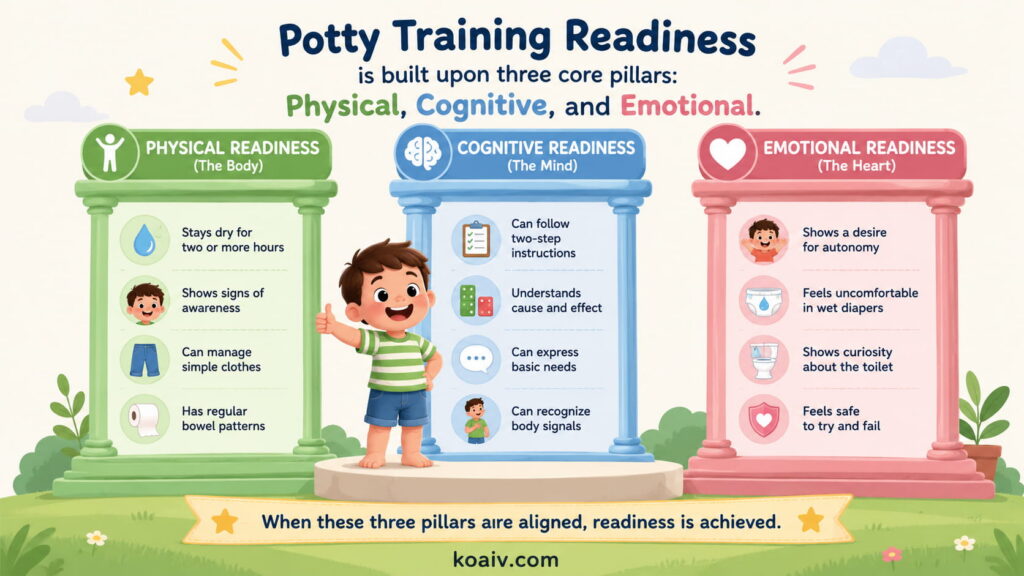
Physical Readiness is the most foundational layer — the neurological and muscular infrastructure without which the other two are moot. Key indicators include the ability to stay dry for at least two hours at a stretch (a sign that bladder capacity has grown large enough to hold a meaningful volume of urine and that the sphincter muscles are developing control); demonstrated awareness of the act of elimination (the telltale pause, the squatting, the facial expression of concentration that signals a bowel movement is underway); and increasing physical coordination — the ability to walk to the bathroom, manage simple clothing, and sit and stand independently.
Cognitive Readiness bridges the body and the behavior. A child who is cognitively prepared can follow a simple, two-step instruction (“pull down your pants and sit on the potty”), has developed a basic understanding of cause and effect (“when my body feels this way, it means I need to go”), and can communicate needs — however imperfectly — through words, signs, or gestures. This is not about intelligence. It is about a specific stage of cognitive development related to sequencing, self-awareness, and communicative intent.
Emotional Readiness is perhaps the most underappreciated of the three, and frequently the one most undermined by external pressure. It encompasses a developing desire for independence and mastery (the “I do it myself!” phase that can be both exhilarating and exhausting for parents), a growing discomfort with soiled diapers (an internal motivation, not an externally imposed one), and — crucially — the psychological safety to want to try without the paralyzing fear of failure if the process does not go perfectly. A child who is afraid of disappointing a parent is not emotionally ready, regardless of what the bladder and brain can do.
It is worth pausing here to emphasize one thing: these three pillars do not develop in lockstep. A child may be physically ready but not emotionally ready. Another child may be cognitively and emotionally eager but physically behind. This is completely normal. The variations in readiness timelines across children are enormous — and they are not a reflection of parenting quality, intelligence, or character.
(For a detailed, sign-by-sign breakdown to help identify where a specific child falls across all three pillars, see the companion article: Potty Training Readiness: 7 Physiological and Behavioral Cues to Look For)
The Psychological Cost of Forced Potty Training “Bootcamps”
With a clear understanding of the biological foundations, a difficult but necessary question comes into focus: What happens when potty training is pushed before those foundations are in place?
The 3-Day Potty Training Method. The Bare-Bottom Approach. The Elimination Communication Protocol. The internet abounds with intensive, militarized systems promising to achieve in 72 hours what the developing nervous system may not be ready to sustain. Some of these programs recommend withholding diapers entirely, confining the child to a single room, and implementing vigilant, hour-by-hour monitoring until the child “gets it.”
The appeal is entirely understandable. Parents are exhausted by diapers. They are financially burdened by the cost — the average American family spends between $2,000 and $3,000 on disposable diapers before a child is trained, according to the National Diaper Bank Network. They face preschool deadlines that feel immovable. The desire for a quick, definitive solution is deeply rational.
The problem arises when the speed of the solution outpaces the readiness of the child. And the consequences, according to a growing body of pediatric research, are more significant than most parents realize.
Chronic Holding and the Anatomy of Constipation
One of the most extensively documented, yet surprisingly underreported, consequences of premature potty training is chronic constipation — a condition that pediatric urologists are increasingly linking directly to forced training before physiological readiness.
To understand why this happens, it helps to understand a concept called a “holding pattern.”
Imagine a child who has been placed on a toilet before the nerve pathway described above is fully myelinated. The child cannot reliably feel the urge to go, cannot reliably control the sphincter, and experiences the entire situation as unpredictable, uncomfortable, and vaguely frightening. The body’s natural defense mechanism in the face of this kind of uncertainty is not to release — it is to hold. The child instinctively tightens the pelvic floor muscles, essentially clamping the “gate” shut to avoid the unpredictable, uncontrollable sensation of unintended elimination.
This holding behavior might “look like” success in the short term — fewer accidents, cleaner underwear — but it sets a destructive physiological cascade into motion:
THE CYCLE OF CHRONIC HOLDING
- PREMATURE TRAINING PRESSURE
- Child instinctively HOLDS to avoid accidents
- Stool accumulates in the rectum
- Rectum STRETCHES over time
- Stretched rectum NUMBS the nerves
- Child can no longer FEEL the urge until it’s too late
- MORE accidents occur (not fewer)
- More pressure is applied → child holds harder
CYCLE REPEATS — PROBLEM WORSENS
Dr. Steve Hodges, a pediatric urologist at Wake Forest School of Medicine and author of It’s No Accident, has spent years documenting this exact cascade. His clinical research reveals that the consequences extend far beyond simple constipation. Chronic holding can lead to encopresis (involuntary soiling, often mistaken for laziness or defiance), recurrent urinary tract infections (caused by stool pressing against the bladder), and persistent bedwetting well into the school-age years — all of which carry enormous emotional and social weight for the child and the family.
The timeline pressure applied in the preschool years, in other words, can generate medical consequences that echo throughout middle childhood and sometimes well beyond.
Protecting Body Autonomy: A Long-Term Investment in Self-Trust
Beyond the mechanics of constipation lies a subtler, equally important dimension: the role of potty training in a child’s early development of body autonomy — the sense that one’s body belongs to oneself, and that its signals are trustworthy.
To understand why this matters, consider a concept from developmental psychology called interoception. Interoception is the body’s ability to perceive and interpret its own internal states — hunger, thirst, temperature, fatigue, the need to eliminate. It is, in a sense, the internal compass that helps a person navigate their own physical experience. Just as a child develops the external senses (sight, hearing, touch) over time, interoceptive awareness also develops gradually, becoming more refined and reliable as the nervous system matures.
Potty training is one of the very first arenas in which a young child is asked to listen to an interoceptive signal, interpret it correctly, and act on it independently. It is a foundational exercise in self-trust.
When that process is guided by patience and respect for the child’s internal timing, the message transmitted is powerful and protective: Your body gives you reliable information. You can trust what it tells you. The adults in your life will support you as you learn to listen to it.
When external pressure, shame, punishment, or intense reward systems override a child’s internal cueing system, the message transmitted — however unintentionally — is the opposite: External expectations matter more than internal experience. What other people want from your body is more important than what your body is telling you.
In the context of body autonomy, consent education, and long-term self-regulation, this is not a trivial message. Research in developmental psychology, including longitudinal studies published in Child Development, consistently links secure, autonomy-supportive parenting to better self-regulation, greater intrinsic motivation, and healthier body image across the lifespan.
Potty training, in this light, is not merely about hygiene or convenience. It is an early crucible — perhaps the earliest — in the lifelong project of teaching a child to trust themselves.
Building the Foundation: A Low-Stress, Prepared Environment for Potty Training
If the first half of this article has been about what not to do — and, more importantly, why — the second half is about what gentle, effective preparation actually looks like in practice.
The most effective potty preparation does not begin with a training method, a start date, or a trip to the store for character-themed underwear. It begins, weeks or even months earlier, with something much quieter and far more powerful: normalization.
The goal of this preparatory phase is elegantly simple. By the time a child’s biology signals readiness, the toilet should feel like a familiar, non-threatening, even boring part of the household landscape — not a strange, high-stakes arena where something important is expected to happen. The groundwork, laid gradually and without fanfare, removes the novelty and anxiety that so often complicate the transition.
Normalizing the Bathroom Experience
Normalization requires no schedule, no curriculum, and no performance. It is a posture, not a program.
Environmental preparation might look like placing a small, child-sized potty in the living room or bathroom weeks before any conversation about “using” it — not with the expectation of use, but as a natural piece of furniture to sit on, explore, or stack blocks beside. A child who has climbed on and off a potty chair two dozen times while playing is a child who will not experience fear or strangeness when the time comes to use it for its intended purpose.
Observational learning is one of the most powerful and underutilized tools in the potty training toolkit. Research published in the journal Pediatrics has long supported the value of imitation as a primary mechanism of skill acquisition during the toddler years. Children learn by watching, and the bathroom is no exception. Open-door modeling — allowing children to observe adults or older siblings using the bathroom, while narrating the process matter-of-factly (“My body told me it was time to go, so I’m sitting on the toilet now”) — demystifies the entire process in a way that no amount of verbal instruction can match.
Sensory preparation is often overlooked. The bathroom can be a genuinely frightening sensory environment for a small child: the loud flush, the cold seat, the echo of the tiles, the sensation of sitting over an open hole. Addressing these sensory elements proactively — using a seat reducer, letting the child flush with the lid closed first to hear the sound, warming the seat with a hand before sitting — can prevent the development of bathroom anxiety that can delay readiness by months.
(For a comprehensive, room-by-room guide to optimizing the physical space, see: Creating a Low-Stress Bathroom Environment for Potty Training Success)
The Power of Neutral Vocabulary in Potty Training
Language shapes experience, and in no domain of early parenting is this more powerfully true than in how families talk about bodily functions.
Consider the difference between two responses to the same event — a toddler having a bowel movement in a diaper:
| Response Type | What the Parent Says | What the Child Internalizes |
|---|---|---|
| Shame-based | “Eww, stinky! That’s gross! Let’s get that yucky thing off you.” | My body produces something disgusting. My natural functions embarrass the people I love. |
| Neutral / Curious | “It looks like your body made poop. That’s what bodies do. Do you want to help with the new diaper?” | My body does normal things. The adults around me are calm and accepting about it. |
The difference seems small. Over hundreds of repetitions across the toddler years, it is enormous.
Anatomically correct, emotionally neutral language — “pee,” “poop,” “urine,” “bowel movement” — communicates that these functions are natural, normal, and not causes for embarrassment. This linguistic framework does more than just avoid shame. It actively builds a child’s vocabulary for their own body, which developmental psychologists identify as a protective factor in body autonomy, self-advocacy, and even personal safety.
Neutral observation (“It looks like your body is getting ready to make poop — do you want to try sitting on the potty?”) is also infinitely more effective as a training strategythan emotional reaction (“Oh no, not again!”). It keeps the parent’s nervous system regulated, keeps the child’s nervous system in a state of safety rather than defense, and preserves the relational trust that is the invisible infrastructure of every successful developmental transition.
Navigating the Inevitable Bumps: Potty Training Regressions and Nighttime Challenges
Even in the most patient, readiness-based potty journeys, progress is rarely linear. Two steps forward, one step back is not a sign of failure. It is, in fact, the entirely predictable rhythm of how all human development unfolds — from learning to walk (toddlers fall thousands of times) to learning a new language (intermediate speakers routinely regress before advancing).
Potty training is no different. And the two most common “bumps” — regressions and nighttime accidents — are also the two most frequently misunderstood.
Understanding Potty Training Regressions
Potty training regression — a return to accidents, refusal, or resistance after a period of consistent success — is among the most emotionally destabilizing experiences in early parenthood, precisely because it arrives when the family believed the hard part was over.
The crucial reframe is this: regression is almost never defiance. It is almost always a stress response.
To understand why, it helps to think about the concept of cognitive load — the total amount of mental processing a brain is managing at any given time. An adult might experience cognitive overload during a particularly stressful work week: suddenly, routine tasks like remembering to eat lunch or locking the front door become surprisingly difficult. The brain, overwhelmed by higher-priority processing demands, temporarily deprioritizes automated routines.
The same principle operates in the developing brain, but with far less buffering capacity. When a young child encounters a significant environmental stressor — a new sibling, a move to a new home, the start of preschool, an illness, a disruption in family routine, or even a major developmental leap in another area (like a language explosion) — the nervous system redirects its limited resources to cope with the new demand. Previously consolidated skills, including recently acquired toilet skills, can temporarily go offline. This is not a step backward in character or a manipulation tactic. It is the nervous system doing exactly what it is designed to do: prioritizing adaptation over automation.
Common triggers for potty training regression include:
- Life transitions: New sibling, new home, new school, new caregiver
- Physical stressors: Illness, teething, growth spurts, disrupted sleep
- Emotional stressors: Parental conflict, family grief, sudden schedule changes
- Developmental leaps: A burst of language, motor, or social development that temporarily monopolizes cognitive resources
The appropriate response is not punishment, alarm, or the withdrawal of previously earned privileges. It is compassion, a temporary and guilt-free return to more supportive structures (including diapers or pull-ups, if needed), and a quiet, confident message that communicates safety: “Your body knows how to do this. It’s just busy with other big things right now. We’ll try again when it’s ready.”
(For a comprehensive exploration of the specific causes, emotional dynamics, and compassionate management of regressions, see: Handling Potty Training Regressions with Compassion)
Nighttime Potty Training
One of the most consequential — and least communicated — truths in potty training education is this: nighttime dryness and daytime dryness are governed by entirely different biological mechanisms. They cannot be meaningfully conflated, and they should not be expected to develop on the same timeline.
Daytime bladder control is primarily a neurological achievement — the result of that myelinated brain-bladder pathway described in detail above. It involves conscious awareness, voluntary muscle control, and cognitive decision-making. It is, in essence, a waking skill.
Nighttime dryness, on the other hand, is largely hormonal. It depends on the brain’s production of sufficient levels of a hormone called vasopressin — also known as Anti-Diuretic Hormone (ADH).
Here is what vasopressin does, explained simply: during waking hours, the kidneys produce urine at a steady rate, and the bladder fills and empties in a regular cycle. During sleep, a well-functioning vasopressin system tells the kidneys to slow down — to produce less urine, so the bladder does not fill beyond its capacity before morning. In adults, this system is so reliable that most people can sleep seven or eight hours without needing to urinate. The bladder simply does not fill fast enough to wake them.
In young children, vasopressin production often has not yet reached the mature pattern necessary for consistent overnight dryness. The kidneys continue producing urine at the daytime rate throughout the night, the bladder fills beyond its capacity while the child is in deep sleep, and the result is a wet bed — not because the child is untrained, not because the child is too deeply asleep, and not because the parent failed to limit fluids at bedtime.
The critical timeline data is important to understand:
| Age | Percentage of Children Reliably Dry at Night |
|---|---|
| 3 years | ~60% |
| 5 years | ~80-85% |
| 7 years | ~90-93% |
| 10 years | ~95% |
Source: International Children’s Continence Society (ICCS) & American Academy of Pediatrics
These numbers reveal a simple truth: a significant minority of perfectly healthy, typically developing children are not consistently dry at night until well past their fifth birthday — and some not until age seven, eight, or even later. All of this falls within normal developmental bounds.
There is no behavioral intervention — no fluid restriction, no middle-of-the-night waking, no reward chart — that can reliably accelerate the maturation of the vasopressin cycle. Waking a sleeping child to use the bathroom addresses the symptom (a wet bed) but does nothing to develop the underlying hormonal mechanism. And it often comes at the cost of disrupted sleep for both child and parent, which carries its own developmental consequences.
The most evidence-based approach to nighttime training is, paradoxically, not to train at all — but to protect the child’s sleep, use absorbent nighttime products without shame, and wait for the biology to arrive. It always does.
(For the full scientific explanation and practical nighttime strategies, see: Nighttime Potty Training: Why Biology Matters More Than Discipline)
Reclaiming Your Peace: The Parent’s Inner Journey Through Potty Training
No discussion of potty training is complete without turning the lens toward the person on the other side of the equation — the parent who is not sleeping well, who dreads outings that involve public restrooms, who feels a hot flush of embarrassment when their three-and-a-half-year-old has an accident at a birthday party while every other child in the playgroup seems to be comfortably in underwear.
Potty training is, for many parents, the first developmental milestone that feels deeply public. A child’s first words happen at home. First steps happen in the living room. But potty training — or the lack thereof — is visible. It is visible in the diaper aisle, at the preschool drop-off, and at the family reunion. And that visibility transforms what should be a private, developmental process into a stage on which parents feel judged.
Detaching Self-Worth from Their Potty Progress
The societal narrative around potty training is, at its core, a narrative about parental competence. When a child trains “early,” the parent is implicitly celebrated — praised for having the “right” method, the “right” consistency, the “right” approach. When a child struggles or simply develops later, the silence from peers and family can feel thunderous. It is a silence that many parents interpret, often correctly, as quiet judgment.
This is a deeply unfair burden to carry. And it is also — from every angle of developmental science — completely unjustified.
A child’s potty training timeline is determined by neurology, genetics, temperament, and the complex interplay of all three pillars of readiness discussed above. It is not determined by how many books the parent read, how many sticker charts were deployed, how many patient reading sessions happened on the bathroom floor, or how motivated the parent was.
A child whose neurological wiring matures at twenty months will train relatively easily at that age. A child whose nervous system matures at thirty-six months will not train easily at twenty months no matter what method is employed — and that is not anyone’s fault. It is not a failure of effort. It is not a failure of love. It is biology doing what biology does: developing on its own schedule, indifferent to social expectations.
The most powerful thing a parent can do at the moment when shame, comparison, or self-doubt begins to creep in is to return to the biological facts outlined in this article. To remember that readiness is not earned. It is not a product of the right technique or the right amount of persistence. It arrives on its own schedule, as surely as a first step or a first tooth. And the parent’s job — the deeply important, profoundly undervalued job — is not to accelerate it, but to be there, regulated and reassuring, when it does.
(For a deeper reflection on releasing external pressure and reclaiming parental peace, see: Why Your Self-Worth Is Not Tied to Their Potty Progress)
Two Counter-Intuitive Perspectives That Change Everything About Potty Training
For those who want to move beyond the conventional wisdom — beyond even the “gentle” advice that dominates most parenting forums — two reframes stand out for their power to fundamentally shift the entire potty training experience. Both challenge assumptions so deeply embedded in the culture that they may feel uncomfortable at first. Both are well-supported by the evidence.
Perspective 1: “Potty Training” Is a Misnomer — And the Language Causes Real Harm
The word training implies that a skill is being installed from the outside in — that the parent’s technique is the primary variable, and the child is the raw material to be shaped. This framing places the parent in the role of manager, coach, or drill sergeant, and the child in the role of subordinate performer.
In reality, the research consistently shows that the child’s readiness is the primary variable, and the parent’s role is facilitation, not installation. The skill is not being imported from outside. It is emerging from within a body that is building itself according to a developmental blueprint.
Renaming the process “potty learning” — even just internally, as a private cognitive shift — changes the parent’s posture from manager to guide. It reframes accidents as information rather than failures. And it releases the parent from the exhausting belief that success or failure rests on their shoulders.
This is the same conceptual shift that made “baby-led weaning” transformative in feeding culture. Parents stopped spoon-feeding purees on a schedule and started offering whole foods and trusting the child to eat when developmentally ready. The result was less mess? No — there was more mess. But there was also less conflict, greater autonomy, and better long-term relationships with food. The same principles apply here.
Perspective 2: Early Potty Training Is Not a Developmental Advantage — It Can Be a Medical Liability
The cultural mythology of the early-training parent as a “good parent” is not only unsupported by the evidence — it is directly contradicted by the pediatric urology literature.
Studies published in The Journal of Urology and The Journal of Pediatric Urology have linked early, intensive training to significantly higher rates of dysfunctional voiding patterns, chronic constipation, encopresis, and urinary tract infections in school-age children. The mechanism is the holding cycle described earlier in this article: a child forced to perform before the nervous system is ready compensates by tightening, which leads to retention, which leads to stretching and nerve desensitization, which leads to the very accidents the training was designed to prevent.
The goal is not the earliest possible transition out of diapers. The goal is the healthiestpossible transition — one that arrives at the right biological moment and leaves the child’s pelvic floor, nervous system, and self-concept intact.
If there is a single sentence that captures the clinical consensus, it is this: a later, readiness-based start is almost always associated with a faster, smoother, and healthier completion. The child who begins at thirty months because the readiness signs are clearly present will, on average, complete the transition more quickly and with fewer setbacks than the child who begins at eighteen months because of a preschool deadline or parental anxiety.
Speed and earliness are not the same thing. And earliness, in this domain, is not a virtue.
Conclusion
Here is the truth that gets lost in the noise of preschool deadlines, social media testimonials, and well-meaning grandparental advice: every healthy, neurotypical adult eventually uses a toilet. Without exception. Without a single three-day bootcamp. Without a single sticker chart.
The question was never whether a child would get there. The question was always how— and what they would carry with them when they did.
A potty training journey rooted in biological readiness, neutral language, low pressure, and relational safety produces a child who arrives at continence with body autonomy intact, trust in their own internal signals undamaged, and a relationship with their caregiver that has been deepened rather than frayed by the process.
That is not a small thing. That is not a “soft” parenting outcome. That is the foundation upon which a child’s entire relationship with their own body will be built — for decades to come.
The body knows what it is doing. It has always known. The nerve pathways are building themselves. The hormones are calibrating. The cognitive and emotional architecture is assembling itself, piece by piece, in the exact order and at the exact pace that this particular child requires.
The most revolutionary act a parent can perform in this particular chapter is not to find the right method or buy the right training seat. It is to get quiet enough to listen to what the body is already saying.
Take a breath. Trust the becoming. The rest will follow.
Sources & Further Reading:
- International Children’s Continence Society (ICCS) — Standardization of Terminology and Assessment of Bladder and Bowel Dysfunction in Children
- National Institute of Diabetes and Digestive and Kidney Diseases (NIDDK) — Bladder Control Problems & Bedwetting in Children
- Pediatrics (AAP Official Journal) — Brazelton’s Child-Oriented Approach to Toilet Training
- Journal of Pediatric Urology — Delayed in toilet training association with pediatric lower urinary tract dysfunction: A systematic review and meta-analysis
- American Academy of Pediatrics (AAP) — Toilet Training Guidelines
October 25, 2026

October 25, 2026

October 25, 2026