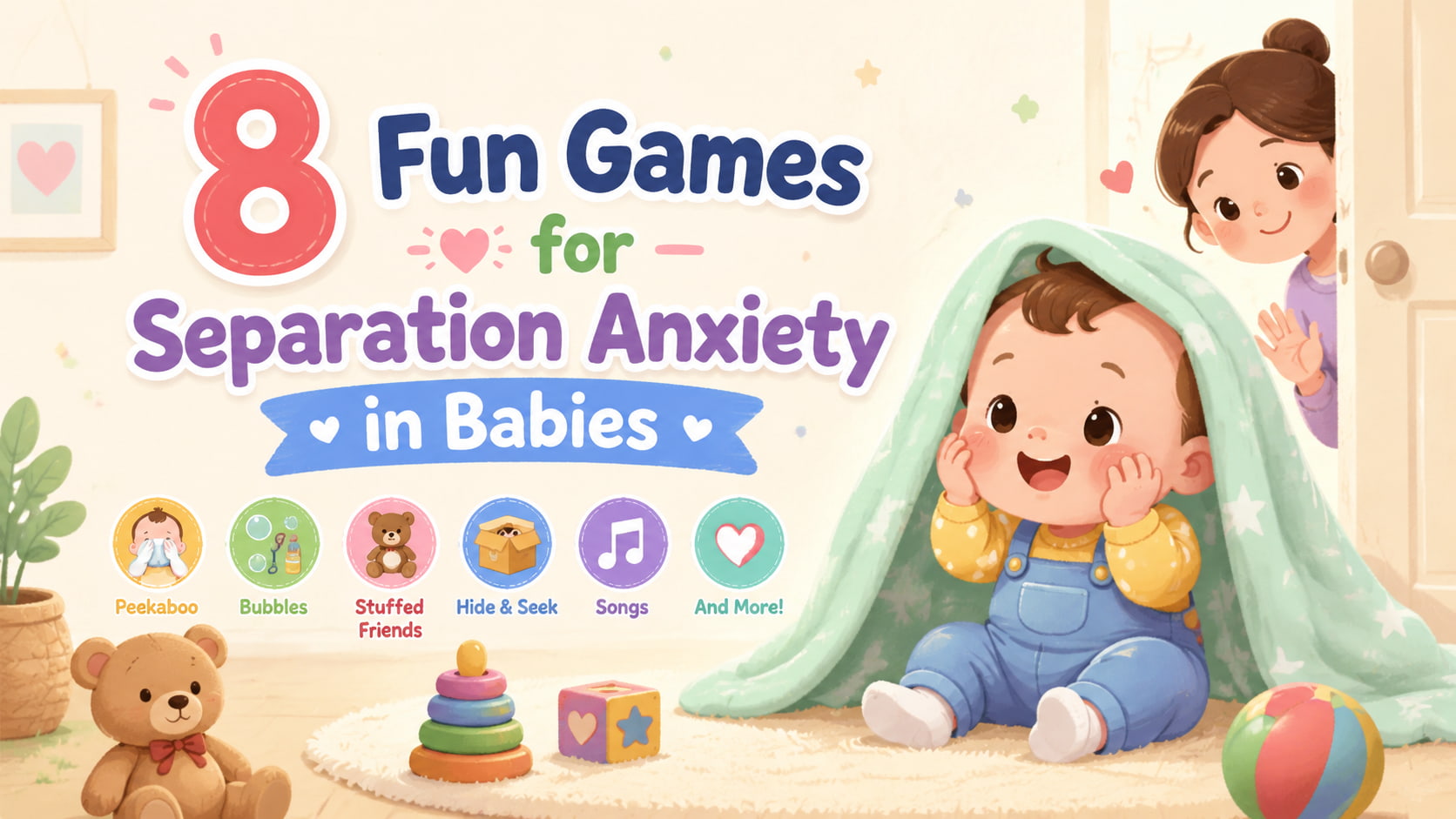
8 Fun Games for Separation Anxiety in Babies
8 Fun Games for Separation Anxiety in Babies
Parents can effectively ease tears and build deep emotional trust by using simple, science-backed games for separation anxiety in babies—such as peek-a-boo variations and brief “I’ll be right back” exercises—to gently teach their children that temporary distance is safe and that every goodbye is always followed by a reliable, joyful return.
For support beyond play, explore our separation anxiety guide for babies and toddlers, with goodbye routines, example words, and a free caregiver handoff template.
There is a moment that nearly every parent knows by heart. It does not announce itself with fanfare or warning. It arrives, instead, on an ordinary Tuesday morning — perhaps while setting a baby into a bouncer to answer the doorbell, or while attempting the seemingly straightforward act of stepping into the bathroom alone.
The parent takes one step. Just one. And the baby — who, until that precise instant, had been contentedly gnawing on a rubber giraffe — erupts. The cry is immediate, guttural, and laced with a desperation that seems wildly disproportionate to the situation. Arms reach. Fingers grasp. A tiny face crumples into an expression of unmistakable, genuine terror.
For the parent, the emotional whiplash is disorienting. Guilt floods in first: What did I do wrong? Confusion follows: They were fine ten seconds ago. And then, if the experience repeats itself over days and weeks — as it almost always does — a quieter, more insidious worry takes root: Is something wrong with my baby?
The answer, nearly always, is no. What is happening is not a malfunction. It is a milestone.
Separation anxiety — the distress a baby feels when separated from a primary caregiver — is one of the most universal, well-documented, and thoroughly studied phenomena in developmental psychology. According to the American Academy of Pediatrics (AAP), it typically emerges between 6 and 8 months of age, intensifies around 14 to 18 months, and gradually diminishes through the toddler years. Research published in the journal Child Development suggests that approximately 65% of infantsdisplay significant separation anxiety behaviors during this developmental window. It is not a rare condition or a sign of fragile temperament. It is, statistically and psychologically, the norm.
And yet, knowing that a challenge is “normal” does not make it easy to live through. What parents need — what they are often desperately searching for at 2 a.m. on parenting forums — is not just reassurance, but a practical toolkit. Specific, concrete things they can do to help their baby navigate this emotional earthquake.
That toolkit exists. It has been refined over decades of clinical research, and its components are deceptively simple. They are games — ordinary, playful, living-room-floor games — that teach babies, through the universal language of play, that goodbye is not the end of the story. It is simply the pause before the joyful part.
Understanding the Psychology: Why Babies Experience Separation Anxiety
To understand why separation anxiety happens — and, crucially, why certain games help — it is necessary to take a brief but illuminating detour into the developing infant brain. Two concepts, in particular, unlock everything that follows.
What Is Object Permanence, and Why Does It Matter?
The first concept is object permanence, a term coined by the Swiss developmental psychologist Jean Piaget in the mid-20th century. It refers to the cognitive ability to understand that objects — and people — continue to exist even when they are no longer visible, audible, or tangible.
For adults, this seems laughably obvious. Of course the car is still in the garage when the garage door is closed. Of course a partner is still at work even though they cannot be seen. This understanding is so deeply embedded in adult cognition that it feels less like a learned skill and more like an inherent property of reality itself.
But for a young baby, it is not obvious at all. In fact, for the first several months of life, babies operate under a fundamentally different model of how the world works — a model that could be summarized as: if I cannot see it, it does not exist.
Imagine, for a moment, what this would feel like. A parent walks out of the room, and from the baby’s neurological perspective, that parent has not merely left. They have vanished from existence. There is no concept of “Mommy is in the kitchen making coffee.” There is no mental image of Daddy retrieving something from the car. There is only the immediate, overwhelming fact of absence — as total and as final, in the baby’s experience, as if the person had never existed at all.
This is why very young infants — those under four or five months — often do not display much separation anxiety. They are not calm because they are brave; they are calm because they lack the cognitive architecture to understand that something has been lost.
The shift begins around 4 to 7 months, when object permanence starts to develop. Piaget documented this through elegant experiments: hiding a toy under a blanket and observing whether the infant would search for it. Before object permanence, the baby would simply lose interest — the toy, once hidden, was gone. After object permanence began to take hold, the baby would reach for the blanket, pull it away, and retrieve the toy. They knew it was still there.
Now, here is where the emotional complexity deepens. As object permanence develops, the baby enters a paradoxical new reality. They now understand that the parent who just walked out of the room still exists somewhere — but they have no way of knowing when, or even whether, that parent will return. They possess the cognitive sophistication to recognize absence, but not yet the temporal understanding to predict reunion.
Think of it as having enough of a map to know that a destination exists, but not enough to find the route. The awareness without the reassurance is precisely what makes this developmental stage so emotionally turbulent.
Separation anxiety often appears to worsen around 8 to 10 months, right when object permanence is consolidating. This is not a regression or a setback. It is, paradoxically, evidence of cognitive progress — the baby’s brain is developing exactly as it should. The tears are a side effect of growing up.
Attachment Theory: Why the Tears Are Actually Good News
The second concept that illuminates separation anxiety is attachment theory, one of the most influential frameworks in all of developmental psychology.
In the 1950s and 1960s, British psychologist John Bowlby proposed a revolutionary idea: that the bond between an infant and a primary caregiver is not merely emotional or sentimental, but biological. It is a survival mechanism, shaped by millions of years of evolution. In the ancestral environment, a baby who stayed close to a protective adult survived; a baby who wandered off did not. Separation anxiety, Bowlby argued, is the behavioral expression of this deep biological imperative — a built-in alarm system that activates whenever the baby perceives that the protective bond is threatened.
In the 1970s, American-Canadian psychologist Mary Ainsworth extended Bowlby’s work with her landmark “Strange Situation” studies. In these experiments, she observed how 12-month-old infants responded when briefly separated from their mothers in an unfamiliar room. What she found was that babies fell into distinct attachment patterns:
- Securely attached infants protested when the mother left (crying, reaching for the door), but were quickly comforted when she returned, settling back into play within minutes.
- Insecurely attached infants either showed little distress at all (suggesting they had learned not to rely on the caregiver) or became so overwhelmed that they could not be soothed upon reunion.
The critical takeaway — and this is the piece of information that every anxious parent needs to hear — is this: a baby who cries when a parent leaves, and who is comforted when the parent returns, is displaying the hallmarks of secure attachment. The tears are not a sign of a problem. They are a sign that the parent has successfully become the baby’s emotional anchor, their safe base, the person whose presence means “the world is okay.”
Longitudinal studies tracking securely attached children into adolescence and adulthood have consistently found that secure early attachment predicts greater emotional resilience, stronger social competence, better academic performance, and healthier romantic relationships in later life. The tears at the daycare door, in other words, are not just normal — they are, in a very real developmental sense, good news.
Separation anxiety sits at the intersection of two developmental milestones — the emergence of object permanence (cognitive) and the deepening of secure attachment (emotional). Both are signs of healthy growth. Understanding this reframe transforms a parent’s experience from “What am I doing wrong?” to “What can I do to support this process?”
The Core Principle: Building Trust Through Incremental Separation
With the psychology in place, a practical question emerges: if separation anxiety is driven by a baby’s uncertainty about whether a parent will return, what is the most effective way to build that certainty?
The answer, supported by decades of clinical and developmental research, is a strategy called incremental separation — a gradual, systematic expansion of a baby’s comfort with physical distance and temporary absence. The key word is gradual. Developmental progress, like physical growth, does not respond well to force. It responds to gentle, consistent stretching.
An analogy may be helpful here. Think of the attachment between a parent and baby as a rubber band. The baby is wired to explore the world — to crawl toward the interesting thing on the other side of the room, to reach for the unfamiliar texture, to move toward novelty. But the baby is also wired to snap back to the safety of the caregiver at the first sign of uncertainty or threat. A healthy rubber band stretches and returns, stretches and returns, growing slightly more flexible with each cycle.
What happens if the rubber band is snapped — if a parent disappears suddenly, without warning, for an extended period? The same thing that happens to any rubber band under excessive force: it breaks. The baby does not learn flexibility; they learn that stretching is dangerous.
What happens if the rubber band is never stretched at all — if a parent never allows any distance, never steps out of sight? The baby never develops the elasticity needed to tolerate eventual, inevitable separations. Overprotection, paradoxically, can be as anxiety-inducing as abandonment.
The sweet spot is in the middle: small, predictable, repeated stretches, each followed by a reliable return. This is the principle that underpins every game in the playbook that follows.
Three supporting pillars make incremental separation effective:
Pillar 1: Predictable Routines Create a Foundation of Safety. Babies and toddlers thrive on consistency. When nap times, meals, and play periods follow a reliable rhythm, the world feels orderly and manageable. This matters because managing separation anxiety requires cognitive and emotional resources — and a baby whose baseline world feels chaotic has fewer of those resources to spare. Think of routine as the solid ground from which the baby launches their explorations.
Pillar 2: Every Successful Return Builds the Trust Bank. Each time a parent says “I’ll be right back” and then actually comes back, a small deposit is made in the baby’s emotional trust account. One deposit is meaningless. Ten deposits are noticeable. A hundred deposits — accumulated over weeks of casual, low-stakes repetitions — create something powerful: an unshakeable, deeply felt expectation that departures are always followed by returns. This expectation is the antidote to separation anxiety.
Pillar 3: Emotional Contagion Is Real — And Babies Are Experts at Reading It. The term emotional contagion describes the well-documented phenomenon by which emotions spread between individuals, often unconsciously. Adults experience it when a colleague’s bad mood darkens an entire office, or when a friend’s laughter becomes irresistibly infectious. Babies experience it with extraordinary intensity, because they are neurologically wired to look to their caregivers for emotional cues about how to interpret the world.
This has a direct, practical implication for goodbyes. A parent who lingers at the daycare door with tearful eyes and a trembling voice is not just expressing their own sadness — they are broadcasting an emergency signal. The baby’s nervous system, expertly calibrated to detect parental distress, interprets the signal clearly: If the big, powerful person who protects me is scared, then I should be terrified. Conversely, a parent who departs with calm confidence, a warm smile, and a quick, cheerful wave sends an equally clear signal: This is safe. Everything is fine. I will be back.
The goal is not to eliminate separation anxiety overnight — that is neither possible nor desirable. The goal is to build, through hundreds of low-stakes repetitions, an unshakeable internal belief in the baby’s developing mind: The people who love me always come back.
8 Step-by-Step Games for Separation Anxiety in Babies
What follows is the heart of this guide: a curated, developmentally sequenced collection of 8 games designed to teach babies the emotional and cognitive skills they need to handle separation with increasing confidence. Each game is presented in a recipe-style format — what to prepare, what to do, why it works, and how to adapt it — because the parents who need this information most are often reading it one-handed, on a phone, at 3 a.m., with a sleeping baby on their chest.
A note before beginning: these games are not magic spells. They are practice. Just as learning to walk requires hundreds of wobbly attempts, learning to tolerate separation requires hundreds of gentle rehearsals. The games build on each other, progressing from the simplest cognitive exercises for young infants to more complex emotional role-play for toddlers. Start wherever the baby’s current developmental stage suggests, and move at their pace — never faster.
Quick Reference: Games by Age
| Game | Best Age | Core Skill Practiced |
|---|---|---|
| 1. Peek-a-Boo Evolution | 6–12 months | Object permanence (visual) |
| 2. Drop & Retrieve | 7–12 months | Object permanence (spatial) |
| 3. Crawl-Away Chasers | 8–14 months | Baby-initiated separation |
| 4. “I’ll Be Right Back” | 9–18 months | Trust in return |
| 5. Tunnel Time | 9–18 months | Full-body disappearance/reappearance |
| 6. Magic Voice | 10–18 months | Connection without physical presence |
| 7. Bye-Bye Toy | 12–24 months | Emotional processing through role-play |
| 8. Safe Treasure Hunt | 14–24 months | Voluntary, independent separation |
Early Stages: Laying the Foundation for Object Permanence (6–12 Months)
The first three games target the youngest babies and focus on the most fundamental lesson: things that disappear come back. These games work at the cognitive level, building the neural pathways that will later support more complex emotional processing.
Game 1: The “Peek-a-Boo” Evolution
Best Age: 6–12 months
What You Need: Hands, a lightweight blanket, and a doorway
Time Required: 5–10 minutes per session
Peek-a-boo is so ancient and so universal that it might seem too simple to be genuinely therapeutic. But its ubiquity is itself a clue to its power. Researchers have found versions of peek-a-boo in virtually every documented culture, from hunter-gatherer societies to modern metropolises. Developmental neuroscientist Dr. Stuart Brown has described it as one of the most neurologically efficient games in the human repertoire — a precisely calibrated exercise that teaches object permanence through the most compelling medium available to an infant: the human face.
What makes peek-a-boo work is not the surprise itself, but the rhythm of tension and release. The face disappears (tension); the face returns (release). Disappears (tension); returns (release). Each cycle etches a pattern into the baby’s developing neural architecture: absence is temporary; presence is restored; the world is predictable and safe.
How to Play — A Three-Stage Progression:
Stage 1 — The Classic (starting at 6 months): Sit face-to-face with the baby. Cover your face with both hands. Pause for a deliberate two to three seconds — this brief period of uncertainty is the “work” of the game, the moment where the baby’s brain is actively processing the concept of absence. Then remove your hands with an enthusiastic “Peek-a-boo!” Watch for the baby’s reaction: a smile, a laugh, a widening of the eyes. These are all signs that the brain is registering the reward of reunion.
Stage 2 — The Blanket (starting at 8 months): Drape a lightweight, breathable blanket or cloth fully over your head, obscuring your face entirely. This is a meaningful step up from hands — the covering is more complete, the visual disappearance more total. Ask, with exaggerated curiosity, “Where did Mommy/Daddy go?” Then — and this is a crucial detail — allow the baby to grab the blanket and pull it away. Resist the temptation to remove it yourself. The act of revealing the hidden face gives the baby a sense of agency — they are not passively witnessing the return; they are causing it.
Stage 3 — The Doorway (starting at 9 months): Stand in a doorway where the baby can see you. Step fully behind the wall, disappearing completely from view for 2 to 3 seconds. Then pop your head back around the frame with a big “Boo!” This stage is the most important, because it introduces physical, spatial separation — the same kind of separation that occurs in real-world goodbyes. Gradually extend the hidden duration to 5, 10, and eventually 20 seconds, always returning with warmth and energy.
Each successful cycle of peek-a-boo deposits the same message into the baby’s developing understanding of how the world operates: Disappearance is temporary. Reappearance is joyful. And it always, always happens.
Tip: Vary the reveals. Sometimes whisper. Sometimes gasp. Sometimes appear wearing a silly hat or making a funny face. Novelty sustains engagement and prevents the game from becoming so predictable that it loses its cognitive value. The surprise must remain genuinely surprising — at least a little — for the learning to continue.
Game 2: The “Drop and Retrieve” — Reframing the High Chair Experiment
Best Age: 7–12 months
What You Need: A high chair and several safe, droppable items (soft blocks, plastic spoons, small rattles)
Time Required: Ongoing, integrated into mealtimes
There is a phase that every parent of a baby recognizes with a mixture of amusement and exasperation: the phase where the baby drops everything from the high chair. The spoon goes over the edge. The parent picks it up. The spoon goes over the edge again. The parent picks it up again. The sippy cup follows. Then the cracker. Then, if permitted, the plate itself.
To the adult mind, this looks like a game at best and defiance at worst. To the developing infant mind, it is neither. It is science. The baby is running an experiment — one of the most important experiments of early cognitive life — and the hypothesis being tested is this: Do things continue to exist when they leave my field of vision?
When the spoon falls below the tray’s edge and disappears, the baby experiences a miniature version of the same uncertainty they feel when a parent walks out of the room. Is it gone? Is it coming back? Does it still exist down there? When the parent retrieves the spoon and returns it to the tray, the hypothesis is confirmed: Yes. Things that disappear can come back. The repetition is not mindless; it is methodical. The baby is replicating the experiment to verify the results, just as any good scientist would.
How to Play:
- Sit close to the high chair during a play session (not necessarily mealtime — this avoids the additional stress of food cleanup).
- Offer the baby a safe toy, such as a soft block or plastic ring.
- When the toy inevitably goes over the edge, lean down with exaggerated drama: “Oh no! Where did it go?! It disappeared!”
- Retrieve the toy with theatrical flair and present it: “Here it is! It came back!”
- Repeat with genuine enthusiasm for as long as the baby’s interest holds. This may be five repetitions or fifty. Follow their lead.
By framing the retrieval as a game rather than a chore — by matching the baby’s energy and treating each drop as an exciting discovery — the parent reinforces the core message of object permanence while simultaneously casting themselves as the reliable agent of return. The parent becomes the person who, when something vanishes, always brings it back. That association, built over hundreds of repetitions, extends naturally to the parent themselves: The person who always retrieves the spoon is also the person who always comes home from work.
Tip: Introduce variety by using different objects — a yellow block, a red ball, a crinkly cloth — to show that the permanence principle applies universally, not just to one specific item.
Game 3: Crawl-Away Chasers — Putting the Baby in the Driver’s Seat
Best Age: 8–14 months (once the baby is mobile — crawling, scooting, or early walking)
What You Need: Open floor space and an enticing target toy
Time Required: 5–10 minutes per session
Most separation anxiety scenarios share a common structure: the parent leaves, and the baby is left behind. The power dynamic is one-sided — the baby has no agency, no choice, and no control. The adult makes the decision to separate; the baby can only react.
This game inverts that power dynamic entirely. Instead of the parent leaving the baby, the baby leaves the parent. And that reversal — small as it might seem — has profound psychological implications.
How to Play:
- Sit on the floor with the baby. Place an appealing, colorful toy approximately four to six feet away — close enough to be motivating, far enough to require real movement.
- Point to the toy and encourage the baby to go get it: “Oh, look at that! Can you go get it? Go on — you can do it!”
- As the baby begins to crawl or scoot toward the toy, stay exactly where you are. Do not follow. Instead, provide a steady stream of verbal encouragement from behind: “Look at you! You’re so far away! You’re so brave!”
- Once the baby reaches the toy and turns back to check (as they almost always will), smile warmly and wave.
- After a moment, crawl playfully toward them: “I’m coming to get you!” Scoop them up with laughter and affection.
Clinical psychologist Dr. Laura Markham, founder of Aha! Parenting and author of Peaceful Parent, Happy Kids, emphasizes that a child’s sense of agency — their feeling of being in control of a situation — is one of the most powerful antidotes to anxiety. When the baby is the one who initiates the distance, the emotional experience of separation changes fundamentally. It is no longer something alarming that happens tothem; it becomes something they choose to do. The parent’s consistent, visible presence at the starting point provides the safety net, while the baby’s voluntary exploration builds the confidence.
Tip: Resist the urge to follow the baby or close the distance before they have had time to enjoy the independent moment. The seconds they spend at a distance, looking back and seeing a calm, smiling parent, are doing the most important developmental work.
Distance & Sensory Games: Expanding the Comfort Zone (9–18 Months)
The next three games build on the foundation laid by the first set, but they introduce a more challenging element: real, sustained, physical separation. The baby can no longer see the parent at all for increasing periods of time. These games also begin to explore a concept that will become increasingly important as the baby grows: the idea that connection can persist even when physical presence is absent.
The transition from the first set of games to this one mirrors the baby’s own developmental arc. At 6 to 9 months, the work is primarily cognitive — learning that hidden things still exist. From 9 to 18 months, the work becomes more emotional — learning to tolerate the feelings that come with knowing something exists but not being able to see it. The games in this section bridge that gap.
Game 4: The “I’ll Be Right Back” Timer Game
Best Age: 9–18 months
What You Need: No props required — only consistency and follow-through
Time Required: 30 seconds to 5 minutes, multiple times daily
If there is a single game on this list that could be called the keystone — the one upon which the effectiveness of all the others rests — it is this one. It is not the most entertaining game. It is not the most creative. But it is, arguably, the most important, because it is the direct, deliberate, real-world practice of the exact skill babies need most: trusting that a departure is always, unfailingly, followed by a return.
The principle is elemental: say what you are going to do, do it, and come back. Repeat until the baby’s nervous system has absorbed the pattern so deeply that it becomes an automatic expectation rather than a desperate hope.
How to Play:
- Wait for a moment when the baby is happily engaged — playing with a toy, eating a snack, exploring a texture. This is important: the first repetitions should occur during moments of low stress, not when the baby is already fussy or tired.
- Make warm, direct eye contact and say, in a cheerful, matter-of-fact tone: “I’m going to the kitchen. I’ll be right back!”
- Walk out of sight completely. Stay away for exactly 3 to 5 seconds. No more — precision matters in the early stages.
- Return with a natural smile and say: “I’m back! I told you I’d come back.”
- The progression: Over the course of days and weeks (not hours), gradually increase the duration of absence. Five seconds becomes ten. Ten becomes thirty. Thirty becomes a minute. A minute becomes three. Each step should feel comfortable before moving to the next.
Developmental researchers use the term “expectancy of return” to describe the cognitive belief — built through experience rather than words — that a departing caregiver will reliably reappear. This belief does not form through a single dramatic demonstration. It forms the way a path forms in a forest: through repeated, consistent use, until the neural pathway is so well-worn that the brain follows it automatically.
By the time a real, high-stakes separation occurs — a daycare drop-off, a babysitter’s arrival, a parent’s departure for work — the baby’s nervous system has already processed hundreds of successful mini-separations. The pattern departure → brief absence → joyful return is not a theory in the baby’s mind; it is established fact, reinforced by a deep well of accumulated evidence.
Critical Rule: If the baby becomes distressed during a longer absence, do not push through it. Return immediately, offer comfort, and resume the game at the last comfortable duration. Trust is built through success, not through endurance.
Game 5: Tunnel Time — A Full-Body Lesson in Disappearing and Reappearing
Best Age: 9–18 months
What You Need: A pop-up play tunnel (widely available and inexpensive) or a homemade version from large cardboard boxes
Time Required: 10–15 minutes per session
There is a meaningful difference between understanding a concept intellectually and understanding it physically, through the body. Adults experience this distinction when they read about swimming versus actually getting in the water, or when they study a map versus walking the route with their own feet. For babies, who are pre-verbal and who learn overwhelmingly through sensory and motor experience, embodied learning is not just helpful — it is the primary channel through which the brain absorbs new information.
The play tunnel offers something no other game on this list can: a full-body, multisensory experience of disappearing and reappearing. The baby crawls into an enclosed space, loses sight of the parent entirely, navigates through darkness and confinement, and emerges — blinking, grinning — into the light and the arms of someone who was waiting for them all along.
How to Play:
- Set up the tunnel on a soft surface. Position yourself at one end; place another caregiver, a sibling, or an enticing toy at the other end.
- Encourage the baby to enter the tunnel from the opposite end. Use your voice as a guide: “Come find me! I’m right here! Keep going!”
- As the baby crawls through, they will experience several seconds during which they cannot see anyone at either end. This brief sensory isolation is the core “work” of the game.
- When they emerge on your side, greet them with unmistakable enthusiasm: “You did it! You came through! I was right here the whole time!”
Dr. Daniel Siegel, clinical professor of psychiatry at UCLA and author of The Whole-Brain Child, has written extensively about the power of embodied experience in early development. The tunnel game works because it engages not just the visual system (as peek-a-boo does) but the entire body — proprioception, spatial orientation, tactile sensation, auditory tracking. The lesson it teaches is the same as peek-a-boo’s (“things that disappear come back”), but it is encoded at a much deeper, more visceral, more durable neurological level.
There is also a metaphorical dimension that, while beyond the baby’s conscious awareness, shapes the experience at a felt level. The tunnel is a passage through uncertainty — dark, enclosed, temporarily disorienting — that reliably leads to warmth, light, and reunion. This narrative structure — separation → uncertainty → reunion — is precisely the emotional arc that babies need to rehearse.
Tip: For babies who are initially hesitant about the tunnel’s enclosed space, start with a very short tunnel (a single large cardboard box with both ends open) and sit close enough that the baby can see you through the entire length. Gradually increase the tunnel’s length as their comfort grows.
Game 6: The “Magic Voice” Audio Game — Connection Beyond Line of Sight
Best Age: 10–18 months
What You Need: A smartphone, tablet, or simple voice recorder
Time Required: 5–10 minutes per session
This game is, in many ways, the most innovative and forward-thinking on this list. It is rooted in a sophisticated psychological concept that is rarely discussed in mainstream parenting advice: multi-modal recognition.
Babies do not recognize their primary caregivers through a single sensory channel. Recognition is a rich, layered experience that integrates multiple streams of information simultaneously — the sight of a familiar face, the sound of a known voice, the scent of a particular skin, the rhythm of a specific heartbeat, the feeling of being held in a particular way. These sensory streams are so deeply interwoven that any one of them can, on its own, activate the baby’s sense of connection and safety.
This is why a baby will turn toward a parent’s voice in a crowded room, even before seeing the parent’s face. It is why a worn t-shirt, carrying the parent’s scent, can soothe a fussy infant in a crib. The implication for separation anxiety is significant: physical presence is not the only form of connection. If a baby can learn to access the feeling of safety through a voice alone, or a scent alone, the experience of physical separation becomes less absolute and less terrifying.
How to Play:
- While the baby is nearby and can observe the process, record a short audio clip on a phone — 15 to 30 seconds of singing a favorite lullaby, narrating a silly story, or simply repeating “I love you” in a warm, playful voice.
- Place the phone under a pillow, behind a stuffed animal, or inside a basket — somewhere in the same room, partially hidden but discoverable.
- Play the audio. When the baby hears the familiar voice, ask with genuine curiosity: “Where is Mommy’s/Daddy’s voice coming from? Can you find it?”
- Guide them toward the phone if needed, and celebrate the discovery together.
Advanced Variation — The Scent Game: Leave a recently worn t-shirt (unwashed, carrying natural body scent) in the baby’s crib, play area, or car seat. Research in olfactory neuroscience has shown that familiar scents activate the limbic system — the brain’s emotional processing center — in ways that produce measurable calming effects, even in the caregiver’s absence. The combination of familiar scent and familiar voice, used across multiple games, builds a multi-layered sense of connection that does not depend on physical proximity.
The game teaches a subtle but profoundly important lesson: that the bond between parent and child is not contingent on being in the same room. Love has textures that transcend physical presence — a voice that can be heard from another room, a scent that lingers on fabric, a song that evokes safety even when played through a speaker. For a baby learning to navigate the uncertain terrain of separation, this knowledge is a compass.
Role-Play & Advanced Transitions: Processing Complex Emotions (12–24 Months)
As babies cross the threshold into toddlerhood — roughly 12 months and beyond — a remarkable new cognitive capacity comes online: symbolic play. This is the ability to use one thing (a stuffed animal, a doll, a toy car) to represent another thing (a person, a feeling, a situation). It is the dawn of imagination, and it opens up an entirely new category of therapeutic tools.
Psychologists and play therapists have long recognized symbolic play as the primary medium through which young children process experiences that are too emotionally complex or overwhelming to handle directly. An adult who is struggling with a difficult situation might talk to a friend, journal, or see a therapist. A toddler who is struggling with a difficult situation plays. The play is the therapy.
The final two games leverage this capacity, allowing toddlers to rehearse the full emotional arc of separation — departure, waiting, uncertainty, reunion — from a safe psychological distance.
Game 7: The “Bye-Bye Toy” Routine — Rehearsing Goodbyes Through Pretend Play
Best Age: 12–24 months
What You Need: A beloved stuffed animal, doll, or action figure
Time Required: 5–10 minutes per session
How to Play:
- Choose a stuffed animal that the baby is attached to — a teddy bear, a plush bunny, a soft dinosaur. Give it a name if it does not already have one.
- Pick up the toy and walk it toward the front door, narrating in a warm, storytelling voice: “Bear is going to work now. Bear has to go to the office, but Bear will be back after lunch.”
- Have the baby wave goodbye to Bear. Encourage the gesture: “Can you wave bye-bye to Bear? Say ‘See you later, Bear!'”
- Place Bear just out of sight — behind the door, inside a bag, around a corner — for 15 to 30 seconds.
- Bring Bear back with celebration and narration: “Bear is back! Bear missed you somuch! Bear is so happy to see you!” Have Bear “hug” the baby, or press its face against the baby’s cheek.
When the separation scenario is projected onto a beloved toy, an elegant psychological mechanism activates. The toddler can observe, process, and rehearse the full emotional cycle of goodbye — including the difficult feelings of waiting and missing — without being directly exposed to the full force of those feelings. The stuffed bear serves as what psychologists call a “safe container” for the anxiety: close enough to be emotionally meaningful, distant enough to be manageable.
Developmental Extension: As the toddler’s language develops, expand the narrative. “Bear is a little nervous about going to work. Bear will miss you. But Bear knows that you will be here when Bear comes home.” This verbalization of emotions — naming feelings, acknowledging them, and pairing them with a positive outcome — is a foundational building block of emotional literacy, a skill that will serve the child for the rest of their life.
Tip: Invite the toddler to take over the storytelling role. Let them be the one to walk the bear to the door, say goodbye, and welcome the bear back. The shift from observer to director further enhances the child’s sense of control and agency.
Game 8: The Safe Treasure Hunt — Choosing Independence
Best Age: 14–24 months
What You Need: A highly desirable item (a favorite snack, a new small toy, or a beloved object)
Time Required: 5–10 minutes per session
The final game in this playbook is the most advanced, and it represents the culmination of all the skills practiced in the preceding seven games. It asks the toddler to do something genuinely challenging: to voluntarily leave the parent’s side and enter another room alone, motivated not by the parent’s instruction, but by their own desire.
This is, in miniature, the experience of healthy independence — the willingness to tolerate temporary discomfort (being in a room without a parent) in pursuit of something desirable (the treasure). It is the same emotional muscle that will, years later, carry a child through the first day of school, the first night at a friend’s house, and eventually, the leap into adulthood.
How to Play:
- Show the baby a highly desirable item — a special snack, a new toy, or a favorite object. Build enthusiasm: “Oh, look at this! This is so exciting! Should we play a game with it?”
- Walk into the next room (with the baby watching, so they know where it goes) and place the item in plain, visible sight — on a low table, a floor cushion, or a chair seat.
- Return and say, with conspiratorial excitement: “It’s hiding in the living room! Can you go find it? I’ll wait right here!”
- Allow them to venture into the other room independently. Resist the instinct to follow. Stay visible in the doorway if the toddler seems uncertain, but aim, over time, to remain in the original room while they explore the next one.
- When they return with the treasure, celebrate: “You found it! You went all by yourself! That was so brave!”
The motivational pull of the treasure creates a bridge over the anxiety threshold.Without the treasure, the next room is simply an empty space without a parent — anxiety-provoking and pointless. With the treasure, the next room becomes a destination worth the emotional cost of temporary separation. Over repeated plays, the toddler accumulates a memory bank of successful independent navigations — each one a small but genuine victory that recalibrates their internal model of what they are capable of handling alone.
Progression: As the toddler’s confidence grows, increase the complexity — hide the treasure behind a pillow instead of in plain sight, or use rooms that are farther from the parent’s position. Each incremental increase builds competence and self-assurance.
Going Beyond the Standard Playbook
Empowering the Transitional Object
Most parents have heard of the “transitional object” — a blanket, stuffed animal, or soft toy that becomes a child’s portable source of comfort. The concept was first described by British pediatrician and psychoanalyst Donald Winnicott in 1951, who recognized that these objects serve a crucial psychological function: they occupy an intermediate space between the child’s internal world (the felt sense of the parent’s love) and external reality (the parent’s physical absence). The blanket is not the parent, but it carries enough of the parent’s emotional resonance to provide genuine comfort.
The standard parenting advice is straightforward: give the baby a lovey and hope they bond with it. But a more effective approach is to actively embed the transitional object into the games described above. Play peek-a-boo with the lovey. Have the lovey be the one who “goes to work” and comes back in the Bye-Bye Toy game. Tuck the lovey into the baby’s arms during the “I’ll Be Right Back” game. By weaving the lovey into the fabric of separation practice, the parent transforms it from a passive comfort item into an active emotional partner — one whose very presence triggers an association with safety, successful returns, and joyful reunions.
The Technology Bridge: Video Call Peek-a-Boo
For parents navigating regular work-related absences, video technology offers a genuinely modern extension of the principles outlined in this guide. With another caregiver physically present to manage the baby’s safety and engagement, a parent can initiate a brief FaceTime or video call from work, play a version of peek-a-boo by moving in and out of the camera’s frame, sing a quick song, and then conclude the call with a cheerful goodbye.
This teaches the baby a lesson that is unique to the modern era but no less important for its novelty: connection does not require shared physical space. The face on the screen is real. The voice is real. The laughter is real. And the love is real — even when it travels through a device.
What Not to Do: The Golden Rules of Real Goodbyes for Babies with Separation Anxiety
Every game in this guide is designed to build trust. But trust is a delicate structure, and it can be undermined in a single moment if real-world goodbyes are handled poorly. Three mistakes, in particular, are worth understanding — not to inspire guilt, but to provide clarity.
The Silent Exit
The temptation is understandable. The baby is happily distracted, playing contentedly with a grandparent or a sitter. Slipping out the door without announcing the departure seems like kindness — a way to avoid the inevitable tears.
It is, in reality, the opposite. Developmental psychologist Dr. Tovah Klein of Barnard College, author of How Toddlers Thrive, has documented the counterproductive effects of the “sneak-out” extensively. A baby who discovers that a parent has vanished without warning does not learn to handle separation more easily. They learn that the world is unpredictable and that adults cannot be trusted. The result is not calm, but hypervigilance — a chronic, simmering anxiety that prevents the baby from ever fully relaxing, because the parent might disappear again at any moment, without any warning at all.
Every unannounced departure erodes the very “expectancy of return” that the games in this guide are designed to build.
The Lingering Goodbye
On the opposite end of the spectrum, drawn-out departures are equally counterproductive. The parent says goodbye, starts to leave, comes back for one more hug, starts to leave again, pauses in the doorway for one more reassurance, and so on.
To the baby’s nervous system, which is carefully attuned to parental behavior for safety cues, each return sends a mixed signal: If it were really safe to leave, why does the parent keep coming back? They must be unsure. If they are unsure, then this situation must be dangerous. The prolonged goodbye, however lovingly intended, inadvertently confirms the baby’s worst fear: that separation is, in fact, something to worry about.
The effective goodbye is warm, brief, and definitive. One clear announcement, one ritual, one smile, one departure.
The Emotional Dismissal
When a baby cries during separation, the instinctive adult response is often to minimize the emotion: “You’re fine!” or “There’s nothing to be scared of!” or “Stop crying — look, toys!”
The intention is comforting, but the effect is invalidating. The baby’s distress is genuine — neurologically, their amygdala is firing a threat response, their cortisol levels are elevated, and their entire nervous system is mobilized for emergency. Telling them they are “fine” does not change their internal reality; it simply communicates that their emotional signals are being ignored.
The more effective response is acknowledgment paired with confidence: “I know you are sad. You miss Mama. That is a big feeling, and it is okay to feel it. I will be back after your nap, and we will read your favorite book.” This validates the emotion without amplifying it, and it provides the critical piece of information the baby’s brain is searching for: a specific, concrete return point.
The Ultimate Daily Game: Designing a Goodbye Ritual for Separation Anxiety
If the eight games above are the practice sessions, the goodbye ritual is the performance — the moment where all the accumulated trust is put to work in a real-world context.
A goodbye ritual is a short, consistent, uniquely personal sequence of actions that serves as a predictable bookmark in the baby’s experience. It communicates, through repetition and familiarity, a simple and powerful message: This is what we do before I leave. And every single time we have done this, I have come back.
The specific actions of the ritual matter far less than their consistency. One family’s ritual might be: two kisses on the forehead, a nose boop, and the phrase “See you later, alligator.” Another might be: a special handshake, a hug, and a thumbs-up from the doorway. A third might involve: handing the baby their lovey, singing one line of a specific song, and blowing a kiss.
The secret to making the ritual effective is to practice it outside of high-stakes moments. Use the ritual before stepping into the kitchen during the “I’ll Be Right Back” game. Use it before walking to the mailbox. Use it before ducking into the bathroom. When the ritual is performed hundreds of times in low-stress contexts — each time followed by a prompt, reliable return — the baby’s nervous system learns to associate the ritual itself with safety.
By the time the ritual appears in a genuinely challenging context — the daycare door, the babysitter’s arrival, the departure for a work trip — it carries with it the accumulated emotional weight of hundreds of successful reunions. The ritual becomes a bridge, sturdy and well-traveled, spanning the gap between goodbye and hello.
Quick Design Formula:
- A physical touch (two kisses, a bear hug, a high five)
- A verbal phrase (a catchphrase, a line from a song, a shared saying)
- A visual anchor (a wave from the doorway, a thumbs-up, blowing a kiss)
Keep it under 15 seconds. Practice it daily.
When to Seek Professional Help
Separation anxiety is a normal developmental phase, and the vast majority of babies will move through it successfully with time, patience, and supportive play. But in some cases, the intensity or duration of the anxiety may signal something beyond the typical developmental pattern. It is worth being aware of a few markers that suggest a conversation with a pediatrician or child psychologist could be beneficial:
- Physical symptoms: Anxiety that causes vomiting, prolonged breath-holding, or other physical distress during or after separations.
- Disruption to basic needs: Complete refusal to eat or sleep for extended periods when separated from the primary caregiver.
- Duration: Intense separation anxiety that persists, without any signs of gradual improvement, well beyond age 3.
- Sudden onset: A dramatic increase in anxiety that appears suddenly after a period of relative calm, which may indicate an environmental stressor or a distressing experience.
Both the American Psychological Association and the AAP emphasize that early professional intervention in cases of clinical-level anxiety — what may be diagnosed as Separation Anxiety Disorder (SAD) — produces significantly better outcomes than a wait-and-see approach. These conversations are never a sign of failure; they are a sign of attentiveness.
Conclusion
Separation anxiety is not a problem to be fixed. It is a developmental chapter to be navigated — with patience, with strategy, and, most of all, with the joyful, transformative power of play.
Every round of peek-a-boo is a lesson in the impermanence of absence. Every crawl through a tunnel is a rehearsal for the bravery that independence requires. Every “I’ll be right back” — said clearly, kept faithfully, repeated hundreds of times — is a small but irreplaceable deposit in the bank of trust that will shape a child’s relationship with the world for decades to come.
The games in this guide are not tricks, distractions, or shortcuts. They are the serious, essential work of early childhood, wrapped in the irresistible disguise of fun. And the parents who commit to them — who sit on the floor and play peek-a-boo for the fortieth time, who cheerfully retrieve the dropped spoon yet again, who record silly songs on their phones and hide worn t-shirts in cribs — are not simply entertaining their children. They are building, one small moment at a time, the neurological and emotional architecture of resilience.
The tears at the door will not last forever. But the trust built through play — the deep, bone-level knowledge that the people who love them always, always come back — that lasts a lifetime.
Sources & Further Reading:
- Emotional and Social Development: 8 to 12 Months
- Harvard University Center on the Developing Child — Serve & Return Interaction Shapes Brain Circuitry
- UNICEF — Early Childhood Development