
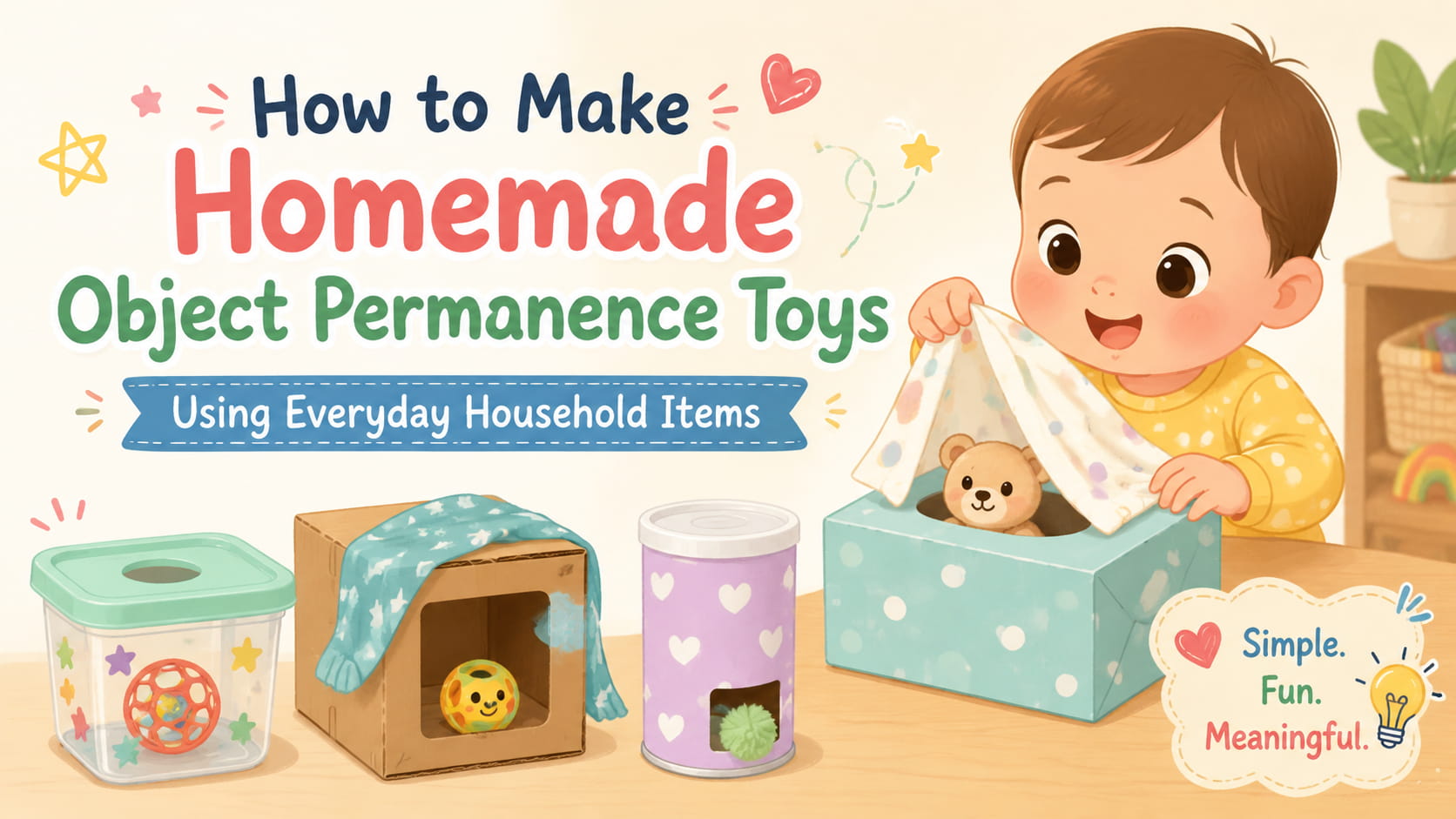
How to Make Homemade Object Permanence Toys Using Everyday Household Items
How to Make Homemade Object Permanence Toys Using Everyday Household Items
You don’t need expensive gear to foster your baby’s crucial cognitive development and ease separation anxiety; instead, you can easily create highly effective, science-backed homemade object permanence toys using everyday household items like shoe boxes, muffin tins, and laundry baskets.
There is a moment — and nearly every parent or caregiver remembers it — when a perfectly content baby transforms into a portrait of existential despair. A parent sets a coffee mug on the counter, turns to grab a dish towel, and takes perhaps three steps away. That’s all. Three steps. And the baby, who was just moments ago happily mouthing a teething ring, erupts into full-volume, heart-wrenching sobbing, as though the parent had vanished from the surface of the earth.
To the sleep-deprived adult on the receiving end, it feels baffling. Irrational. Perhaps even a little manipulative. But here’s the remarkable truth hidden inside that wail: the baby is doing something profoundly intelligent. That cry is not a tantrum. It is evidence that a tiny brain — one still forming billions of neural connections every single day — has just crossed one of the most important cognitive thresholds in all of human development. The baby has begun to understand that things continue to exist when they can no longer be seen.
Developmental psychologists call this milestone object permanence, and it is one of those rare concepts in child development that sounds academic but is, in reality, as practical and immediate as the pile of cardboard boxes in the recycling bin. Because those boxes — along with the scarves in a drawer, the muffin tin in the kitchen, and the laundry basket in the hallway — can be transformed into extraordinarily effective learning tools.
What Is Object Permanence? Understanding the Science Behind the Milestone
Before diving into the toys themselves, it helps to understand the concept they’re designed to teach — because object permanence is one of those ideas that seems almost absurdly simple once explained, yet represents a genuine revolution in how a baby experiences reality.
The Core Idea: A World That Doesn’t Disappear
Object permanence is the understanding that objects — and people — continue to exist even when they cannot be seen, heard, or touched.
Think about what that means by imagining, for a moment, what the world looks like without this understanding. For a newborn, the universe operates on a kind of magical, moment-to-moment logic. A rattle that rolls behind a cushion hasn’t been “hidden” — it has simply ceased to exist. A parent who walks into the next room hasn’t “left” — they have, as far as the baby’s brain is concerned, blinked out of existence entirely. The world is a constant stream of appearing and vanishing, like a magician’s stage show where nothing is stable and nothing can be predicted.
Here is a useful analogy: imagine watching a movie where every time the camera cut away from a character, that character was permanently gone from the story. No explanation. No return. Just — gone. That’s what early infancy feels like, neurologically. Every moment is a fresh scene with no guaranteed connection to the last one.
Object permanence is the cognitive leap that changes this. It is the moment a baby’s brain begins to build an internal model of the world — a mental map that says, “Even though I can’t see that ball right now, it still exists somewhere, and I might be able to find it.” This internal model is the foundation upon which virtually every other form of complex thinking will eventually be built.
Who Discovered This? A Brief History
The concept was first described in detail by Jean Piaget (1896–1980), a Swiss developmental psychologist who is widely regarded as one of the most influential figures in the history of child development research. Piaget spent decades meticulously observing children — including his own three — and documenting how they came to understand the world around them.
In his 1952 work, The Origins of Intelligence in Children, Piaget proposed that human cognitive development unfolds in a series of predictable stages. He placed object permanence within what he called the sensorimotor stage, which spans from birth to approximately 24 months. During this stage, babies learn about the world primarily through their senses (seeing, hearing, touching, tasting) and their motor actions (reaching, grasping, mouthing, kicking). Object permanence, in Piaget’s framework, was the crowning achievement of this stage — the moment when a baby’s understanding graduates from “I know only what I can sense right now” to “I can think about things that aren’t immediately present.”
More recent research has added nuance to Piaget’s original findings. In a landmark 1991 study published in the journal Cognition, developmental psychologists Renée Baillargeon and Julie DeVos demonstrated that infants as young as 3.5 months showed surprise (measured by how long they stared) when objects seemed to violate the rules of permanence — for example, when a toy appeared to pass through a solid barrier. This suggests that a rudimentary awareness of object permanence may develop earlier than Piaget believed, even though the ability to act on that awareness (searching for a hidden object, lifting a cloth) takes several more months to emerge.
The distinction matters for parents: a baby may understand more than their behavior shows. The 5-month-old who doesn’t search for a hidden toy may still “know,” on some level, that it’s there — they simply don’t yet have the motor coordination, the working memory, or the problem-solving skills to go find it. This is precisely why well-designed play activities are so powerful: they give the baby a context in which to practice and strengthen these emerging abilities.
When Does Object Permanence Develop? A Timeline
Object permanence doesn’t arrive all at once, like a switch being flipped. It unfolds gradually over months, more like a sunrise than a light bulb — a slow brightening of understanding that moves through several distinct phases.
Here is a general timeline, based on the research consensus from organizations including the American Academy of Pediatrics and the CDC’s developmental milestone guidelines:
| 0–4 months | No object permanence. “Out of sight, out of mind” in the most literal sense. | Baby shows no reaction when a toy is hidden. No searching, no distress, no looking. |
| 4–7 months | Early awareness begins. The baby starts to understand that things might still exist when hidden. | Baby may stare at the spot where a toy disappeared. May look surprised or confused. Might reach for a partially hidden toy. |
| 7–9 months | Active searching begins. The baby will look for objects that are completely hidden. | Baby lifts a cloth to find a hidden toy. May make the “A-not-B error” (searching in the last place they found the toy, not where they saw it hidden). |
| 9–12 months | Understanding deepens. The baby can track more complex hiding. | Baby searches in the correct location even after a delay. Begins to understand that objects can be moved from one hiding spot to another. |
| 12–18+ months | Full object permanence with “invisible displacement.” | Baby can find an object even when they didn’t see it being hidden — they can infer its location based on logic. |
One pattern worth highlighting: the A-not-B error that appears around 7–9 months. This is a fascinating and well-documented phenomenon.
Imagine hiding a toy under Cup A several times. Each time, the baby successfully finds it. Now, while the baby watches, move the toy to Cup B.
Remarkably, many babies at this age will still search under Cup A — the place where the toy was found before, not the place where they just watched it being moved. This isn’t a failure of memory or attention. It reflects the fact that the baby’s search behavior is still partially governed by habit and motor memory, not yet fully by visual evidence. It’s a transitional stage, and it resolves naturally with continued development and practice.
The Hidden Curriculum of Peek-a-Boo: Why Play Is the Brain’s Best Teacher
Understanding what object permanence is leads naturally to the next question: How does a baby actually learn it? The answer, backed by decades of research in developmental neuroscience, is both reassuring and remarkably simple.
Babies learn object permanence through play.
Not through flashcards. Not through educational apps. Not through any product with the word “genius” in its name. Through play — specifically, through the kind of repetitive, predictable, emotionally engaging play that caregivers have been instinctively offering babies for millennia.
Dr. Stuart Brown, founder of the National Institute for Play and a clinical researcher who has spent over 40 years studying play in humans and animals, describes play as “the most important work a child can do.” The Harvard Center on the Developing Child goes further, identifying what it calls “serve and return” interactions — the back-and-forth exchanges between a child and a responsive caregiver — as among the most powerful builders of neural architecture in early childhood.
Here is what’s happening at the neurological level during a game of peek-a-boo or a session with a ball-drop box:
- Prediction. The baby’s brain anticipates what might happen. (“The ball went in the hole. Will it come back?”)
- Surprise or confirmation. The outcome either matches the prediction (building confidence) or doesn’t (creating a “learning moment” that rewires neural pathways).
- Emotional reward. The caregiver’s reaction — the gasp of surprise, the cheer of delight — floods the baby’s brain with dopamine, the neurotransmitter associated with pleasure and motivation.
- Repetition. The baby wants to experience this cycle again. And again. And again.
This loop — predict, observe, feel rewarded, repeat — is the fundamental mechanism of learning in the human brain. It is the same basic loop that drives scientific discovery, musical practice, athletic training, and language acquisition. The context and complexity change, but the architecture is identical. A baby dropping a ball into a box fifty times in a row is running the same cognitive program as a physicist testing a hypothesis in a laboratory. The scale is different; the process is not.
This understanding leads to a critically important practical insight for caregivers: the sophistication of the hiding activity should match the developmental stage of the child. Offering a 5-month-old a complex container puzzle will produce frustration, not learning. Offering a 10-month-old a blanket that barely covers a toy will produce boredom, not engagement. Developmental play, like physical exercise, must be progressive — challenging enough to require effort, but not so challenging that it overwhelms.
The Four Levels of Object Permanence Play: A Framework for Progression
To make this practical, here is a framework for understanding the progression of object permanence play, organized from simplest to most complex:
| Level 1: Partial Hiding | A toy is partially covered — a corner sticks out from under a cloth | The baby only needs to recognize a partially visible object and pull the cover away | 4–6 months |
| Level 2: Total Hiding (Simple) | A toy is completely covered by a soft cloth or placed behind a single barrier | The baby must remember the object exists despite having no visual evidenceand must initiate a search | 6–8 months |
| Level 3: Total Hiding (Container) | A toy is placed inside a box, under a cup, or inside an opaque container | Same as Level 2, but requires more complex motor actions (lifting, opening, reaching inside) | 8–10 months |
| Level 4: Invisible Displacement | A toy is hidden in a hand, the hand goes under a cloth, and the toy is left there — the baby must infer the location | The baby must track a sequence of movements and reason about where the object ended up without directly seeing the final hiding | 10–12+ months |
This framework is the organizing principle for all six of the homemade toys described below. Each toy is tagged with its corresponding level, so caregivers can select activities that match where a particular baby is in the developmental progression — and know when it’s time to advance to the next challenge.
6 Homemade Object Permanence Toys Any Parent Can Make Today
The commercial market for object permanence toys has grown considerably in recent years. A single wooden Montessori object permanence box — typically a minimalist cube with a hole in the top and a small tray where the ball rolls out — retails for between $25 and $60 on platforms like Etsy and Amazon. These are beautifully crafted objects, and there is nothing wrong with purchasing one if the budget allows.
But here’s what the research consistently shows: babies do not evaluate the aesthetics of their learning materials. A baby’s brain does not learn faster from hand-finished beechwood than from a repurposed cardboard shoe box. The learning happens in the mechanism — the act of hiding and finding, the cycle of disappearance and return — not in the material. A baby’s neurons do not fire more enthusiastically for a $50 toy than for a free one.
What follows are six homemade object permanence toys that can be assembled in minutes, cost virtually nothing, and teach the exact same cognitive principles as their commercial counterparts. They are organized by developmental level so that caregivers can start where their baby is and progress naturally
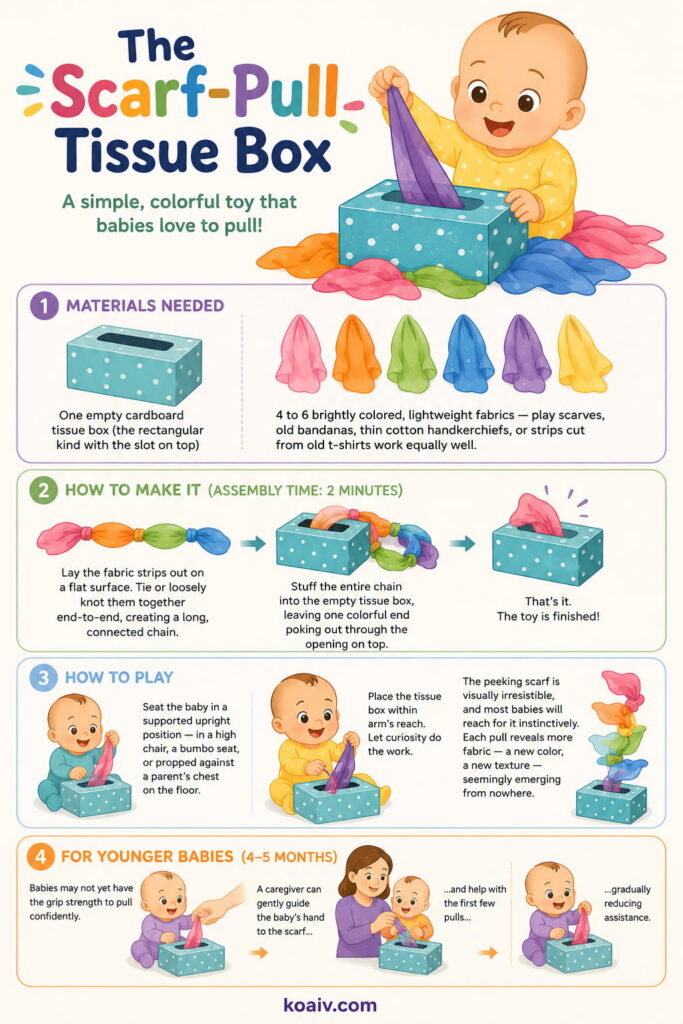
Toy 1: The Scarf-Pull Tissue Box — A Baby’s First Magic Trick (Level 1–2)
The developmental goal: Introduce the foundational idea that a hidden object can be made to appear through a baby’s own deliberate action.
Think of this as “object permanence with training wheels.” The scarf is never fully invisible — a colorful end always peeks out of the box, giving the baby a visual anchor. But the act of pulling and the cascade of emerging color create a powerful sensory experience: something was hidden inside that box, and I made it come out. This is a baby’s first taste of agency — the understanding that their own actions can change the world around them.
Materials needed:
- One empty cardboard tissue box (the rectangular kind with the slot on top)
- 4 to 6 brightly colored, lightweight fabrics — play scarves, old bandanas, thin cotton handkerchiefs, or strips cut from old t-shirts work equally well
How to make it (assembly time: 2 minutes):
Lay the fabric strips out on a flat surface. Tie or loosely knot them together end-to-end, creating a long, connected chain. Stuff the entire chain into the empty tissue box, leaving one colorful end poking out through the opening on top. That’s it. The toy is finished.
How to play:
Seat the baby in a supported upright position — in a high chair, a bumbo seat, or propped against a parent’s chest on the floor. Place the tissue box within arm’s reach. Let curiosity do the work. The peeking scarf is visually irresistible, and most babies will reach for it instinctively. Each pull reveals more fabric — a new color, a new texture — seemingly emerging from nowhere.
For younger babies (4–5 months) who may not yet have the grip strength to pull confidently, a caregiver can gently guide the baby’s hand to the scarf and help with the first few pulls, gradually reducing assistance.
What to watch for:
The moment the baby begins to anticipate the next color — reaching eagerly before the previous scarf is fully out — is a sign that working memory is engaging. The baby is forming the prediction: “There is more in there.”
💡 Variation for older babies (9+ months): Reverse the game. Let the baby stuff the scarves into the box through the opening. This develops fine motor skills and introduces the concept of objects being deliberately hidden — a precursor to Level 3 and 4 play.
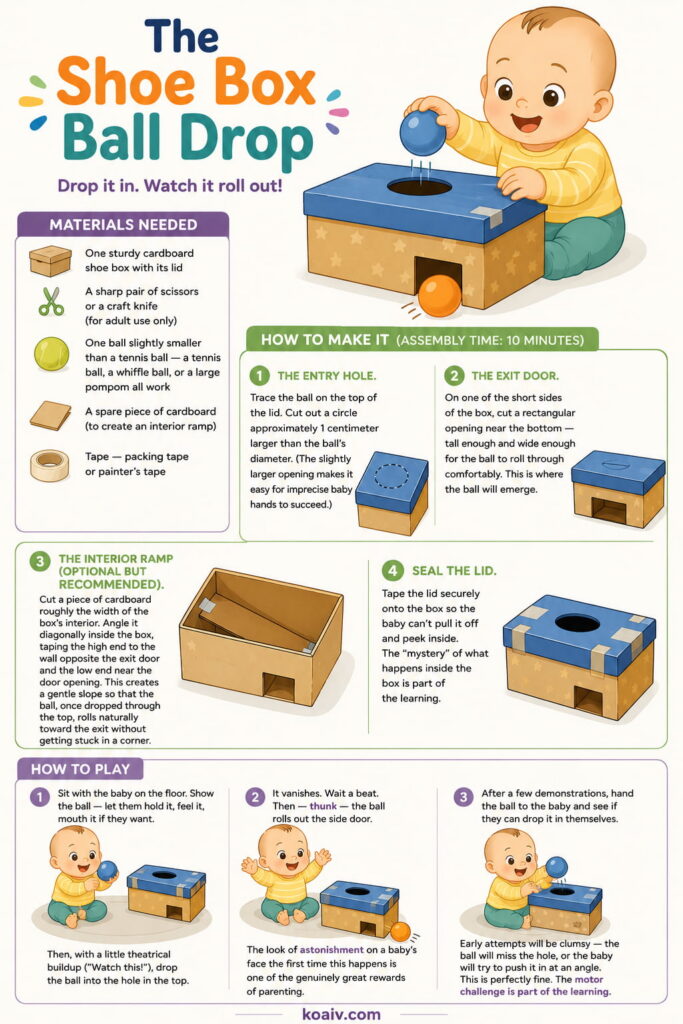
Toy 2: The Shoe Box Ball Drop — A DIY Montessori Object Permanence Box (Level 3)
The developmental goal: Demonstrate that an object can completely disappear into a container, travel an unseen path, and reappear in a new and unexpected location.
This is the homemade version of the single most iconic Montessori infant toy. The ball undergoes total visual disappearance — it drops into the box and, for a moment, simply does not exist in the baby’s visual field. Then it reappears, rolling out of a door on the side. This is a genuinely magical moment for a baby at the right developmental stage. It challenges the brain to hold two pieces of information simultaneously: the ball still existsand the ball is going to come out somewhere. That’s working memory and spatial reasoning operating in concert.
Materials needed:
- One sturdy cardboard shoe box with its lid
- A sharp pair of scissors or a craft knife (for adult use only)
- One ball slightly smaller than a tennis ball — a tennis ball, a whiffle ball, or a large pompom all work
- A spare piece of cardboard (to create an interior ramp)
- Tape — packing tape or painter’s tape
How to make it (assembly time: 10 minutes):
- The entry hole. Trace the ball on the top of the lid. Cut out a circle approximately 1 centimeter larger than the ball’s diameter. (The slightly larger opening makes it easy for imprecise baby hands to succeed.)
- The exit door. On one of the short sides of the box, cut a rectangular opening near the bottom — tall enough and wide enough for the ball to roll through comfortably. This is where the ball will emerge.
- The interior ramp (optional but recommended). Cut a piece of cardboard roughly the width of the box’s interior. Angle it diagonally inside the box, taping the high end to the wall opposite the exit door and the low end near the door opening. This creates a gentle slope so that the ball, once dropped through the top, rolls naturally toward the exit without getting stuck in a corner.
- Seal the lid. Tape the lid securely onto the box so the baby can’t pull it off and peek inside. The “mystery” of what happens inside the box is part of the learning.
How to play:
Sit with the baby on the floor. Show the ball — let them hold it, feel it, mouth it if they want. Then, with a little theatrical buildup (“Watch this!”), drop the ball into the hole in the top. It vanishes. Wait a beat. Then — thunk — the ball rolls out the side door.
The look of astonishment on a baby’s face the first time this happens is one of the genuinely great rewards of parenting.
After a few demonstrations, hand the ball to the baby and see if they can drop it in themselves. Early attempts will be clumsy — the ball will miss the hole, or the baby will try to push it in at an angle. This is perfectly fine. The motor challenge is part of the learning.
How to adjust difficulty:
- For younger babies (6–8 months): Cut the side door wide open — so wide that the baby can see the ball traveling through the interior of the box. This reduces the cognitive load by eliminating the “invisible path” component and focuses purely on the basic disappearance-and-return.
- For more advanced babies (10+ months): Make the exit door small enough that the ball only barely peeks out. The baby must reach in and retrieve it — adding a manual search component to the cognitive one.
💡 Why not just buy the Montessori version? The Montessori version is beautiful and durable. But the cognitive principle — drop, disappear, reappear — is identical whether the box is made of hand-sanded basswood or a Nike shoe box. Research in child development consistently shows that it is the interaction pattern, not the material, that drives learning. The shoe box teaches the same lesson for $0.
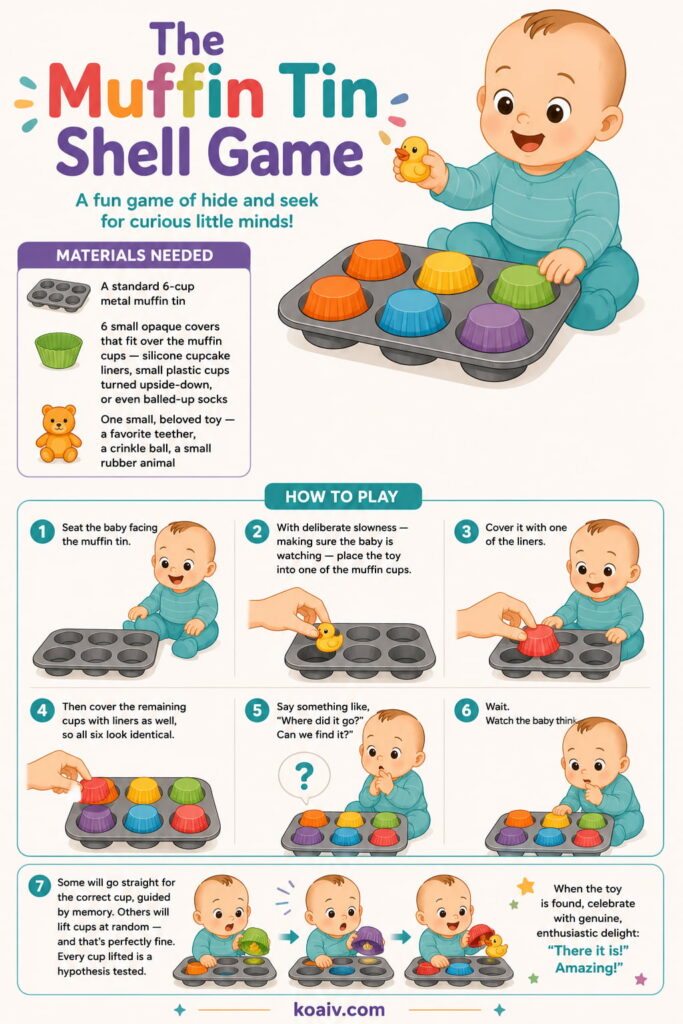
Toy 3: The Muffin Tin Shell Game — Memory Training in the Kitchen (Level 2–3)
The developmental goal: Practice active, targeted searching for a hidden object among multiple possible locations — the definitive behavioral marker of established object permanence.
Why this toy matters:
The previous toys involved objects disappearing and reappearing in a fixed, predictable way. This toy introduces a fundamentally new challenge: multiple possible hiding locations. The baby’s brain must now do more than simply remember that the object exists — it must remember where the object was hidden. This is a significant step up in working memory demand and introduces the earliest form of what cognitive scientists call spatial memory — the ability to remember the location of things in space.
This is the same cognitive function that allows adults to remember where they parked their car, which drawer holds the scissors, or where their keys were last placed. (And yes, the fact that adults still regularly fail at this task demonstrates just how cognitively demanding spatial memory remains throughout life.)
Materials needed:
- A standard 6-cup metal muffin tin
- 6 small opaque covers that fit over the muffin cups — silicone cupcake liners, small plastic cups turned upside-down, or even balled-up socks
- One small, beloved toy — a favorite teether, a crinkle ball, a small rubber animal
How to play:
Seat the baby facing the muffin tin. With deliberate slowness — making sure the baby is watching — place the toy into one of the muffin cups. Cover it with one of the liners. Then cover the remaining cups with liners as well, so all six look identical. Say something like, “Where did it go? Can we find it?”
Wait. Watch the baby think. Some will go straight for the correct cup, guided by memory. Others will lift cups at random — and that’s perfectly fine. Every cup lifted is a hypothesis tested. When the toy is found, celebrate with genuine, enthusiastic delight: “There it is! Amazing!”
Progression:
- Beginner (7–8 months): Use only 2–3 cups. Cover only the cup with the toy, leaving the others empty and uncovered. This makes the “different” cup visually obvious.
- Intermediate (9–10 months): Cover all cups. Let the baby search.
- Advanced (11+ months): After hiding the toy, gently shuffle two of the cups (slowly, while the baby watches). This introduces tracking — the baby must follow the movement and update their mental model of where the toy is.
What to watch for — the A-not-B Error:
At around 8–9 months, a fascinating phenomenon may appear. If the toy is hidden under Cup A several times in a row and the baby successfully finds it each time, and then the toy is moved to Cup B while the baby watches, many babies will still reach for Cup A. This is the A-not-B error, first described by Piaget, and it is not a sign of inattention or confusion.
It reflects a transitional stage where the baby’s search behavior is still partially driven by habit and motor memory (“my hand went there before and found the toy”) rather than visual evidence (“I just watched it go to a different spot”). This error resolves naturally, usually by 10–12 months, and it is a normal and even expected part of cognitive development.
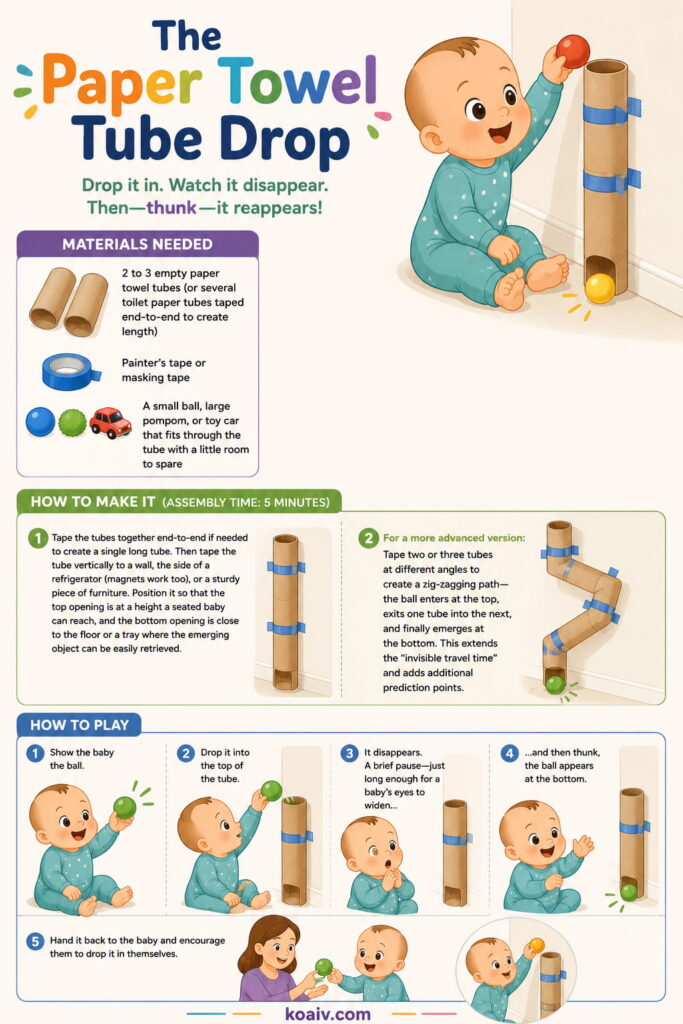
Toy 4: The Paper Towel Tube Drop — Tracking the Invisible Path (Level 2)
The developmental goal: Develop visual tracking ability and the understanding that an object continues to exist while traveling along a path that cannot be seen.
Every toy so far has involved a stationary hiding place — something is put somewhere and stays there. This toy introduces movement through hidden space. The ball enters the top of the tube, disappears from view, and exits at the bottom. During the fraction of a second it spends inside the tube, it is invisible — but it is also moving. The baby’s brain must not only maintain the belief that the ball exists, but also track its trajectorythrough space, predicting where and when it will emerge. This is an early form of spatial reasoning and predictive modeling — cognitive skills that will eventually support everything from catching a thrown ball to understanding that a car turning a corner hasn’t vanished.
Materials needed:
- 2 to 3 empty paper towel tubes (or several toilet paper tubes taped end-to-end to create length)
- Painter’s tape or masking tape
- A small ball, large pompom, or toy car that fits through the tube with a little room to spare
How to make it (assembly time: 5 minutes):
Tape the tubes together end-to-end if needed to create a single long tube. Then tape the tube vertically to a wall, the side of a refrigerator (magnets work too), or a sturdy piece of furniture. Position it so that the top opening is at a height a seated baby can reach, and the bottom opening is close to the floor or a tray where the emerging object can be easily retrieved.
For a more advanced version: Tape two or three tubes at different angles to create a zig-zagging path — the ball enters at the top, exits one tube into the next, and finally emerges at the bottom. This extends the “invisible travel time” and adds additional prediction points.
How to play:
Show the baby the ball. Drop it into the top of the tube. It disappears. A brief pause — just long enough for a baby’s eyes to widen — and then thunk, the ball appears at the bottom. Hand it back to the baby and encourage them to drop it in themselves.
What to expect:
Repetition. Enormous, relentless, seemingly inexhaustible repetition. A baby who discovers this toy may drop the ball through thirty, forty, fifty times without pause. To an adult, this looks monotonous. To the baby, it is the opposite of monotonous — it is empirical research. Each drop is a new trial in an ongoing experiment: Does this work every time? What happens if the ball is dropped from a slightly different angle? What happens with more force? Less force? A different object? The baby is not being repetitive in the way adults experience repetition. The baby is being methodical.
The developmental psychologist Alison Gopnik, in her book The Philosophical Baby(2009), describes babies and young children as “the R&D department of the human species” — the most cognitively open and exploratory humans alive. This relentless tube-dropping is what R&D looks like at six months old. Interrupting it because a parent finds it boring is, from a developmental standpoint, like pulling a researcher out of the laboratory mid-experiment.
Toy 5: The Sensory Water Reveal — A Multi-Sensory Approach to Object Permanence (Level 3)
The developmental goal: Combine object permanence learning with tactile sensory play, requiring the baby to reach past a physical obstacle to retrieve a known object.
Every other toy in this guide — and, indeed, most commercial object permanence toys on the market — relies on a single sensory channel: vision. An object is hidden from sight, and the baby must use sight (and reaching) to find it. This toy introduces something different: tactile occlusion. The object is blocked not only from view but also by a physical barrier (water, foam, a sponge) that the baby must reach through to retrieve it. The brain is now processing two simultaneous challenges: the cognitive task of knowing the object exists and the motor-sensory task of navigating an unfamiliar physical medium to reach it.
This matters because learning research increasingly supports the principle of embodied cognition — the idea, championed by developmental scientists Esther Thelen and Linda B. Smith in their influential 1994 work A Dynamic Systems Approach to the Development of Cognition and Action, that physical, bodily experience is not separate from cognitive development but integral to it. A baby who reaches through water to retrieve a hidden toy is building more robust neural connections than a baby who simply lifts a cloth from a dry surface, because more sensory systems are engaged simultaneously.
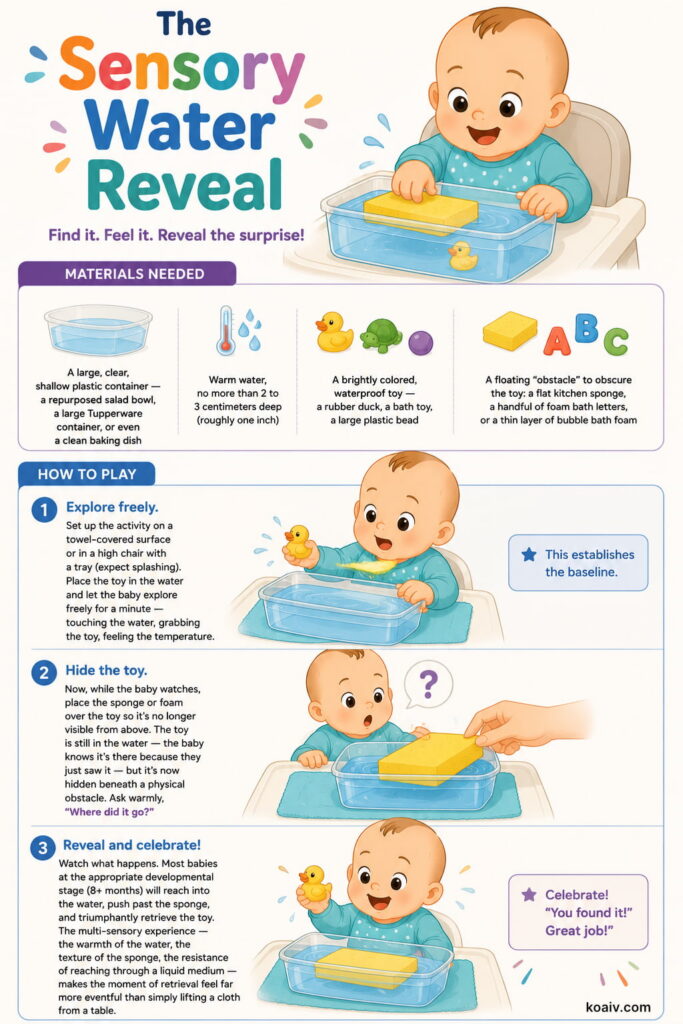
Materials needed:
- A large, clear, shallow plastic container — a repurposed salad bowl, a large Tupperware container, or even a clean baking dish
- Warm water, no more than 2 to 3 centimeters deep (roughly one inch)
- A brightly colored, waterproof toy — a rubber duck, a bath toy, a large plastic bead
- A floating “obstacle” to obscure the toy: a flat kitchen sponge, a handful of foam bath letters, or a thin layer of bubble bath foam
How to play:
Set up the activity on a towel-covered surface or in a high chair with a tray (expect splashing). Place the toy in the water and let the baby explore freely for a minute — touching the water, grabbing the toy, feeling the temperature. This establishes the baseline.
Now, while the baby watches, place the sponge or foam over the toy so it’s no longer visible from above. The toy is still in the water — the baby knows it’s there because they just saw it — but it’s now hidden beneath a physical obstacle. Ask warmly, “Where did it go?”
Watch what happens. Most babies at the appropriate developmental stage (8+ months) will reach into the water, push past the sponge, and triumphantly retrieve the toy. The multi-sensory experience — the warmth of the water, the texture of the sponge, the resistance of reaching through a liquid medium — makes the moment of retrieval feel far more eventful than simply lifting a cloth from a table.
What makes this different from other object permanence activities:
The water adds an entirely new dimension of sensory feedback. The baby is processing temperature, texture, resistance, and visual distortion (objects look slightly different through water) all at the same time they’re exercising working memory and search behavior. This kind of multi-channel learning is, according to the embodied cognition research, significantly more effective at building neural connections than single-channel activities.
⚠️ Safety note: Never leave an infant unattended near water — not even an inch of water in a shallow dish. This activity requires continuous, hands-on adult supervision. Keep sessions brief (5–10 minutes), and dry the baby’s hands promptly afterward.
Toy 6: The “Where Did They Go?” Laundry Basket Game — Object Permanence for People (Level 1–4, Adaptable)
The developmental goal: Apply object permanence not just to objects, but to the most emotionally important category of all — people — building the neural foundation of trust and secure attachment.
Every toy described so far involves hiding an object — a ball, a scarf, a rubber duck. These are effective cognitive exercises, and they absolutely build the neural pathways associated with working memory and spatial reasoning. But the deepest, most consequential application of object permanence is not about objects at all. It’s about people.
When a baby hides behind a laundry basket and a parent appears on the other side, or when a parent covers their face with a blanket and then pulls it away with a joyful “peek-a-boo!”, the baby’s brain is running the most emotionally charged version of the object permanence experiment: The person I love most in the world disappeared. Will they come back?
And every time the answer is yes — every single time the parent reappears, smiling, arms open, voice warm — the baby’s brain records another data point in what may be the most important dataset of early childhood: People who leave come back. Reliably. Predictably. Every time.
This is the neurological mechanism of what John Bowlby called secure attachment — the deep, felt sense that the world is safe because the people in it are reliable. Bowlby’s attachment theory, first published in 1969 and since supported by decades of longitudinal research, demonstrates that secure attachment in infancy predicts better emotional regulation, stronger social relationships, greater resilience in the face of adversity, and higher academic achievement throughout childhood and into adulthood.
A laundry basket and a blanket, in other words, are not just toys. They are tools for teaching a baby to trust.
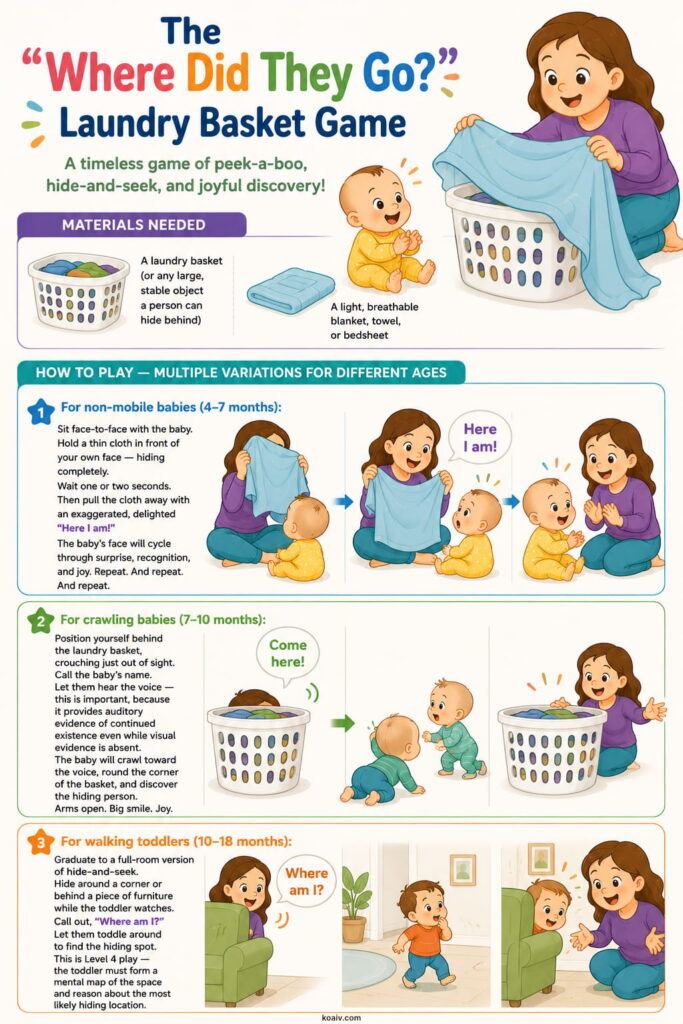
Materials needed:
- A laundry basket (or any large, stable object a person can hide behind)
- A light, breathable blanket, towel, or bedsheet
How to play — multiple variations for different ages:
For non-mobile babies (4–7 months):
Sit face-to-face with the baby. Hold a thin cloth in front of one’s own face — hiding completely. Wait one or two seconds. Then pull the cloth away with an exaggerated, delighted “Here I am!” The baby’s face will cycle through surprise, recognition, and joy. Repeat. And repeat. And repeat.
For crawling babies (7–10 months):
Position oneself behind the laundry basket, crouching just out of sight. Call the baby’s name. Let them hear the voice — this is important, because it provides auditory evidence of continued existence even while visual evidence is absent. The baby will crawl toward the voice, round the corner of the basket, and discover the hiding person. Arms open. Big smile. Joy.
For walking toddlers (10–18 months):
Graduate to a full-room version of hide-and-seek. Hide around a corner or behind a piece of furniture while the toddler watches. Call out, “Where am I?” Let them toddle around to find the hiding spot. This is Level 4 play — the toddler must form a mental map of the space and reason about the most likely hiding location.
What to watch for:
As the baby matures, watch for the moment when they initiate the hiding. A 10-month-old who crawls behind the laundry basket and waits to be “found” is demonstrating not just object permanence but role reversal — a form of social cognition that reflects the understanding that other people have minds, intentions, and expectations too. This is, in an elemental way, the beginning of empathy.
Pro Tips for Maximizing the Brain-Building Power of Play
The toys are only half the equation. How they are used matters just as much as whatthey are. The following insights, drawn from developmental research, can significantly amplify the learning impact of any object permanence activity.
1. Follow the Baby’s Lead
If the baby loses interest in the “intended” use of a toy and would rather chew on the cardboard box or bang the muffin tin against the floor, this is not failure. It is the baby redirecting their attention to the sensory experience that is most compelling to them in that moment. Dr. Magda Gerber, the founder of the RIE (Resources for Infant Educarers) approach, advocated for a philosophy she called “observing without interfering” — allowing babies to direct their own play and trusting that the activity they choose is the one their developing brain needs most.
Forcing a structured game when a child is disengaged produces cortisol (the stress hormone), which actively impairs learning. The most effective developmental play is intrinsically motivated — the child participates because the experience is genuinely rewarding, not because an adult is directing them to do it.
2. A Caregiver’s Reaction Is Half the Learning Experience
Research in social referencing — the well-documented tendency of infants to look at a caregiver’s face to interpret ambiguous situations — demonstrates that a caregiver’s emotional reaction to a moment of discovery significantly amplifies the baby’s learning. The exaggerated gasp of “Where did it GO?!”, the wide-eyed surprise, the triumphant “YOU FOUND IT!” — these are not theatrical flourishes. They are co-regulation signalsthat tell the baby’s brain: This moment is significant. Pay attention. This matters.
The Harvard Center on the Developing Child uses the metaphor of a tennis match to describe this: the baby “serves” an action (dropping the ball), and the caregiver “returns” with a reaction (an excited response). Each volley in this back-and-forth exchange builds neural connections. A flat, distracted, phone-scrolling response produces significantly less cognitive stimulation than the same toy used with a caregiver who is emotionally present and genuinely engaged.
3. Repetition Is Research — Not Obsession
This point bears repeating (appropriately enough): when a baby drops a ball into a tube for the fortieth consecutive time, they are not perseverating. They are not “stuck.” They are conducting a controlled experiment with the rigor of a junior scientist.
Each drop is a new data point: Does this outcome hold true under all conditions? What if the ball is dropped from a different height? What if a different hand is used? What if it’s done faster? Slower? This is the scientific method in its most primal form — hypothesis, experiment, observation, repetition for verification.
Parents and caregivers who understand this are far less likely to interrupt the process out of boredom or impatience. The repetition is the learning. Cutting it short is like ending a piano lesson after the first scale.
4. Narrate the Experience Out Loud
Adding language to the play — “The ball went IN the top… it’s GONE… wait for it… THERE it is! It came out the BOTTOM!” — integrates language development directly into the cognitive experience. The baby hears vocabulary words associated with spatial concepts (in, out, under, behind, on top of, inside, through) at precisely the moment those concepts are being physically demonstrated. This is what language acquisition researchers call contextual embedding, and it is vastly more effective for vocabulary building than isolated word drills.
Frequently Asked Questions About Homemade Object Permanence Toys
When Is the Best Time to Introduce Homemade Object Permanence Toys?
The earliest activities — Level 1 games like the scarf-pull tissue box and simple face-covering peek-a-boo — can begin around 4 to 5 months, as soon as a baby is sitting with support and showing interest in reaching for and grasping objects. Container-based activities like the shoe box ball drop and the muffin tin game are best introduced around 7 to 8 months, when the baby has developed enough motor coordination to lift covers and reach into containers. The more advanced activities — the sensory water reveal, the laundry basket game — can begin around 9 to 10 months and remain engaging well into the toddler years.
There is no strict deadline, and every baby develops at their own pace. The developmental levels described in this guide are guidelines, not gates. A baby who isn’t interested in a particular activity at 7 months may be captivated by it at 9 months. Follow the baby’s cues, not the calendar.
How Does Object Permanence Connect to Separation Anxiety?
This is one of the most frequently misunderstood aspects of infant development, so it’s worth stating clearly: separation anxiety is not a problem to be solved. It is a sign that object permanence is developing normally.
Here is the logic, step by step:
- A baby without object permanence does not cry when a parent leaves the room, because the parent has, neurologically speaking, ceased to exist. There is no one to miss.
- A baby with developing object permanence knows the parent still exists after leaving the room — but does not yet have the cognitive sophistication or the accumulated experience to predict when the parent will return.
- This gap between knowing (“Mom exists somewhere”) and not knowing (“But will she come back?”) produces anxiety.
- Object permanence games — especially people-based games like peek-a-boo and hide-and-seek — help close this gap by providing repeated evidence that disappearance is always followed by return.
Over time, with enough repetitions of this pattern, the baby’s brain builds a robust predictive model: People leave, and people come back. The world is reliable. The anxiety diminishes not because the baby has been “trained” out of it, but because they have genuinely learned something true about how the world works.
Can These Activities Help Babies With Developmental Delays?
The principles underlying these activities — graded challenge, repetitive practice, multi-sensory engagement, responsive caregiver interaction — are precisely the same principles used by early intervention specialists, occupational therapists, and developmental pediatricians. In that sense, these activities are broadly aligned with evidence-based therapeutic practice.
However, parents or caregivers who have specific concerns about a child’s development — particularly regarding milestones like reaching, grasping, visual tracking, or social engagement — should always consult with a pediatrician or developmental specialist. Homemade toys are wonderful tools for supporting typical development and enriching everyday play, but they are not a substitute for professional evaluation when there are genuine developmental concerns.
What a Cardboard Box Is Really Teaching
It would be easy — tempting, even — to view this entire guide as a collection of clever craft projects for rainy afternoons. And these toys do serve that purpose admirably. But stepping back to appreciate the larger picture reveals something more profound.
Every time an infant searches for a hidden object, their brain is performing a feat that would have been neurologically impossible just weeks or months earlier: holding a mental image of something that is no longer present in sensory experience, and using that invisible image to guide physical action. This is the beginning of symbolic thinking — the cognitive capacity that will eventually enable language, mathematics, storytelling, scientific inquiry, moral reasoning, and art.
A baby who knows a ball exists inside a shoe box, even though it can’t be seen, is operating on the same fundamental cognitive principle as a physicist who knows an electron exists inside an atom, or a novelist who holds an entire fictional world in mind while writing. The complexity is different. The scale is vastly different. But the underlying architecture — the ability to think about things that are not immediately present — is identical.
That is what a cardboard shoe box and a tennis ball are really teaching.
The developmental psychologist Alison Gopnik captures this beautifully in The Philosophical Baby: “Babies and young children are like the R&D department of the human species — the blue-sky, pure-research wing. They are the ones who explore, imagine, and learn. Adults are production and marketing.” These homemade toys don’t just support that exploration; they honor it. They communicate something essential to the tiny researcher in the living room: Your curiosity is worth taking seriously. We will meet it where it is, with whatever materials are at hand.
Conclusion
The global baby toy market is projected to surpass $115 billion by 2030 (Grand View Research, 2024). Parents and caregivers are inundated with marketing messages suggesting that the right product — the right subscription box, the right app, the right ergonomically designed sensory widget — is the key to raising a cognitively advanced child.
The developmental science tells a different story. It tells a story in which the most powerful tools for infant brain development are not sold in stores at all. They are a present, responsive caregiver; a simple mechanism that creates surprise and delight; and the unhurried freedom to explore the same thing, over and over, until it makes sense.4–7 months
Sources & Further Reading:
- The Origin Of Intelligence In The Child
- Thelen, E., & Smith, L.B. (1994). A Dynamic Systems Approach to the Development of Cognition and Action.
- Harvard Center on the Developing Child. Serve & Return Interaction Shapes Brain Circuitry.