Non-Nutritive-Sucking-in-Babies
Non-Nutritive Sucking in Babies: What It Is, Benefits & When to Encourage or Limit It
Non-nutritive sucking is one of the oldest and most elegantly designed features of the human infant. It predates spoken language by millennia. It predates parenting philosophies, cultural norms, and the invention of the silicone pacifier by countless generations. It is a biological endowment — wired into the fetal brain well before the third trimester, refined through infancy, and gradually released as the developing nervous system acquires richer, more versatile tools for self-regulation, communication, and emotional management.
There is a particular kind of silence that descends over a household at two in the morning when a wailing infant finally finds the pacifier, latches on, and melts into stillness. For exhausted parents, it feels like a minor miracle — a ceasefire negotiated by a small piece of silicone. For the baby, however, something far more profound is taking place beneath the surface.
A cascade of neurochemical events is rippling through the infant’s brain and body: stress hormones are receding, endorphins are rising, the heart rate is decelerating, and the gut is quietly beginning to do its work more efficiently. What looks, from the outside, like a simple comfort habit is in reality one of the most sophisticated self-regulatory mechanisms the human body possesses.
And here is the part that surprises most people: it begins long before birth.
What Exactly Is Non-Nutritive Sucking?
Before diving into the science, it helps to draw a crisp line between two things that look similar but serve very different purposes.
When a baby feeds — whether at the breast or from a bottle — they are performing what researchers call nutritive sucking. The goal is caloric: the infant is extracting milk to fuel growth and hydration. The sucking pattern during nutritive feeding is slow, powerful, and deliberate, with deep jaw compressions coordinated tightly with swallowing. Think of it as the baby’s way of eating dinner — purposeful, rhythmic, and driven by hunger.
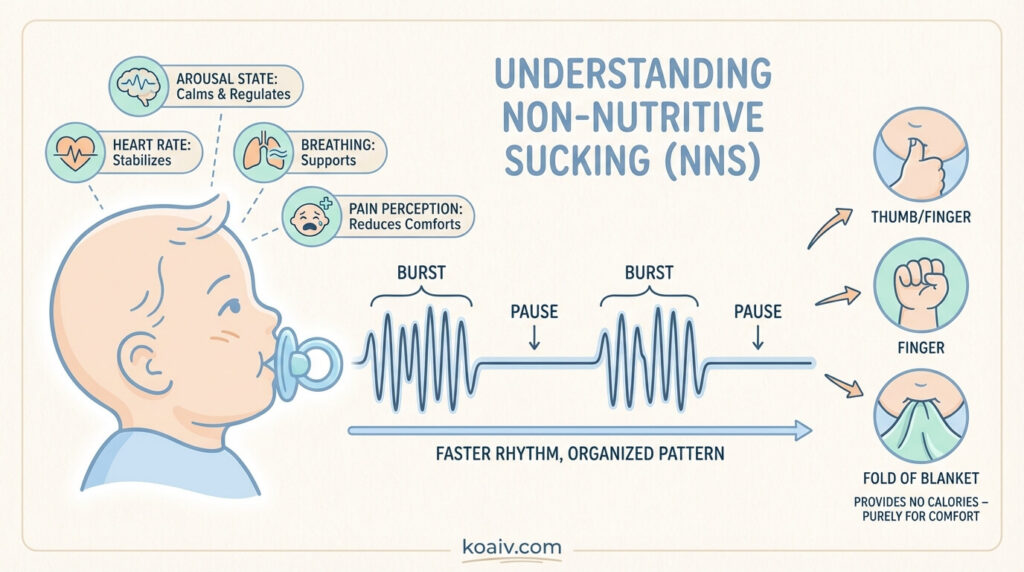
Non-nutritive sucking is something else entirely. It is sucking that happens on a pacifier, a thumb, a finger, or even a fold of blanket — anything that provides no calories whatsoever. The purpose is not nutritional but neurological. And the difference is visible even to the naked eye: NNS follows a distinctly faster rhythm, roughly twice the speed of nutritive sucking, organized into a signature pattern that researchers describe as “burst-pause.” The baby sucks in a rapid cluster of small movements, pauses for a beat, and then begins the cycle again. This rhythm is not random fidgeting. It is a precisely organized neural output — a pattern that directly influences the infant’s arousal state, heart rate, breathing, and even pain perception.
To use an analogy, if nutritive sucking is like a person eating a meal, non-nutritive sucking is closer to that same person rhythmically tapping their foot under the desk during a stressful meeting. The tapping isn’t serving any external function, but it is doing critical internal work — managing tension, modulating focus, and keeping the nervous system from tipping over into overwhelm.
Perhaps the most fascinating clue to the true nature of NNS lies in how early it appears. Ultrasound imaging has captured human fetuses sucking their thumbs as early as fifteen weeks of gestation — barely into the second trimester, months before the lungs are ready to breathe or the eyes are ready to see. At that stage, there is no milk to practice for, no hunger to satisfy, no external world to cope with. The fetus is sucking because the brain is already wiring itself for this fundamental act of self-regulation.
When scientists see a behavior appear that early, with no learned component and no obvious survival utility in the womb, they reach a strong conclusion: this is not a habit. It is an instinct, hardwired into the deepest layers of human neurobiology from the very earliest stages of development.
The Remarkable Benefits: What NNS Actually Does for a Baby’s Body and Brain
To dismiss a pacifier as a lazy shortcut for tired parents — as some corners of popular culture are inclined to do — is to profoundly misunderstand the physiology at play. Non-nutritive sucking is, in a very literal, measurable sense, a therapeutic intervention. The difference is that instead of a clinician administering it, the baby performs it on themselves.
The Bridge from Chaos to Calm: How Babies Learn to Self-Regulate
To appreciate why NNS matters so deeply, it helps to understand a foundational concept in developmental psychology: the difference between co-regulation and self-regulation.
A newborn arrives in the world with an immature nervous system. When overwhelmed — by hunger, by cold, by a startlingly loud noise — the baby’s stress response activates, flooding the small body with cortisol and adrenaline, and the only way to bring that system back to equilibrium is through the calming presence of another person. A caregiver’s warm skin, steady heartbeat, soft voice, or rocking motion acts as an external thermostat for the infant’s internal climate. Scientists call this co-regulation: the baby’s nervous system essentially borrows stability from a calmer, more mature nervous system nearby. Every parent who has held a screaming newborn against their chest and felt the tiny body gradually unclench has experienced co-regulation in action.
But co-regulation, by definition, requires another person. What happens when the caregiver sets the baby down, or when the infant wakes at three in the morning and needs a few moments to resettle before the parent arrives? This is where NNS enters the story as a developmental bridge.
By engaging in rhythmic sucking — finding a thumb, accepting a pacifier — the baby begins, for the very first time, to dampen their own stress response without external help. Studies published in Early Human Development have demonstrated that NNS measurably lowers salivary cortisol (the primary stress hormone) in infants within minutes of initiation. The baby is not merely being distracted from distress, the way a jangling set of keys might momentarily capture attention. The baby is actively modulating their own neurochemistry — turning down the volume on the internal alarm system through their own motor action.
This is an extraordinary developmental milestone, even though it rarely appears in baby books alongside first smiles and first steps. It represents the earliest emergence of self-regulation — the ability to manage one’s own emotional and physiological states — which is a capacity that will underpin everything from emotional resilience to academic focus for years to come. The pacifier, in this light, is not circumventing development. It is scaffolding it.
The Built-In Painkiller: Why Hospitals Reach for the Pacifier
The analgesic properties of NNS — its ability to genuinely reduce the sensation of pain — are perhaps its most rigorously documented benefit and the one with the most direct medical application. To understand why, a brief detour into the body’s pain-management architecture is helpful.
Every human body manufactures its own class of pain-relieving molecules called endorphins — chemicals that are structurally similar to opioid drugs like morphine but are produced naturally by the brain. Endorphins bind to specialized receptors in the nervous system and, when released, produce a real, measurable dampening of pain signals. In adults, this system is activated by vigorous exercise (the famous “runner’s high”), laughter, or even certain foods. In newborns, one of the most reliable triggers for endorphin release turns out to be the rhythmic motor pattern of sucking.
This is not a folk remedy dressed in scientific clothing. It is a finding replicated across dozens of rigorous clinical trials. A landmark Cochrane review — widely considered the gold standard in medical evidence synthesis — analyzed data from more than 1,500 infants and found that the combination of a pacifier with a small amount of sucrose solution was significantly more effective at reducing acute procedural pain than sucrose alone. The pacifier was not merely a distraction; it was activating a genuine analgesic pathway in the brain.
This is precisely why neonatal and pediatric units worldwide have formally integrated NNS into their protocols for minor procedures. When a newborn needs a heel-lance blood draw or a vaccination, the clinical team will often offer a pacifier — sometimes dipped in a drop of sugar water — not as a gesture of comfort but as a non-pharmacological pain management tool. It is medicine without a prescription, administered by the baby’s own jaw.
The SIDS Connection: A Statistic That Demands Attention
Of all the evidence supporting NNS, the data surrounding Sudden Infant Death Syndrome (SIDS) is arguably the most consequential — and the most likely to reshape a parent’s thinking.
SIDS, for those unfamiliar with the term, refers to the sudden, unexplained death of an apparently healthy infant during sleep. It remains one of the leading causes of death in babies between one month and one year of age, and despite decades of research, its precise mechanism is not fully understood. What is well established, however, is a robust body of epidemiological data showing that certain environmental factors can significantly reduce the risk. One of those factors, recognized formally by the American Academy of Pediatrics (AAP) in its safe sleep guidelines, is offering a pacifier at bedtime and nap time throughout the first year of life.
The numbers behind this recommendation are striking. A large meta-analysis published in the British Medical Journal — which pooled data from multiple studies across different populations — found that pacifier use during the last sleep was associated with a roughly 90% reduction in SIDS risk. Even after adjusting for confounding variables, the protective association remained substantial.
Why would a pacifier protect a sleeping infant? The honest answer is that scientists are still working out the precise causal chain, but several compelling hypotheses have emerged.
One theory holds that the pacifier’s bulky shield helps keep a baby’s face clear of blankets or soft bedding that might otherwise obstruct breathing. Another suggests that the physical presence of the pacifier in the mouth helps maintain a forward tongue position, reducing the risk of upper airway obstruction — a mechanism analogous to how certain dental devices help adults with obstructive sleep apnea. A third, well-supported hypothesis proposes that NNS keeps the infant in a slightly lighter state of sleep, making it easier for the baby to rouse if oxygen levels drop or breathing becomes compromised. In SIDS research, the ability to arouse from deep sleep in response to physiological danger signals is considered critically protective.
It is worth emphasizing that these findings describe an association, not a guarantee. No single intervention eliminates SIDS risk entirely, and pacifier use should always be considered as one element within the broader framework of safe sleep practices — supine positioning, a firm mattress, the absence of loose bedding, and a smoke-free environment. Still, the magnitude and consistency of the data have been sufficient for the AAP to include pacifier use as a formal recommendation, and that is not a threshold that the world’s most influential pediatric body crosses lightly.
An Unexpected Insight: The Vagus Nerve Highway
There is a facet of NNS that rarely appears in mainstream parenting literature but represents some of the most exciting recent research in neonatal physiology. It involves one of the most important and least famous structures in the human body: the vagus nerve.
Imagine a long, branching cable that runs from the base of the brain all the way down through the neck, past the heart, through the lungs, and into the deepest reaches of the abdomen, touching nearly every major organ along its path. That cable is the vagus nerve — the longest of the twelve cranial nerves and the primary communication line of the parasympathetic nervous system. If the sympathetic nervous system is the body’s accelerator (triggering “fight or flight” when danger is perceived), the parasympathetic system is the brake pedal (activating “rest and digest” when the coast is clear). The vagus nerve is, quite literally, the wiring that carries the “all clear” signal from the brain to the body.
Here is why this matters for non-nutritive sucking: the rhythmic jaw and tongue movements of NNS directly stimulate branches of the vagus nerve in the oral cavity and throat. This stimulation sends a powerful parasympathetic signal cascading downward through the body, producing a chain of measurable effects — slowing of the heart rate, deepening and regularizing of breathing, reduction of systemic inflammation, and crucially, the triggering of peristalsis (the wave-like muscular contractions that move food through the digestive tract).
In practical terms, this means that NNS is not just calming a baby’s mood; it is actively optimizing digestion. Neonatal research has demonstrated that premature infants who engage in NNS during tube feeding show faster gastric emptying and improved intestinal motility — meaning the act of sucking on a pacifier literally helps food move through the gut more efficiently. For a premature baby whose digestive system is still developing, this is not a trivial benefit. It is a measurable clinical advantage.
The brain-mouth-gut connection is not a metaphor or a piece of wellness marketing. It is a real, anatomically traceable physiological highway, and non-nutritive sucking is one of the very first vehicles a human being learns to drive along it.
Pacifiers vs. Thumbs: A Debate Without a Clear Winner
This is the question that inevitably splits the room at any pediatrician’s office, any lactation support group, any late-night parenting forum: is a pacifier better, or should parents let the baby find their thumb?
The honest answer is that each option carries a distinct profile of advantages and trade-offs, and the “right” choice depends heavily on the individual baby, the family’s circumstances, and the parents’ comfort with the weaning challenge that lies ahead.
The pacifier’s central strategic advantage is parental control over the timeline. Because the pacifier is an external object, a parent can decide when to introduce it, can restrict its use to specific contexts (sleep only, for example), and can ultimately remove it from the environment entirely through deliberate weaning. From a dental perspective, the forces a pacifier exerts on developing oral structures tend to be more evenly distributed and, critically, more reversible than those produced by a thumb or finger, particularly when orthodontically shaped designs are used. The pacifier can also be sterilized, replaced when worn, and offered strategically — advantages that an internal digit simply cannot match.
The corresponding disadvantages, however, are real. Pacifiers create a dependency loop that can exhaust caregivers: the baby drops it in the crib, wakes in distress because it is gone, and a parent must retrieve and replace it — a cycle that can repeat multiple times per night. There is also an ongoing cost of purchase and replacement, and the perennial question of which shape to buy among the dozens available.
On that last point, the emerging expert consensus is reassuring: while manufacturers market “orthodontic” shapes aggressively, the research suggests that the duration and intensity of sucking matter considerably more than the shape of the object. A baby who sucks gently on a standard pacifier for twelve months is at far less dental risk than one who sucks aggressively on an orthodontic model for four years.
The thumb or finger, by contrast, offers something no manufactured product can replicate: total self-sufficiency. It is always available, incurs no cost, cannot be dropped through crib slats, and — most importantly for sleep-deprived families — allows the baby to self-soothe in the middle of the night without any adult intervention whatsoever. From a developmental independence standpoint, this is a genuinely significant advantage.
The trade-off arrives at the other end of the timeline. Thumb-sucking habits are notoriously difficult to break, for the simple and irreducible reason that there is no object to confiscate. The weaning intervention must be psychological and behavioral — reward systems, trigger identification, gentle redirection — rather than the comparatively straightforward environmental removal that pacifier weaning permits. Additionally, because a thumb concentrates force on a smaller, more asymmetric area of the palate than a broad pacifier, prolonged digit sucking tends to produce more pronounced dental changes when it persists deep into the preschool years.
A Developmental Reframe Worth Considering
Around the age of two to three months, many infants begin purposefully bringing their hands to their mouths for the first time — and the parental anxiety reflex often fires immediately. “Is this the start of a thumb-sucking problem?”
The developmental science, however, tells a far more interesting and reassuring story. This moment represents a major neurological milestone: the infant’s motor cortex is developing sufficient precision to coordinate arm, hand, and mouth; the sensory system is actively mapping the body’s geography; and the baby is demonstrating, for the very first time, the capacity for volitional self-comforting. They identified a need (I feel unsettled), formulated a motor plan (move this thing at the end of my arm toward my face), executed it successfully, and achieved the desired result (I feel better). Far from being the beginning of a bad habit, this is an observable act of problem-solving — the brain discovering itself, one soggy fist at a time.
NNS and Breastfeeding
For families weighing pacifier use against feeding goals, compare this topic with breastfeeding guidance, the 5S Technique, and infant oral care from birth.
For breastfeeding families, the question of when — or whether — to introduce a pacifier often arrives wrapped in considerable anxiety. Much of that anxiety centers on a concept that has achieved near-mythical status in parenting culture: nipple confusion.
The original theory was straightforward and intuitive: if a breastfed baby is exposed to an artificial nipple (whether pacifier or bottle), the baby will become “confused” about how to latch at the breast and breastfeeding will suffer. It is an idea that resonated with many parents and entered the conventional wisdom largely unchallenged.
Contemporary lactation science, however, has substantially refined this picture. Most specialists now prefer the term “flow preference” over “nipple confusion,” because the evidence suggests that the real issue is not cognitive confusion but biomechanical preference. An artificial bottle nipple delivers milk with less effort than a breast — the flow is faster, the baby works less — and some infants, having experienced that easier delivery, become frustrated with the slower pace of breastfeeding.
This is not a baby forgetting how to nurse; it is a baby expressing a preference for the path of least resistance. Importantly, this phenomenon is far more associated with bottles than with pacifiers, because pacifiers deliver no flow at all. There is less reason for a pacifier to create flow preference than a bottle.
The widely recommended practice of waiting approximately three to four weeks before introducing a pacifier to a breastfed newborn is grounded less in confusion concerns and more in the mechanics of milk supply.
In the early postpartum period, a mother’s body is establishing its milk production through a demand-driven feedback loop: the more frequently the baby stimulates the breast, the more milk the body learns to produce. If a genuinely hungry baby is soothed with a pacifier instead of being offered the breast during this critical calibration window, that feeding stimulus is lost, and the supply signal is weakened. Once breastfeeding is well established and the milk supply is robust — which typically occurs within the first month — the evidence for meaningful pacifier-related interference with breastfeeding becomes considerably thinner.
When NNS Becomes Clinical Medicine
There is one population for whom non-nutritive sucking is not a lifestyle choice but a formal therapeutic protocol: premature infants in the neonatal intensive care unit.
Many premature babies are born before the neural coordination required for safe oral feeding has fully matured. These infants receive their nutrition through nasogastric tubes — thin tubes passed through the nose into the stomach — which bypass the mouth entirely. The immediate problem is nutritional delivery, but a subtler long-term challenge emerges: the baby needs to eventually learn to eat by mouth, and that transition requires the brain to build an association between the motor act of sucking and the gastric sensation of fullness. Without that associative link, the transition to independent oral feeding is slower, more difficult, and more prone to complications.
This is where NNS enters the NICU as a precision clinical tool. During tube feedings, premature infants are routinely offered a pacifier to suck on. The goal is neurological bridging: the baby practices the oral motor patterns of sucking while simultaneously experiencing the sensation of a filling stomach, even though the two events are technically being delivered by different pathways (mouth versus tube). Over time, the brain integrates these inputs, and the baby begins to associate sucking with satiation — exactly the cognitive link needed for oral feeding.
The clinical evidence supporting this practice is robust. Multiple studies have demonstrated that premature infants who receive NNS during tube feeds show faster transition to full oral feeding, improved weight gain, and shorter overall hospital stays compared to those who do not. In the NICU — an environment where every day of hospitalization carries both medical risk and enormous financial cost — the humble pacifier functions as a remarkably effective and entirely non-invasive medical instrument.
What Deserves Genuine Attention
A credible account of non-nutritive sucking requires engaging honestly with its downsides — not catastrophizing them, but not minimizing them either. Three areas of concern have accumulated meaningful evidence, and all three are worth understanding clearly.
Dental Development
The dental consequences of prolonged NNS are real — and, crucially, almost entirely preventable with appropriate timing.
To understand why, a brief primer on infant dental anatomy is helpful. The bones that form a young child’s jaw and palate are not yet fully calcified; they are still malleable and responsive to pressure, much like a green branch that can be gently bent in a way that a dry branch cannot.
This plasticity is a double-edged sword. On one hand, it means that sustained sucking pressure can reshape the developing oral architecture if it continues for years. On the other hand, it means that if the pressure is removed while the bones are still plastic, the structures tend to self-correct without professional intervention — the palate springs back, the teeth drift back into alignment under the guidance of the surrounding musculature.
The critical threshold identified by the American Academy of Pediatric Dentistry (AAPD) falls between ages two and four. NNS habits that resolve before this window rarely produce lasting structural changes.
Habits that persist well beyond it carry an increasing risk of three specific orthodontic concerns. Anterior open bite describes a condition in which the front upper and lower teeth fail to meet when the jaw is closed, leaving a visible gap — the direct result of the pacifier or thumb physically preventing the teeth from erupting into their normal position. Posterior crossbite occurs when sustained sucking pressure narrows the upper jaw, causing the upper and lower teeth to misalign from side to side. And protrusion of the maxillary incisors — colloquially, “buck teeth” — results from the forward pressure the thumb or pacifier exerts on the upper front teeth over time.
The reassuring takeaway is that these outcomes are dose-dependent. They correlate with duration and intensity, not with the mere fact of NNS having occurred. A baby who uses a pacifier for twelve months and then stops is at minimal dental risk. A child who aggressively sucks a thumb until age five is in different territory.
Middle Ear Infections
A less widely discussed risk involves the anatomy of the Eustachian tubes — the small canals that connect the middle ear to the back of the throat. In adults, these tubes are angled downward, allowing fluid to drain efficiently from the ear under the force of gravity. In infants, however, the tubes are oriented more horizontally (because the skull is still developing), making them inherently more prone to poor drainage and fluid accumulation.
Sustained, vigorous sucking can create repetitive pressure changes in the nasopharynx (the area at the back of the throat where the Eustachian tubes open), potentially interfering with normal tube function and promoting fluid stagnation in the middle ear. Multiple epidemiological studies have found a statistically significant association between frequent pacifier use and a higher incidence of otitis media — the clinical term for middle ear infections.
An important nuance, however, lies in the dose response. The risk appears to be concentrated in continuous daytime pacifier use rather than sleep-restricted use. This finding supports the widely recommended strategy of progressively limiting the pacifier to sleep contexts as the infant moves past the newborn period — a practice that preserves the SIDS-protective benefit while minimizing the ear infection signal.
Speech and Language
The third concern is less about what NNS causes and more about what it prevents. The first two years of life are an extraordinary period of oral-motor and linguistic experimentation. Cooing, babbling, blowing raspberries, experimenting with consonant-vowel combinations — all of this is the raw practice material from which spoken language will eventually emerge. And all of it requires an unobstructed mouth.
A one-year-old who spends extended waking hours with a pacifier in place has, purely as a matter of mathematics, fewer opportunities to practice these foundational pre-language skills. The pacifier is not damaging the speech apparatus; it is simply occupying it during a period when the baby would otherwise be experimenting with the sounds and tongue positions that form the building blocks of speech.
Speech-language pathologists and orofacial myologists also note a subtler concern: prolonged NNS can encourage what clinicians call an anterior tongue rest posture, where the tongue habitually rests between or against the front teeth rather than in its optimal position pressed against the roof of the mouth. This resting pattern, if persistent, can contribute to a frontal lisp during early speech development and, in some cases, may require targeted therapeutic intervention to resolve.
The practical solution is both simple and effective: reserve the pacifier for sleep and moments of genuine distress, and create generous windows of pacifier-free, talk-rich, exploration-rich wakeful time. This strategy preserves the calming and sleep-protective benefits of NNS while ensuring that the mouth is free to do its other critical job — learning to communicate.
The Exit Strategy: How to Wean from NNS with Confidence and Compassion
Every pacifier and every thumb eventually reaches the end of its developmental usefulness. How a family navigates this transition — with anxiety or with confidence, abruptly or gradually, punitively or warmly — makes a meaningful difference in how smoothly the chapter closes.
Knowing When to Start
Pediatric guidelines converge around a general two-phase timeline. Beginning at around six to twelve months of age, most experts recommend starting to restrict NNS to sleep contexts only — removing the pacifier during waking, play, and exploration time. The goal of full weaning — whether from pacifier or thumb — is generally recommended by age two to three, well before the risk of lasting dental change becomes significant and before the habit becomes so deeply embedded in the child’s psychological routine that dislodging it requires a major campaign.
It is worth noting that these are guideposts, not deadlines enforced by developmental police. Every child’s trajectory is different, and a calm, gradual weaning that concludes at thirty months is far preferable to a traumatic, abrupt elimination at twenty-four months that leaves the entire household in distress.
Reframing the Story: An Upgrade, Not a Loss
The most effective weaning strategies — the ones that produce the least resistance and the most sustainable results — tend to share a common philosophical foundation. They present the transition not as the removal of something beloved, but as a developmental promotion. The pacifier served its purpose brilliantly. It was the right tool for the right time. And now the child is ready for newer, more sophisticated tools — a silky blanket to hold, a cherished stuffed animal to squeeze, words to name and process feelings, a caregiver’s arms to fall into.
This reframing matters because it preserves the child’s sense of competence and forward momentum. Rather than experiencing the loss of a comfort object — a narrative that can trigger genuine grief in a toddler — the child is invited into a story of growing up, of gaining new abilities, of outgrowing old ones the way they outgrew their first pair of shoes. The psychological difference between “your pacifier is being taken away” and “you are so big now that you get to use your special bear instead” is not semantic. It is structural — and children feel it.
Navigating Pacifier Weaning
The most commonly successful approach for pacifier weaning is gradual restriction: progressively narrowing the contexts in which the pacifier is available. First, it disappears from car rides and stroller outings. Then it leaves the playroom. Then it is reserved only for nap time and nighttime. Then naps go pacifier-free, and only bedtime remains. Finally, bedtime itself transitions. Each step should be given enough time — typically at least several days — for the child to adjust before the next restriction is introduced. Rushing this sequence often produces setbacks.
For toddlers old enough to engage with narrative and transaction (typically between two and three years), milestone-based events can be remarkably effective. The “Binky Fairy” — a character who collects pacifiers from big kids and delivers them to new babies, leaving a gift in exchange — has achieved near-legendary status among pediatric sleep consultants for good reason: it transforms a loss event into a story of generosity, agency, and reward. Variations include planting the pacifiers in the garden to “grow” a special toy, or allowing the child to personally select a new comfort object as a ceremonial replacement. The common thread is giving the child some degree of ownership over the process rather than imposing it unilaterally.
The Thumb: Navigating the Trickier Terrain
Weaning a child from thumb-sucking requires a fundamentally different strategy than pacifier weaning, because the core challenge is different. There is no object to remove from the environment. The thumb is permanently attached, always available, and entirely under the child’s control. Success, therefore, depends not on environmental management but on understanding and addressing the psychological triggers that drive the behavior.
The first step is observation. When does the child reach for the thumb? During transitions? When tired? When bored? When watching screens? When anxious? Identifying the trigger allows parents to address the root need — offering a cuddle during transitions, providing a squeeze toy during screen time, proactively soothing during anxious moments — rather than simply trying to suppress the symptom.
For children old enough to participate in behavioral incentive systems (generally age three and older), positive reinforcement through sticker charts or small rewards for thumb-free intervals can be effective, particularly when the child has been involved in setting the goals. The crucial pitfall to avoid is punishment, nagging, or shaming, which research consistently shows to be counterproductive. Negative attention to the behavior tends to increase its emotional salience and can drive it underground — into moments when the child is alone and unobserved, which makes the habit harder, not easier, to address.
For children whose thumb-sucking habit persists past age four and is beginning to affect dental alignment or speech patterns, a referral to a pediatric dentist or a myofunctional therapist (a specialist in the muscles and functions of the face and mouth) can provide targeted, evidence-based support tailored to the individual child.
A Visual Map of the NNS Journey
| Stage | Age Range | What to Know | Recommended Approach |
|---|---|---|---|
| Prenatal Onset | ~15–28 weeks gestation | Fetus practices sucking in the womb | Natural development — no action needed |
| Newborn Period | 0–4 weeks | NNS helps regulate stress, pain, and transitions to feeding | Offer pacifier or allow hand-to-mouth; prioritize breastfeeding establishment first |
| Early Infancy | 1–6 months | NNS supports self-soothing, sleep, and SIDS-risk reduction | Offer at sleep times; allow broad use for comfort |
| Later Infancy | 6–12 months | Speech rehearsal windows become important; ear infection risk grows | Begin restricting to sleep and distress; create pacifier-free play time |
| Toddlerhood | 1–2 years | Dental forces begin to matter; child can engage with weaning narratives | Limit to bedtime/sleep; introduce transition strategies |
| Preschool Window | 2–3 years | Optimal weaning target before structural dental risk increases | Guide toward full weaning; use gentle, child-led approaches |
| Late Preschool | 3–4+ years | Persistent habits warrant professional attention | Pediatric dentist or myofunctional therapist consultation |
Hese age ranges reflect general pediatric consensus and are best understood as flexible guideposts rather than hard deadlines. Individual children vary considerably in their readiness and their pace of development. A conversation with a pediatrician or pediatric dentist will always produce more tailored guidance than any generalized framework.
Conclusion
Understanding NNS through the lens of science reveals a simple but powerful truth: the pacifier on the nightstand and the thumb tucked into a sleeping two-year-old’s mouth are not parenting failures. They are evidence that a sophisticated nervous system is doing exactly what it evolved to do — seeking rhythm, seeking regulation, seeking peace. The parent’s role is not to engineer that instinct away prematurely or to feel guilty for honoring it. The parent’s role is to understand the instinct deeply enough to support it wisely — embracing NNS when it serves the infant’s needs, setting thoughtful limits as the child grows, and guiding the eventual transition with warmth, consistency, and confidence.
The best parenting decisions are rarely the loudest or most Instagram-worthy ones. They are the quiet ones made at two in the morning — the retrieved pacifier, the gentle back rub, the slow breath of a baby finally settled back into sleep — backed by knowledge, by grace, and by an abiding trust in the remarkable intelligence of the developing human body. That intelligence was there before the first parenting book was printed, before the first pacifier was manufactured, before the first anxious internet search. It is, perhaps, worth trusting.
Key References & Sources
- American Academy of Pediatrics (AAP) — Task Force on Sudden Infant Death Syndrome: Safe Sleep Guidelines
- American Academy of Pediatric Dentistry (AAPD) — Policy on Oral Habits
- Cochrane Database of Systematic Reviews — Sucrose for Analgesia in Newborn Infants Undergoing Painful Procedures
- Do Pacifiers Reduce the Risk of Sudden Infant Death Syndrome? A Meta-analysis

October 25, 2026

October 25, 2026

October 25, 2026